Is there pesticide residue in olive oil? What 487 virgin olive oil samples showed in the EU's 2024 monitoring
In the EU's 2024 monitoring, 2.5% of the 487 virgin olive oil samples numerically exceeded the residue limit; in the previous round the figure was 0.3%. The article reads EFSA's May 2026 report: what the figures show, how the Italy note and the origin problem limit them, and how the health risk is assessed.
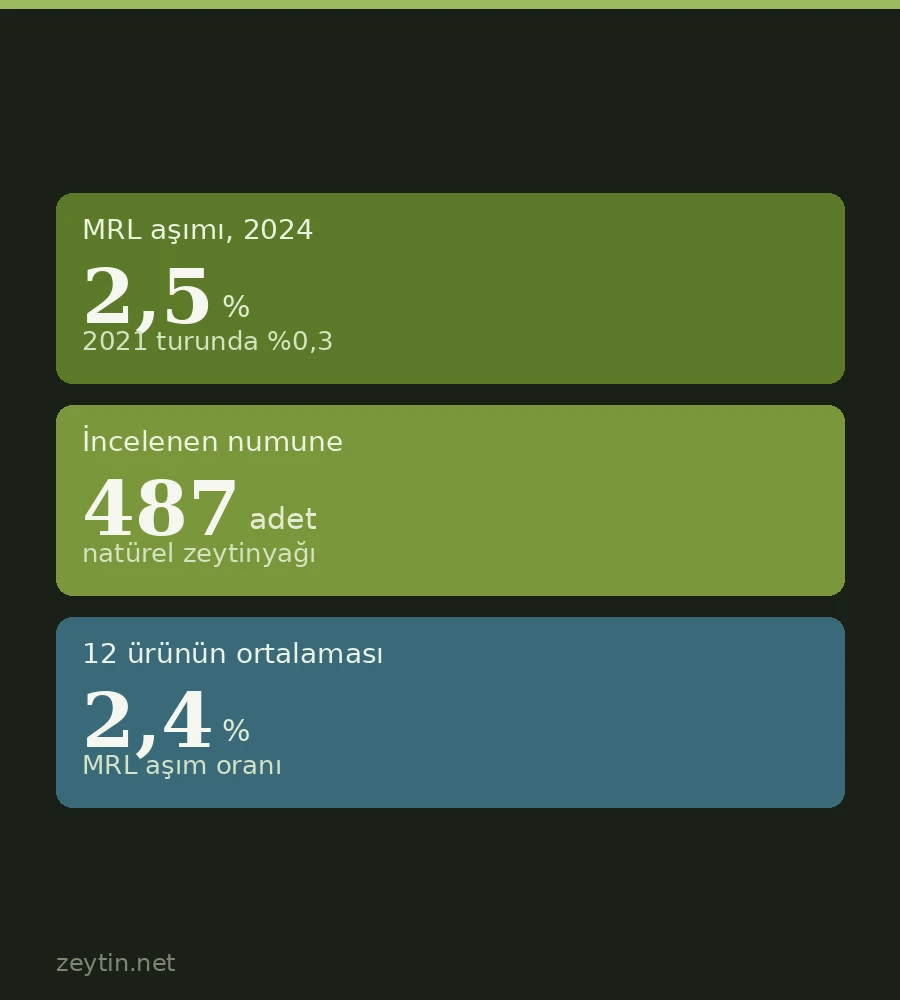
Short answer: yes, pesticide residues can be found in olive oil; but in the European Union's 2024 monitoring, only 2.5% of the 487 virgin olive oil samples numerically exceeded the legal limit. In the previous round of the same programme that figure was 0.3%, so for oil the picture got worse; yet the overall assessment by EFSA is that the risk to consumer health from individual substances is low. In this article we read the "2024 European Union report on pesticide residues in food" (EFSA Journal 2026;24:e10054), published by the European Food Safety Authority (EFSA) on 5 May 2026, and separate what its figures say from what they do not.
Where do these figures come from?
Under a multiannual control programme run jointly by member states, the EU randomly samples twelve products each round. In 2024 these were aubergines, bananas, broccoli, cultivated fungi, grapefruit, melons, sweet peppers, table grapes, virgin olive oil, wheat, bovine fat and chicken eggs. According to the report, 9,842 samples were reported in total and they were analysed for 200 pesticide residues on average.
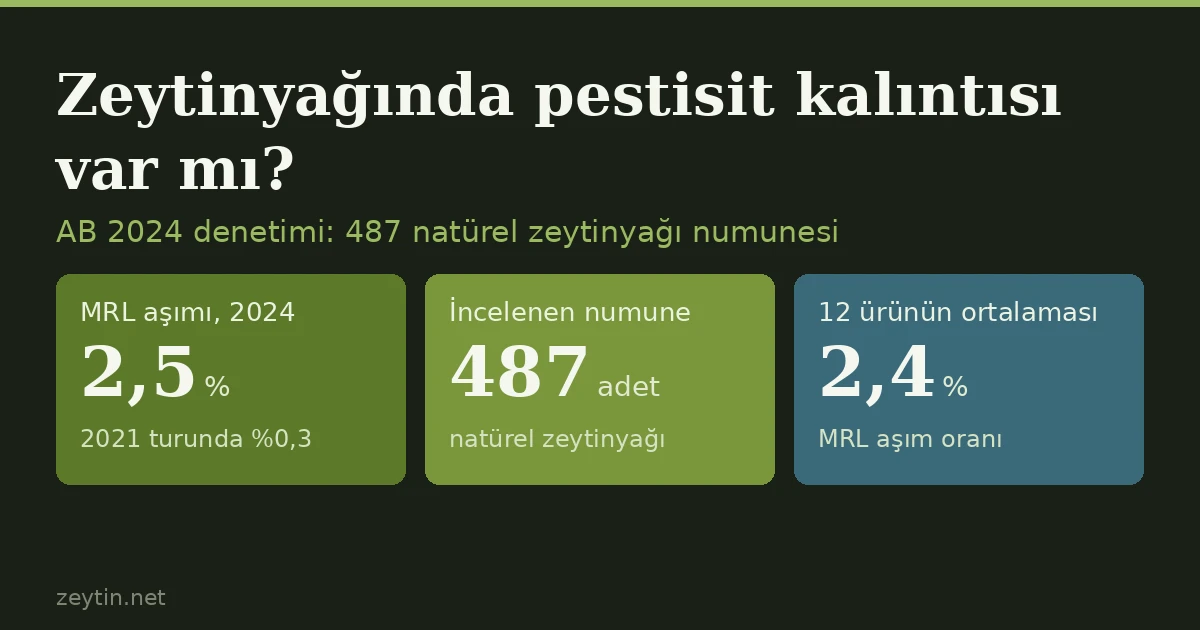
There are three categories and they must not be confused:
- No quantifiable residue: the result is below the lowest level the method can measure (the limit of quantification). Across all twelve products, 43.1% of samples came out this way.
- Residue present but within the legal limit: 54.5%.
- Maximum residue level (MRL) exceeded: 2.4% (234 samples). Of these, 113 (1.2%) were still counted as non-compliant after measurement uncertainty was taken into account.
The difference between an "MRL exceedance" and "non-compliance" matters: the report notes that the first is only a numerical comparison, while legal action can be triggered by the second.
This twelve-product programme is only one part of the report. Together with the national programmes, 86,449 samples of more than 1,140 products were analysed in 2024; 96.7% of them stayed within the legal limits and 3.3% exceeded them.
What was measured for virgin olive oil?
487 samples of virgin olive oil were examined. The regulation sets a minimum of 683 samples per product; wheat (658) and virgin olive oil did not reach it, and EFSA calls on countries to put this right. So the olive oil figure comes from a smaller sample than the others.
| Product | 2018 | 2021 | 2024 |
|---|---|---|---|
| Virgin olive oil | 0.6 | 0.3 | 2.5 |
| Sweet peppers | 2.4 | 3.4 | 4.7 |
| Table grapes | 2.6 | 2.1 | 4.3 |
| Wheat | 0.6 | 1.5 | 0.5 |
| Chicken eggs | 0.1 | 0 | 1.4 |
| All twelve products | 1.4 | 2.1 | 2.4 |
Two things should be read together here. First, the 2024 rate for olive oil (2.5%) is almost the same as the average across the twelve products (2.4%), and below sweet peppers and table grapes. Second, the speed of change: EFSA names eggs and virgin olive oil as the products where the MRL exceedance rate rose the most compared with 2021 and 2018, and recommends keeping them under watch and investigating the reasons. The report does not explain the increase, and we do not guess. 2.5% of 487 samples corresponds to roughly 12 samples (our calculation); with so small a number, a difference of one or two samples moves the rate noticeably.
Limits of the report
A footnote in the report says that Italy informed EFSA of a problem during data collection, so the report does not reflect the whole of Italy's sampling programme. Because Italy is a major olive oil producer, that note should be kept in mind when reading the olive oil result.
The second limit is origin: virgin olive oil is the product with the highest share of samples of unknown country of origin (12.5%), followed by wheat at 9.9%. The report links this to the difficulty of stating origin for bulked products made of mixed lots, and calls on authorities and businesses to ensure the traceability that shows where an oil comes from. This report describes samples taken on the EU market; it contains no separate figure for oils sold in Türkiye.
What do the terms in the report mean?
Four abbreviations keep coming up in residue reports. The limit of quantification (LOQ) is the lowest residue level an analysis can measure reliably; "no residue" means the level is below it, not that it is zero. The MRL is the highest residue level permitted in a product and is less a safety threshold than a yardstick for whether agricultural practice followed the rules. Health assessment is a separate calculation: the ADI is the amount that could be consumed every day for a lifetime without a problem, and the ARfD is the amount that could be consumed in a single day or meal. So checking against the legal limit and calculating health risk are two separate jobs, which EFSA carries out in separate parts of its report; a sample exceeding the MRL does not by itself mean "poisonous".
Residue from the olive, or from the oil?
Another part of the report concerns the olive fruit rather than the oil itself. Chlorpyrifos, not approved in the EU since April 2020, was looked for in 65,207 samples, exceeded the MRL in 0.5% of them and was found in 90 different products; among those where it is found most often the report lists olives for oil production. EFSA recalls that the substance has a proven genotoxic effect and asks member states to keep monitoring these product-substance combinations. This finding links to how treatments in the grove are carried out: for the choice of product, timing and the interval before harvest, see our articles on the spray calendar for olives and on how many days after the last spray the harvest can be done.
How large is the health risk?
Using samples from the 2022-2024 monitoring programmes, EFSA calculated acute and chronic risks for individual substances. In the chronic assessment, for 333 of the 334 active substances examined, the probability of exceeding the acceptable daily intake was below 1 in 1,000,000 people; only for pyrimethanil was a higher probability found in some population groups. The overall conclusion: the risk to consumers from individual substances is low.
Olive oil is still named in the acute risk assessment of two substances. For phosmet, olive oil is among the products driving the probability of exceeding the ARfD, along with apples and peaches; for dimethoate, in a tentative acute assessment, it is listed together with apples, oranges and mandarins. The report writes that the approval of phosmet was withdrawn in 2023 and its MRLs lowered to the limit of quantification, which is expected to reduce exposure in the 2024-2026 cycles. For dimethoate it says that any quantification at all would be considered misuse.
What conclusion to draw
The figures do not say "olive oil is dangerous", and they do not say "olive oil is flawless". Most virgin olive oil samples reporting residues were within the limit, but the exceedance rate rose in the latest round and EFSA finds that worth watching. For the buyer, the anchor is knowing where an oil comes from and who produced it; our articles on reading an olive oil label, on adulteration and fraud and on reading an analysis report can help.
One rating per visitor; you can change yours at any time. Ratings are real reader votes — no seeded or default scores.
Related
 Article
Olive Oil Prices: Week 35 of 2026
Turkish exchange prices, European producer prices and exchange rates side by side: extra virgin at 300 TL/kg in Edremit, Spain's national average €3.52/kg.
 Article
Geyikli Olive Oil: a registration that names its pollinators
Registered in 2020. From the Ayvalık cultivar; the certificate also records Gemlik and Hanım Parmağı as pollinators in the groves. Limits are set on 16 aroma compounds.
 Article
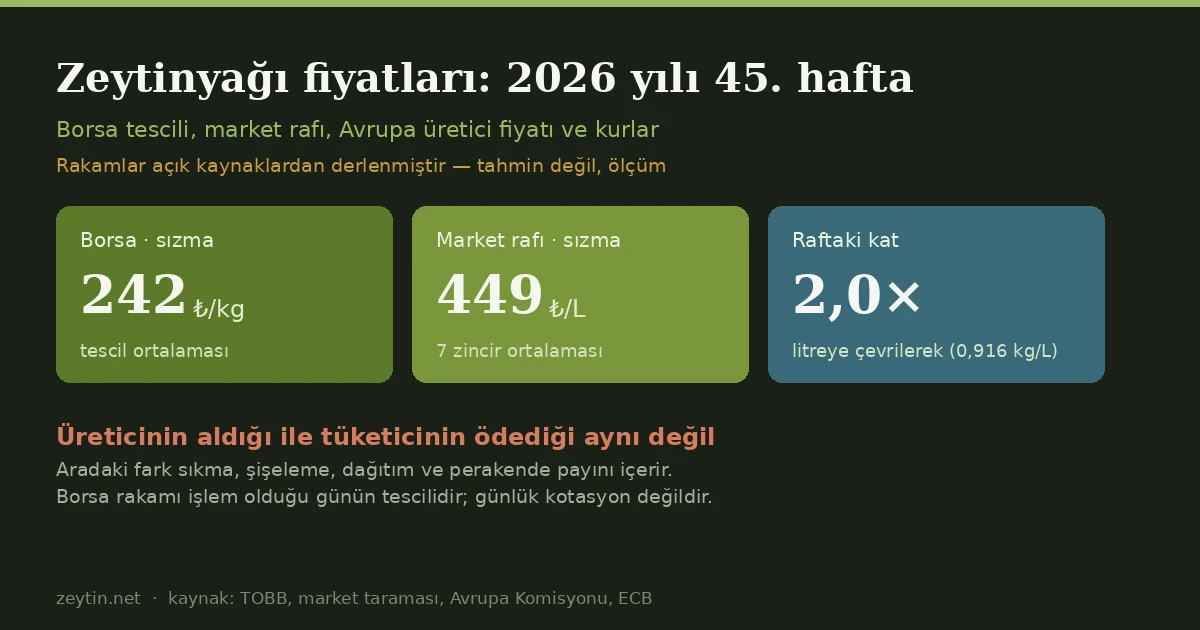
Olive Oil Prices: Week 45 of 2026
Week 45 of 2026: Turkish exchange prices, European producer prices and exchange rates side by side.
 Article
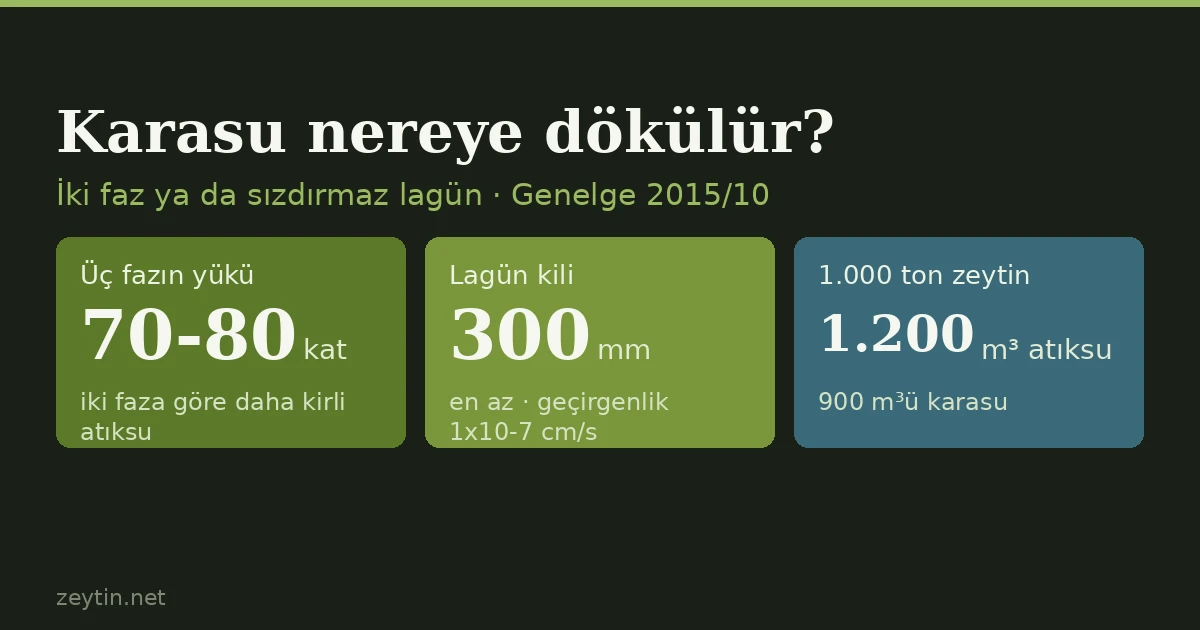
Where does olive mill wastewater go? Lagoon rules and the two-phase option
When pressing starts, the dark liquid piling up behind the mill has one legal destination, and it is not the stream. Türkiye offers two lawful routes: switch to a two-phase system, or build a sealed evaporation lagoon. The lagoon's clay thickness, permeability, depth and area are all fixed by numbers in a ministry circular — worked example included.