How to Read an Olive Oil Label
Grade, harvest year, acidity, origin and bottling place: which statements on a label are binding and which are just marketing — with a quick checklist.
Not every phrase on a bottle of olive oil carries the same weight. Some are defined in regulation and binding; others are marketing language. This guide goes through them in order.
The grade comes first
The first thing to look for is the grade. It is defined in regulation and tied to laboratory values.
| What the label says | What it means | Binding? |
|---|---|---|
| Extra virgin olive oil | Mechanical extraction only, acidity at most 0.8%, no defect in the sensory panel | Yes — the top grade |
| Virgin olive oil | Mechanical extraction, acidity at most 2%, slight sensory defects tolerated | Yes |
| Riviera / just "olive oil" | Refined oil blended with some virgin oil | Yes — but NOT extra virgin |
| Pomace oil | Solvent-extracted from the pulp; not olive oil in the strict sense | Yes — a separate product |
⚠ The rule is this: if a product is extra virgin, the label says so plainly. A bottle marked only "olive oil" is not extra virgin. Be wary of packaging that hides the grade in small type on the back.
More: extra virgin, virgin, riviera explained.
Harvest year: the most overlooked line
Olive oil does not mature, it ages. Freshness directly determines quality.
- Prefer a product stating the harvest year or season, such as "2025/2026 harvest".
- A best-before date is not a substitute. It is set 18-24 months from bottling; oil harvested two years ago can still show a date in the future.
- Where no harvest year is given, there is no way to know how old the oil is.
Storage matters just as much: how to store olive oil.
The acidity figure
You will see a number such as 0.3% or 0.5%. This is free fatty acid, a measure of breakdown; it has nothing to do with sour taste.
⚠ Low acidity alone is not proof of quality — a refined oil can be brought to 0.2% by chemical treatment with its polyphenols long gone. Look at the grade first, then the number. More: what acidity means.
Origin and place of bottling
Two different things, often confused:
- Origin: where the olives grew and the oil was extracted
- Bottling / packing place: the plant where it was filled
"Packed in X" does not say the oil came from X. In registered products, origin is bound by the registration — see geographical indication olive products.
Other binding statements
"Cold pressed" / "cold extraction". Defined in regulation: the paste must not exceed a set temperature during extraction. See how cold pressed olive oil is made.
Nutrition table. Mandatory.
Lot / batch number. Mandatory, for recall and traceability.
Geographical indication emblem. Only a registered product may carry it, and it can be verified on the registration portal.
Information that must appear on the label
Under Turkish food labelling rules, the label of packaged olive oil must include at least:
- The name of the product: with its grade ("extra virgin olive oil", for example)
- Net quantity: in litres or millilitres
- Best before date
- Storage conditions: such as "store in a cool, dark place"
- Name and address of the producer, bottler or importer
- Lot or batch number
- Business registration or approval number
- Nutrition declaration
Because it is a single-ingredient product, olive oil does not need a separate ingredients list. For blends such as riviera oil, however, the product name must state clearly what the blend is. If any of this information is missing, the product does not comply with labelling rules.
Health claims: which are real?
Not every health-related sentence on a label carries the same weight.
- Authorised claim: "Olive oil polyphenols contribute to the protection of blood lipids from oxidative stress." It may only be used for oils containing at least 5 mg of hydroxytyrosol and its derivatives per 20 grams. A product carrying the claim must be able to prove that value by analysis. What polyphenols are is explained in oleocanthal and polyphenols.
- Potentially misleading emphasis: "Cholesterol free." True, but true of all vegetable oils; presenting it as a product-specific advantage is misleading.
- Undefined claims: general phrases such as "heart friendly", "boosts immunity" or "healing" are not authorised health claims.
Terms on Turkish labels
Terms you will meet on Turkish olive oil bottles and their English equivalents:
| Turkish label | English equivalent |
|---|---|
| Natürel sızma zeytinyağı | Extra virgin olive oil |
| Natürel birinci zeytinyağı | Virgin olive oil |
| Riviera zeytinyağı | Olive oil composed of refined and virgin olive oils |
| Prina yağı | Olive pomace oil |
| Soğuk çekim / Soğuk sıkım | Cold extraction / Cold pressed |
| Hasat tarihi / hasat yılı | Harvest date / harvest year |
| Tavsiye edilen tüketim tarihi | Best before |
| Menşe adı | Designation of origin |
| Mahreç işareti | Geographical indication |
Turkey's geographical indication system has two types of registration: "designation of origin" (menşe adı) and "geographical indication" (mahreç işareti). The registered olive oil products, and what they are good for, are listed in geographical indication olive products.
Marketing phrases that are NOT binding
None of these is defined in regulation; they say nothing measurable about the product:
- "Natural", "additive-free" — olive oil contains no additives whatever its grade
- "Homemade", "village style", "traditional" — undefined
- "First class", "premium", "special reserve" — no such grade exists in regulation
- "Unfiltered" — a preference, not a quality mark; unfiltered oil throws sediment and can age faster
- "Early harvest" — not defined in regulation, but it does describe a real production choice; verify it against the harvest date and the taste
The packaging tells you something too
- Dark glass or tin is preferable: light is olive oil's worst enemy
- Clear plastic is not suited to long shelf life
- Buying a large tin and decanting into a small dark bottle reduces the opened bottle's contact with air
Quick checklist
1. Is the grade stated plainly? ("extra virgin", or just "olive oil"?)
2. Is there a harvest year?
3. How far off is the best-before date?
4. Is origin given, or only the place of bottling?
5. Is the packaging dark glass or tin?
6. Does the price square with the cost of the fruit? (see fraud and adulteration)
7. In doubt: <a href="https://guvenilirgida.tarimorman.gov.tr" target="_blank" rel="noopener">the ministry's counterfeit and adulteration list</a>
And the best check of all: once opened, taste it. A good extra virgin leaves a slight sting at the back of the throat and smells of fresh grass — how to tell good olive oil.
One rating per visitor; you can change yours at any time. Ratings are real reader votes — no seeded or default scores.
Related
 Article
Aydın Memecik Olive Oil: bitterness and pungency written into the definition
Registered in 2020. Total phenols > 100 mg/kg, peroxide ≤ 18, defect median 0. Intense fruit aroma with pronounced bitterness and pungency.
Article
Aydın Memecik Olive Oil: bitterness and pungency written into the definition
Registered in 2020. Total phenols > 100 mg/kg, peroxide ≤ 18, defect median 0. Intense fruit aroma with pronounced bitterness and pungency.
 Article
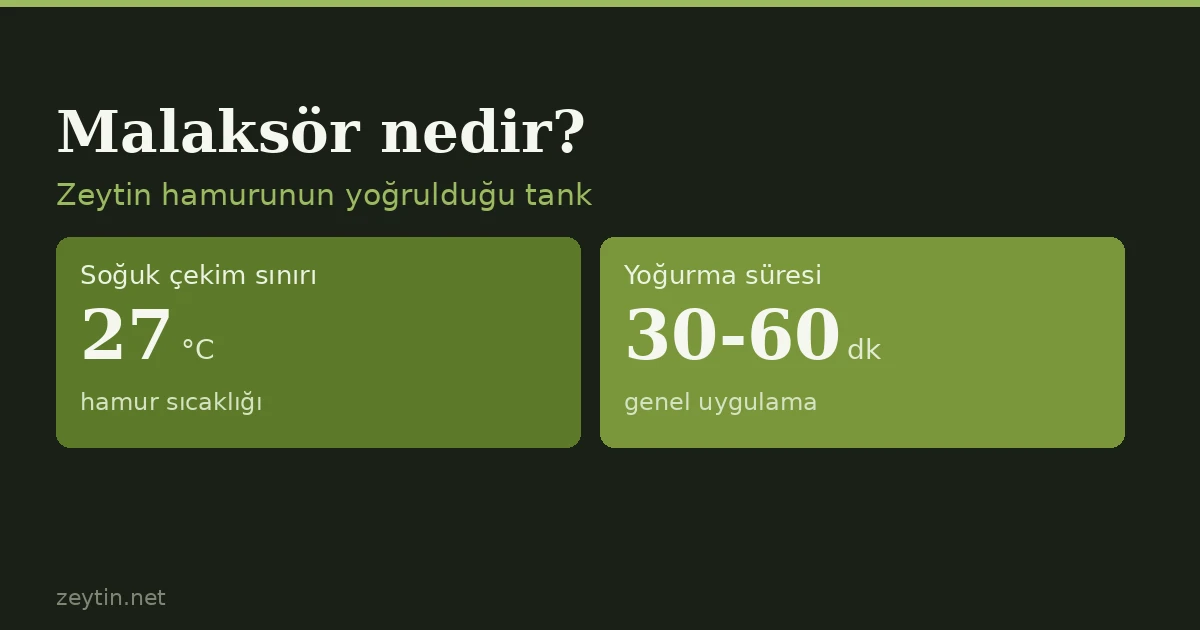
What is a malaxer? The tank where olive paste is kneaded, and the 27 °C limit
A malaxer is the stainless steel kneading tank where crushed olive paste is slowly mixed so that oil droplets can merge. Time and temperature decide both yield and aroma, and this is also where the limit for "cold extraction" is drawn.
Article
What is a malaxer? The tank where olive paste is kneaded, and the 27 °C limit
A malaxer is the stainless steel kneading tank where crushed olive paste is slowly mixed so that oil droplets can merge. Time and temperature decide both yield and aroma, and this is also where the limit for "cold extraction" is drawn.
 Article
Milas Olive Oil: a press bed dated to 2000 BC
Registered in the European Union as well. The certificate's archaeological anchor is a press bed cut into rock at Pilavtepe — four thousand years old.
Article
Milas Olive Oil: a press bed dated to 2000 BC
Registered in the European Union as well. The certificate's archaeological anchor is a press bed cut into rock at Pilavtepe — four thousand years old.
 Article
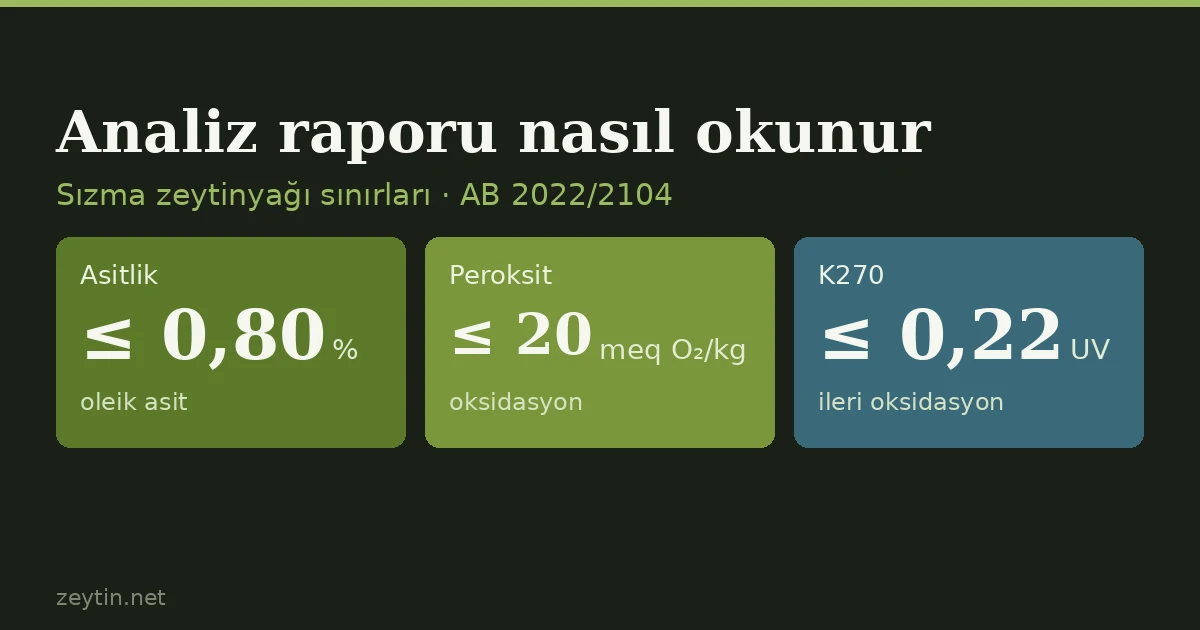
How to read an olive oil lab report: acidity, peroxide, K232, K270 and ΔK
The rows of figures on an olive oil lab report look cryptic at first. What do free acidity, peroxide value, K232, K270, ΔK, ethyl esters and sensory analysis measure, what are the limits for extra virgin and virgin grades, and how do you interpret a report using a worked example?
Article
How to read an olive oil lab report: acidity, peroxide, K232, K270 and ΔK
The rows of figures on an olive oil lab report look cryptic at first. What do free acidity, peroxide value, K232, K270, ΔK, ethyl esters and sensory analysis measure, what are the limits for extra virgin and virgin grades, and how do you interpret a report using a worked example?