How soon must harvested olives be pressed? What waiting writes into the oil
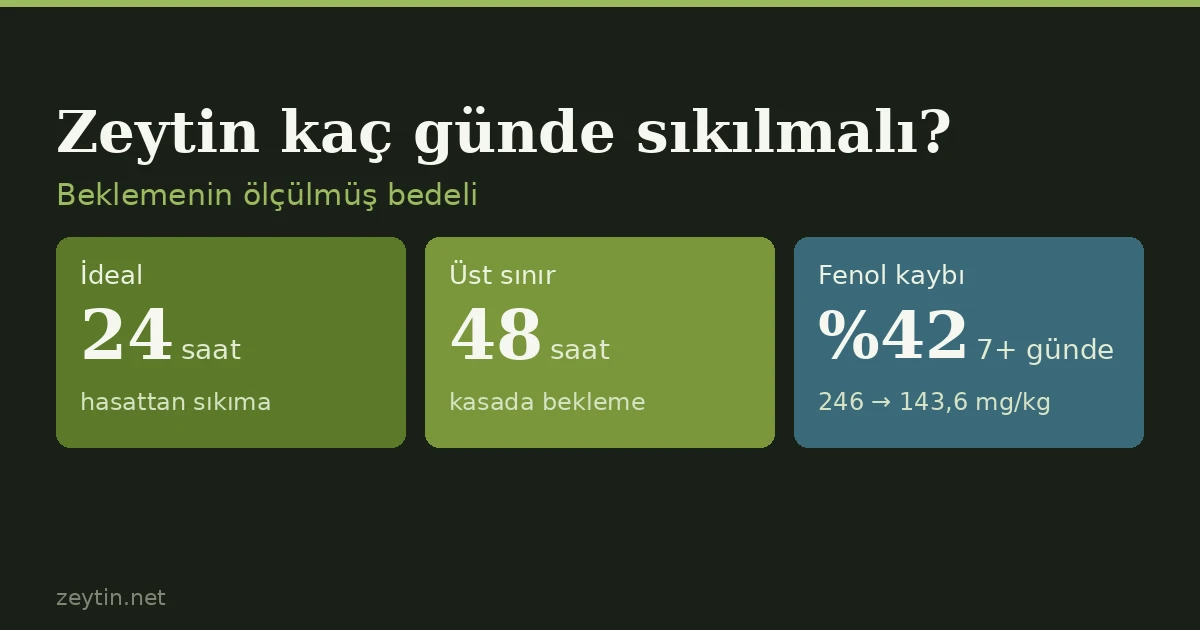
The right answer is 24 hours, with 48 as the outer limit. Measurements on 228 batches across seven mills show that olives left waiting lose 42% of their polyphenols, more than half of their green aroma and a third of their oxidative stability — even while staying inside the legal acidity limit. In an 'on' year, with mill queues lengthening, this is the grower's most critical call.
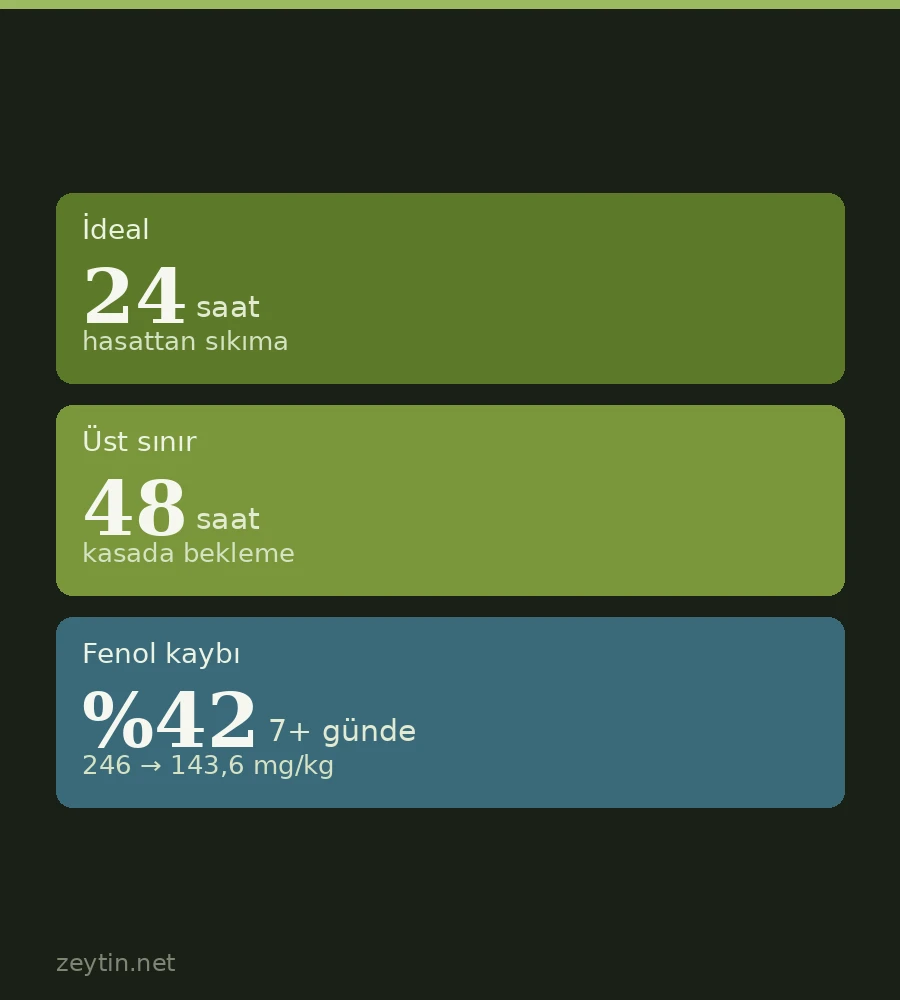
Short answer: olives should reach the mill the same day they leave the branch and be pressed within 24 hours. The outer limit is 48 hours. Waiting beyond three days in the crate has already taken away a part of the oil that cannot be recovered.
The advice is often repeated but rarely justified. Yet the cost of waiting has been measured. In Italy's Emilia-Romagna region, across seven mills and three harvest seasons, 228 batches of olives were sorted into four storage classes and analysed: up to 24 hours, 2-3 days, 4-6 days, and 7 days or more.
The measured loss
| Parameter | ≤24 h | 2-3 days | 4-6 days | ≥7 days |
|---|---|---|---|---|
| Free acidity (g/100 g) | 0.30 | 0.37 | 0.51 | 0.56 |
| Peroxide (meq O₂/kg) | 6.96 | 9.03 | 8.67 | 9.56 |
| K232 | 1.48 | 1.64 | 1.55 | 1.66 |
| Total phenols (mg/kg) | 246.0 | 202.5 | 179.2 | 143.6 |
| Oxidative stability (hours) | 28.28 | 22.60 | 16.90 | 19.91 |
| Fruitiness (sensory) | 2.25 | 1.98 | 1.79 | 1.75 |
| Green notes | 1.36 | 0.92 | 0.64 | 0.57 |
| Bitterness | 2.16 | 1.76 | 1.35 | 1.40 |
| Pungency | 1.93 | 1.74 | 1.43 | 1.41 |
| Defect intensity | 0.29 | 0.34 | 0.79 | 0.57 |
The real finding: the acidity limit is not breached
The most important line in that table is not acidity. Even beyond seven days of waiting, acidity stays at 0.56, below the 0.8 ceiling for extra virgin. On paper, oil from olives left waiting still qualifies as extra virgin.
The loss happens elsewhere. Beyond seven days of storage:
- Total phenols fall from 246 mg/kg to 143.6, a loss of roughly 42%.
- Green notes drop from 1.36 to 0.57, losing more than half.
- Oxidative stability declines from 28.3 hours to 19.9, with the worst reading in the 4-6 day band at 16.9 hours.
- Bitterness and pungency fall markedly; these are the sensory expression of polyphenols.
The conclusion is that waiting does not stop the oil being extra virgin; it stops it being good oil. Judging by acidity and concluding "no problem" means looking where the loss is not recorded. We also discussed what acidity does and does not tell you in how to read an olive oil label.
What happens in the heap
Three processes run at once.
Enzymes keep working. The fruit does not die when it is detached; the lipase enzyme inside it breaks down the oil and raises free fatty acids. That is why acidity climbs slowly but steadily.
Temperature rises. A heap of olives respires and generates heat, which accelerates both enzyme activity and microbial growth. This is why the depth of the heap can matter more than the elapsed time.
Microorganisms multiply. Bacteria and fungi grow exponentially during the first two days of storage. Once fermentation begins, the resulting defects pass into the oil.
The distribution of defects found in the same study is telling: fusty/fermented 67%, vinegary 29%, musty 4%. The typical penalty for waiting is not mould but fermentation.
The study also stresses that duration is not the only thing setting the pace of loss: the phytosanitary state and integrity of the raw material matter as much. Bruised or split fruit, or fruit carrying olive fruit fly damage, deteriorates far faster. We reported this season's fly situation in a pre-harvest olive fly warning.
Crates, not sacks
How the olives wait matters as much as how long.
- Use perforated plastic crates. They allow air movement and limit the depth of the heap. Crates of 20-25 kilograms suit the job.
- Avoid sacks. A sack has no air circulation; the fruit heats itself and is crushed under its own weight. Even a single day in a sack costs more than a day in a crate.
- Do not stack crates tightly, and keep them shaded and cool. A crate left in the sun makes the time calculation meaningless.
- Do not store wet fruit. Damp olives picked after rain are an ideal medium for mould.
- Separate fruit picked off the ground. It is already bruised, and in the same crate as sound fruit it drags down the whole batch.
There is research indicating that brief refrigeration preserves quality, but at farm scale this is not a practical option for most growers. The rule stays simple: speed, not cooling.
Does waiting really raise the oil yield?
A belief heard often in the field is that letting olives wait raises the oil yield. On the scales it does look that way, but the reason is not an increase in oil.
Once detached from the branch the fruit produces no more oil; oil accumulation happens on the tree and ends with the harvest. What happens to waiting olives is water loss. As the fruit gives up moisture its weight falls, so the oil percentage calculated on fresh weight appears to rise. The total quantity of oil in your hands has not grown — and as the table above shows, its quality has fallen.
Building the yield calculation on this misunderstanding costs twice: the oil share per kilogram looks higher while the total weight of fruit declines, and quality goes unnoticed because nobody measures it. A yield that looks good as a percentage can mean less oil in absolute terms, and weaker oil at that.
Queues will be longer this season
This year carries a specific condition. Olives are in an "on" year, and in some basins the share going to oil is rising sharply: in Orhangazi the crop is expected to double while the oil share climbs from 10% to 40%. That is precisely why mills have accelerated their maintenance work.
In a season of rising volume, the queue outside the mill can take the 24-48 hour window out of the grower's hands. There are ways to answer that:
1. Book the slot before you harvest. Milling time is not available if you call after the olives are already picked.
2. Split the harvest to match mill capacity. Picking what can be milled in a day beats bringing down three days' fruit at once and letting it wait.
3. Consider night and early-morning milling. In peak periods mills run shifts, and the hour when the queue is short feeds directly into oil quality.
4. Keep the fruit shaded while queuing. Hours spent in the sun in the mill yard count toward the storage time too.
We covered what to watch during milling in what to check when having olives pressed at a mill and how the production line works in how cold-pressed olive oil is made and what is a malaxer.
Harvest timing and milling timing are separate decisions
These two questions should not be conflated. When to pick is a decision about ripeness; picking early means higher polyphenols and lower oil yield. The detail is in when to harvest olives and the maturity index and is early harvest expensive or valuable.
How long to let the fruit wait, by contrast, has nothing to do with ripeness and everything to do with loss. Polyphenols gained through early picking can be handed straight back by three days in a crate. The drop from 246 to 202.5 in the 2-3 day band shows exactly that.
How to protect the oil after milling is a third question, which we covered in how to store freshly pressed olive oil. For the general harvest calendar and methods, see the olive harvest: when and how.
One rating per visitor; you can change yours at any time. Ratings are real reader votes — no seeded or default scores.
Related
 Article
Mut Olive Oil: a landscape that needs no pesticide
The certificate's real claim rests on altitude and humidity: 10-40% relative humidity keeps out both the olive fly and peacock spot. That is why organic production is straightforward here.
Article
Mut Olive Oil: a landscape that needs no pesticide
The certificate's real claim rests on altitude and humidity: 10-40% relative humidity keeps out both the olive fly and peacock spot. That is why organic production is straightforward here.
 Article
What is riviera olive oil? How it differs from extra virgin, and what the label means
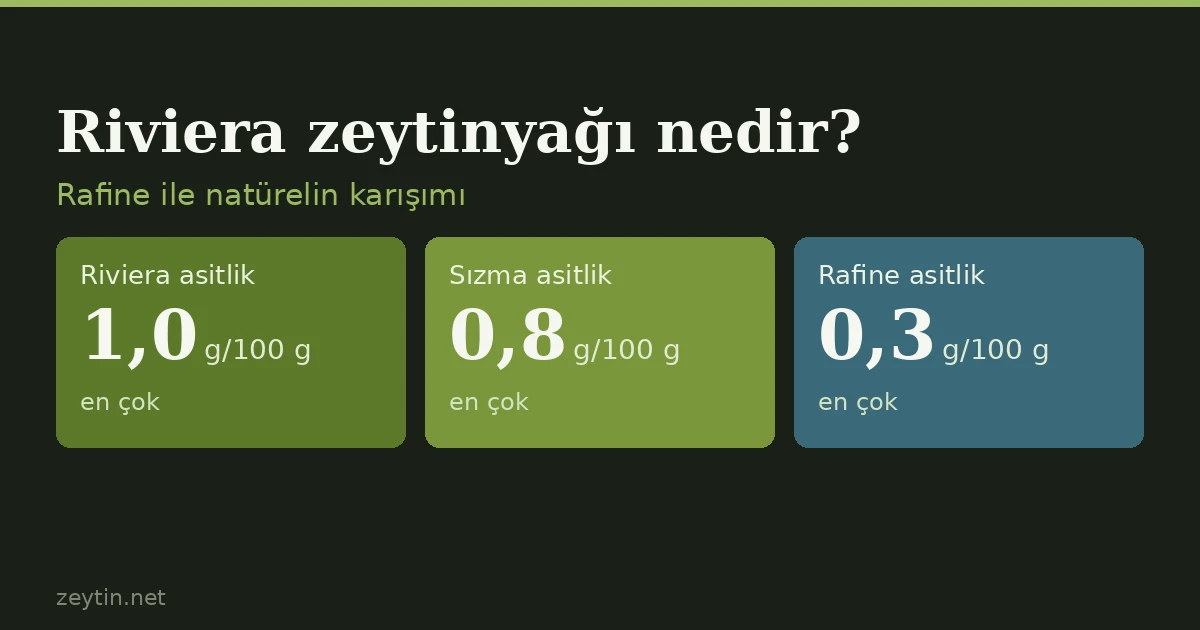
Riviera is not a grade of quality but the name of a blend: refined olive oil mixed with virgin olive oil fit for direct consumption. Under the Turkish Food Codex its free acidity may not exceed 1.0 and its peroxide value 15. What refining removes, what the label is obliged to say, and the real answer to the frying question.
Article
What is riviera olive oil? How it differs from extra virgin, and what the label means
Riviera is not a grade of quality but the name of a blend: refined olive oil mixed with virgin olive oil fit for direct consumption. Under the Turkish Food Codex its free acidity may not exceed 1.0 and its peroxide value 15. What refining removes, what the label is obliged to say, and the real answer to the frying question.
 Article
What are zeytinyağlılar? The logic of Turkish dishes cooked in olive oil
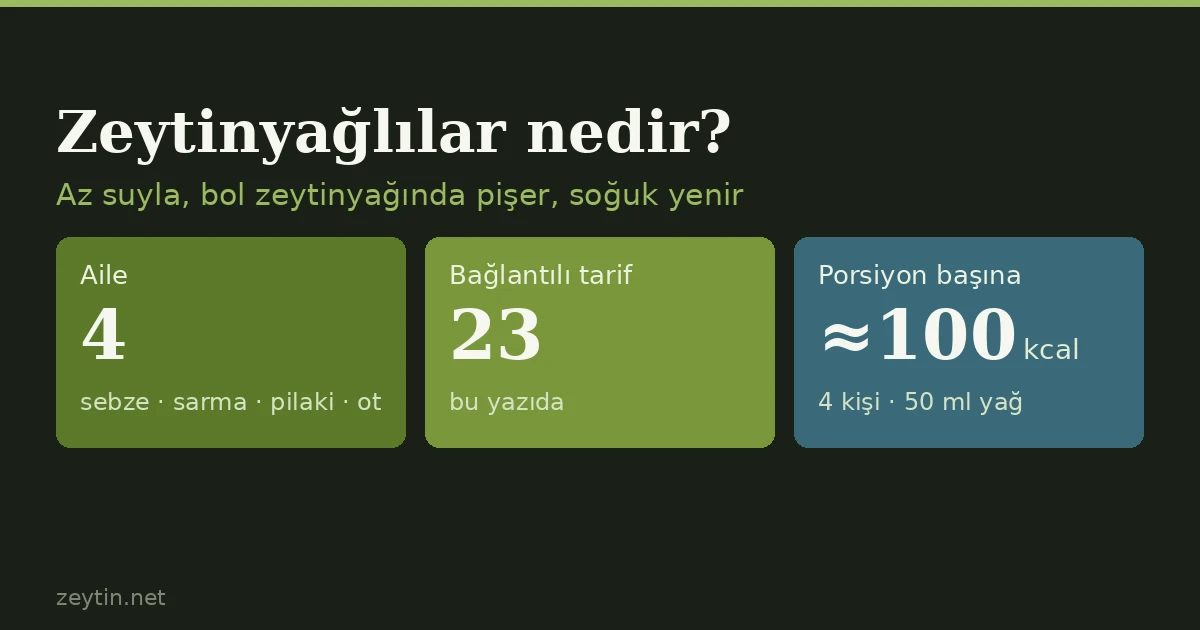
Zeytinyağlılar are Turkish dishes in which vegetables or pulses are cooked with little water in plenty of olive oil until they absorb their own juices, then eaten cold at room temperature. They contain no meat, can be made a day ahead and taste better the next day. Vegetable dishes, stuffed leaves and vegetables, pilaki beans and Aegean wild greens are the four main families.
Article
What are zeytinyağlılar? The logic of Turkish dishes cooked in olive oil
Zeytinyağlılar are Turkish dishes in which vegetables or pulses are cooked with little water in plenty of olive oil until they absorb their own juices, then eaten cold at room temperature. They contain no meat, can be made a day ahead and taste better the next day. Vegetable dishes, stuffed leaves and vegetables, pilaki beans and Aegean wild greens are the four main families.
 Article
Ödemiş Çekişte Olive Oil: a separate harvest window called “çakır”
Registered in 2020. The certificate names two harvest windows: early (green, November-December) and “çakır” (green turning pink, mid-December to mid-January).
Article
Ödemiş Çekişte Olive Oil: a separate harvest window called “çakır”
Registered in 2020. The certificate names two harvest windows: early (green, November-December) and “çakır” (green turning pink, mid-December to mid-January).