Hatay Olive Salad: an olive dish registered together with its recipe
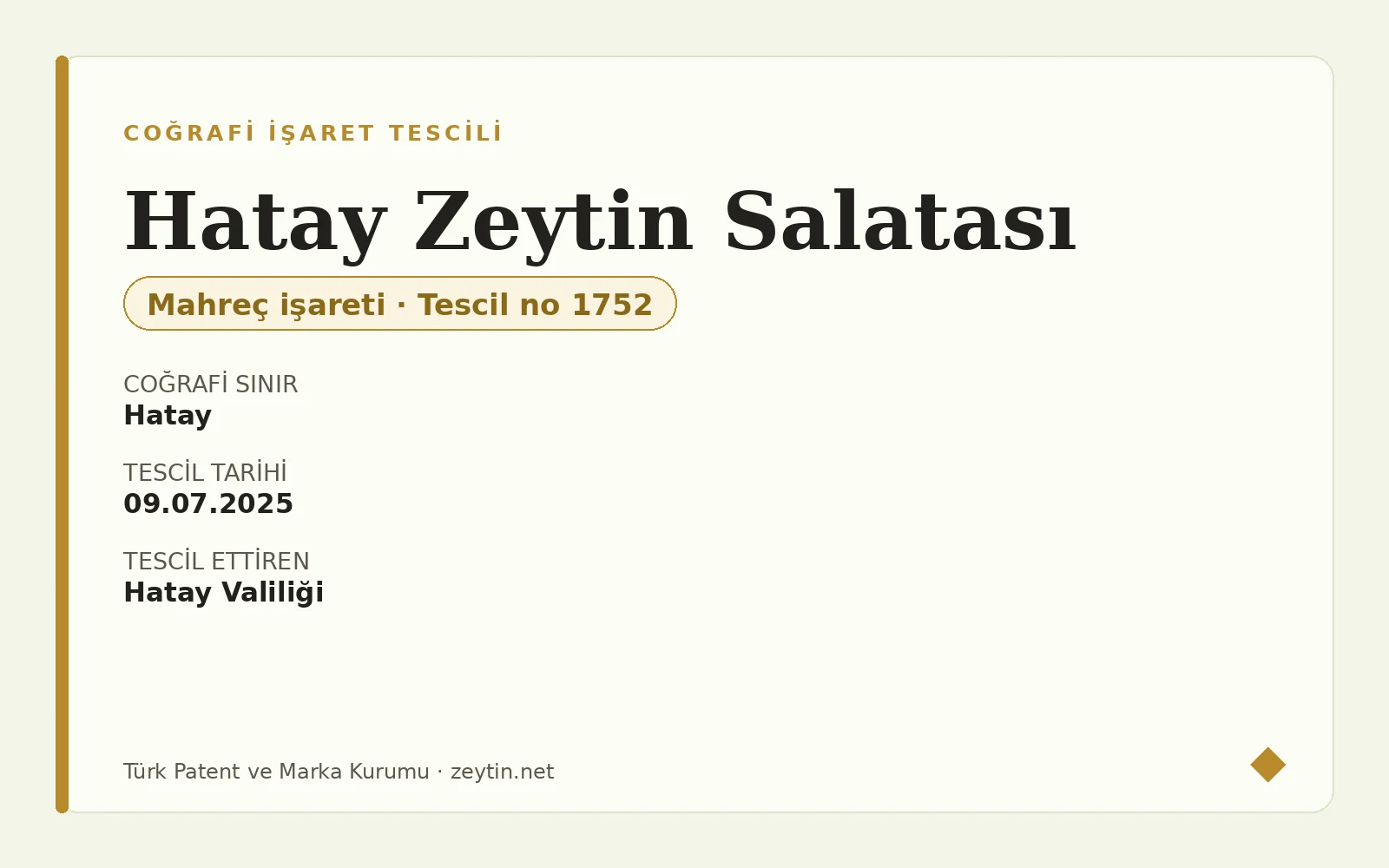
Registered in 2025. The document defines the salad by weight: 300 g cracked green olives, registered Hatay pomegranate molasses, extra virgin oil.
Almost every olive-related geographical indication protects a raw material: a region's olives or its olive oil. Hatay Olive Salad stands out on that list as a dish, and its document defines it not by name but by recipe. The ingredients are given in grams, the debittering of the olives is fixed in days, and even the pomegranate molasses must be a specific registered product.
Reference details
| Registration no. | 1752 |
| Registration date | 09.07.2025 |
| Application | C2023/000317 · 27.11.2023 |
| Type | Geographical indication (mahreç işareti) |
| Registered by | Governorship of Hatay |
| Geographical area | Hatay province |
| Product group | Salad / Processed and unprocessed fruit, vegetables and mushrooms |
Protection runs from the application date, 27 November 2023. The application was filed about ten months after the earthquakes of 6 February 2023.
Ingredients in the document
| Ingredient | Quantity |
|---|---|
| Cracked green olives | 300 g |
| Extra virgin olive oil | 50 ml |
| Tomato | 50 g |
| Spring onion | 50 g |
| Red pepper | 20 g |
| Hatay pomegranate molasses | 10 ml |
| Salt | 2 g |
| Parsley | half a bunch |
Two ingredients carry extra conditions. The olive oil must be extra virgin. The pomegranate molasses must be Hatay Pomegranate Molasses, registered under no. 1361; the salad's registration makes another registered product part of its own definition. By weight, more than half the salad is olives: 300 grams in a mixture of roughly 500.
The home version with the same quantities is in our Hatay olive salad (zeytin piyazı) recipe.
Where the olives come from and how they are prepared
The document also describes the olives. Halhalı, haşebi and gemlik olives grown in the area are picked green, in September and October. Cloths are spread under the trees so the fruit does not touch the ground, and it is carried in plastic crates to avoid bruising. Cracking is traditionally done with a wooden mallet or a stone, and by machine in industrial production.
The bitterness is removed without chemicals: the cracked olives sit in drinking-quality water for about 7 days, with the water changed daily. They are then kept in brine of about 20 percent salt. The high salt extends shelf life, and before the salad is made the olives are soaked again to remove it. According to the document, cracked olives prepared this way keep for 6 months to a year at an average of 25 °C, which is why the salad can be made all year round.
The halhalı olive is separately registered in the same province: the Hatay Halhalı Olive document also states that cracked green olives are debittered with water. The home method is in cracked green olives at home, and why olives are debittered at all is in how are olives cured.
The preparation order in the document
The pits are removed from the cured cracked olives. The tomato is peeled and finely chopped; the red pepper, spring onion and parsley are finely chopped as well. Salt, olive oil and pomegranate molasses are added and everything is mixed. The document even adds a serving note: a lemon wedge on the side. The salad is eaten at breakfast, at lunch, as a snack and as a meze.
Why a mahreç indication with every stage in Hatay?
The registration type is mahreç işareti, which normally requires at least one stage of production to take place in the defined area. The document, however, states that the salad is tied to the place by reputation and has a deep-rooted place in Hatay's food culture, and requires all production stages to take place within the province.
Inspection
Inspection is coordinated by the Governorship of Hatay and carried out by a body with at least one expert each from the Governorship and the Hatay Provincial Directorate of Agriculture and Forestry. Regular inspection takes place once a year, and at any time after a complaint or when deemed necessary. The body checks three things: the conformity of the ingredients, conformity with the production method, and the use of the name "Hatay Zeytin Salatası" and the indication's emblem. If the product is packaged, the name and emblem go on the packaging; if not, they must be displayed visibly at the business, which means the registration also covers restaurants and meze shops.
In short
Hatay Olive Salad is a geographical indication that protects an olive dish together with its recipe. What the document teaches is that it turns "local flavour" into measures: 300 grams of olives, 7 days in water, 20 percent brine, 10 ml of registered pomegranate molasses. For the wider picture of olive growing in the province, see olive growing in Hatay.
One rating per visitor; you can change yours at any time. Ratings are real reader votes — no seeded or default scores.
Related
 Article
Yamalak Sarısı: the local table cultivar of Aydın
A local cultivar of Aydın counted among Turkey's most important table olives, and the subject of a phenotypic characterisation study.
 Article
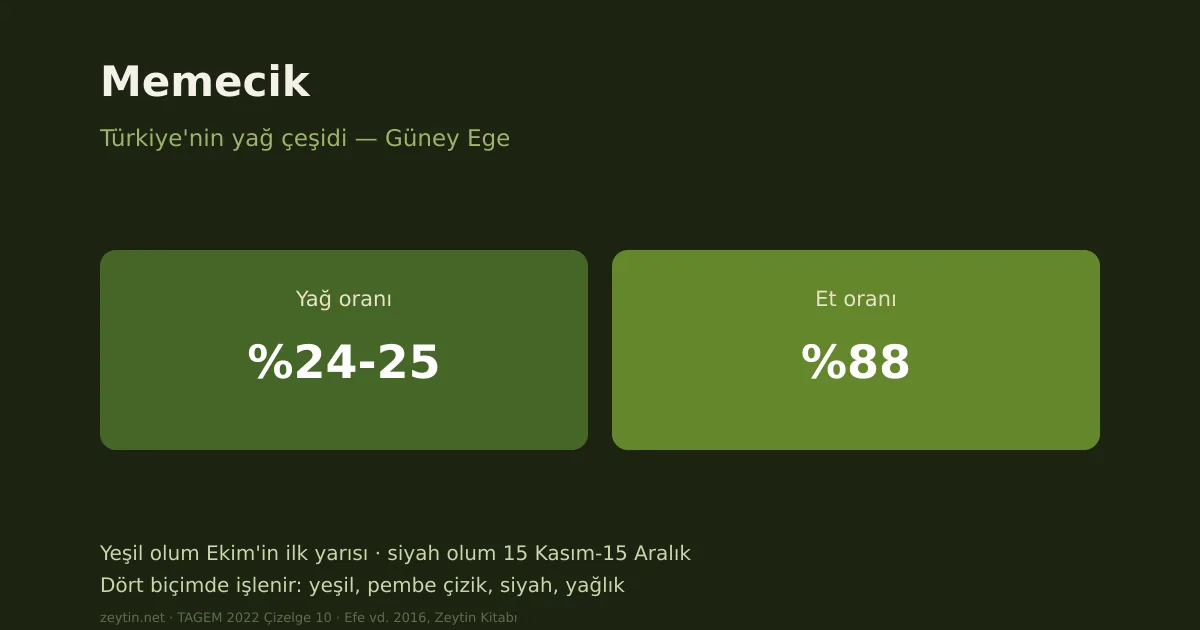
The Memecik olive: Türkiye's oil variety
Between 19% and 45% of the tree stock. 24-25% oil, 88% flesh. Green maturity in early October, two months after Gemlik.
 Article
Gölvala olive
Gölvala is a recorded variety of the Black Sea. No measured pomological data published.
 Article
Aydın Yamalak Sarısı Olive: a table fruit reaching 11 grams
Registered in 2021. At 6-11 g the fruit is among Turkey's largest table olives. It is propagated by grafting onto wild rootstock and harvested in late September.