Frost damage in olive trees: signs, risk factors and what to do after a frost
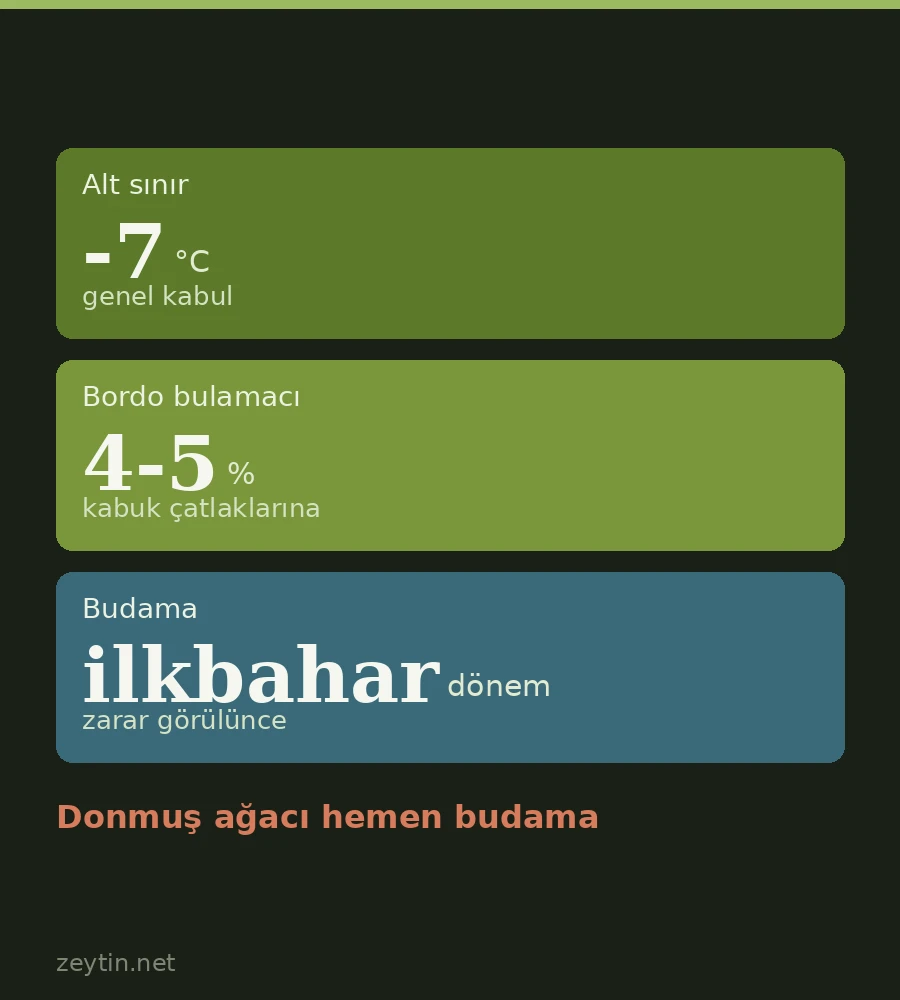
The generally accepted lower limit for olives is around -7 °C, but damage does not depend on the thermometer alone: how long the cold lasts, sudden drops, humidity, tree age and nutrition all matter. Here are the signs of frost damage on leaves, shoots, bark and fruit, ways to reduce the risk and which job to do when after a frost.
The olive is a tree of the Mediterranean climate: it loves hot, dry summers and gives its best yields where winters are mild. Most of Türkiye's olive-growing areas lie in that climate belt. But hard cold spells that come every few years can cause serious damage, especially in groves near inland areas, at higher altitude or in hollows. This article explains how to recognise frost damage, what increases the risk and which job to do when after a frost.
At what temperature are olives damaged?
The generally accepted lower limit for olives is around -7 °C. Below that, damage starts in thin shoots; as the cold deepens it can move on to branches, the trunk and, in the worst cases, the roots.
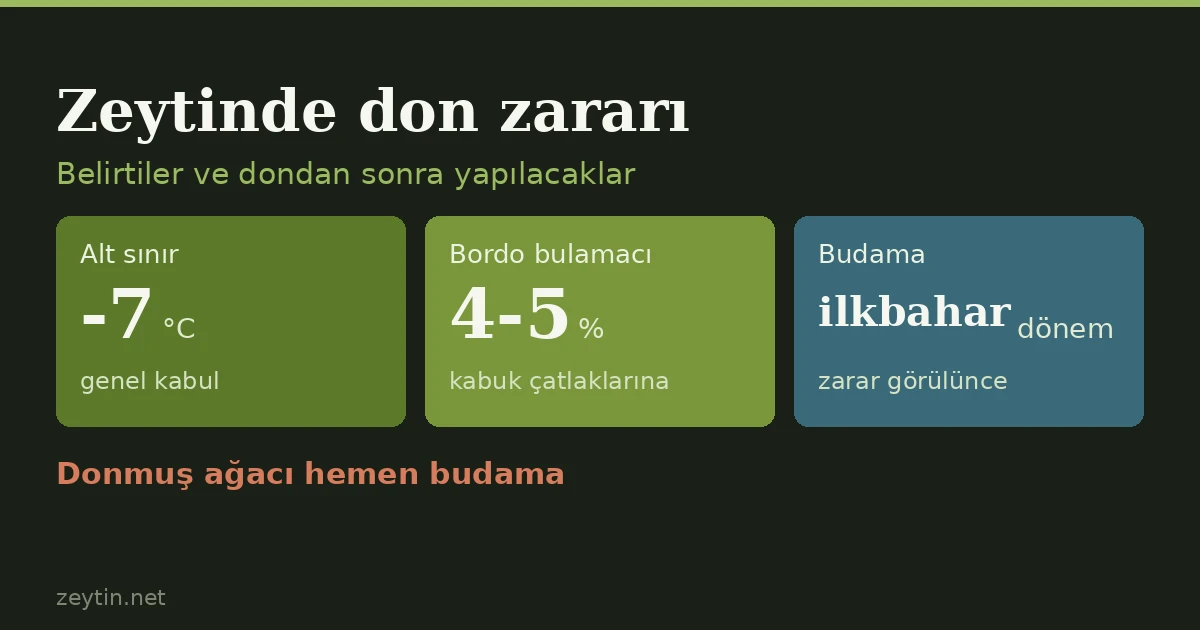
On its own, however, that number is misleading. The same -7 °C can leave no trace in one grove and kill trees in another, because other factors decide how severe the damage is.
Factors that increase the risk
How long the cold lasts. A few hours of night-time cold and a cold spell lasting days do not have the same effect. Tissues staying below freezing for a long time deepens the damage.
Sudden drops. Trees "harden" for winter as temperatures fall gradually in autumn. A hard frost arriving suddenly after a mild autumn, or a sharp frost following warm days in midwinter, catches tissues that have not finished hardening, or have softened again, unprepared.
Humidity and rain. Wet branches and leaves suffer more, especially in frosts that follow soon after rain. Dry, strong winds blowing with the cold also increase water loss from tissues.
Site. Cold air is heavy and collects in hollows and valley floors. That is why, in the same village, trees on a slope may survive while those on the valley floor are damaged.
Tree age. The thin trunks and shallow roots of young trees are far more exposed to cold than mature trees.
Nutrition and care. Nitrogen fertiliser applied in autumn delays the tree's preparation for winter and produces soft, water-rich shoots that are much more sensitive to frost. Potassium deficiency also lowers hardiness. Early pruning in midwinter leaves cut surfaces exposed to frost.
Variety. Cold hardiness varies from variety to variety. If a grove is to be planted in an area with frost risk, varieties should be chosen with that criterion from the outset.
Signs: which part of the tree to look at
| Part | Sign | What it means |
|---|---|---|
| Leaves | Leaves dry out, curl, lose colour and drop | Mild to moderate damage; the tree usually shoots again |
| Young shoots | Blackening and drying starting from the tips | Damage at shoot level; dead parts are removed at pruning |
| Branch and trunk bark | Bark cracking, blistering, separating from the tissue beneath | Serious damage; high risk of disease entry |
| Fruit | Shrivelling, softening, darkening | Quality of the crop on the tree falls |
The real extent of frost damage is often not visible straight away. A branch that looks healthy just after the cold may fail to shoot in spring and die, while a tree that at first looks completely dead may shoot again from the lower trunk. That is why the most important rule after a frost is not to rush.
Immediately after a frost
1. Seal bark cracks. Publications of Türkiye's Ministry of Agriculture and Forestry recommend applying 4-5% Bordeaux mixture to bark cracks on thick branches immediately after the cold, and binding the bark tightly so that it presses against the wood beneath. The aim is to stop open wounds drying out and to prevent disease entry.
2. Protect against disease. Frost-damaged tissue is an open door for the olive knot bacterium. A protective copper spray is recommended after cold damage. Products licensed for olives should be used at the doses and under the conditions on the label. We describe the disease's symptoms on our olive knot disease page.
3. Deal with the fruit on the tree. If frost strikes a grove before harvest is complete, damaged fruit should be picked and processed without delay. Oil from frozen, shrivelled olives loses quality; known to tasting panels as the "frostbitten olives" defect, it can lower the oil's grade. It is best not to mix such a batch with sound fruit.
Pruning: wait
The ministry's advice is clear: trees damaged by cold should not be pruned immediately. You should wait until the next pruning season to see the level of damage and where new shoots emerge.
In practice that means waiting for shoots to wake in spring:
- Branches that do not shoot, and whose tissue under the bark is brown and dry when scraped, are considered dead and are cut back to healthy tissue.
- Branches that are green and moist under the bark are alive and should not be cut.
- After severe damage, the tree may regrow from the lower trunk or from basal shoots. In that case a rejuvenation pruning using selected healthy shoots is needed.
- In areas where frost may return, pruning should start only once the danger of frost has fully passed.
- After pruning, cuts and open wounds should be protected with a copper spray.
You will find the general rules of pruning and how to carry out rejuvenation pruning in our guide olive pruning: how and when.
Rebuild nutrition
After cold damage the tree's overall nutrient balance is upset and some deficiency symptoms may appear on the leaves. Ministry publications recommend leaf and soil analysis to diagnose these deficiencies correctly. Giving plenty of nitrogen because "the tree is weak" after a frost can be a mistake: excess nitrogen forces an already stressed tree into unnecessary shoot growth. The programme should be based on analysis; details are on our olive fertilisation and soil analysis page.
Ways to reduce frost risk
Frost cannot be prevented entirely, but damage can be reduced:
- Site choice: when planting a new grove, avoid hollows and valley floors where cold air collects.
- Variety choice: in areas with frost risk, choose varieties known for cold hardiness.
- No nitrogen in autumn: leave most nitrogen for late winter to early spring.
- Do not neglect potassium: a well-fed tree is more resistant to cold.
- Prune after frosts: pruning in midwinter leaves cut surfaces exposed to frost.
- Protect young trees: in cold areas, planting in spring and protecting young trunks reduces damage; we explain planting tips in how to plant an olive sapling.
The good side of cold
Cold is not only a threat. Olives need a period of cool winter temperatures to form flower buds, and flowering can weaken after very mild winters. The ideal winter for olives is one that is cool enough without frost. We look at that balance in chilling requirement in olives and climate change and the olive.
Summary
- The general lower limit is -7 °C, but duration, sudden drops, humidity, site, age, nutrition and variety decide the damage.
- Signs: leaf drop, blackened shoot tips, cracked bark, shrivelled fruit.
- Right after frost: 4-5% Bordeaux mixture on bark cracks and binding; copper protection; damaged fruit processed separately and quickly.
- No immediate pruning; dead parts are removed once shoots show and the danger of frost has passed.
- Nutrition is rebuilt based on analysis; no nitrogen in autumn.
One rating per visitor; you can change yours at any time. Ratings are real reader votes — no seeded or default scores.
Related
 Article
Building a high-density olive grove: five requirements
High-density planting is not a choice of variety but a five-component system — miss one and it performs worse than a traditional grove. Spacing, yields, the overlooked oil-content trade-off, and who it does not suit.
Article
Building a high-density olive grove: five requirements
High-density planting is not a choice of variety but a five-component system — miss one and it performs worse than a traditional grove. Spacing, yields, the overlooked oil-content trade-off, and who it does not suit.
 Article
When to harvest olives: deciding with the maturity index
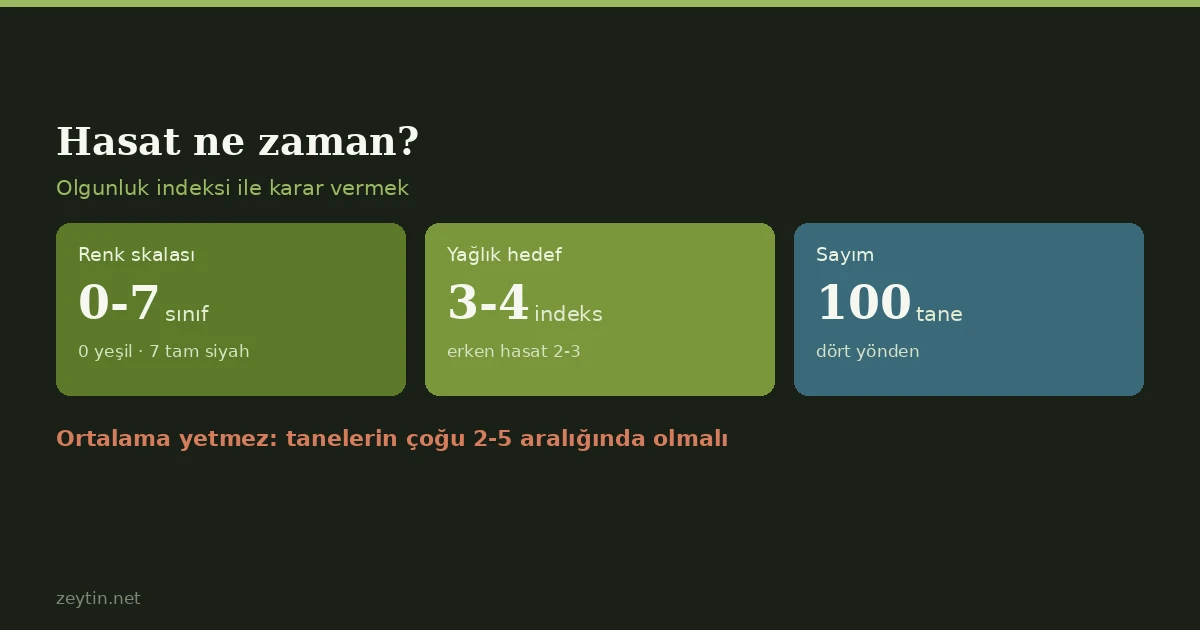
Harvest timing is set by the maturity index, not the calendar. The 0-7 colour scale, how to calculate it from 100 fruits, early versus late harvest compared, and ripening times by variety.
Article
When to harvest olives: deciding with the maturity index
Harvest timing is set by the maturity index, not the calendar. The 0-7 colour scale, how to calculate it from 100 fruits, early versus late harvest compared, and ripening times by variety.
 Article
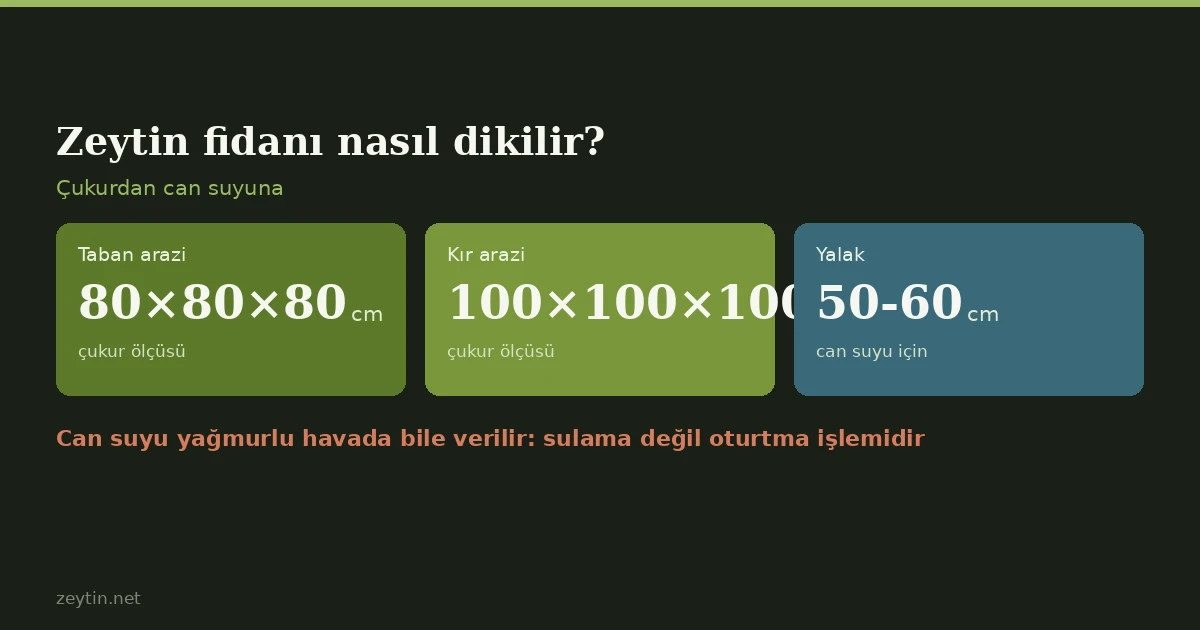
How to plant an olive sapling
Planting season, hole dimensions, removing a potted sapling, planting depth and the graft union, the basin and settling water — why settling water is given even in rain, first-year care and five common mistakes.
Article
How to plant an olive sapling
Planting season, hole dimensions, removing a potted sapling, planting depth and the graft union, the basin and settling water — why settling water is given even in rain, first-year care and five common mistakes.
 Article
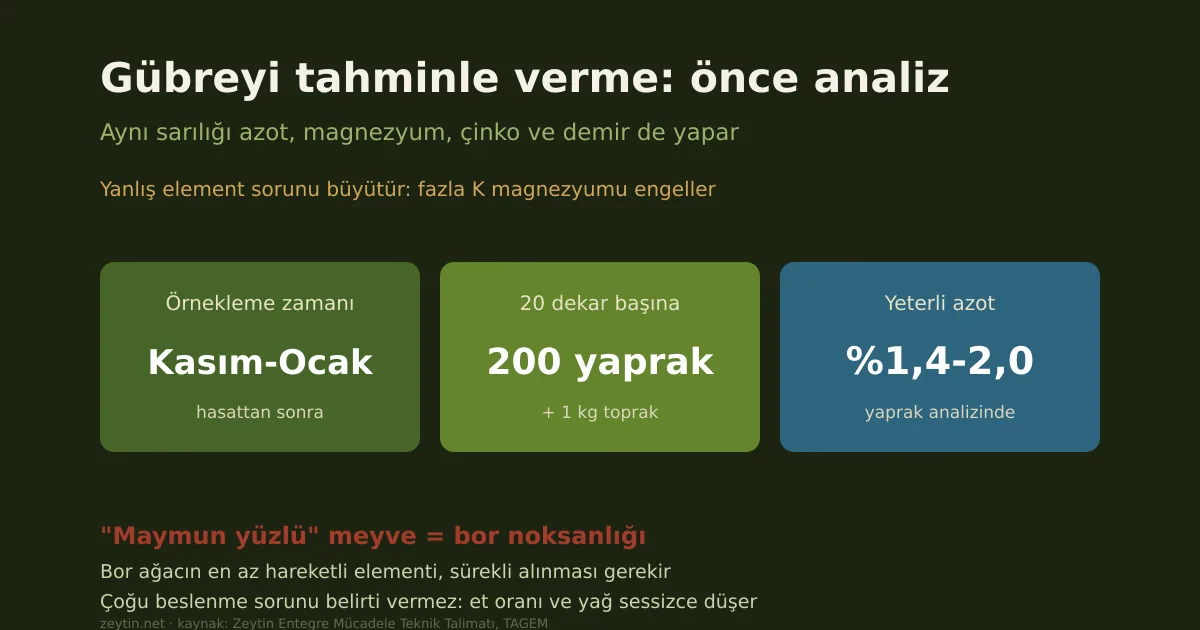
Nutrient deficiencies in olive: from symptom to element
The same yellowing can mean nitrogen, magnesium, zinc or iron, and the wrong element makes it worse. Standard leaf analysis values, symptom-to-element matching and the boron schedule.
Article
Nutrient deficiencies in olive: from symptom to element
The same yellowing can mean nitrogen, magnesium, zinc or iron, and the wrong element makes it worse. Standard leaf analysis values, symptom-to-element matching and the boron schedule.