The Çilli olive: large fruit, low chilling requirement
At 6.90 g it ranks among the large-fruited cultivars, and sits in the low chilling-requirement group — second only to Adana Topağı.
Çilli is one of the Aegean's local olive varieties. Two measured traits stand out: its large fruit and its low chilling requirement.
Çilli in numbers
| Property | Value | Note |
|---|---|---|
| Fruit weight | 6.90 g | second among the large-fruited varieties |
| Fruit length | 26.97 mm | |
| Fruit width | 21.80 mm | among the widest fruit in the trial |
| Fruit shape index | 1.24 | close to round |
| Flesh weight | 5.85 g | |
| Flesh ratio | 85% | upper group |
| Stone weight | 1.05 g | |
| Flesh-to-stone ratio | 5.57 | |
| Water-soluble dry matter | 14.0 °Brix | highest in the trial |
| Chilling requirement | 247 CU (369 hours) | second lowest, just behind Adana Topağı |
| Region | Aegean |
Two traits together
In the trial the large-fruited varieties rank like this: Domat 7.96 g · Çilli 6.90 g · Mavi 6.61 g · Adana Topağı 6.0 g.
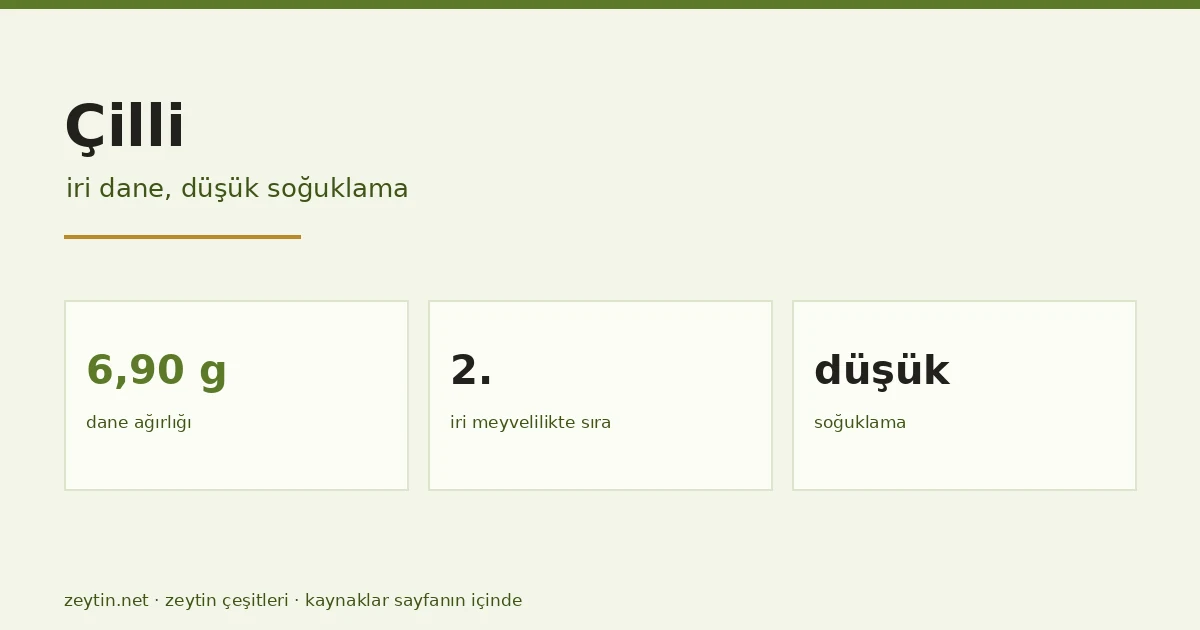
On the chilling scale the lowest requirement belongs to Adana Topağı, followed by Çilli, Mavi, Gemlik and Ayvalık.
So Çilli sits near the top of both lists: large fruit and little cold needed. That combination makes for an interesting table-olive profile in a warming climate — size sets the price, while a low chilling requirement gives some assurance of flowering.
The page does not fill the gaps in by estimation.
Among the Aegean's local varieties
Çilli appears on the list of local varieties grown in the Aegean: Ak Zeytin, Aşıyeli, Çakır, Çekişte, Çilli, Dilmit, Erkence, Girit, Eşek (Ödemiş), Hurma Kaba, Hurma Karaca, İzmir Sofralık, Karayaprak, Kiraz, Memeli, Taşarası, Tavşanyüreği, Sarıyaprak, Yağ Zeytini, Yerli Yağlık and Yamalak.
The list shows how broad Turkey's variety diversity is — and against that, three quarters of production comes from just three varieties.
In short
With a fruit weight of 6.90 g Çilli sits among the large-fruited varieties, and in the low group for chilling requirement. Together those two traits make an interesting table-olive profile at a time of warming winters. No published measurement was found for its other pomological values.
Note on sources
The pomological and chilling values on this page come from a comparative trial of Turkish and foreign olive varieties conducted under Adana conditions. Properties without a measurement have not been filled in by estimation; they are left blank.
Turkey's full variety distribution and comparative tables: olive varieties.
Where it stands among measured varieties
çeşit sayfası
Zeytin Kitabı — Efe, Soykan, Cürebal, Sönmez (2016), Kitabevi Yay. s.37-80
çeşit sayfası
çeşit sayfası
Values are those published on each variety's own page; the comparison covers only varieties with a measured figure, so it is a comparison of what is known — not of every Turkish variety. See the full ranking and how it is built →
One rating per visitor; you can change yours at any time. Ratings are real reader votes — no seeded or default scores.
Related
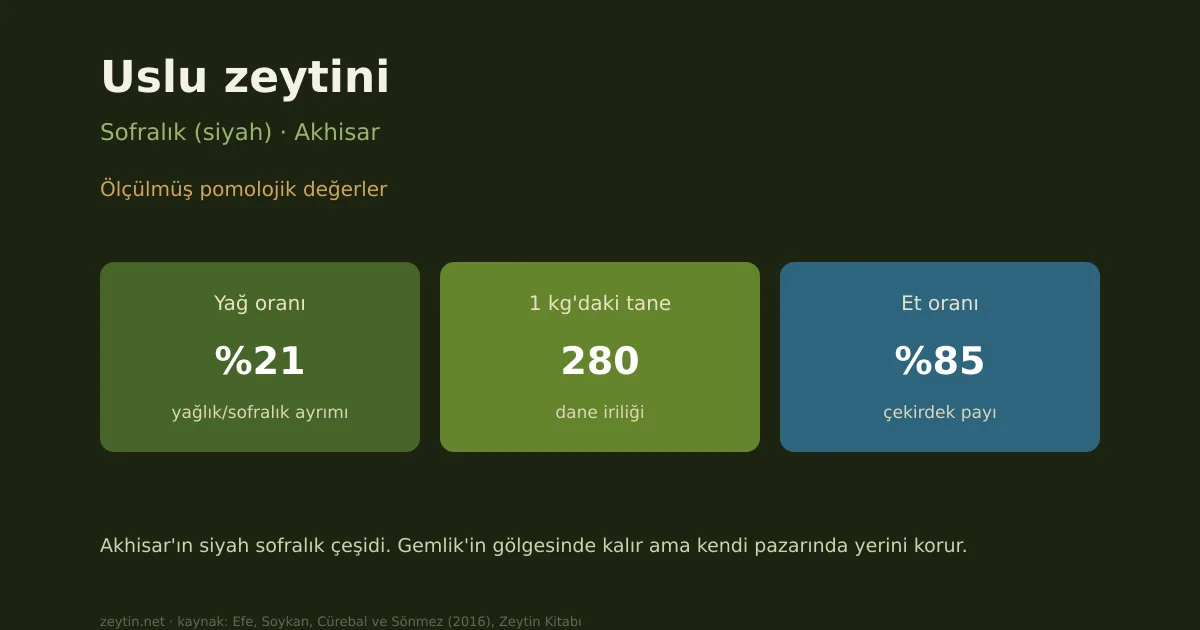 Article
Uslu olive: characteristics, oil content and growing areas
Akhisar's black table variety. Overshadowed by Gemlik, yet holding its own market.
Article
Uslu olive: characteristics, oil content and growing areas
Akhisar's black table variety. Overshadowed by Gemlik, yet holding its own market.
 Article
Gölvala olive
Gölvala is a recorded variety of the Black Sea. No measured pomological data published.
Article
Gölvala olive
Gölvala is a recorded variety of the Black Sea. No measured pomological data published.
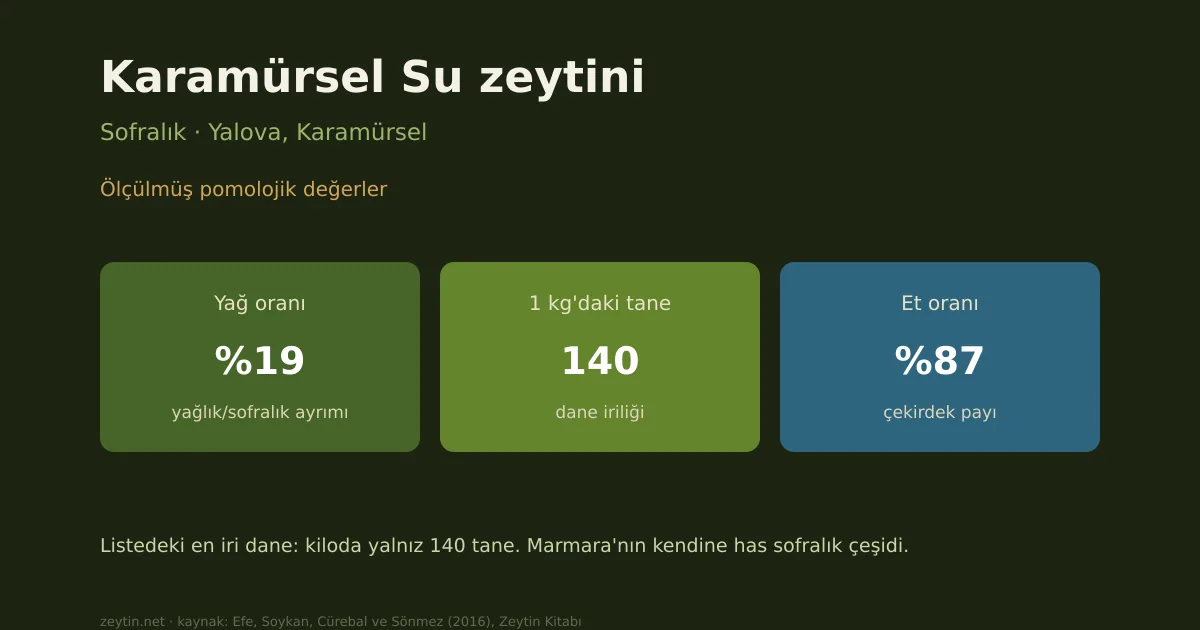 Article
Karamürsel Su olive: characteristics, oil content and growing areas
The largest fruit on the list: only 140 per kilo. Marmara's own distinctive table variety.
Article
Karamürsel Su olive: characteristics, oil content and growing areas
The largest fruit on the list: only 140 per kilo. Marmara's own distinctive table variety.
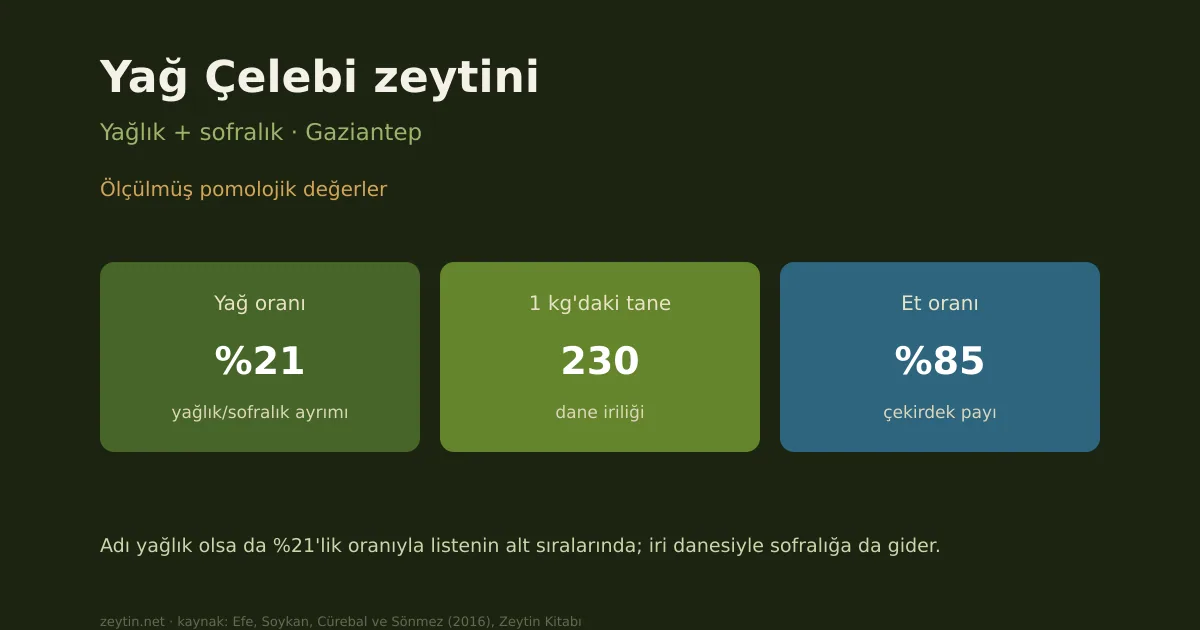 Article
Yağ Çelebi olive: characteristics, oil content and growing areas
Despite the name, its 21% oil puts it low on the list; its large fruit also serves the table.
Article
Yağ Çelebi olive: characteristics, oil content and growing areas
Despite the name, its 21% oil puts it low on the list; its large fruit also serves the table.