Can sheep grazing in an olive grove compact the soil? Seven plots in Jaén and an 11-year yield trial
On seven olive grove plots in Jaén, controlled sheep grazing did not raise soil bulk density; values were lower in grazed plots. In an 11-year yield trial, sheep, tillage and herbicide gave no significant yield difference. The article reads both studies, the limits of the comparison and the unmeasured question of damage to trees.
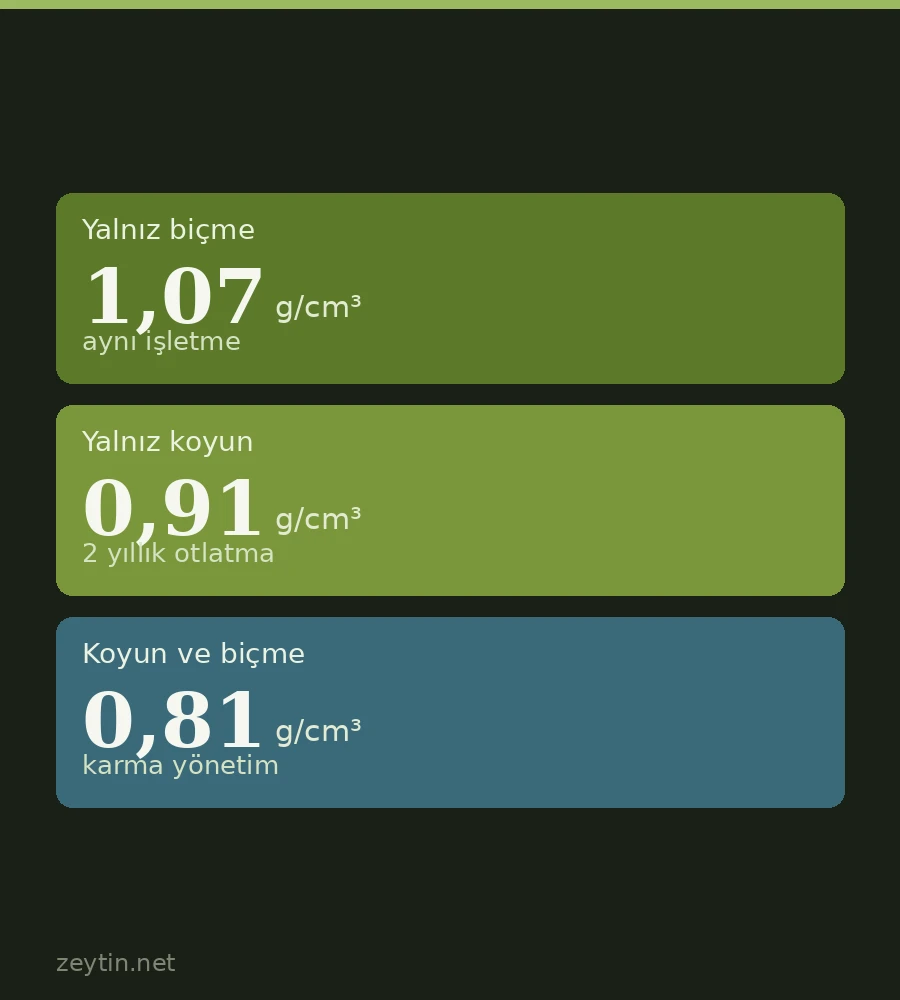
Short answer: in the two studies we read, controlled sheep grazing did not compact the soil; on the contrary, soil bulk density in grazed plots was lower than in plots kept bare or only mown. But the result is conditional: both studies used a suitable animal density, one on a single organic farm, the other in a single rainfed olive grove. In this article we read a soil study from Jaén, Spain (Cebadero Cayetano et al., Spanish Journal of Soil Science, 2020) side by side with an 11-year yield trial (Dimande et al., Agriculture, 2024). For the second we could only reach the abstract, so we report only what the abstract says.
Why does the question matter?
Controlling weeds with animals instead of destroying them entirely is an old practice; our article on weed management without herbicides covers the methods in outline. But the effect of the practice on the soil is debated. The introduction of the Spanish paper says that, with the spread of herbicides, chemical fertiliser and stall-fed livestock, keeping olives and livestock together has been abandoned in recent decades, that the idea that animals (sheep being the most suitable) damage trees is widespread, and that some authors have proposed returning to animals for cover control. The worry about compaction comes from the same place: earlier studies reported that intensive grazing raised soil bulk density. The paper notes that the stocking rate in those studies was very high.
Seven plots in Jaén
The study was carried out in Pegalajar, Jaén. The soil lies over hard limestone and limestone debris, on slopes of 8 to 15%. There were two farms, both traditional, wide-spaced Picual groves. One farms conventionally: soil kept bare all year with herbicide and chemical fertiliser. The other has been organic for 13 years; it uses manure, plant matter from the cover, shredded pruning residue and composted olive pomace, and keeps 130 head of Ojinegra and Segureña sheep. The organic farm was divided into four plots:
- G: the cover is controlled by sheep only, for 2 years.
- GA: the same, but for 6 years.
- Mix: mechanical mowing and animals together, with animals entering at intervals according to the amount of vegetation; animals for 2 years.
- CON: mechanical mowing only.
All four plots have had a cover for 15 years. The bare plot (BL) on the conventional farm and adjacent natural areas (holm oak woodland and esparto grassland) were sampled for comparison.
| Plot | Bulk density (g/cm³) | Total nitrogen (%) | Moisture at 33 kPa (%) |
|---|---|---|---|
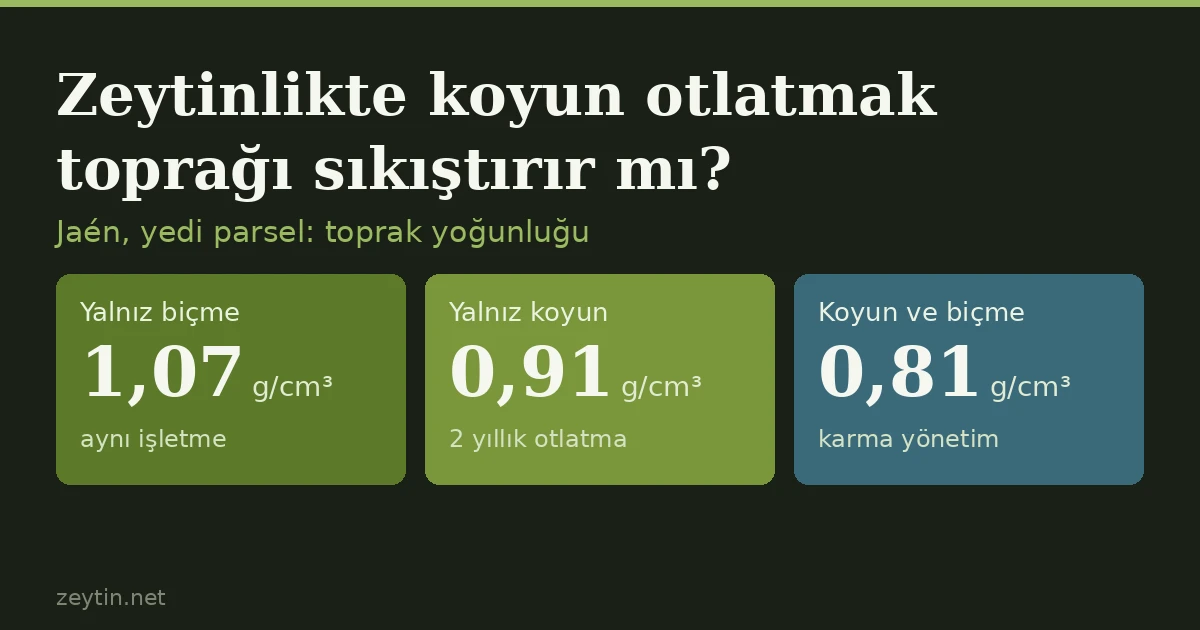
| BL: bare, herbicide (conventional farm) | 1.07 | 0.15 | 31.94 |
| CON: mechanical mowing only | 1.07 | 0.24 | 35.60 |
| G: sheep only, 2 years | 0.91 | 0.35 | 34.40 |
| GA: sheep only, 6 years | 0.92 | 0.40 | 39.03 |
| Mix: sheep and mowing | 0.81 | 0.29 | 34.32 |
According to the paper, the difference in bulk density between the conventional plot and the plots with animals was significant, with one exception: GA had a lower value but the difference was not significant. The authors attribute the lower bulk density in grazed areas, compared with conventional farming, to the increase in organic matter and to suitable livestock management. In plots under a cover, soil moisture was also higher, whatever the type of cover control.
In their conclusions the authors say that the plots with animals improved many properties (moisture, soluble organic carbon, nitrogen and pH) compared with conventional management. Short-term animal management (G) and animals combined with occasional clearing (Mix) lowered soil bulk density compared with the other managements. Plots managed with animals alone (G and GA) improved soluble organic carbon and, in the longer term, available water. The mixed management was not as positive for soluble carbon.
How should this comparison be read?
The bare plot (BL) in the table is from another farm, which uses chemical fertiliser. So the whole difference between BL and the other plots cannot be credited to the sheep: the farm being organic, the manure, the compost and 15 years of cover contribute as well. The comparison closest to the effect of the sheep themselves is between G, GA and Mix on the same farm and the CON plot, which is only mown mechanically. Here there was no significant difference in total organic carbon among the plots under a cover (Mix, CON, G, GA); soluble organic carbon, however, responded more quickly to a change in management. The authors state clearly that longer-term studies are needed.
An 11-year yield trial
Dimande and colleagues compared three soil managements in a rainfed olive grove between 2011 and 2022: conventional tillage, glyphosate-based herbicide and sheep grazing.
| Measure | Sheep grazing | Tillage | Herbicide |
|---|---|---|---|
| Total accumulated yield (kg/tree) | 225.1 | 230.9 | 245.0 |
| Total soil organic carbon, last year (g/kg) | 41.3 | 33.7 | 37.3 |
According to the abstract there was no significant difference in yield between the treatments. The yield of the sheep plot was numerically about 8% below that of the herbicide plot (our calculation: 19.9 kg), but the difference was not found significant. Soil carbon was highest in the sheep plot; the abstract does not state whether this difference was significant. The authors write that with a suitable stocking rate the vegetation was controlled effectively in spring, that soil properties and yield were comparable with the other methods, and that further benefits such as income from animal products and the chance to move to organic farming may follow.
Limits, and the question of damage to the tree
Neither study measured damage to the trees; no figure in this article gives any assurance for young trees, saplings or goats. The Jaén study is limited to seven plots and two farms; the text mentions 130 head of sheep, but we found no density per hectare. For the yield trial we read only the abstract, and the abstract does not state where the work was done. The Jaén study was carried out outside Türkiye.
For carbon too there is a note: in another study of 24 olive groves in Andalusia (Torrús-Castillo et al., 2023), animal grazing was counted, together with spontaneous cover, compost and shredded pruning residue, among the shared practices of groves that were storing carbon in the soil; but the share of sheep alone was not separated out.
What we can conclude is this: in these two studies, controlled sheep grazing did not compact the soil and did not significantly lower yield. Before carrying this over to your own grove, consult a local expert about animal density and grazing period. For the general choice between tilling and leaving a cover, see our article on tilling or leaving weeds in the grove.
One rating per visitor; you can change yours at any time. Ratings are real reader votes — no seeded or default scores.
Related
 Article
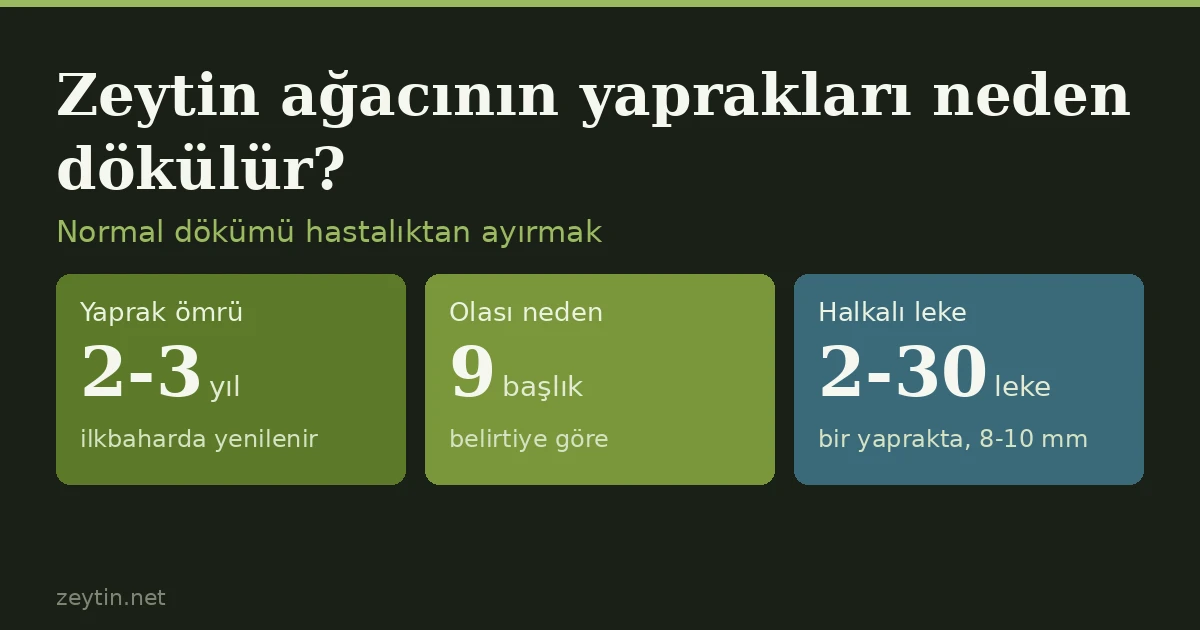
Why is my olive tree dropping its leaves?
An olive leaf lives two to three years and falls in spring along with the new growth; that is normal. The worrying drop is the one whose season, location or amount does not fit. Rings on the upper surface point to peacock spot, grey patches underneath to Cercospora leaf spot, dieback on one branch to Verticillium, one-sided yellowing to root rot. Water, nutrient deficiencies, scale insects, frost and lack of light also make olives shed leaves. How to tell them apart, and what to do.
 Article
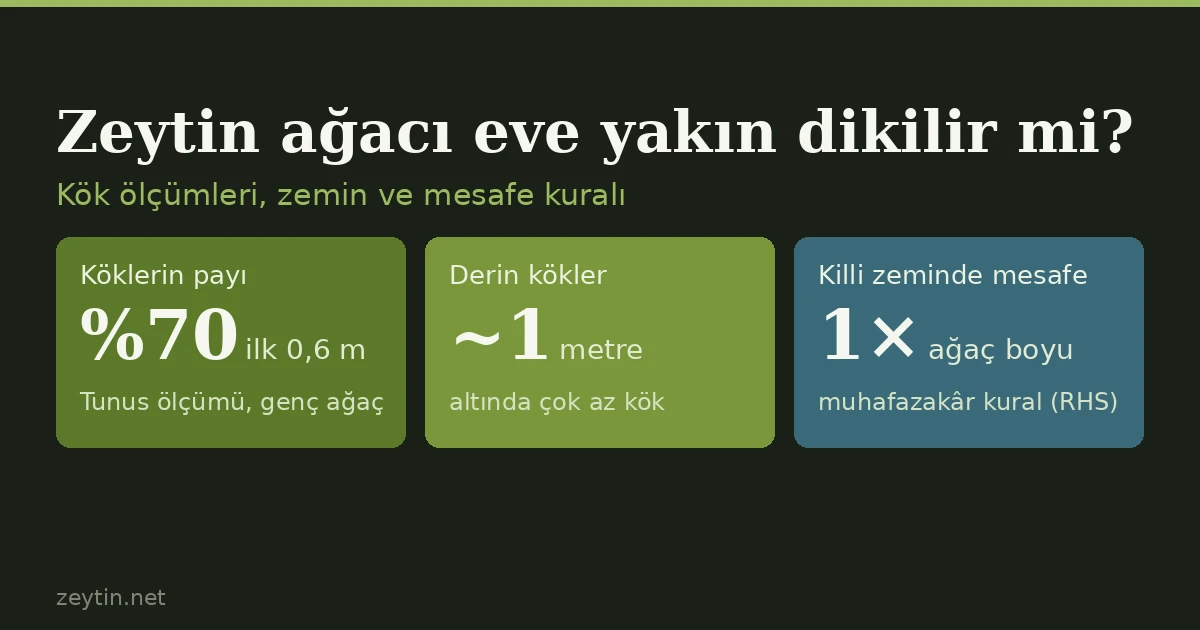
Can you plant an olive tree near a house? Do its roots damage foundations?
Olive roots are concentrated mostly in the top 60 centimetres of soil and do not penetrate a sound foundation directly. The real risk is soil shrinkage on clay, which can make a building settle. What root measurements show, a distance rule based on tree height, pipes, and what Turkish law says about the neighbour's boundary.
 Article
Can an olive cutting root in water? How to root olive cuttings at home
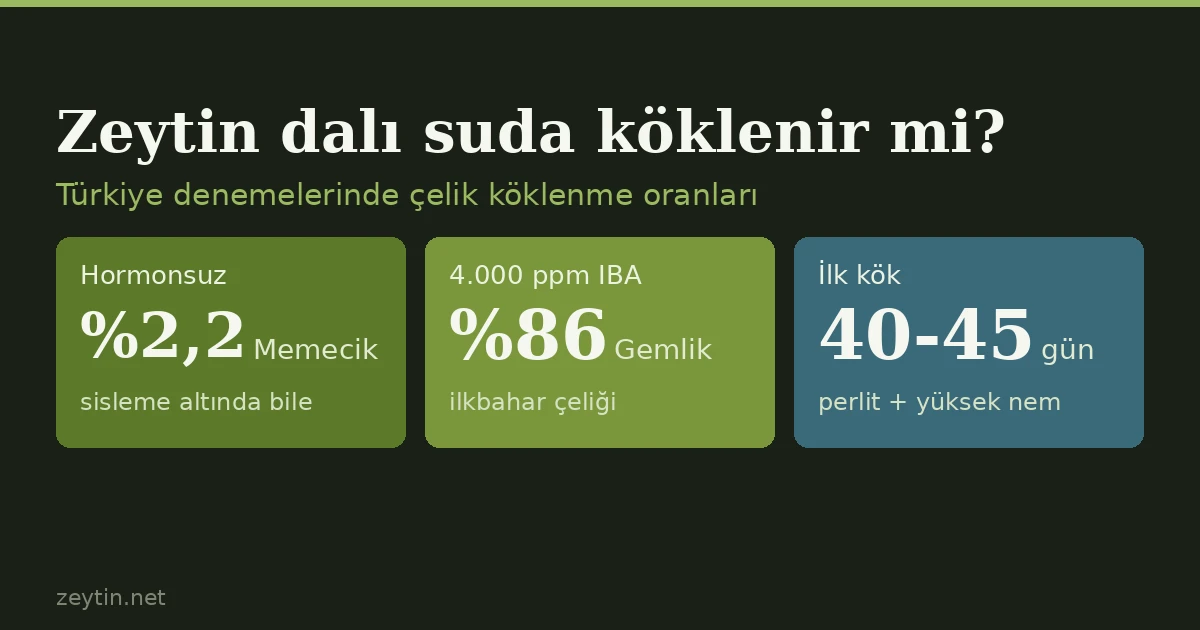
Standing an olive twig in water is not a tested method for olives. Nurseries root cuttings in perlite under high humidity with hormone; in Turkish trials rooting ranged from 2% to 86% depending on variety and hormone.
 Article
What happens if an olive tree is flooded? Root asphyxiation, root rot and what to do after the water recedes
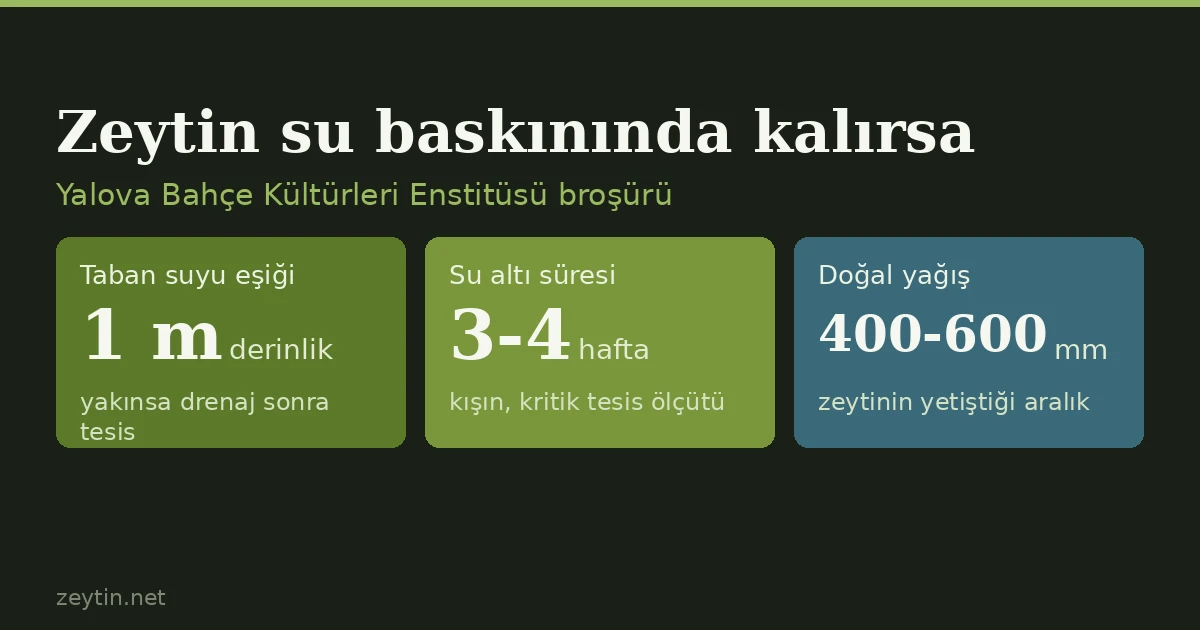
In a flood the olive suffers mainly at the roots: roots starved of oxygen stop working and root rot fungi follow. Symptoms appear weeks later. The article draws on ministry research-institute leaflets and a peer-reviewed study and sets out sensible steps after a flood and drainage criteria for planting.