Can you plant an olive tree near a house? Do its roots damage foundations?
Olive roots are concentrated mostly in the top 60 centimetres of soil and do not penetrate a sound foundation directly. The real risk is soil shrinkage on clay, which can make a building settle. What root measurements show, a distance rule based on tree height, pipes, and what Turkish law says about the neighbour's boundary.
People who want to plant an olive in the garden usually ask first not about the tree but about the house: will the roots reach the foundations, crack the walls, block the pipes? The short answer is that an olive root does not bore through a sound foundation. The real risk is indirect and depends on one particular type of soil. With the right distance and a few precautions, an olive can live comfortably next to a house.
The short answer
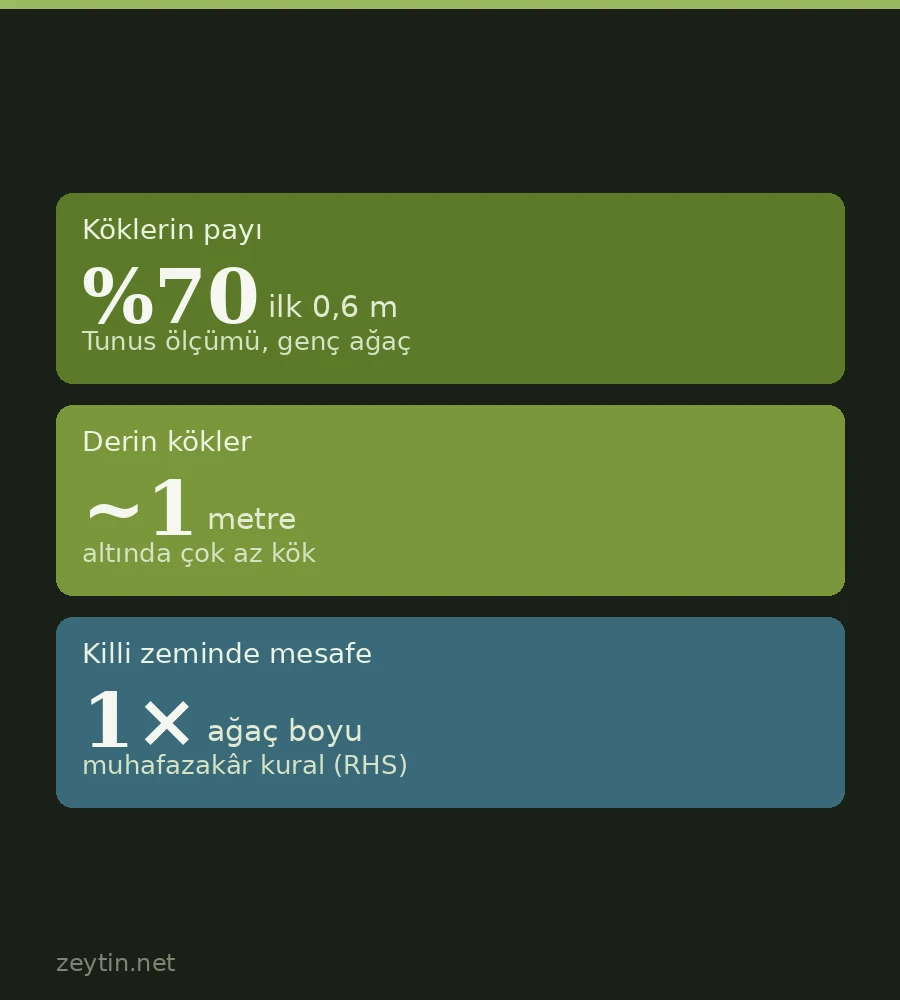
- Olive roots are concentrated mostly in the top 60 centimetres of soil, and those that go deeper usually stop at around 1 metre.
- Roots do not penetrate a sound foundation directly. Damage to buildings comes from drying soil rather than from the roots themselves, and it occurs mainly on shrinkable clay soils.
- Roots do not enter a watertight pipe; they enter cracked pipes or pipes with open joints.
- A conservative rule for distance: plant the tree at least as far from the house as its mature height. On sand, gravel or rock the distance can be shorter.
How far do olive roots reach?
One of the clearest measurements of the olive's root system comes from Tunisia. Researchers from the Olive Tree Institute of Tunisia and the National Agronomic Institute of Tunisia (Masmoudi-Charfi and colleagues, Advances in Horticultural Science, 2011) excavated and counted the roots of young drip-irrigated Chétoui trees growing in a clay soil about 2 metres deep at Mornag. They found that:
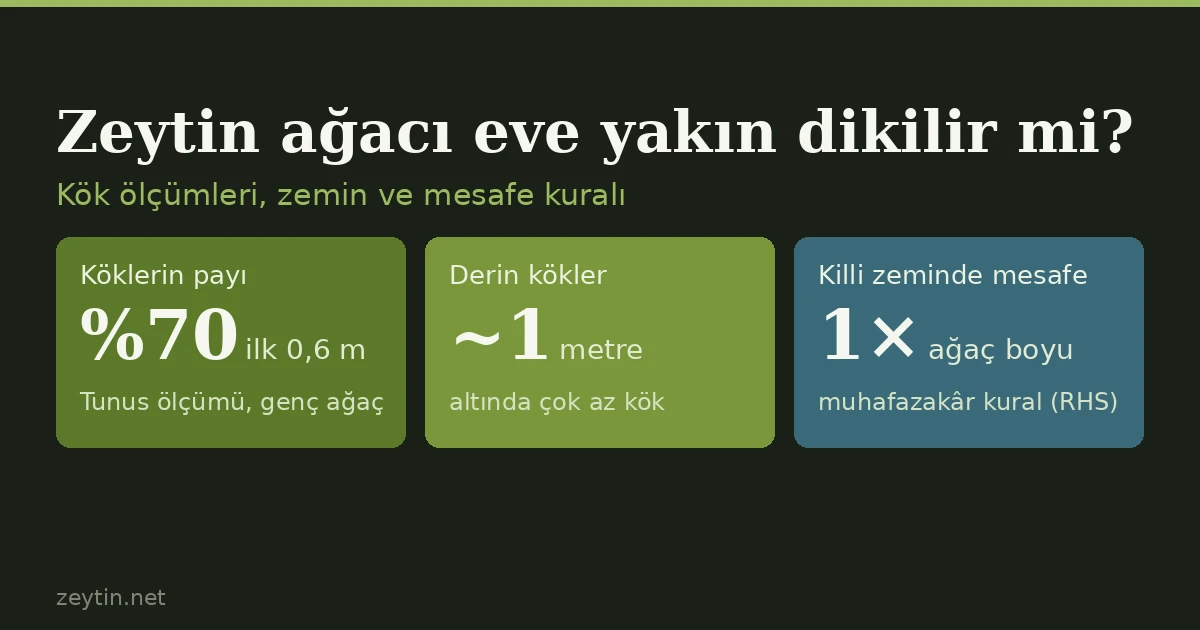
- 70 percent of the roots lay in the top 0.6 metres, with root density highest at 20-40 centimetres.
- Some roots reached 1 metre, but even in the six-year-old tree very few roots were found below that depth.
- Roots spread sideways and grew together with the canopy: the relationship between root area and canopy area was very strong (r = 0.94). In the six-year-old tree, the farthest root was 2.10 metres from the trunk, while the edge of the canopy was at 1.95 metres.
- As the trees aged, thicker roots developed below the first 30 centimetres and grew horizontally.
The earlier studies reviewed in the same paper point the same way: the root system of young olives was reported to be confined mainly to the top metre of soil, and in Crete five-year-old Kalamon trees had the largest number of roots at 0.4 metres. In a dry environment with only 150 millimetres of annual rainfall, root density in seven-year-old trees was concentrated at 15-30 centimetres.
In older trees the roots extend beyond the edge of the canopy. As we explained in our article on the botany of the olive tree, the olive's root system is wide rather than deep. That is what keeps the tree standing in shallow, stony soils; for a garden, it means the roots spread sideways and close to the surface rather than down under the foundations.
Do roots break through foundations?
The guidance on trees near buildings published by the Royal Horticultural Society (RHS) in the United Kingdom is clear on this point: tree roots are unlikely to directly penetrate sound footings. Nearly all damage happens indirectly, when the soil dries and settles.
The mechanism works like this. Clay soils shrink when they dry and swell when they become wet again. In spring and summer, tree roots draw water from the soil and dry the clay; if a foundation sits within that drying layer, the building moves downwards, and it partly recovers in winter when the soil is wet again. According to the guidance, the risk is greatest on shrinkable clay soils and for older buildings with shallow foundations. On sandy, gravelly or rocky ground the problem generally does not arise.
The fact that the olive tolerates drought does not mean it will not dry the soil. Like any tree, it uses the water in its root zone during the summer months, and its roots can extend beyond the canopy. That is why planting an olive right next to an old building with shallow foundations on a clay plot is not something to do without precautions.
How far away should it be planted?
The RHS guidance gives three practical measures:
- Tree roots can spread up to three times the height of the tree, so a tree's influence sometimes reaches farther than expected.
- For high water-demand species, the soil-drying influence extends to a distance equal to the tree's height.
- For moderate and low water-demand species, the influence is unlikely to exceed half the tree's height.
The guidance does not place the olive in any of these classes. Given that uncertainty, the safest approach on clay is to use the measure given for high water-demand species:
| Mature height of the tree | Conservative (equal to height) | Assuming moderate-low water demand (half height) |
|---|---|---|
| 3 metres | 3 m | 1.5 m |
| 5 metres | 5 m | 2.5 m |
| 8 metres | 8 m | 4 m |
The rule comes from the RHS "Trees near buildings" guidance; applying it to these tree heights is our own calculation.
The olive has one advantage here: its height can be controlled by pruning. A tree that can grow up to 15 metres in natural conditions is kept much lower in gardens through pruning (olive pruning). Keeping a garden olive at 3-4 metres makes both the distance calculation and the harvest easier.
Pipes, septic tanks and paving
According to the RHS guidance, if drains are watertight, tree roots will not generally trouble them. Roots go where moisture and nutrients are: an old sewer or rainwater pipe that has cracked or whose joints have opened is a target that roots can enter and gradually block. Knowing the condition of nearby pipes before planting, and relining or replacing them if they are old, is the most lasting precaution.
Paving, garden paths and the edges of swimming pools are a separate matter. Because the olive's thicker roots run horizontally and close to the surface, they can gradually lift thin surfaces laid very close to the trunk. This should not be confused with structural damage to the building; the RHS also treats the two effects separately.
The boundary with the neighbour: what Turkish law says
Article 740 of the Turkish Civil Code deals with overhanging branches and roots. If branches and roots that cross onto a neighbour's land and cause harm are not removed within a reasonable time after the neighbour asks, the neighbour may cut them and take ownership of them. Under the same article, a neighbour who tolerates branches overhanging land that is cultivated or built upon has the right to pick the fruit growing on those branches. In other words, the olives on branches that hang over the boundary belong to the neighbour who puts up with them.
Article 741 states that the rules neighbouring owners must follow when planting are to be set by special laws. Cutting down or uprooting an olive tree later is a separate issue; we covered the legislation restricting the felling of olive trees in olive groves and mining: the legislative record. Before cutting a tree, it is advisable to consult the local district directorate of agriculture.
What to do in practice
1. Find out what the soil is. If there is a ground survey for the plot, check the soil class; on clay, keep the distance generous.
2. Plan for the mature height. Choose the spot based not on the sapling's current size but on the height you intend to keep it at by pruning.
3. Check the pipes. If there is an old line nearby, deal with it before planting the tree.
4. Irrigate away from the house. Place drippers at the outer edge of the canopy, not against the wall; roots follow the water (drip irrigation).
5. Plant it properly. For the planting hole, soil preparation and spacing, see how to plant an olive sapling. If space is very tight, an olive in a pot is another option.
If there is already a large olive next to your house and you notice cracks in the wall, have the cause determined by a structural engineer rather than by guesswork. The RHS also recommends that when cracks appear, their cause should be investigated by structural engineers and monitoring specialists.
Reading notes
⚠ The root measurements come from young, irrigated trees; in old trees grown without irrigation the roots can spread over a wider area.
⚠ The distance rules are based on building and soil experience in the United Kingdom; foundation types and soils in Türkiye may differ. Decisions about the safety of a building should rest on an on-site engineering assessment.
⚠ The distances in the table are general guidance, not a precise threshold.
One rating per visitor; you can change yours at any time. Ratings are real reader votes — no seeded or default scores.
Related
 Article
What happens if it rains during the olive harvest? Wait, or pick?
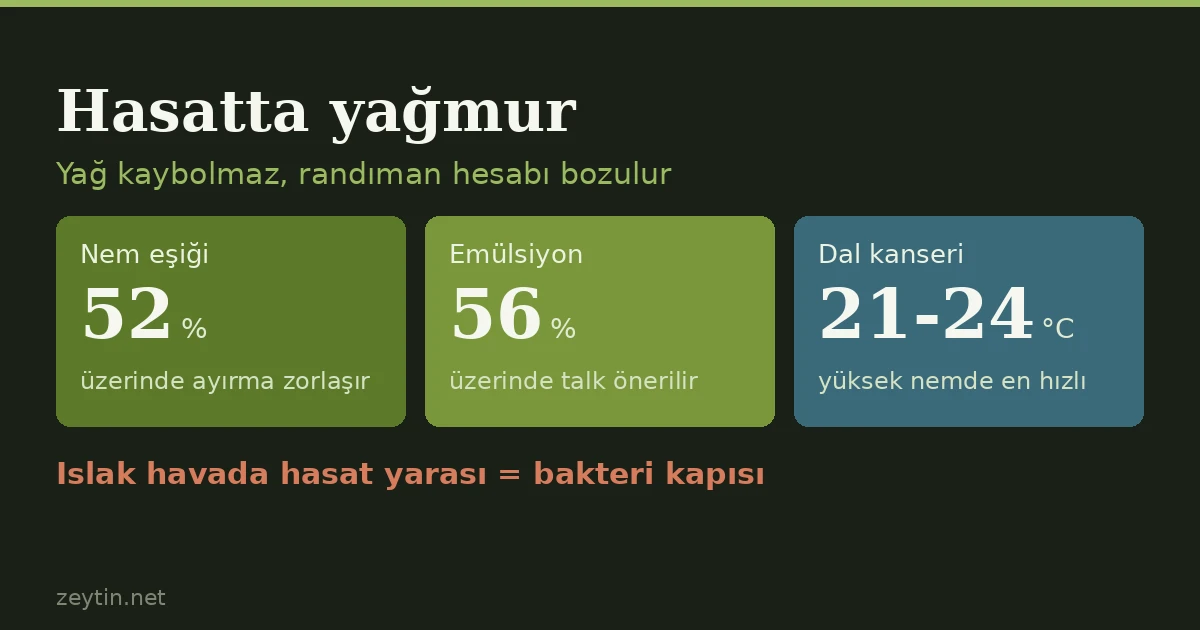
Rain does not destroy the oil; it distorts the yield figure, because fruit oil content is measured on a fresh-weight basis. The real damage shows up as emulsion at the mill, as the "musty-humid-earthy" sensory defect, and as olive knot bacteria entering harvest wounds in wet weather.
 Article
Do olives grow in cold regions?
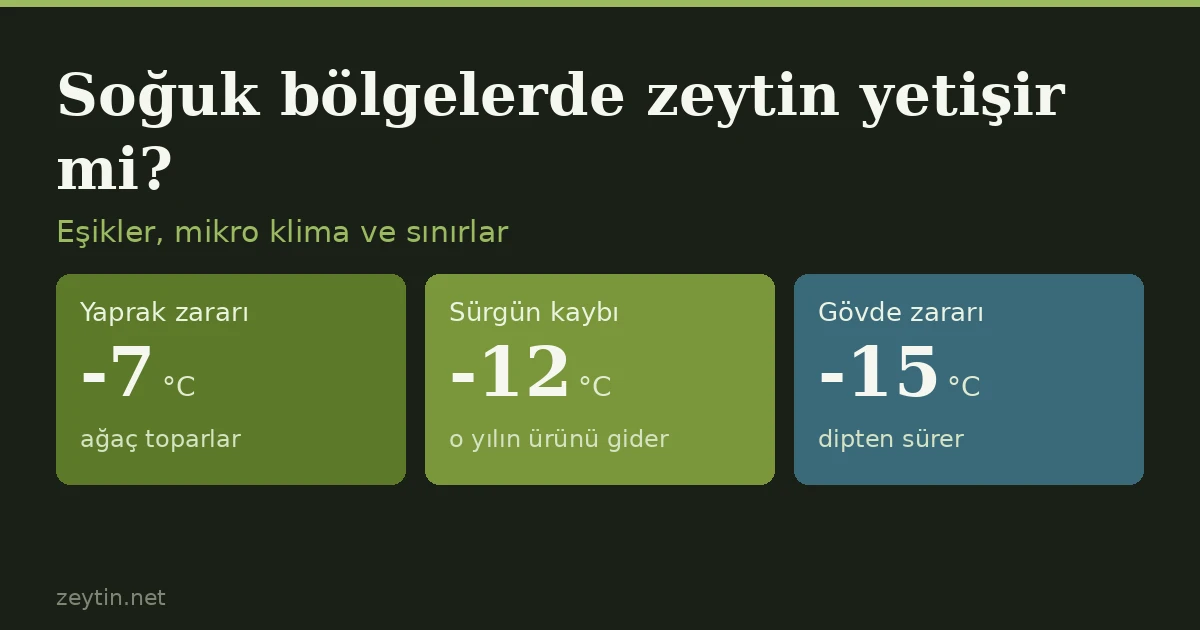
Olives survive -7 °C, lose shoots at -12 °C and the trunk below -15 °C. Yet Artvin delivers Turkey's highest yield per tree: microclimate beats the map.
 Article
Arbequina IRTA-i18: the clone behind super-high-density olive groves
IRTA-i18, developed from Arbequina by clonal selection, was chosen for super-high-density groves. What early bearing, mechanical harvest and a low 459-hour chilling requirement actually mean.
 Article
When to harvest olives: deciding with the maturity index
Harvest timing is set by the maturity index, not the calendar. The 0-7 colour scale, how to calculate it from 100 fruits, early versus late harvest compared, and ripening times by variety.