Bayramiç Olive Oil: aroma compounds defined as percentages
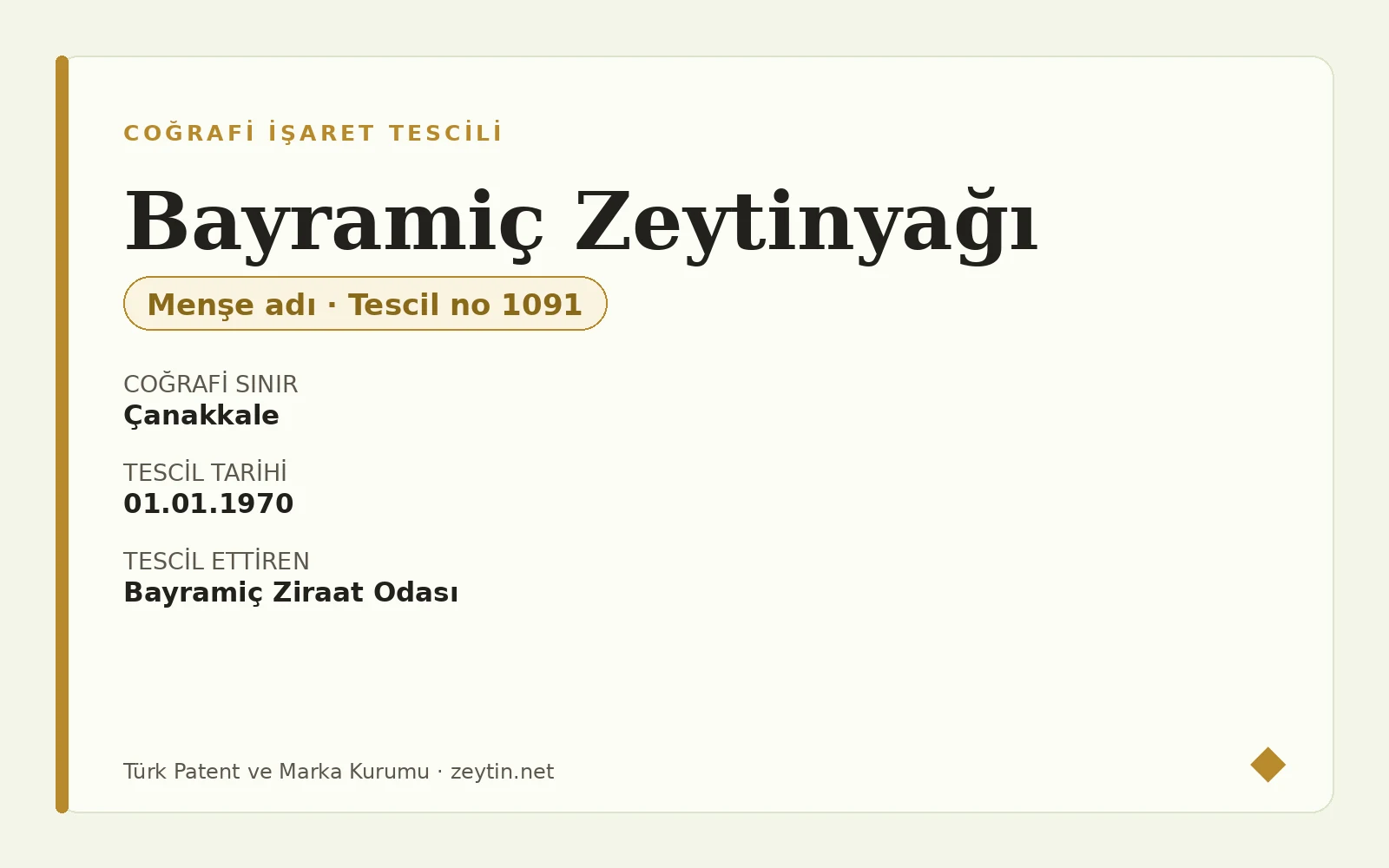
Registered in 2022. The certificate defines aroma by compound rather than adjective: hexanal 36.15%, E-2-hexenal 26.14%. Iodine value 80-93.
Olive oil registrations usually describe aroma with adjectives: grass, artichoke, green apple. Bayramiç Olive Oil's certificate also gives the compounds that produce them, as percentages.
The record
| Registration no | 1091 |
| Registration date | 25.04.2022 |
| Protection from | 05.02.2021 |
| Type | Designation of origin |
| Registered by | Bayramiç Chamber of Agriculture |
| Area | The Bayramiç district of Çanakkale |
| Cultivar | Ayvalık (Edremit) |
Aroma compounds
| Compound | % |
|---|---|
| Hexanal | 36.15 ± 2.73 |
| E-2-hexenal | 26.14 ± 2.54 |
| Z-3-hexenal | 6.96 ± 0.69 |
| 2,4-hexadienal | 3.45 ± 0.50 |
| Hexyl acetate | 2.68 ± 0.43 |
These are C6 aldehydes — the group that carries olive oil's “green” aroma. They form enzymatically when the fruit is crushed and diminish as the oil ages. Writing their percentages into the certificate therefore also sets an indirect measure of freshness.
Sensory description
The oil has high fruitiness and is lightly flowing and light on the palate. It leaves a mild-to-moderate bitterness and a late-arriving mild-to-moderate pungency.
In aroma it must carry at least one of the Ayvalık cultivar's characteristic perceptions: green tomato, green apple, grass, artichoke, soft fruity.
Chemical limits
| Criterion | Value |
|---|---|
| Free acidity | ≤ 0.8 |
| Peroxide | ≤ 20 meq/kg |
| Iodine value | 80.00 – 93.00 |
| K232 | ≤ 2.50 |
| K270 | ≤ 0.22 |
The iodine value indicates an oil's degree of unsaturation; the typical range for olive oil is 75-94. Placing it in the definition adds a further test of the oil's identity.
Bayramiç is the Ayvalık cultivar's registration in Çanakkale — same province as Geyikli Olive Oil, a different district.
The criteria the document binds
The registration does not only protect a name; it defines the product numerically:
| Criterion | Value in the document |
|---|---|
| Peroxide value | 20 meq O₂/kg (max) |
Inspection. The inspection body convenes with at least once a year. Members: Bayramiç Ziraat Odası, Çanakkale Ticaret Borsası, Çanakkale Onsekiz Mart Üniversitesi. Results are reported under Industrial Property Law no. 6769 and submitted to the Turkish Patent and Trademark Office.
Its place in Çanakkale's olive production
| Item | Value |
|---|---|
| Fruit production | 170,800 t |
| — for oil | 160,356 t |
| — for the table | 10,444 t |
| Olive oil production | 28,428 t |
| Trees | 5,161 thousand |
| Yield per tree | 33.1 kg |
94% of the province's fruit goes to oil. An oil-based registration matches how the province actually produces.
Why aroma? What the field study found
Listing aroma compounds as percentages may look like excessive detail. A comparative study carried out in the region shows why it is necessary.
Gündoğdu and Nergis (2020) compared oils from Bayramiç and the Edremit Gulf using the same method:
| Item | Value |
|---|---|
| Cultivar | Ayvalık |
| Sampling points | 18 (9 villages in Bayramiç, 9 sites in the Edremit Gulf) |
| Harvest | three ripeness stages: green, veraison, black |
| Measured | maturity index, quality parameters, volatile compounds, fatty acid composition, sensory |
The result has two parts, and together they explain the registration:
- No statistically significant difference appeared between the two regions in maturity index or oil quality parameters. Classic measures such as acidity and peroxide cannot separate a Bayramiç oil from an Edremit one.
- Significant differences were found in volatile compounds — particularly among the aldehyde, alcohol and ester groups.
The conclusion follows directly: what distinguishes Bayramiç is not quality but aroma. Writing the percentages of hexanal, E-2-hexenal and Z-3-hexenal into the definition is therefore not a redundant detail; it defines the only place where the distinction actually lies.
Where the difference comes from: which side of Mount Ida
The study attributes the difference to climate. Bayramiç lies on the northern side of Mount Ida and receives cooler winds; the Edremit Gulf sits on the mountain's southern slope, facing the Aegean and milder.
The same cultivar, the same name, two sides of one mountain — and a measurably different aroma profile. This is the textbook case for the logic of a designation of origin: what is protected is not the cultivar but the form the cultivar takes in that place. We discussed how the Ayvalık cultivar underpins five separate registrations on the Edremit Zeytinyağı page; this study shows by measurement why those five are separately meaningful.
The cooler position has one further consequence: C6 aldehydes form enzymatically when the fruit is crushed, and the efficiency of that pathway is temperature-sensitive. A cooler ripening period is consistent with the "green" aroma group remaining higher.
One rating per visitor; you can change yours at any time. Ratings are real reader votes — no seeded or default scores.
Related
 Article
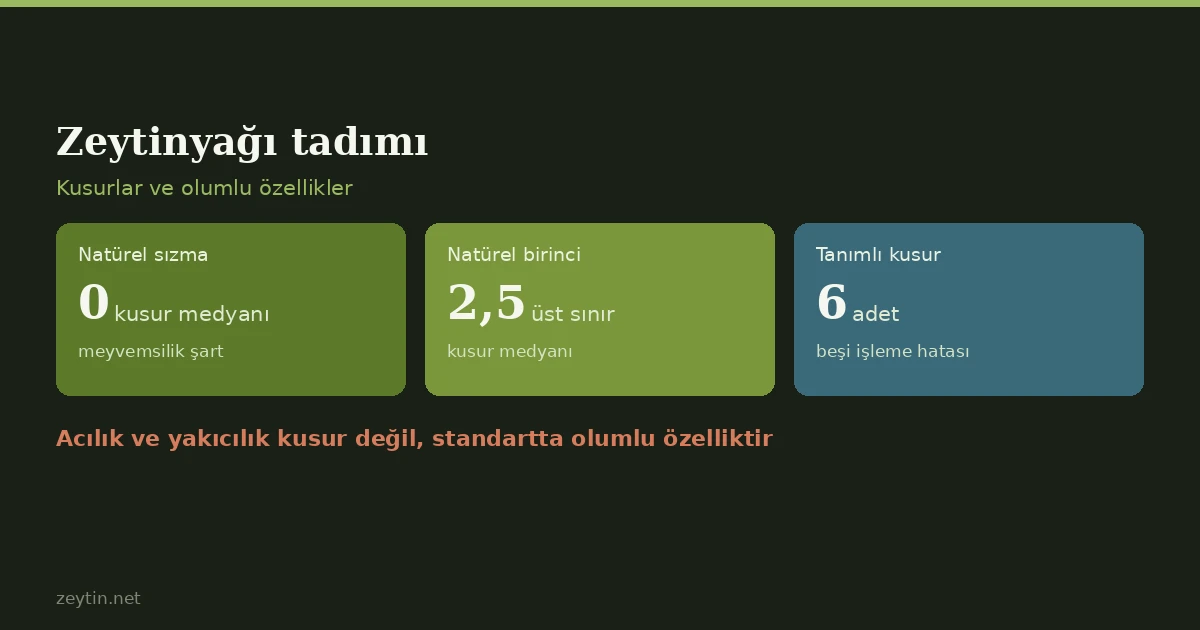
Tasting olive oil: defects and positive attributes
Laboratory tests alone do not make an oil extra virgin — it must pass a tasting panel. The three positive attributes, the six defects in the standard, and what each one says about how the oil was made.
Article
Tasting olive oil: defects and positive attributes
Laboratory tests alone do not make an oil extra virgin — it must pass a tasting panel. The three positive attributes, the six defects in the standard, and what each one says about how the oil was made.
 Article
Burhaniye Olive Oil: two thousand years attested by the Adramytteion excavations
Registered in 2021. The certificate grounds two thousand years of olive growing in the excavation of an ancient city, and sets separate sensory thresholds for early and ripe harvest.
Article
Burhaniye Olive Oil: two thousand years attested by the Adramytteion excavations
Registered in 2021. The certificate grounds two thousand years of olive growing in the excavation of an ancient city, and sets separate sensory thresholds for early and ripe harvest.
 Article
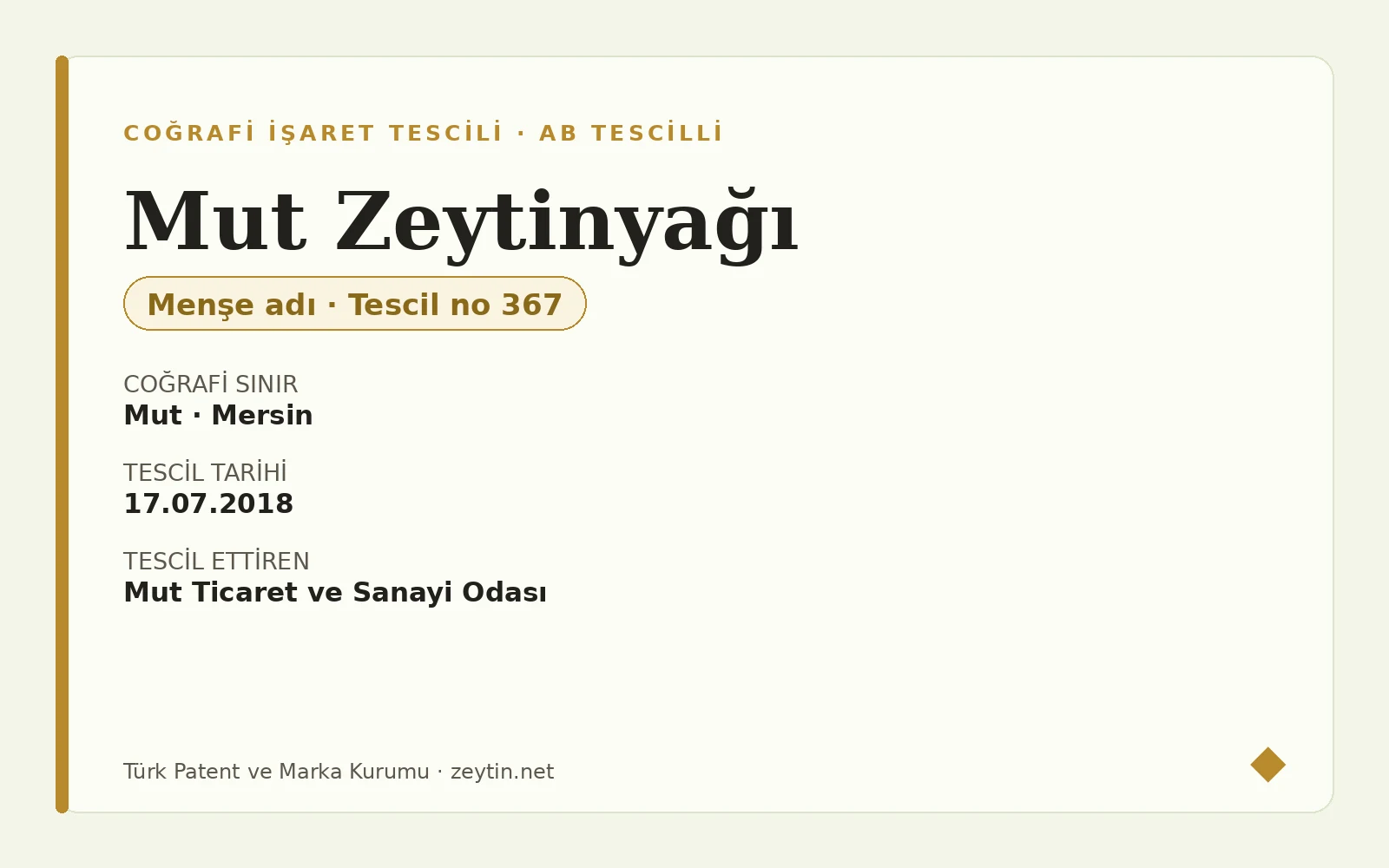
Mut Olive Oil: a landscape that needs no pesticide
The certificate's real claim rests on altitude and humidity: 10-40% relative humidity keeps out both the olive fly and peacock spot. That is why organic production is straightforward here.
Article
Mut Olive Oil: a landscape that needs no pesticide
The certificate's real claim rests on altitude and humidity: 10-40% relative humidity keeps out both the olive fly and peacock spot. That is why organic production is straightforward here.
 Article
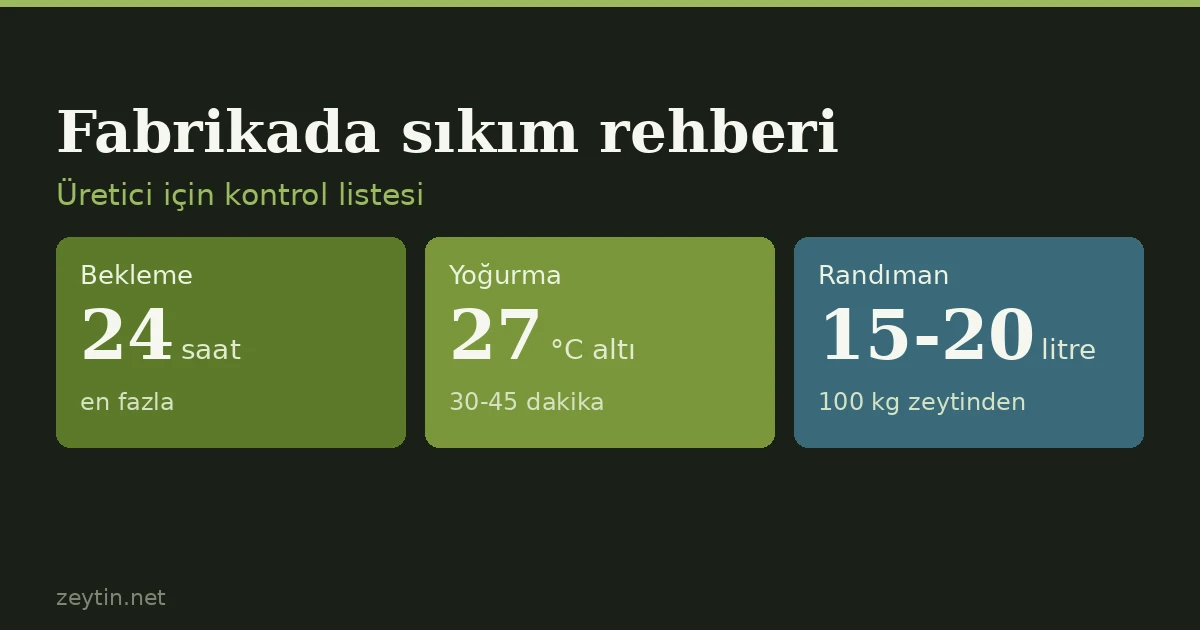
What to check when having your olives pressed at a mill: a grower's checklist
The same olives can give a very different oil when pressed at a different mill under different conditions. From what to do before bringing olives in to two-phase versus three-phase systems, kneading temperature, yield, milling fees and the questions to ask when collecting the oil, here is what a grower having olives pressed needs to know.
Article
What to check when having your olives pressed at a mill: a grower's checklist
The same olives can give a very different oil when pressed at a different mill under different conditions. From what to do before bringing olives in to two-phase versus three-phase systems, kneading temperature, yield, milling fees and the questions to ask when collecting the oil, here is what a grower having olives pressed needs to know.