Olive fruit fly warning before harvest in Aydın: check groves, spray only above the threshold
The Didim District Directorate of Agriculture and Forestry, together with the Aydın Provincial Directorate, has warned growers about the olive fruit fly ahead of the harvest. Growers were asked to check groves regularly, monitor pest density and, if needed, act only with products licensed for olives and at the right time. Fly pressure rising in autumn cuts both yield and oil quality.
With only weeks to go before the olive harvest, growers in Aydın have received an important warning. The Didim District Directorate of Agriculture and Forestry, together with the Aydın Provincial Directorate of Agriculture and Forestry, met olive growers and called on them to watch out for the olive fruit fly and to take pre-harvest measures on time. District director İlker Çolak reminded growers that the fly can cause losses in both yield and quality.
Aydın is one of the provinces with the largest number of olive trees in Türkiye, so a pest warning there concerns not only local growers but the overall quality of the season.
What were growers asked to do?
The directorate set out three basic steps:
1. Check groves regularly. Traps and fruit should be inspected at intervals.
2. Monitor pest density. The decision should rest on measured density, not on simply seeing flies.
3. If needed, act only with licensed products and at the right time. Any product used must be licensed for olives; timing of interventions close to harvest is decisive both for avoiding losses and for protecting product quality.
The last point matters most. Using unsuitable products or ignoring pre-harvest intervals close to picking creates a residue risk in olives and oil, with serious consequences for consumer health and for exports.
Why is the fly dangerous now?
The olive fruit fly (Bactrocera oleae) is described in the technical instruction of Türkiye's Ministry of Agriculture and Forestry as the main pest of olives. According to that instruction:
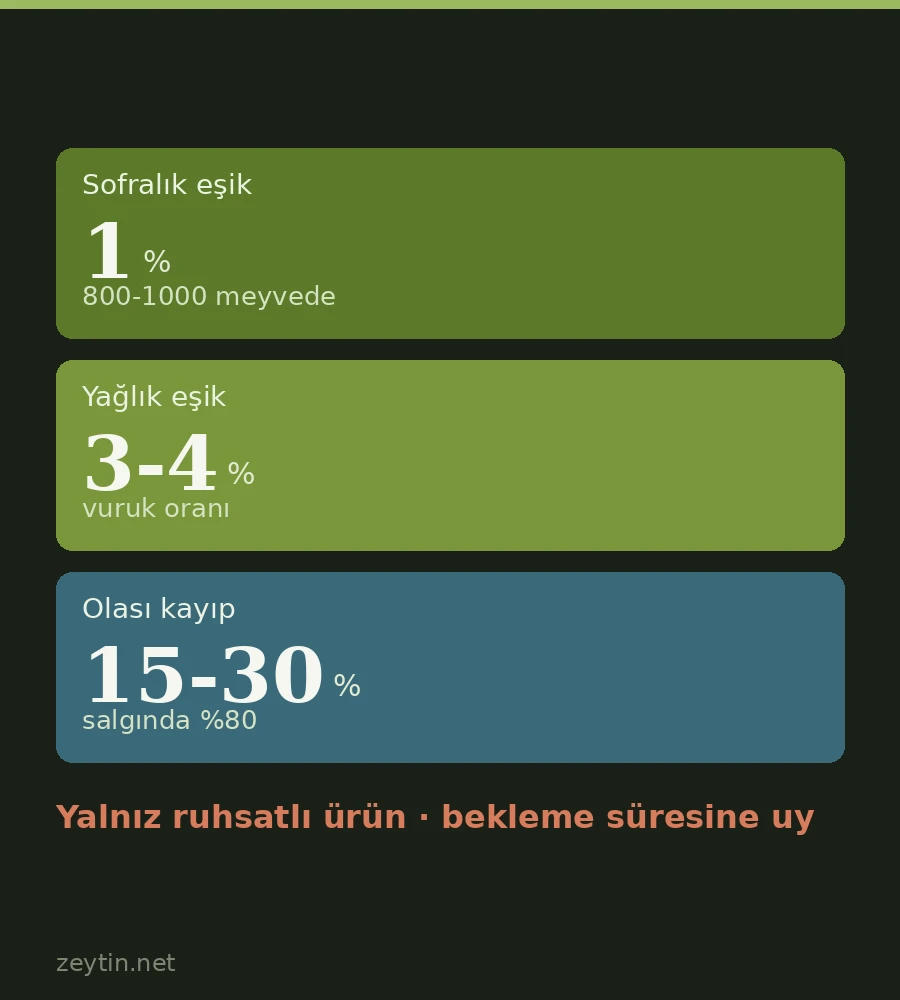
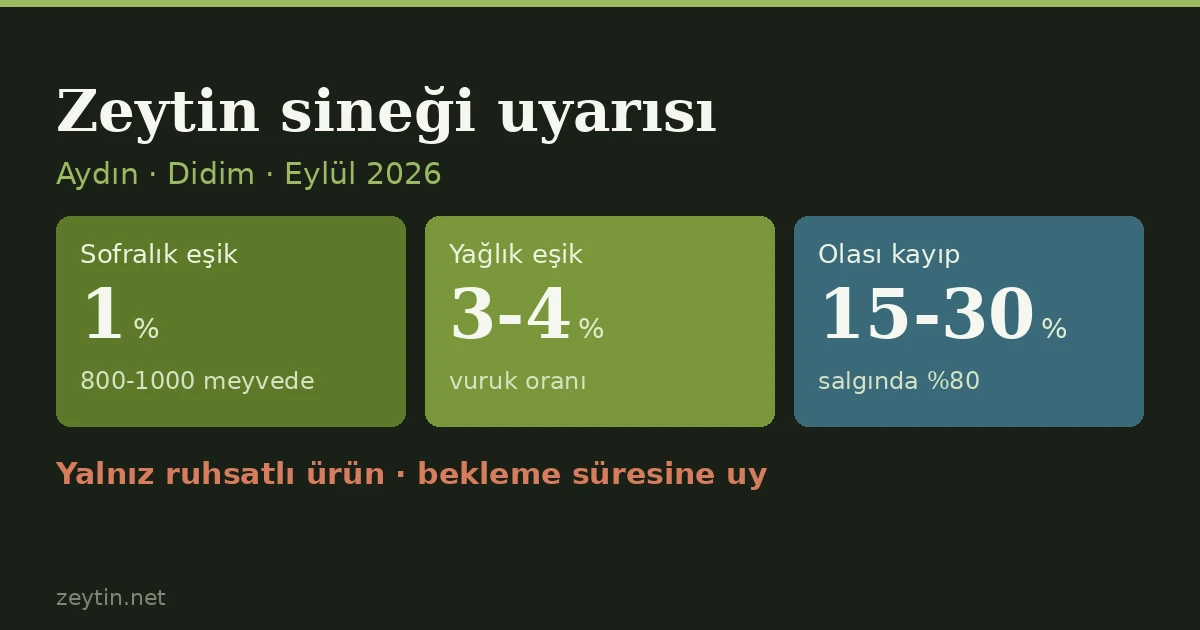
- Without control, losses reach 15-30%, and up to 80% in outbreak years.
- In the Aegean it completes 4-5 generations a year; one generation takes 30-40 days.
- Females choose large, glossy fruit that has started to accumulate oil. September is exactly that period.
- Because larvae feed by tunnelling around the stone, fruit drops, oil yield falls and acidity rises.
That last effect is a direct financial loss for oil olive growers: oil with higher acidity drops out of the extra virgin category and sells for less. For table olives there is almost no tolerance; fruit marked by the fly cannot be sold.
When to spray: the thresholds
The core rule in the ministry's instruction is this: you spray because the threshold is exceeded, not because you see flies. For a check, 800-1,000 fruits are collected from the grove and the share showing egg-laying punctures (known locally as "vuruk") is calculated.
| Olive type | Punctured fruit |
|---|---|
| Table olives | 1% |
| Oil olives | 3-4% |
Spraying below the threshold wastes money and kills the fly's natural enemies, making the problem worse in later years. When chemical control is needed, the instruction gives priority to partial branch spraying, which targets a small area on the south-east side of the tree rather than the whole canopy; it can be repeated until 20 days before harvest.
How to calculate the puncture rate: an example
Checking the threshold needs no laboratory, but correct sampling is essential:
1. Fruit is collected not from a single tree but from trees in different parts of the grove and from different sides of each tree. A sample taken from one corner is misleading.
2. A total of 800-1,000 fruits is gathered.
3. Each fruit is examined by eye or with a magnifying glass for the small dark brown mark left where an egg was laid.
4. The number of punctured fruits is divided by the total.
For example, if 35 out of 1,000 fruits from an oil olive grove show punctures, the rate is 3.5%: within the 3-4% threshold for oil olives, so a control decision needs to be discussed. Had the same result come from a table olive grove, the 1% threshold would have been passed long ago. Repeating the check at intervals until harvest makes sure a sudden rise is spotted in time.
Effective measures without chemicals
As the harvest approaches, the cheapest methods matter just as much:
- Collect infested fruit: gathering fallen and punctured fruit every 3-4 days and removing it from the grove stops the larvae inside from developing.
- Harvest early: picking varieties that have reached maturity without delay is the most direct way to avoid damage from the fly's last autumn generation.
- Monitoring traps: McPhail food traps and pheromone yellow sticky traps show when to act.
- Respect pre-harvest intervals: if a grove has been sprayed, do not harvest before the period on the product label has passed.
We explain all of these methods, including how to make a bottle trap, in our olive fruit fly control guide based on the official technical instruction. For when to look out for which pest through the year, see our olive pest calendar and intervention thresholds.
A second warning in Didim
This is the second time this year that the Didim directorate has drawn attention to olive diseases and pests. In February, as the harvest ended, it warned that the risk of olive peacock spot (ring spot) had reached its highest level and asked growers to start spraying in groves where picking was finished. We cover the symptoms and control of that disease on our olive peacock spot page.
If you want to know when and how to harvest, see our guide the olive harvest: when and how, and for the effect of early picking on the oil, our article is early harvest expensive or valuable?
⚠ No product names or doses are given in this article. For products and doses, consult your provincial or district directorate of agriculture and the current list of licensed products.
One rating per visitor; you can change yours at any time. Ratings are real reader votes — no seeded or default scores.
Related
 Article
The 2026/27 season opens: first harvests in Ayvalık, Gemlik and Bozcaada
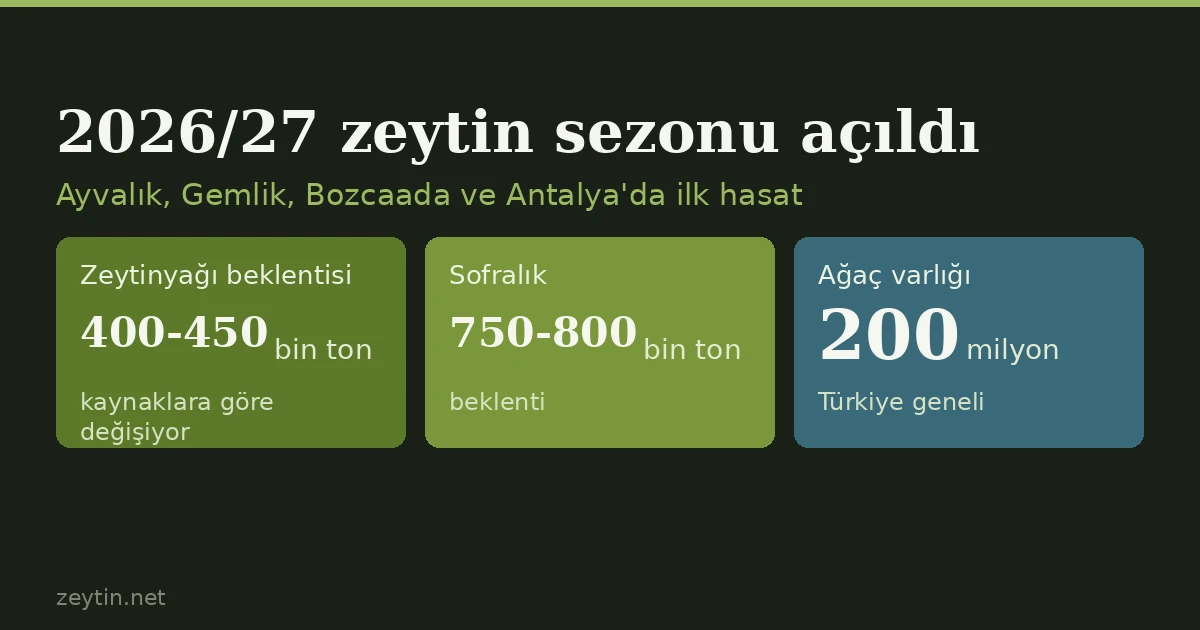
The new olive season opened with three events on 11-13 September. In Ayvalık, an on-year forecast of 400,000-450,000 tonnes of olive oil was voiced; in Gemlik the first olives were picked during the festival; and on Bozcaada the island's first olive oil was pressed with a portable system.
Article
The 2026/27 season opens: first harvests in Ayvalık, Gemlik and Bozcaada
The new olive season opened with three events on 11-13 September. In Ayvalık, an on-year forecast of 400,000-450,000 tonnes of olive oil was voiced; in Gemlik the first olives were picked during the festival; and on Bozcaada the island's first olive oil was pressed with a portable system.
 Article
Xylella has left Puglia: seven olive trees test positive in Calabria
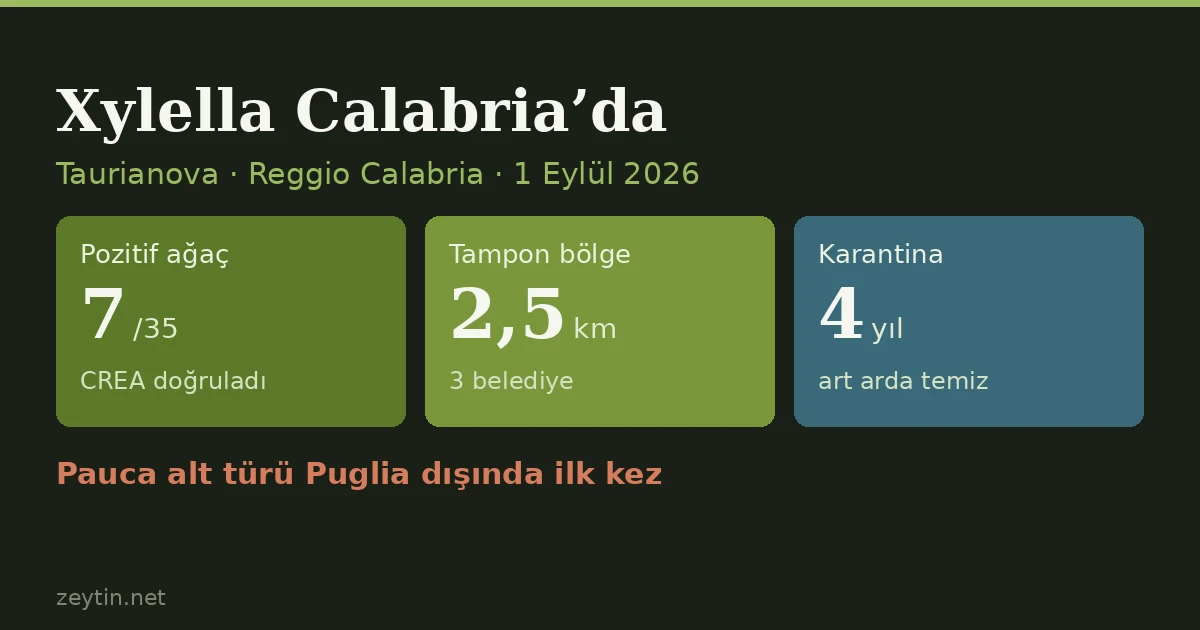
The pauca subspecies of Xylella fastidiosa, which dries out olive trees, had been confined to Puglia since 2013. In Taurianova, Calabria, 7 of 35 samples tested positive; the region issued a quarantine decree on 1 September with a 2.5 km buffer zone.
Article
Xylella has left Puglia: seven olive trees test positive in Calabria
The pauca subspecies of Xylella fastidiosa, which dries out olive trees, had been confined to Puglia since 2013. In Taurianova, Calabria, 7 of 35 samples tested positive; the region issued a quarantine decree on 1 September with a 2.5 km buffer zone.
 Article
Edremit Chamber: olive oil needs at least 50 lira per litre in support
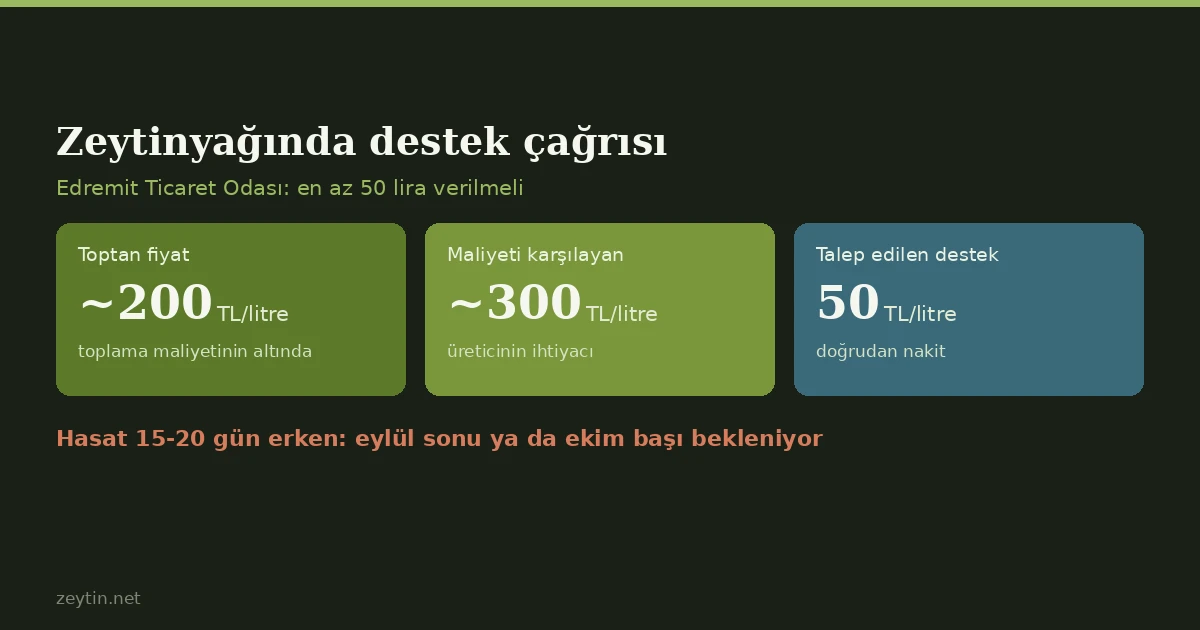
Chamber President Ahmet Çetin says the wholesale price has fallen to 200 lira, below the cost of picking. The level needed to cover costs is 300 lira. Harvest is expected 15-20 days early.
Article
Edremit Chamber: olive oil needs at least 50 lira per litre in support
Chamber President Ahmet Çetin says the wholesale price has fallen to 200 lira, below the cost of picking. The level needed to cover costs is 300 lira. Harvest is expected 15-20 days early.
 Article
Table olives with half the salt: potassium, calcium and magnesium instead of sodium
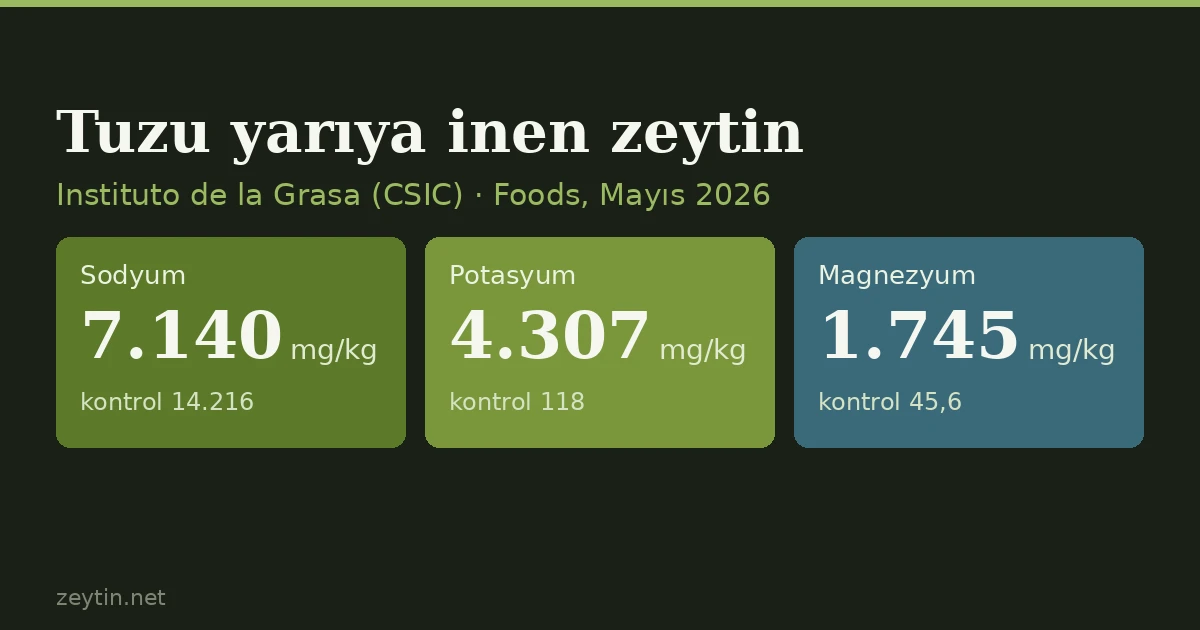
Researchers at Spain's Instituto de la Grasa (CSIC) cut sodium in pimento-stuffed green Manzanilla olives from 14,216 mg to about 7,100 mg per kilogram. Potassium, calcium and magnesium salts added to the packing brine made the olives a source of these minerals.
Article
Table olives with half the salt: potassium, calcium and magnesium instead of sodium
Researchers at Spain's Instituto de la Grasa (CSIC) cut sodium in pimento-stuffed green Manzanilla olives from 14,216 mg to about 7,100 mg per kilogram. Potassium, calcium and magnesium salts added to the packing brine made the olives a source of these minerals.