What are zeytinyağlılar? The logic of Turkish dishes cooked in olive oil
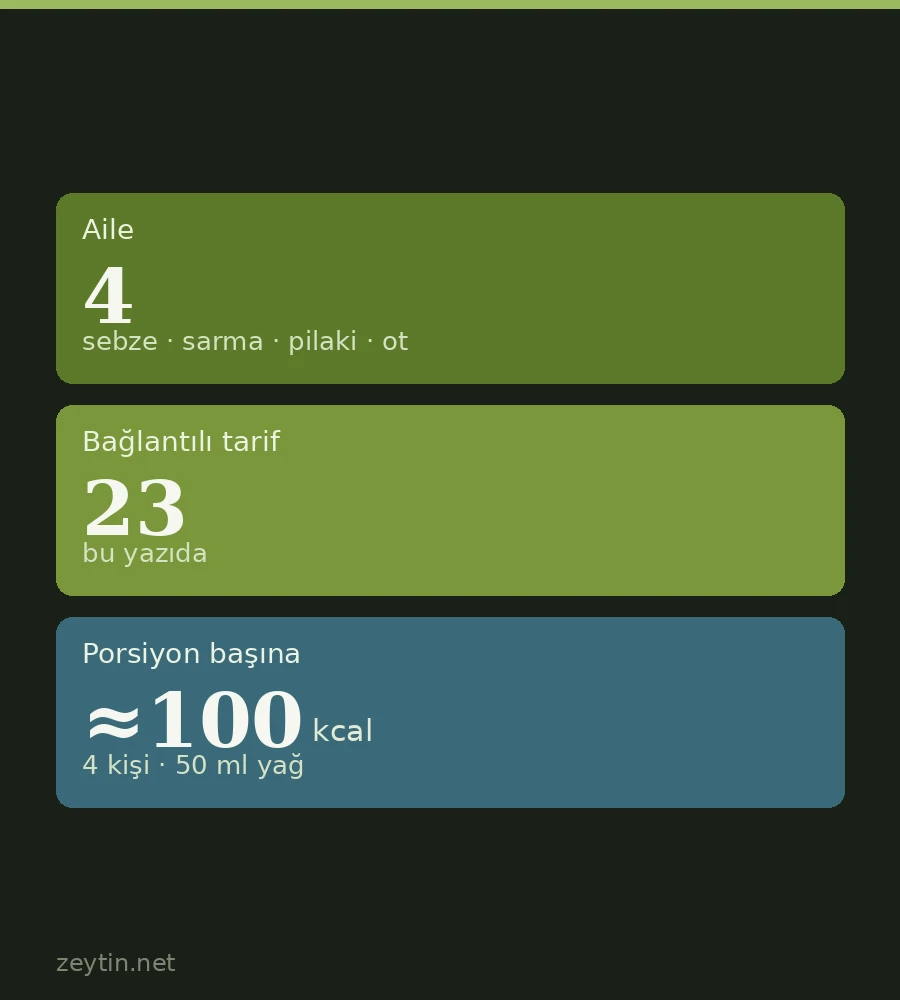
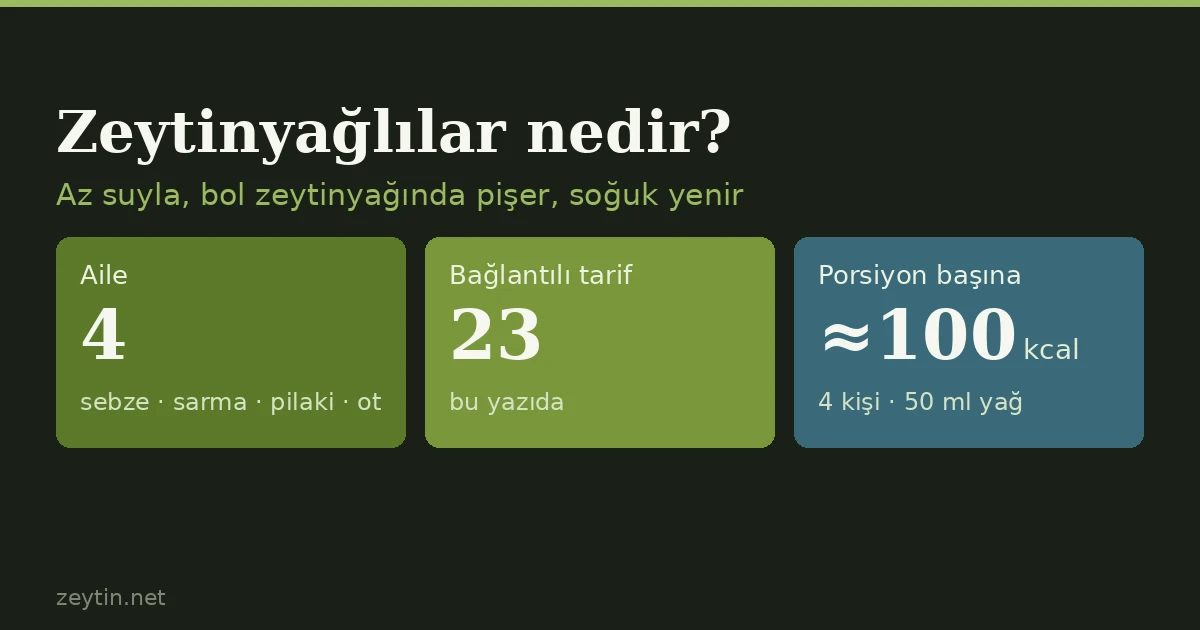
Zeytinyağlılar are Turkish dishes in which vegetables or pulses are cooked with little water in plenty of olive oil until they absorb their own juices, then eaten cold at room temperature. They contain no meat, can be made a day ahead and taste better the next day. Vegetable dishes, stuffed leaves and vegetables, pilaki beans and Aegean wild greens are the four main families.
In Turkish cooking the word "zeytinyağlı" (literally "with olive oil") describes not an ingredient but a family of dishes. The artichokes, green beans, stuffed vine leaves and leeks sitting in the cold cabinet of a Turkish restaurant are all cooked with the same logic. This article explains that logic and gives a map of the olive oil dishes among the recipes on this site.
What makes a dish a zeytinyağlı?
For a dish to count as zeytinyağlı, these four features usually come together:
1. The fat is olive oil, and there is a fair amount of it. The oil is added not just to grease the pan but to form the sauce of the dish.
2. There is no meat. Zeytinyağlılar are made with vegetables, pulses or rice. The same vegetable may also have a meat version, but that is then an "etli" (meat) dish, not a zeytinyağlı.
3. They cook slowly with little water. The vegetable releases its own juice and simmers gently until that juice is absorbed together with the oil.
4. They are eaten cold. The cooked dish is left to cool in the pot and served at room temperature.
Most recipes also include a pinch of sugar and some lemon. The sugar balances the sweetness of the vegetables, especially onion and carrot; the lemon brightens the flavour and protects the colour of vegetables that darken, such as artichokes.
Why are they eaten cold?
There are practical reasons for serving them cold. The oil only fully soaks into the vegetables as they cool, which is why zeytinyağlılar are usually thought to taste better the next day. Because they contain no meat, they are pleasant cold and can be prepared in advance and stored.
But "cold" does not mean straight from the fridge. Olive oil turns cloudy and thick at low temperatures; on an icy plate the oil looks dull and heavy. Taking a zeytinyağlı out of the fridge half an hour to an hour before serving noticeably improves both flavour and appearance.
Four big families
| Family | Examples |
|---|---|
| Vegetable dishes | Artichokes, green beans, leeks, celeriac, broad beans, okra, cauliflower, spinach, imam bayıldı |
| Stuffed leaves and vegetables | Stuffed vine leaves, cabbage rolls, stuffed peppers, stuffed courgette flowers |
| Pulses | Borlotti bean pilaki, chickpeas |
| Aegean greens | Wild chicory, wild fennel, gundelia, mallow, wild radish greens, purslane, samphire, chard |
Vegetable dishes are the largest branch of the family. They usually start with onion and carrot; the main vegetable is added, a little water goes on top and the lid is closed.
In stuffed leaves and vegetables, the filling is made with rice, onion, currants, pine nuts and spices. Because there is no meat, these are popularly called "yalancı dolma", or "fake" dolma.
Pilaki is a method in which pulses are cooked with carrot, potato, garlic and olive oil. The best known is made with borlotti beans.
Aegean greens are a simpler branch. Wild and semi-wild greens gathered on the Aegean coast in winter and spring are blanched or sautéed directly in olive oil with onion, and are often eaten with lemon.
Why the Aegean and Marmara?
Zeytinyağlılar are richest where olives grow, along the coasts. In the Aegean and Marmara regions, oil was not an expensive ingredient bought from a distant market but a staple kept in the household pantry. In a way of life where meat did not reach the table every day and garden vegetables and wild greens were plentiful, making vegetables filling with oil was a natural solution. The same logic appears on the other side of the Aegean: in Greek cooking, vegetable dishes cooked in olive oil are called "ladera", meaning the oily ones. The kitchens of olive centres such as Ayvalık and Edremit offer the widest examples of this family.
Which oil?
A zeytinyağlı carries the taste of its oil directly. Because it is served cold, both the flaws and the qualities of the oil come through on the plate. Fresh, well-stored extra virgin oil gives the best result. Some cooks prefer a milder oil for cooking and drizzle extra virgin oil over the top when serving. The difference between extra virgin, virgin and refined grades helps in making that choice.
Smoke point concerns hardly apply here: zeytinyağlılar cook over low heat with water, and the oil never reaches frying temperature.
How much oil, how many calories?
Traditional recipes use oil generously, and much of the flavour comes from it. When half a tea glass (about 50 ml) of olive oil goes into a pot for four, roughly 100 calories per portion come from the oil. The details are in how many calories are in olive oil. Mopping up the oil left on the plate with bread is the most pleasant habit that pushes that number up.
Storage
Zeytinyağlılar usually keep their flavour for two or three days in a closed container in the fridge. Rice-filled stuffed leaves and vegetables can spoil faster than vegetable dishes, so it is better to eat them without delay. Do not leave them at room temperature for long; take out only as much as you will serve.
Reading notes
The boundaries of zeytinyağlılar vary by region; a dish considered zeytinyağlı in one area may be made with butter or meat in another. The grouping here follows the recipes on this site.
One rating per visitor; you can change yours at any time. Ratings are real reader votes — no seeded or default scores.
Related
 Article
Burhaniye Olive Oil: two thousand years attested by the Adramytteion excavations
Registered in 2021. The certificate grounds two thousand years of olive growing in the excavation of an ancient city, and sets separate sensory thresholds for early and ripe harvest.
Article
Burhaniye Olive Oil: two thousand years attested by the Adramytteion excavations
Registered in 2021. The certificate grounds two thousand years of olive growing in the excavation of an ancient city, and sets separate sensory thresholds for early and ripe harvest.
 Article
How is olive oil acidity measured? Titration, the formula and taking a sample
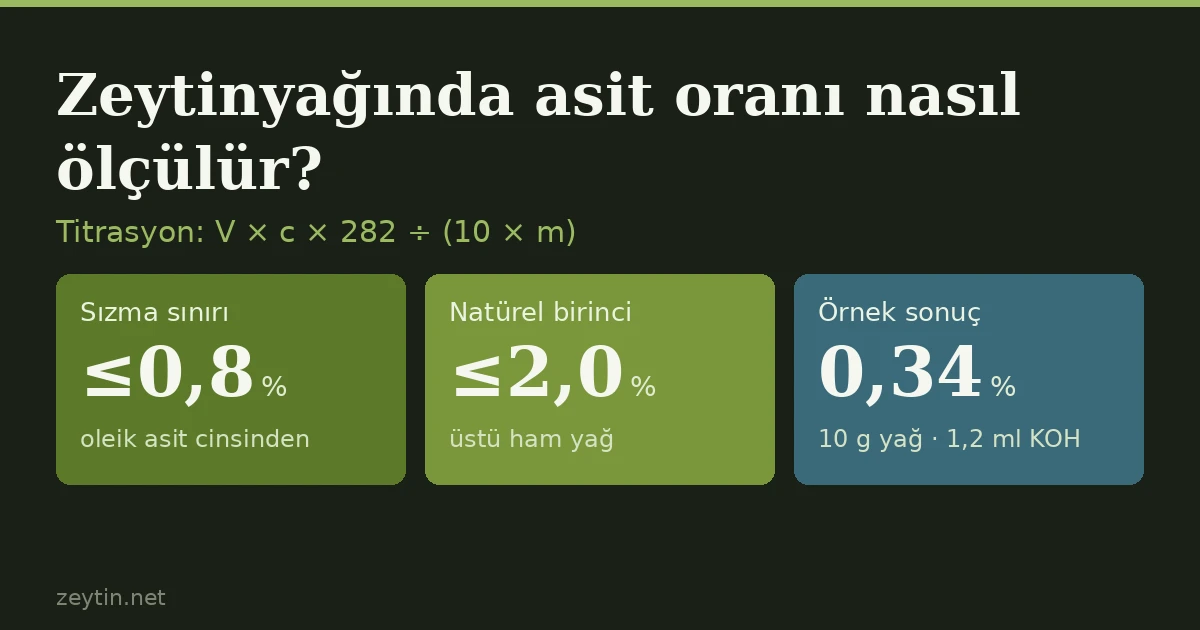
Olive oil acidity is measured in a laboratory by titration: the oil is dissolved in a solvent, free fatty acids are neutralised with potassium hydroxide, and the percentage is calculated as oleic acid from the amount used. The formula, a worked example, sampling and the limits of home test kits.
Article
How is olive oil acidity measured? Titration, the formula and taking a sample
Olive oil acidity is measured in a laboratory by titration: the oil is dissolved in a solvent, free fatty acids are neutralised with potassium hydroxide, and the percentage is calculated as oleic acid from the amount used. The formula, a worked example, sampling and the limits of home test kits.
 Article
North Aegean Olive Oils: a registration stricter than the food codex
The mark of ten localities rather than one district — and unusually, it sets tighter limits than the national standard on peroxide, FAEE, waxes and K270.
Article
North Aegean Olive Oils: a registration stricter than the food codex
The mark of ten localities rather than one district — and unusually, it sets tighter limits than the national standard on peroxide, FAEE, waxes and K270.
 Article
Edincik Su Olive Oil: ripening slowed by the sea
Registered in 2024. The certificate attributes aroma intensity to one cause: near the Erdek gulf the olives develop slowly and ripen late.
Article
Edincik Su Olive Oil: ripening slowed by the sea
Registered in 2024. The certificate attributes aroma intensity to one cause: near the Erdek gulf the olives develop slowly and ripen late.