What are waxes (wax esters) in olive oil, and what do they catch?
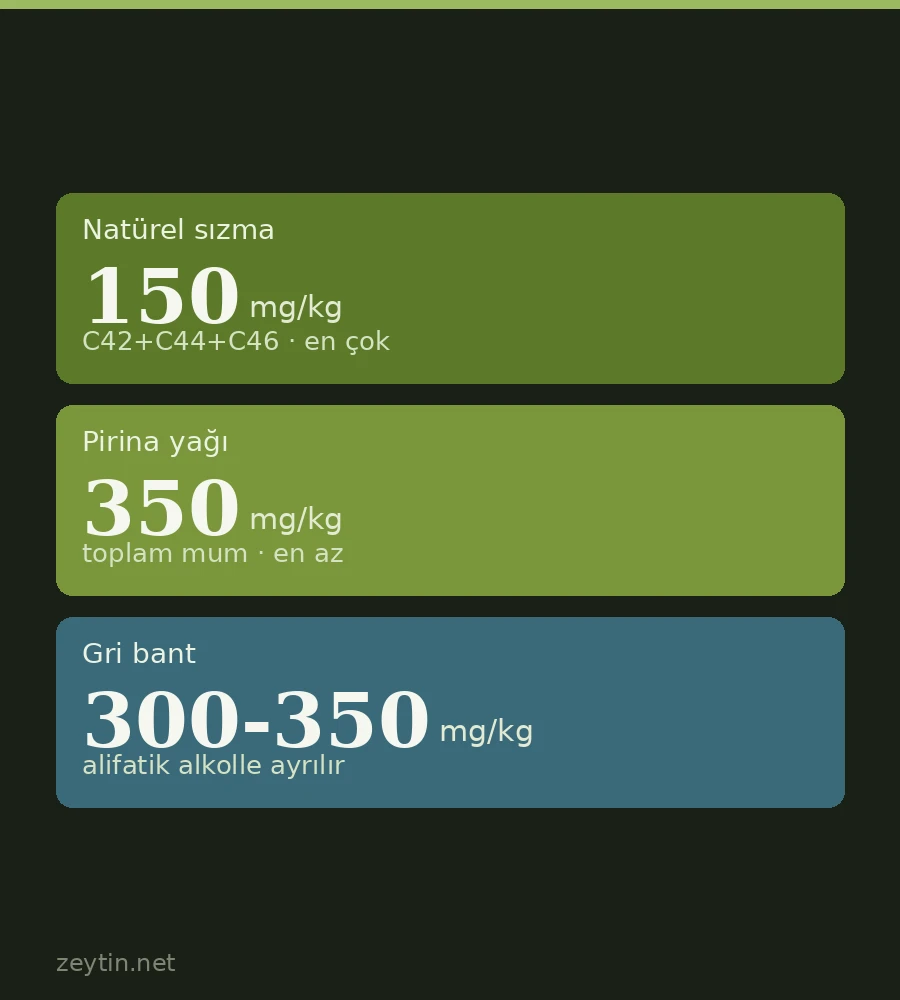
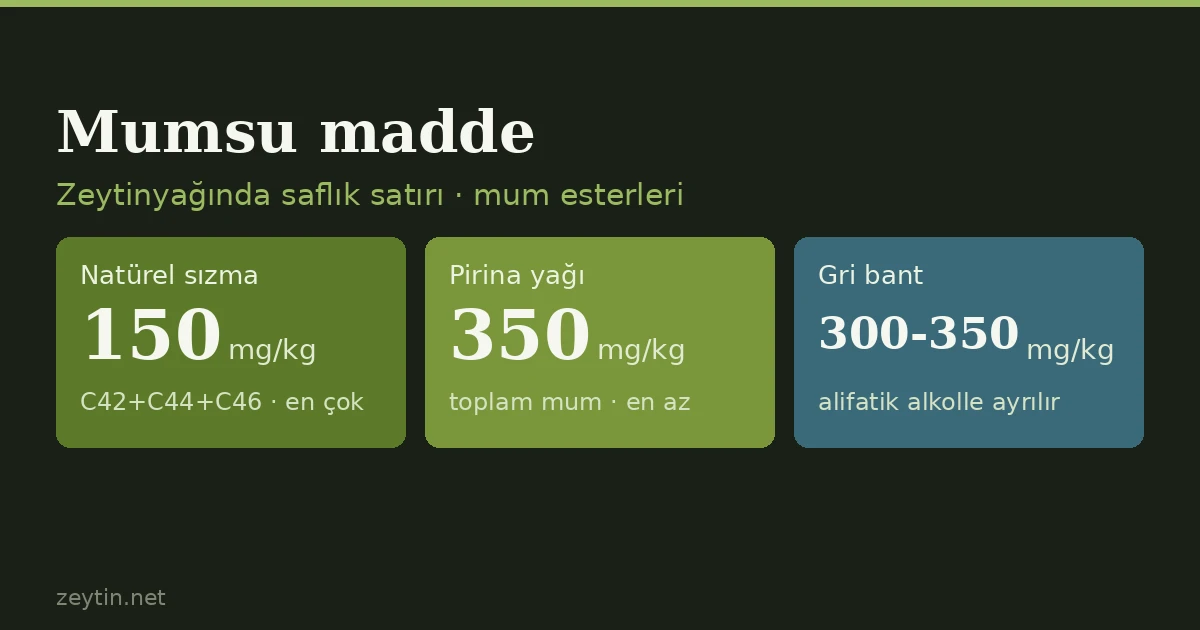
If a label states the acidity, the wax content has to be printed too. Wax comes from the protective layer on the olive skin; little of it passes into mechanically pressed oil, while solvent extraction from pomace pulls out many times as much. That makes it a purity indicator rather than a quality one: it tells you by what route the oil was obtained. In the International Olive Council standard, extra virgin oil must stay below 150 mg/kg for C42+C44+C46, while the pomace grades must exceed 350 mg/kg in total. In the grey band between 300 and 350 the decision is taken with aliphatic alcohols and erythrodiol plus uvaol.
If the label on a bottle of olive oil states an "acidity" or "maximum acidity" figure, Turkish food law requires three more numbers to appear next to it: the peroxide value, the wax content and the specific extinction under ultraviolet light. The Turkish Food Codex communiqué on olive oil and olive pomace oil says so explicitly — all three must be printed in the same percentage and the same size as the acidity figure.
Most growers know what acidity and peroxide mean. The line in the middle, wax content, is almost never asked about. Yet it is the one line in a laboratory report that answers a single, blunt question: was this oil really pressed from olives, or has oil extracted from pomace with a solvent been blended into it?
Where the wax comes from
The skin of an olive is not bare. It carries a thin layer of wax, a protective coating the plant produces itself to limit water loss and external damage. Chemically that layer consists of esters formed from a long-chain fatty acid joined to a long-chain fatty alcohol. In analysis these esters are named by their carbon number: C40, C42, C44, C46.
When olives are pressed mechanically — crushing, malaxation, centrifugation — only a small part of the skin wax passes into the oil. Wax dissolves poorly in oil, and in a cold process most of it stays behind with the pomace and the mill wastewater.
That remaining part is where the issue arises. When pomace is put through solvent extraction — usually with hexane — the solvent takes the oil and pulls the wax out along with it. The result is that pomace oil, although it comes from the same fruit, carries many times the wax content of mechanically pressed oil. Wax content is therefore not a quality indicator but a purity indicator: it tells you by what route the oil was obtained.
The limits in one table
The International Olive Council's trade standard in force (COI/T.15/NC No. 3/Rev. 22, June 2026) sets the limits as follows.
| Grade | Total measured | Limit |
|---|---|---|
| Extra virgin and virgin olive oil | C42+C44+C46 | ≤ 150 |
| Ordinary virgin olive oil | C40+C42+C44+C46 | ≤ 250 |
| Lampante virgin olive oil | C40+C42+C44+C46 | ≤ 300 |
| Refined olive oil | C40+C42+C44+C46 | ≤ 350 |
| Olive oil (refined plus virgin blend) | C40+C42+C44+C46 | ≤ 350 |
| Crude olive pomace oil | C40+C42+C44+C46 | > 350 |
| Refined olive pomace oil | C40+C42+C44+C46 | > 350 |
| Olive pomace oil | C40+C42+C44+C46 | > 350 |
The logic of the table reverses halfway down: for the pomace grades the figure is a lower limit. An oil sold as "olive pomace oil" whose wax content falls below 350 mg/kg does not match its own definition.
The Turkish Food Codex regulates the same parameter under the name "waxy substances (C40+C42+C44+C46)", grade by grade: no more than 300 mg/kg in lampante olive oil, 250 in extra virgin and virgin, 350 in refined and in the refined-virgin blend, and above 350 in the pomace grades. The grade definitions in the Codex correspond one to one with those in the Council standard.
Why there are two different sums
The detail worth noticing is that the top two grades count only C42+C44+C46, while the others add C40 to the total. This is not arbitrary; there are two practical reasons.
The first is a measurement problem. On the chromatogram the C40 peak splits into two, and those two peaks do not resolve cleanly in every laboratory. Where they do not, the share of another compound contaminates the result.
The second is storage. Wax esters can increase inside the oil over time, and the increase is more pronounced in oils with a high content of free fatty acids and free fatty alcohols. In other words, a virgin oil that has been held for a long time and whose acidity has risen can push its total wax figure upward without ever having seen a drop of pomace oil. Removing C40 from the total in the top grades reduces both sources of noise at once.
The grey band between 300 and 350
When the wax figure lands in the 300-350 mg/kg range it is no longer enough on its own, and two further parameters come into play. The Council standard and the Turkish Codex write the same rule:
- If the total aliphatic alcohol content is below 350 mg/kg, or the erythrodiol plus uvaol share is below 3.5%, the oil counts as lampante virgin olive oil.
- If the total aliphatic alcohol content is above 350 mg/kg and the erythrodiol plus uvaol share is above 3.5%, the oil counts as crude olive pomace oil.
Erythrodiol and uvaol also come from the olive skin, so the logic is the same as for wax. The three parameters corroborate one another.
How it is measured
Wax is not measured on its own. In the International Olive Council's method document (COI/T.20/Doc. No 28), waxes, fatty acid methyl esters and fatty acid ethyl esters are determined together in one analysis: the sample is first separated on a silica column and the resulting fraction is read by capillary gas chromatography with a flame ionisation detector. The Turkish Codex references the same method through its own analytical methods communiqué.
The practical consequence is that one analysis yields both the wax figure and the ethyl ester figure. When you ask a laboratory for wax content, the report will usually show the two side by side.
"Olive pomace oil may under no circumstances be called olive oil"
That sentence from the Turkish communiqué is enough to show how much weight the wax line carries in law. Pomace oil is not a banned product; it may be sold under its own name and its own label. What is banned is selling it as olive oil. The refined-virgin blend sold as olive oil contains no pomace oil, while pomace oil is a blend of refined pomace oil with virgin oils and must carry the word "pomace" on the label.
Both products come from the same fruit; what separates them is the processing route. The trio of wax, aliphatic alcohols and erythrodiol plus uvaol measures precisely that route. Those three lines are the instrument that checks whether the name on the label is the right one.
What wax content catches, and what it misses
This distinction matters, because a laboratory report is read as a whole:
- It catches the blending in of oil extracted from pomace with a solvent.
- It misses the blending in of seed oils such as sunflower, soya or rapeseed. Sterol composition and the ECN 42 triglyceride difference catch those.
- It misses the blending of refined olive oil into virgin oil. Stigmastadienes and ultraviolet absorbance catch that.
The reasons given in the Turkish Ministry of Agriculture and Forestry's adulteration announcements are spread across these same three headings. In the announcement dated 12 October 2026, four of the five olive oil entries concerned seed oil blending and one concerned the blending in of lower-grade olive oil — so no entry in that list was one the wax line would have caught. Each parameter sees a different kind of fraud.
What it means in practice
If you are sending a sample to a laboratory in order to sell your oil, note that wax content belongs to the purity group of analyses and is not automatically included in the quality package of acidity, peroxide value, ultraviolet absorbance and sensory assessment. It has to be requested specifically.
On the labelling side the rule is unambiguous: if you print the acidity, you are obliged to print the wax content as well. A label that says "acidity 0.3%" and carries no other figure beside it is not complying with that article of the Codex.
Reading this carefully
A high wax figure does not by itself mean fraud. In an oil that has been stored a long time and whose acidity has risen, the value can climb on its own. The decision is taken together with the aliphatic alcohol and erythrodiol plus uvaol figures.
The numbers above are taken from the International Olive Council trade standard in force, dated June 2026. Because the Turkish Codex publishes its grade table as a scanned annex, it is worth confirming the limits against the current annex of the communiqué when assessing an actual report.
Finally, a wax ester is not the same thing as an alkyl ester (a fatty acid ethyl ester). The two are measured together by the same gas chromatography method but point to different things: alkyl esters are the trace of poor or fermented fruit, wax esters the trace of solvent-extracted oil.
One rating per visitor; you can change yours at any time. Ratings are real reader votes — no seeded or default scores.
Related
 Article
Ceyhan Olive Oil: harvest defined as “no green fruit left on the tree”
Registered in 2022. The certificate defines harvest not by calendar but by the state of the tree: when no green fruit remains and oil content peaks.
 Article
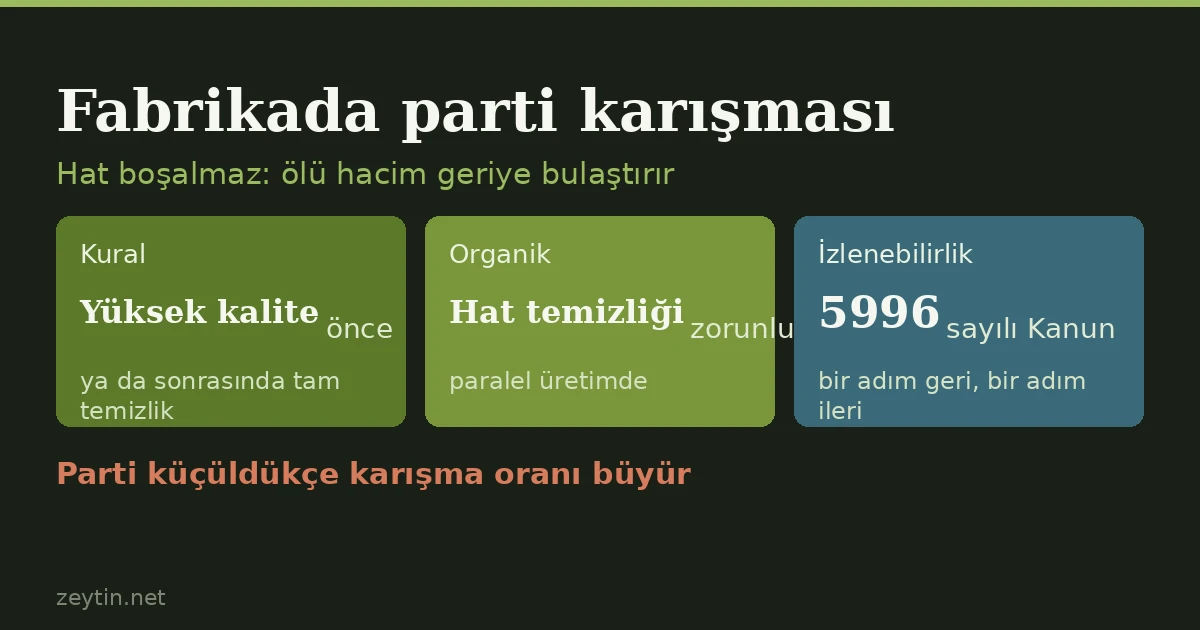
Do batches get mixed at the olive mill? Dead volume in the line and milling order
A mill line does not empty completely between batches: oil remains in the crusher, malaxer, decanter, separator and pipework. Part of the first oil out therefore comes from the previous batch. Why milling order is a rule, why organic certification requires line cleaning, and what a grower should ask at the mill.
 Article
Olive Oil Prices: Week 37 of 2026
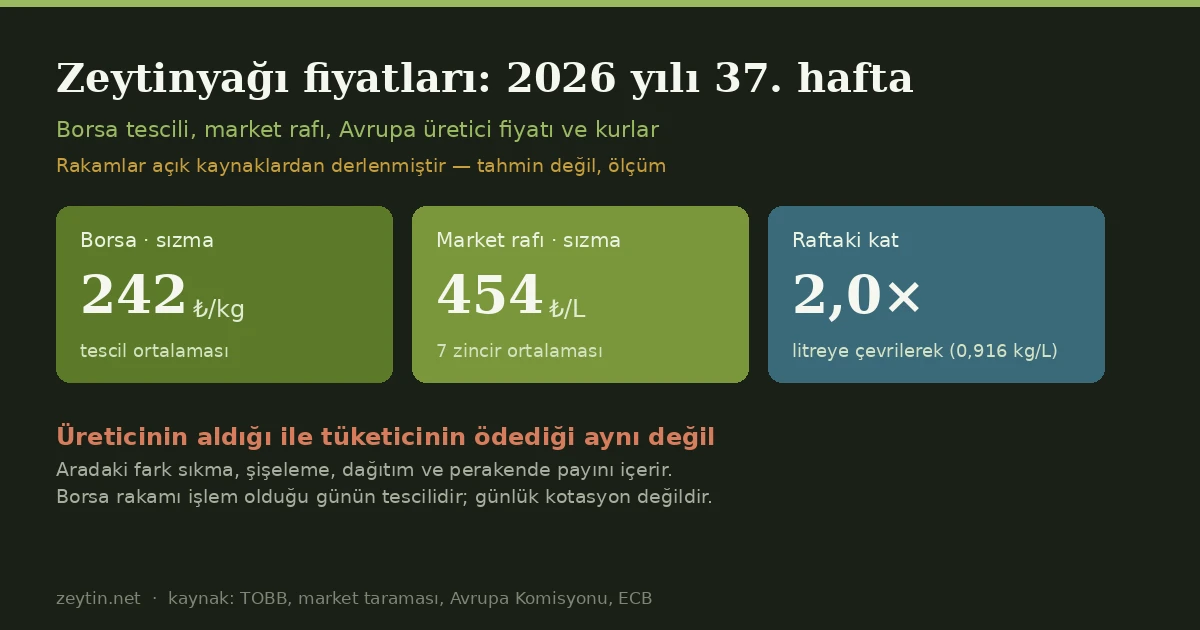
Week 37 of 2026: Turkish exchange prices, European producer prices and exchange rates side by side.
 Article
Tasting olive oil: defects and positive attributes
Laboratory tests alone do not make an oil extra virgin — it must pass a tasting panel. The three positive attributes, the six defects in the standard, and what each one says about how the oil was made.