Picual olive: Spain's oil variety
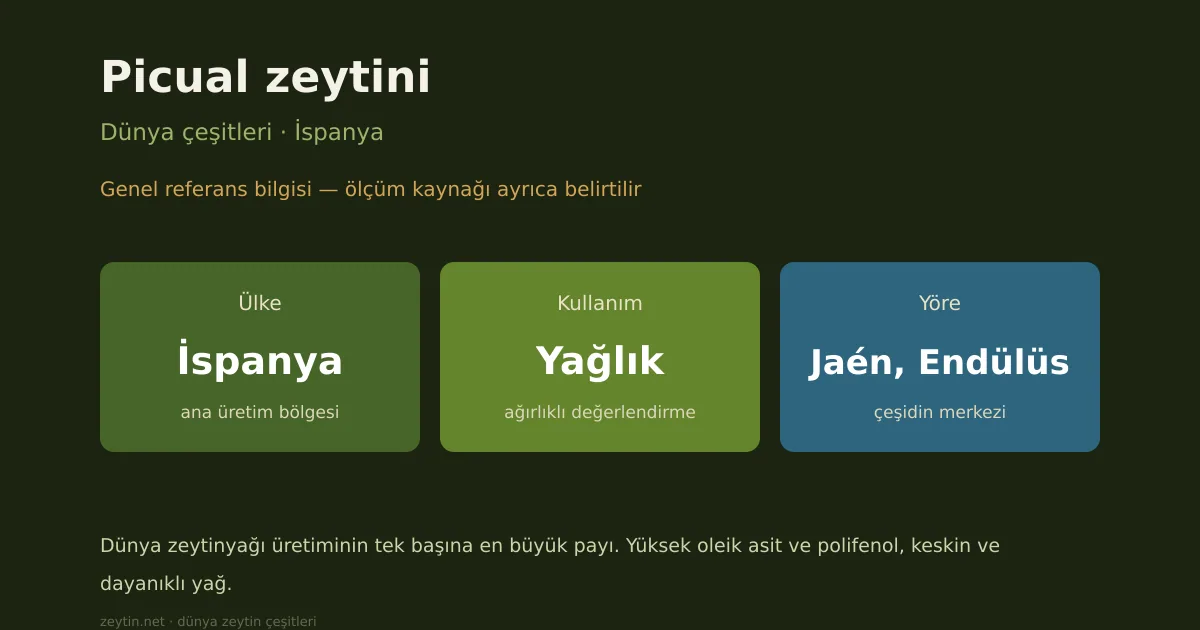
The single largest share of world olive oil production. High oleic acid and polyphenols, a pungent and stable oil.
Roughly one in every five bottles of olive oil pressed worldwide comes from a single variety: Picual. In the Spanish province of Jaén, groves stretching to the horizon are almost entirely this one cultivar.
Why is it so widespread?
What made Picual the world leader is not its flavour but its productivity and durability:
- Oil content is high and yields are consistent.
- The oil is very high in oleic acid and low in linoleic acid — a composition that resists oxidation.
- Polyphenol levels are high, extending shelf life and producing the characteristic bitter, pungent taste.
The result is an oil that keeps well and travels well. At industrial scale, exactly what is wanted.
Flavour profile
Picual oil differs from the mild profile most people recognise as "olive oil": it carries clear bitterness and a peppery catch in the throat. Green tomato, fig leaf and woody notes are commonly described.
That sharpness is not a fault — it is the polyphenol. In olive oil, bitterness and pungency are direct indicators of antioxidant content: what bothers the palate is what the body wants.
Compared with Türkiye
Picual's closest Turkish counterparts are the high-oil varieties of the southeast: Kilis Yağlık and Kalem Bezi, both at 31% oil. The difference is scale: Kilis Yağlık is a regional variety, Picual a world standard.
Its weakness
Picual is susceptible to Verticillium wilt, a serious risk in monoculture groves — millions of trees of one cultivar are all exposed to one pathogen at once. On the disease: Verticillium wilt in olive.
Picual in numbers
| Use | Oil |
| Fat yield | High |
| Oleic acid | Very high |
| Oil stability | High — resistant to rancidity |
| Entry into production | Early |
| Productivity | High and constant — little alternate bearing |
| Self-fertility | Yes |
| Ripening | Early |
| Mechanical harvest | Suitable — low detachment resistance |
| Tolerant to | Cold, salinity |
| Susceptible to | Drought, chalky soil, leaf spot, Verticillium, olive fly |
Source: International Olive Council (IOC), World Catalogue of Olive Varieties. Distribution from the same source: over 850,000 hectares in Andalusia; Picual accounts for 97% of the olive groves in Jaén province, 40% in Granada and 38% in Córdoba.
The most important line here is not the oil yield but the constancy of the crop. Olives naturally alternate — a heavy year followed by a light one. Picual largely does not, which is why planning at industrial scale became possible.
The second decisive trait is self-fertility: it sets fruit without a pollinator variety. That is what allowed vast single-variety groves to be planted — and what created the vulnerability described below.
Related pages
Where it stands among measured varieties
et/çekirdek oranı 8,34'ten türetildi — kaynak: IOC Dünya Zeytin Çeşitleri Kataloğu — Avustralya denemesi 19
Vossen, UC Cooperative Extension — IOC World Catalogue (Barranco vd.)
IOC Dünya Zeytin Çeşitleri Kataloğu — Avustralya denemesi 1998-2004 (Tablo 4)
IOC Dünya Zeytin Çeşitleri Kataloğu — Avustralya denemesi 1998-2004 (Tablo 4)
Values are those published on each variety's own page; the comparison covers only varieties with a measured figure, so it is a comparison of what is known — not of every Turkish variety. See the full ranking and how it is built →
One rating per visitor; you can change yours at any time. Ratings are real reader votes — no seeded or default scores.
Related
 Article
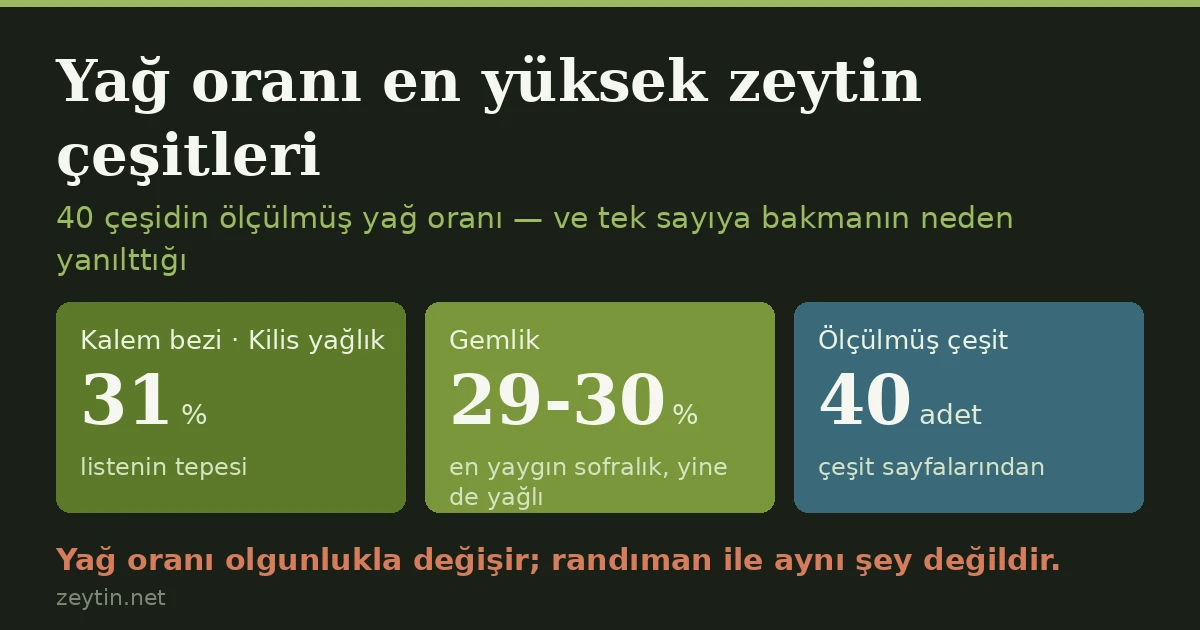
Which olive varieties have the highest oil content?
Kalem bezi and Kilis yağlık lead at 31 percent, with Gemlik just behind at 29-30. Measured oil content for 40 varieties — and what the figure does and does not tell you.
Article
Which olive varieties have the highest oil content?
Kalem bezi and Kilis yağlık lead at 31 percent, with Gemlik just behind at 29-30. Measured oil content for 40 varieties — and what the figure does and does not tell you.
 Article
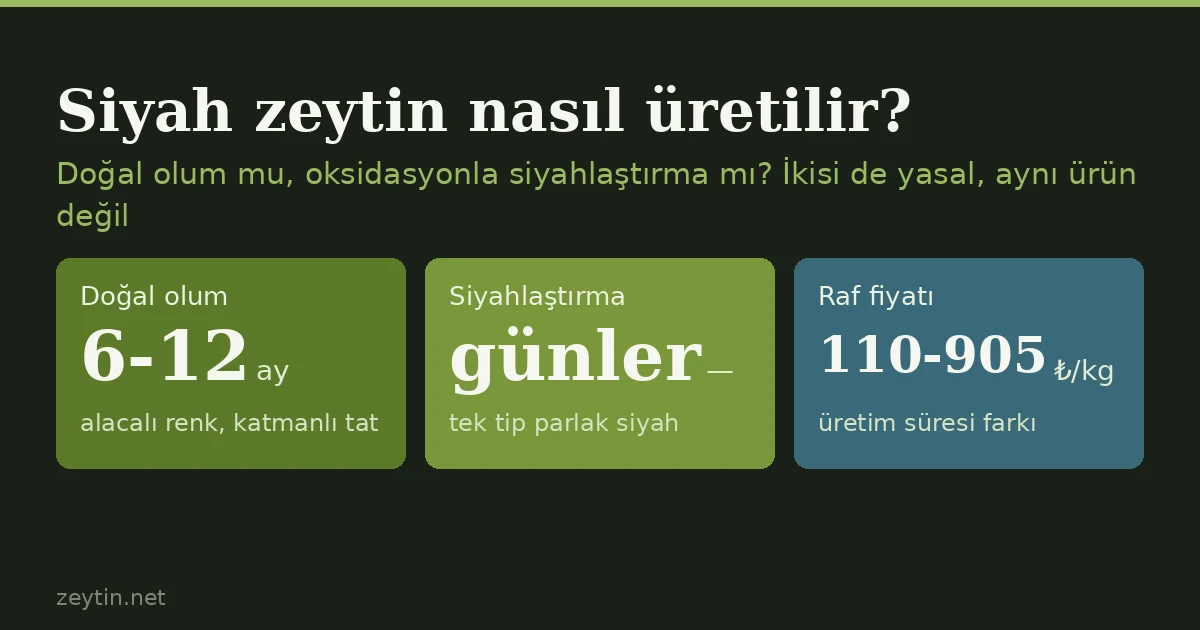
How are black table olives made? Natural ripening versus blackening
Two different black olives sit on the shelf: ripened on the tree and brined, or picked green and blackened by oxidation. Both lawful, but not the same product.
Article
How are black table olives made? Natural ripening versus blackening
Two different black olives sit on the shelf: ripened on the tree and brined, or picked green and blackened by oxidation. Both lawful, but not the same product.
 Article
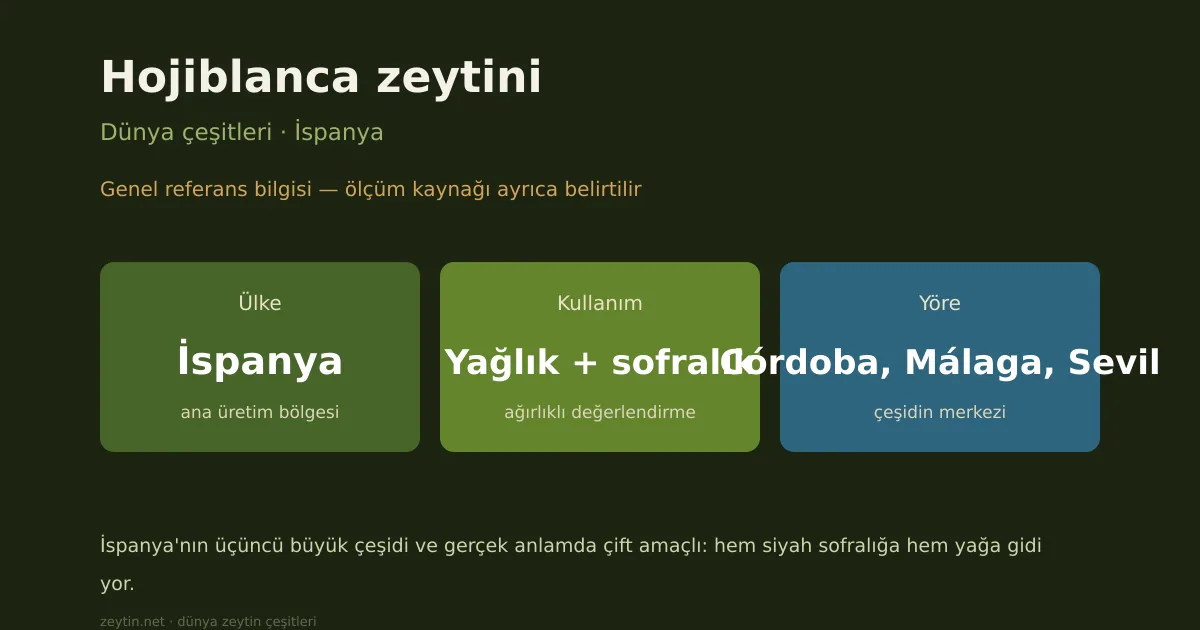
Hojiblanca olive: Spain's oil and table variety
Spain's third-largest variety and genuinely dual-purpose: it goes to black table olives and to oil alike.
Article
Hojiblanca olive: Spain's oil and table variety
Spain's third-largest variety and genuinely dual-purpose: it goes to black table olives and to oil alike.
 Article
Otur olive
Otur is a recorded variety of the Black Sea. Described in the source.
Article
Otur olive
Otur is a recorded variety of the Black Sea. Described in the source.