Nizip Yağlık olive: characteristics, oil content and growing areas
The southeast's main oil variety and one of the rare self-fertile cultivars on the list — it crops even without a pollinator.
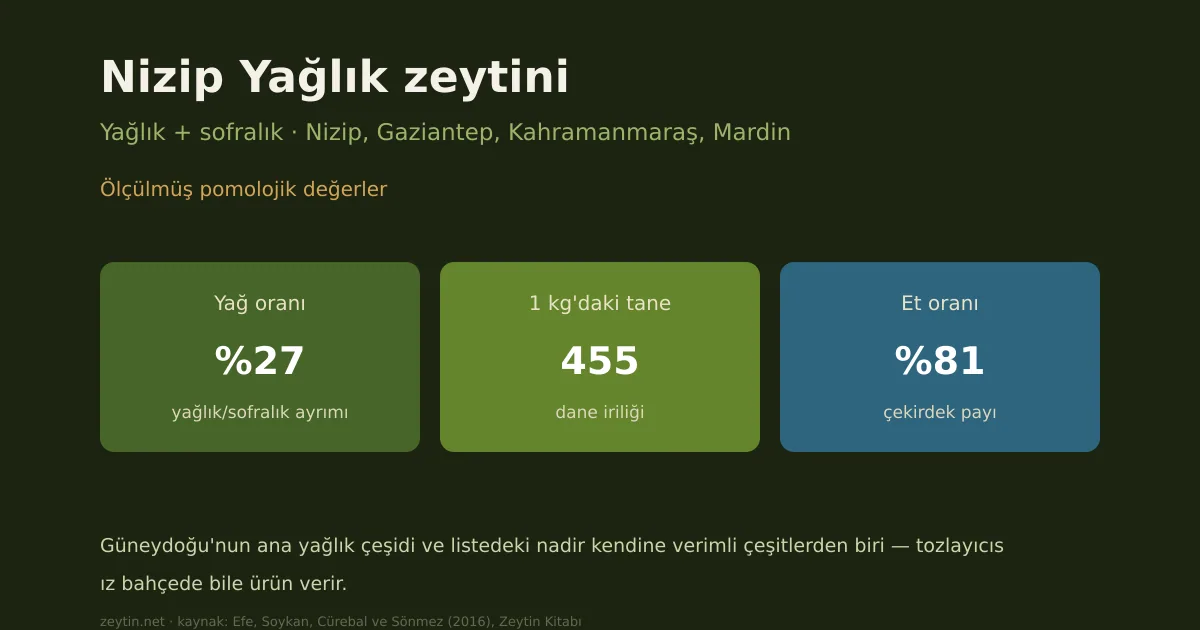
Nizip Yağlık is southeastern Anatolia's main oil variety, and it has one distinction on this list: it is self-fertile. It sets a crop without a pollinator variety — rare among olives.
Nizip Yağlık in numbers
| Oil content | 27% |
| Fruits per kilo | 455 |
| Flesh ratio | 83% |
| Use | Oil and table |
| Main areas | Nizip, Gaziantep, Kahramanmaraş, Mardin |
Source: Efe, Soykan, Cürebal and Sönmez (2016), Zeytin Kitabı. Fields the source leaves blank are shown as "—"; nothing has been estimated.
Why self-fertility matters
Most olive varieties are self-sterile or partially self-fertile, needing pollen from another variety for a full crop. An isolation trial on five varieties in a grove at Koruklu, Şanlıurfa, produced this picture:
| Variety | Status |
|---|---|
| Nizip Yağlık | Self-fertile |
| Delice (wild olive) | Self-fertile |
| Domat | Partially self-fertile |
| Gemlik | Partially self-fertile |
| Yuvarlak Halhalı | Self-sterile |
Nizip Yağlık's self-fertility means a single-variety block is viable in the southeast. Not having to set aside pollinator rows also simplifies planting on tight ground.
An oil variety that also goes to the table
At 27% oil it is clearly an oil variety, yet Nizip Yağlık is also used locally for the table. Its flesh ratio of 81% is among the lowest on the list — the stone is relatively large; the table use rests on local taste, not on size.
Genetic work has shown Nizip Yağlık shares over 60% similarity with Domat, Gemlik, Kilis Yağlık and Manzanilla — most of Türkiye's main varieties come from a closely related pool.
In short
At 27% oil, Nizip Yağlık is the southeast's main oil variety, and it stands out for being self-fertile. Being able to plant a single-variety block without pollinator rows is a real advantage on tight ground.
Where it stands among measured varieties
çeşit sayfası
çeşit sayfası
Values are those published on each variety's own page; the comparison covers only varieties with a measured figure, so it is a comparison of what is known — not of every Turkish variety. See the full ranking and how it is built →
One rating per visitor; you can change yours at any time. Ratings are real reader votes — no seeded or default scores.
Related
 Article
Büyük Topak Ulak olive
Büyük Topak Ulak is a recorded variety of the Mediterranean. Described in the source.
Article
Büyük Topak Ulak olive
Büyük Topak Ulak is a recorded variety of the Mediterranean. Described in the source.
 Article
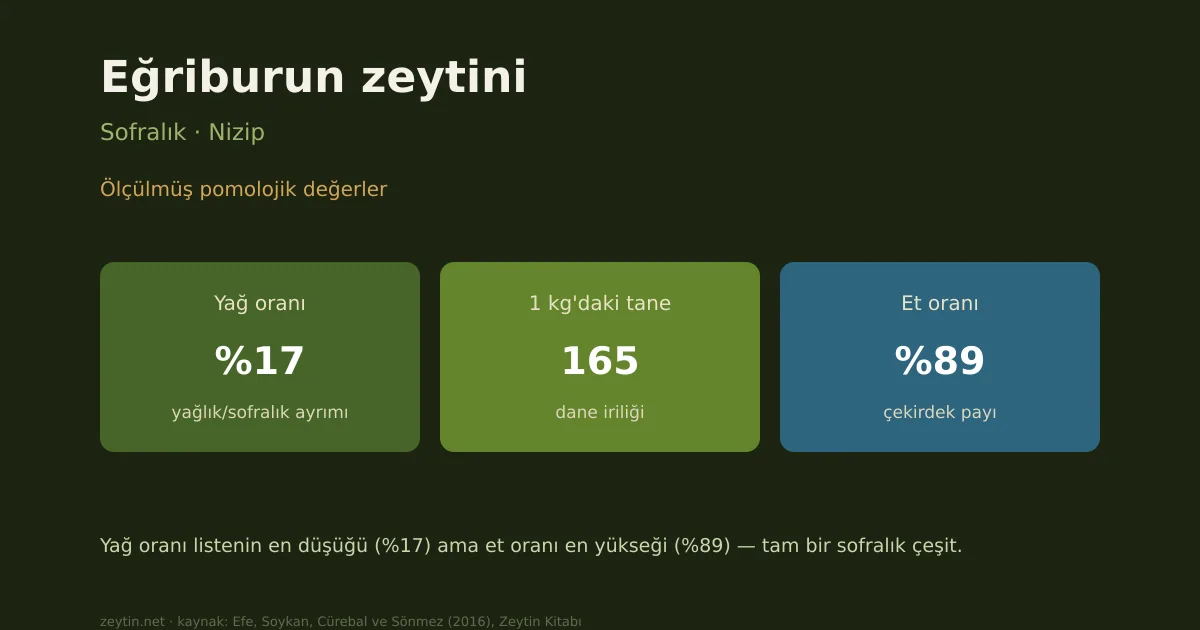
Eğriburun olive: characteristics, oil content and growing areas
The lowest oil content on the list (17%) but the highest flesh ratio (89%) — a pure table variety.
Article
Eğriburun olive: characteristics, oil content and growing areas
The lowest oil content on the list (17%) but the highest flesh ratio (89%) — a pure table variety.
 Article
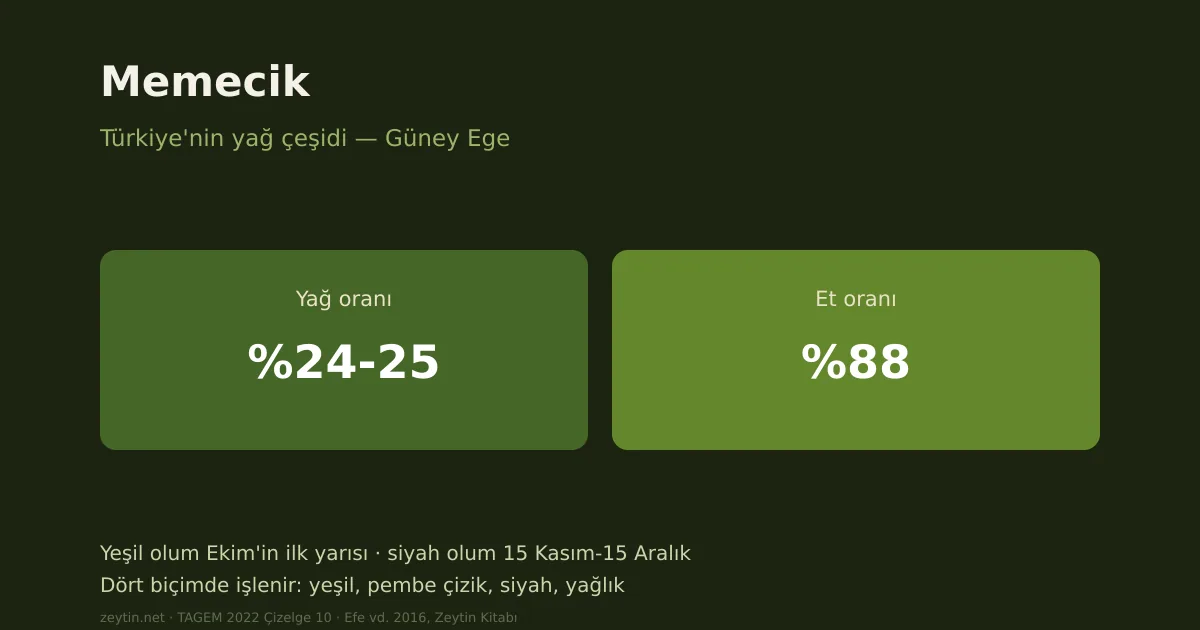
The Memecik olive: Türkiye's oil variety
Between 19% and 45% of the tree stock. 24-25% oil, 88% flesh. Green maturity in early October, two months after Gemlik.
Article
The Memecik olive: Türkiye's oil variety
Between 19% and 45% of the tree stock. 24-25% oil, 88% flesh. Green maturity in early October, two months after Gemlik.
 Article
Olive varieties: seventeen Turkish varieties in numbers
Gemlik, Ayvalık, Memecik, Domat and the rest: Türkiye's olive varieties with oil content, fruit size, flesh ratio, region and ripening calendar.
Article
Olive varieties: seventeen Turkish varieties in numbers
Gemlik, Ayvalık, Memecik, Domat and the rest: Türkiye's olive varieties with oil content, fruit size, flesh ratio, region and ripening calendar.