Manisa's olive trees reach 38 million: 8 million added in three years, sector asks for premium support
Manisa's olive tree count rose from 30 million in 2023 to 38 million in 2026. Data shared at a sector meeting hosted by the Manisa Commodity Exchange shows the province alone accounts for 17 percent of Turkey's oil-olive output and 22 percent of its table-olive output. The meeting also reported that annual per-capita olive oil consumption in Turkey has climbed from 1-1.5 kg to 2-2.5 kg. Exchange chairman Sadık Özkasap called for higher state support and premium incentives against the lower processing costs of Spain, Tunisia and Morocco.

Manisa's olive tree count has risen from 30 million to 38 million in three years. The figure was shared at an olive and olive oil sector meeting hosted by the Manisa Commodity Exchange, where it was also announced that the province expects a record olive oil harvest this season.
According to data presented at the meeting, Manisa alone accounts for 17 percent of Turkey's oil-olive production and 22 percent of its table-olive production. The province weighs more heavily on the table-olive side — and in a country where two-thirds of olive export earnings come from table olives, that share touches exports directly.
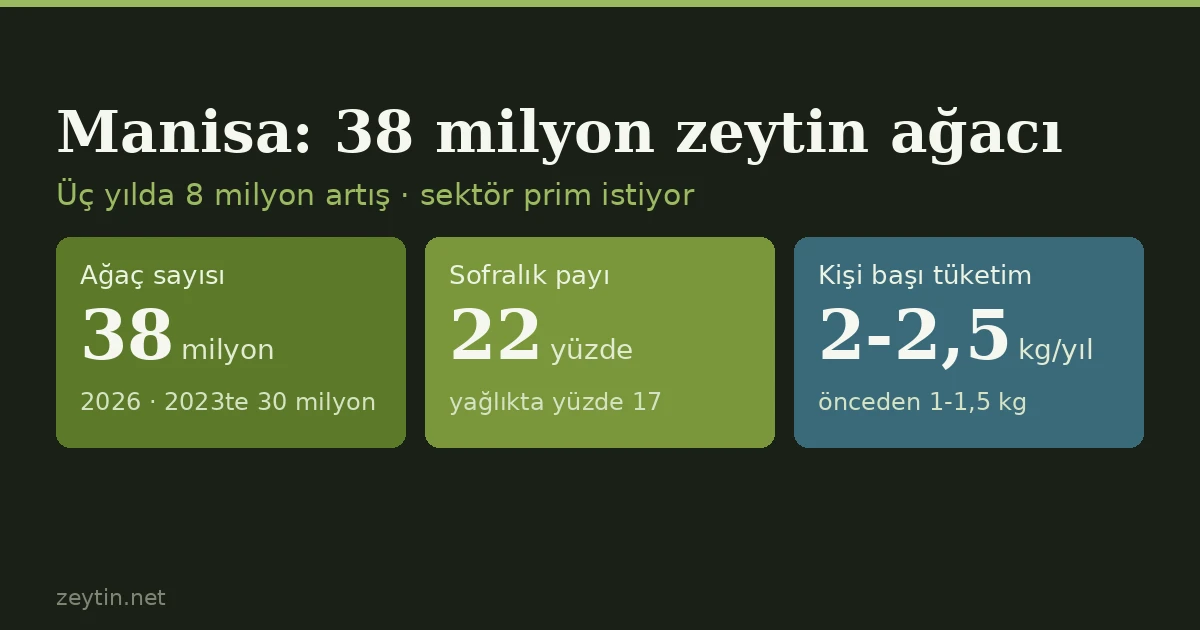
| Manisa | Value |
|---|---|
| Olive trees (2026) | 38 million |
| Olive trees (2023) | 30 million |
| Three-year increase | +8 million |
| Share of Turkey's oil-olive output | 17% |
| Share of Turkey's table-olive output | 22% |
| Per-capita annual oil consumption (formerly) | 1-1.5 kg |
| Per-capita annual oil consumption (today) | 2-2.5 kg |
Eight million trees in three years
Going from 30 million trees in 2023 to 38 million in 2026 means roughly 2.7 million new trees a year. For a single province establishing new groves, that is a fast pace.
Reading the number requires one distinction: not every tree planted comes into bearing the same year. A new grove reaches full yield years later, depending on planting density and management, so growth in tree numbers shows up in the harvest with a lag. In other words, 38 million trees describes the capacity of coming seasons, not only this one.
The expectation voiced for this season is high as well: a record olive oil harvest. That points the same way as the 500,000-600,000 tonne national figure being discussed for Turkey as a whole.
"Our competitors process more cheaply"
Speaking at the meeting, Manisa Commodity Exchange chairman Sadık Özkasap drew attention to the cost side alongside the potential created by a large harvest. In his account, high labour and processing costs are the main burden on growers, while countries such as Spain, Tunisia and Morocco press on the world market with lower processing costs.
Özkasap said state support and premium incentives need to be increased if Turkish olive oil is to hold its competitive position in export markets. The same demand has come from other quarters this season: the Edremit Chamber of Commerce called for 50 lira per kilo of support, and a 50-lira premium for olive oil has become a shared item on the sector's agenda.
Domestic consumption up to 2-2.5 kg
The most striking figure at the meeting was not about price but about consumption. Annual per-capita olive oil consumption in Turkey, previously 1-1.5 kilograms, has risen to 2-2.5 kilograms. Sector representatives expect any decline in shelf prices to lift domestic demand further.
In an abundant season that is a meaningful buffer: when export prices are under pressure, a wider domestic market is one way of keeping part of the crop at home. Even so, the band remains below the averages of other producing countries.
The message: quality, not volume
The shared emphasis at the meeting was on focusing on quality rather than volume. Participants noted that good oil cannot be obtained by good milling alone — quality begins the moment the olive leaves the branch, and harvesting, transport, milling, storage and packaging all act directly on the final product.
Processing facilities were on the agenda too. Dr. Defne Bacınoğlu, head of the Food and Feed Branch at the Manisa Provincial Directorate of Agriculture and Forestry, gave a technical presentation to mill managers on food hygiene, equipment cleaning and the prevention of contamination risks; Leyla Yeşim Kale Kıvrak, food engineer responsible for contaminants, presented on contaminants in olive oil.
Geographically registered harvest opens in Akhisar
Manisa's production weight took concrete form this week in Akhisar, where the harvest of Domat olives carrying geographical indication registration began and the Akhisar District Directorate of Agriculture and Forestry visited the groves being picked. Akhisar is one of the country's largest table-olive centres, and it also stands out for the number of its registered products: Akhisar Domat olives, Akhisar Domat olive oil, Akhisar Uslu olives and Akhisar Uslu olive oil are each registered separately, and the province also holds a registration for Soma olive oil.
Registration can be read as the institutional counterpart of the meeting's emphasis on quality: a geographical indication ties a product to a defined area and a defined production recipe, opening a value space outside the bulk price. That the harvest has opened in the district is also the first sign of how the province's 22 percent share of table olives will be filled this season.
What it means for Turkey
The numbers say two things at once. Manisa's capacity is growing — eight million trees in three years, 17 percent of oil olives, 22 percent of table olives. Yet in the same season Turkish oil is not on the cheap side of the world price: extra virgin was registered at 298.23 lira per kilo on the Edremit exchange on 25 September. At the European Central Bank's 6 October rate (1 euro = 55.4196 lira) that is about 5.38 euros. In the same week the producer price for extra virgin was 3.45 euros in Spain, 3.42 euros in Jaén and 4.75 euros in Italy.
This is exactly where the cost gap Özkasap pointed to becomes visible. Added capacity does not deliver the next step by itself: while Spain debates withdrawing oil from the market in November and Tunisia sets records in bulk exports, what Manisa's 38 million trees are worth depends on the price they meet abroad. The meeting's call to focus on quality is the other face of the same problem: if you cannot win on the bulk, low-cost side, quality has to close the gap.
One rating per visitor; you can change yours at any time. Ratings are real reader votes — no seeded or default scores.
Related
 Article
Tunisia sold 381,000 tonnes of olive oil in ten months: 85.5% in bulk, half of it to Spain and Italy
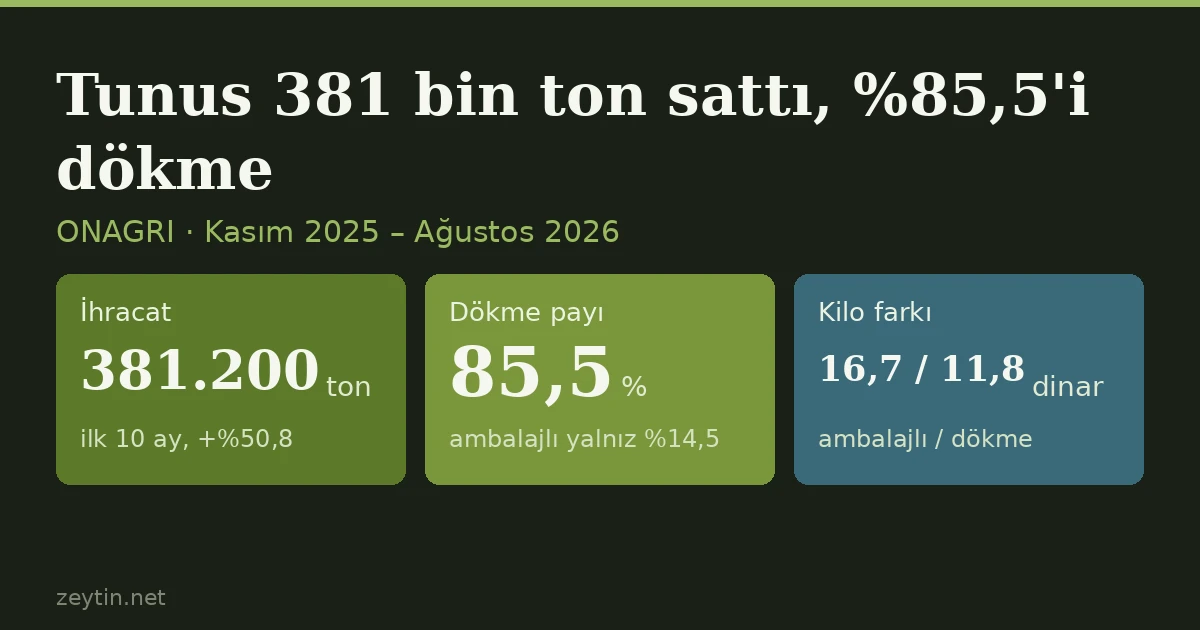
According to the National Observatory of Agriculture (ONAGRI), Tunisia exported 381,200 tonnes of olive oil in the first ten months of the 2025/26 season — volumes up 50.8% and receipts up 41.2% year on year. But 85.5% of it left the country in bulk, and more than half went to Spain and Italy. Packaged oil averaged 16.7 dinars per kilo against 11.8 for bulk. Production is set to fall 40% next season, which changes the bulk market Turkish exporters face.
Article
Tunisia sold 381,000 tonnes of olive oil in ten months: 85.5% in bulk, half of it to Spain and Italy
According to the National Observatory of Agriculture (ONAGRI), Tunisia exported 381,200 tonnes of olive oil in the first ten months of the 2025/26 season — volumes up 50.8% and receipts up 41.2% year on year. But 85.5% of it left the country in bulk, and more than half went to Spain and Italy. Packaged oil averaged 16.7 dinars per kilo against 11.8 for bulk. Production is set to fall 40% next season, which changes the bulk market Turkish exporters face.
 Article
Two pressures before the harvest: costs and 100,000 tonnes carried over
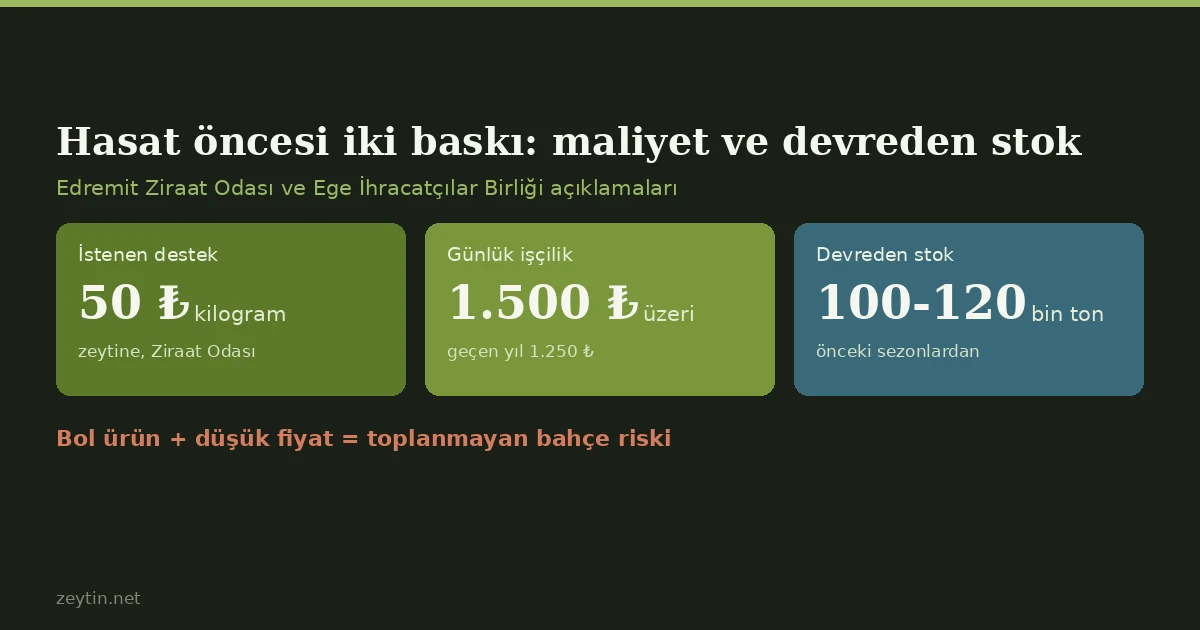
The chamber of agriculture wants 50 lira per kilo; daily labour has passed 1,500 lira. Exporters report 100,000-120,000 tonnes carried over from previous seasons.
Article
Two pressures before the harvest: costs and 100,000 tonnes carried over
The chamber of agriculture wants 50 lira per kilo; daily labour has passed 1,500 lira. Exporters report 100,000-120,000 tonnes carried over from previous seasons.
 Article
Harvest opens in Mut: 300,000 tonnes expected, orchard prices start at 10 lira
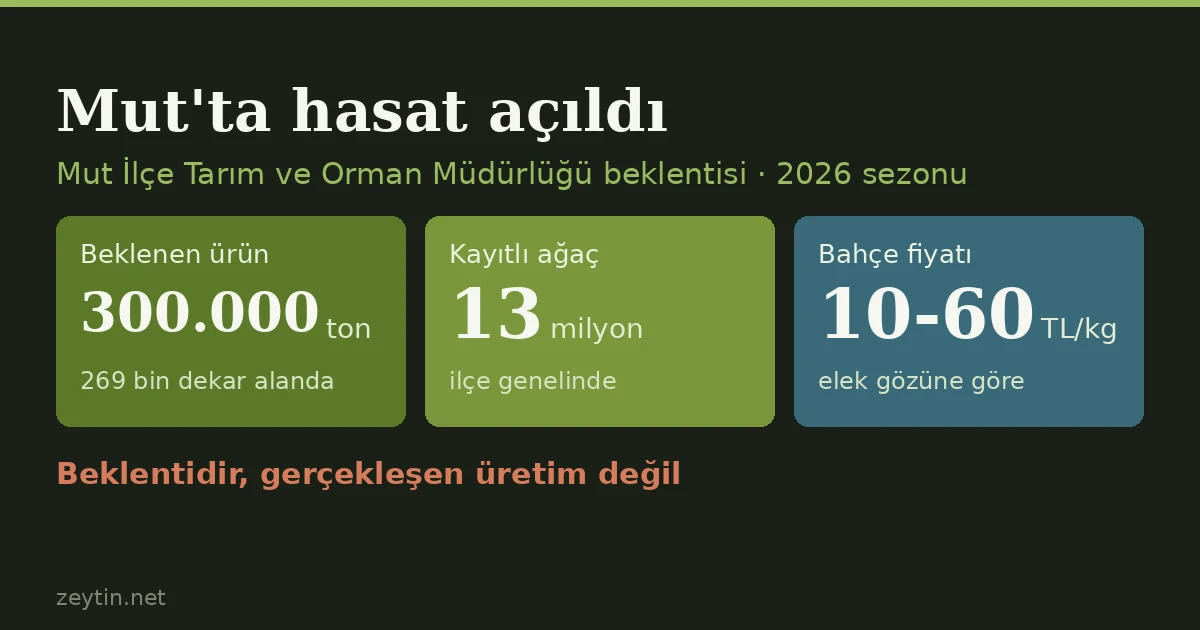
Mut's district agriculture directorate reports 300,000 tonnes expected from 269,000 decares, with orchard prices ranging from 10 to 60 lira by sieve size. Yield is high but growers are unhappy with prices. Set against our own Mersin figures the tonnage leaves an unresolved measurement gap, and we report it as such.
Article
Harvest opens in Mut: 300,000 tonnes expected, orchard prices start at 10 lira
Mut's district agriculture directorate reports 300,000 tonnes expected from 269,000 decares, with orchard prices ranging from 10 to 60 lira by sieve size. Yield is high but growers are unhappy with prices. Set against our own Mersin figures the tonnage leaves an unresolved measurement gap, and we report it as such.
 Article
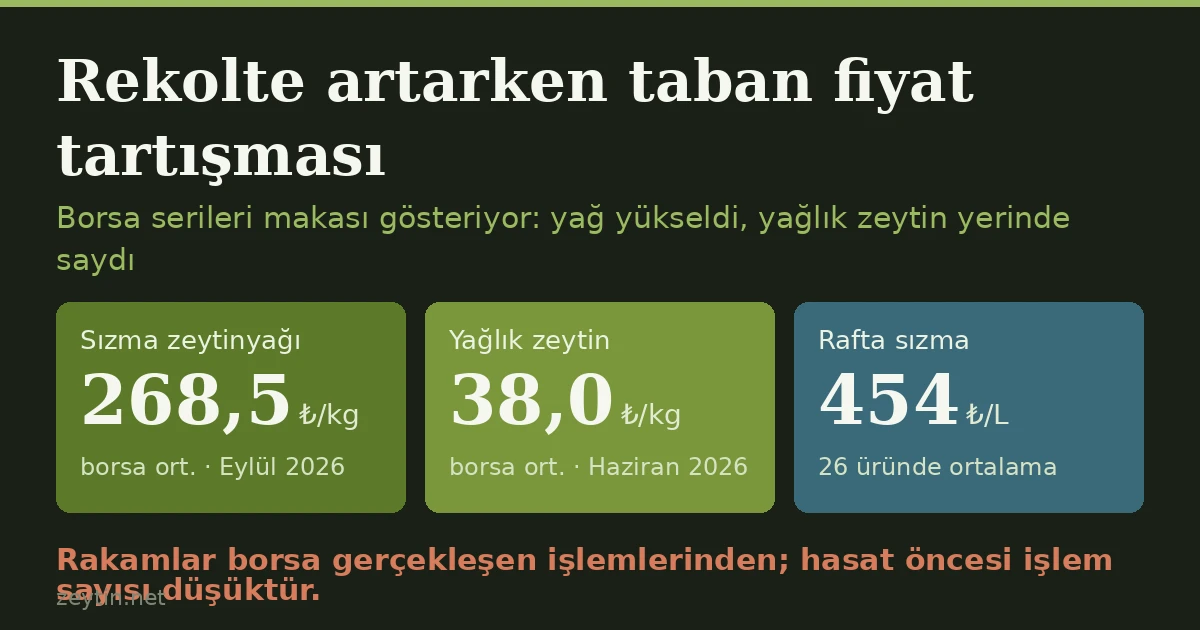
Crop forecast climbs as the minimum-price debate returns: what the exchange numbers say
With the 2026 harvest approaching, crop forecasts are up 40 percent in some provinces and growers want a floor price. Our exchange series shows why the dispute is really about olives, not oil.
Article
Crop forecast climbs as the minimum-price debate returns: what the exchange numbers say
With the 2026 harvest approaching, crop forecasts are up 40 percent in some provinces and growers want a floor price. Our exchange series shows why the dispute is really about olives, not oil.