The International Olive Council grows: Iraq joins, Brazil and South Africa apply
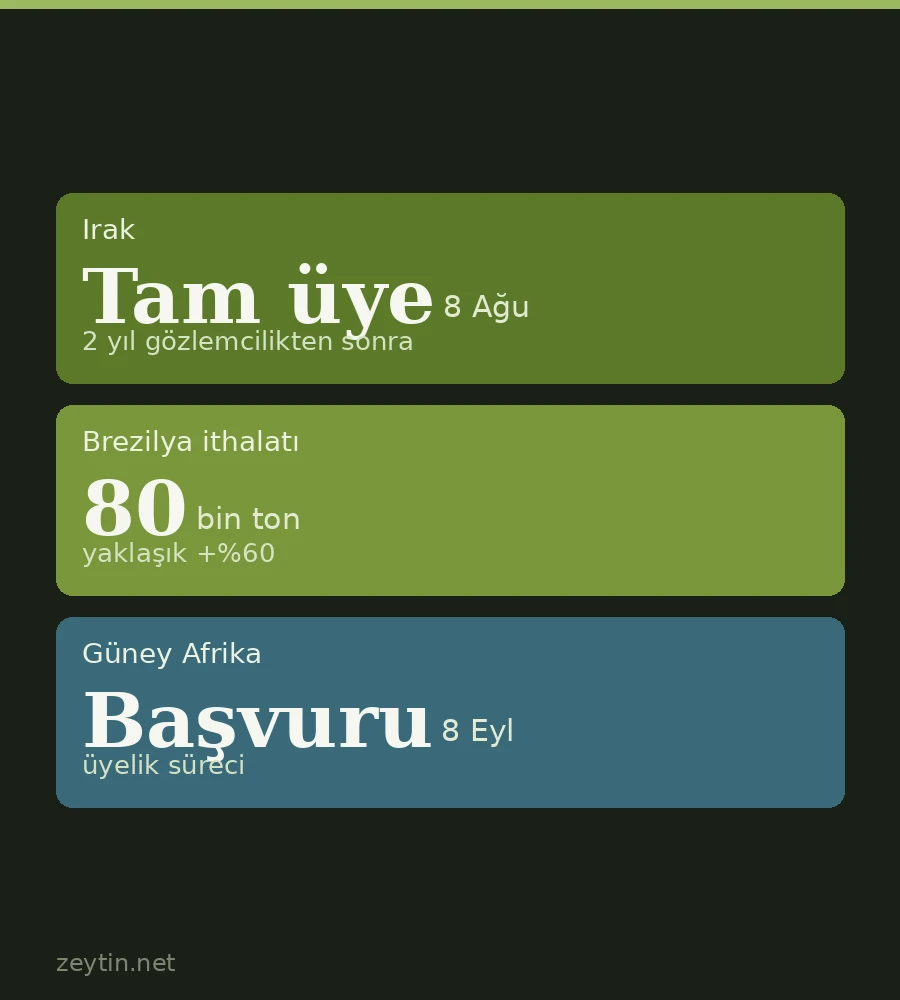
The International Olive Council (IOC) saw three developments in a month: Iraq became a full member on 8 August, South Africa submitted its membership request on 8 September and Brazil on 9 September. The expansion reflects olive oil's shift towards production and consumption areas beyond the Mediterranean.
The Madrid-based International Olive Council (IOC) is the only intergovernmental body for olives and olive oil. It sets standards, quality criteria and common trade rules. In the first week of September the council made three separate announcements, and all three point the same way: the world of the olive is expanding beyond the Mediterranean.
Three developments
| Country | Development | Date |
|---|---|---|
| Iraq | Became a full member | 8 August 2026 |
| South Africa | Submitted membership request | 8 September 2026 |
| Brazil | Submitted membership request | 9 September 2026 |
All the announcements followed meetings between IOC Executive Director Jaime Lillo and the countries' ambassadors to Spain at the council's Madrid headquarters.
Iraq: from observer to member
Before becoming a full member, Iraq took part in the council's work as an observer for two years. Its membership took effect on 8 August 2026. During a courtesy visit on 9 September by Iraq's Ambassador to Spain, Ali Shamran Hajem, it was stressed that membership will let Iraq benefit from the council's technical cooperation and training activities and take part in its specialised work.
Iraq is not a major producer today. But membership means a country can classify and register its own product according to international standards and build laboratory and tasting panel capacity through the council's programmes. For new growing areas, council membership is a kind of shortcut to technical infrastructure.
Brazil: Latin America's biggest importer
Brazil's application was delivered at a meeting with its Ambassador to Spain, Luiz Alberto Figueiredo Machado. Brazil had been attending recent meetings as an observer. The figures the council shared sum up why the country matters:
| Brazil | Value |
|---|---|
| Olive oil imports (ten years ago) | about 50,000 t |
| Olive oil imports (today) | about 80,000 t |
| Ten-year increase | about 60% |
Brazil is Latin America's largest olive oil importer. The IOC's olive oil promotion campaign in the country has been extended to the end of 2027. Brazil is not only a buyer, either: extra virgin olive oils produced in Brazil have won places in the council's Mario Solinas Quality Awards for the Southern Hemisphere.
South Africa: the other Southern Hemisphere pillar
South Africa's request was delivered at a meeting with its Ambassador to Spain, Sankie Dolly Mthembi-Mahanyele. The council's announcement noted that South African producer De Rustica Estate took second prize in the "robust green fruity" category of the 2025 Mario Solinas Quality Awards.
In the Southern Hemisphere the harvest calendar runs opposite to the Mediterranean's; olives are picked during what are spring months in the north. That is why the council holds a separate Southern Hemisphere edition of its quality competition. Membership for South Africa and Brazil would give that calendar more weight within the council.
What does the council's standard define?
The IOC trade standard defines the categories we see on shelves. Extra virgin olive oil must not exceed 0.8% free acidity, and virgin olive oil 2%; classification rests not only on chemical analysis but also on a sensory assessment by a trained tasting panel. Oil found to be defective falls outside the virgin categories.
These definitions carry into member countries' own regulations. A country joining the council is taking a step towards using the "extra virgin" label on its domestic market by the same criteria. That matters for consumers too: the same label starts to stand for the same quality in different countries. We explain how to read these categories and how they are priced on exchanges in our exchange price guide.
What it means for Türkiye
Türkiye is one of the council's member countries. The expansion has two practical sides.
The first is markets. When a country with growing imports such as Brazil adopts council standards, the classification and labelling of the olive oil sold there move closer to international criteria. That eases market access for exporters producing to those standards. With end-of-August data showing Turkish olive oil exports down 62% in volume for the season, alternative markets matter more. We covered losses in the main markets in our piece on the US tariff.
The second is competition. Southern Hemisphere output reaches the market with fresh oil in the months when the north is short of supply. As these producers gain weight within the council, seasonal price gaps could narrow over time. We examined how production swings among Mediterranean countries affect prices through the opposite phases of Türkiye and Tunisia.
Read with care
⚠ An application is not membership. Brazil's and South Africa's requests have been submitted; membership takes effect only when the accession process to the international agreement is complete.
⚠ Brazil's import figures are rounded. The 50,000 and 80,000 tonnes were given as "about" in the council's announcement; they are not official annual statistics.
⚠ The council's total number of members was not stated in the announcements, so we have not given one.
One rating per visitor; you can change yours at any time. Ratings are real reader votes — no seeded or default scores.
Related
 Article
The world's largest bottler is for sale: a €500 million race for Deoleo
Deoleo, owner of Bertolli and Carbonell, holds 22% of global bottled olive oil sales. Italy's Coricelli leads at €500 million, Spain's Dcoop cooperative at €470 million. The Spanish government regards the company as nationally strategic. Because Deoleo is a major bulk buyer, the outcome matters to Turkish exporters too.
Article
The world's largest bottler is for sale: a €500 million race for Deoleo
Deoleo, owner of Bertolli and Carbonell, holds 22% of global bottled olive oil sales. Italy's Coricelli leads at €500 million, Spain's Dcoop cooperative at €470 million. The Spanish government regards the company as nationally strategic. Because Deoleo is a major bulk buyer, the outcome matters to Turkish exporters too.
 Article
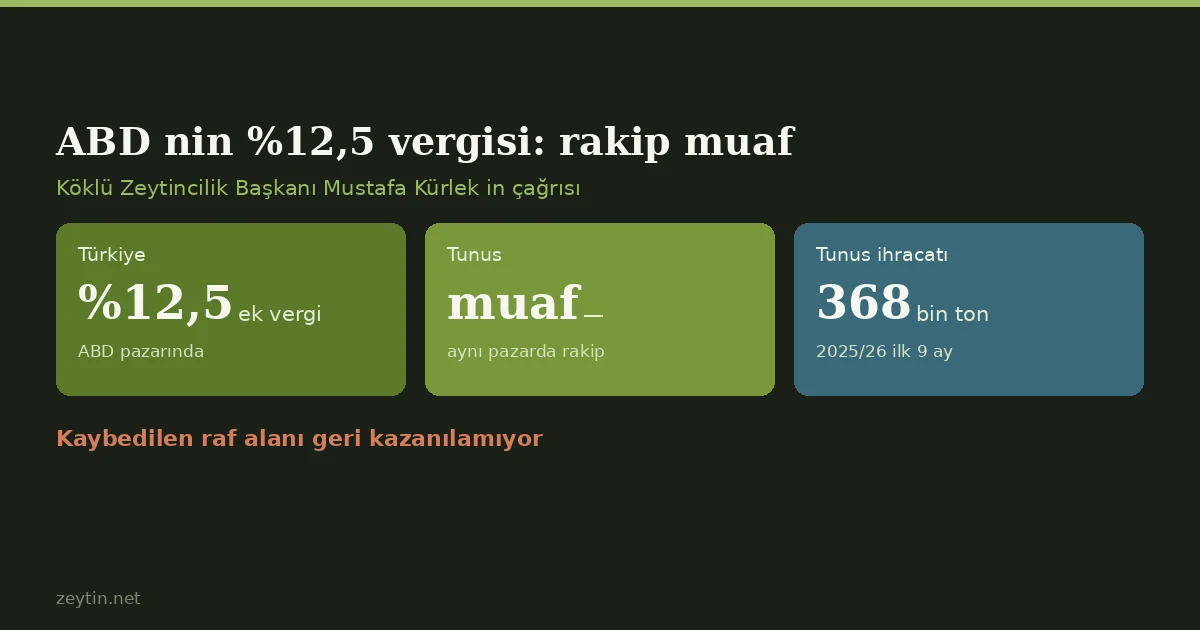
The 12.5% US tariff: the competitor is exempt, the Turkish exporter is not
Mustafa Kürlek notes the 12.5% additional US tariff on Turkish olive products is not applied to competitors such as Tunisia, and calls for DFİF and Eximbank measures.
Article
The 12.5% US tariff: the competitor is exempt, the Turkish exporter is not
Mustafa Kürlek notes the 12.5% additional US tariff on Turkish olive products is not applied to competitors such as Tunisia, and calls for DFİF and Eximbank measures.
 Article
A 282-member doctors' cooperative puts sensors in the olive grove
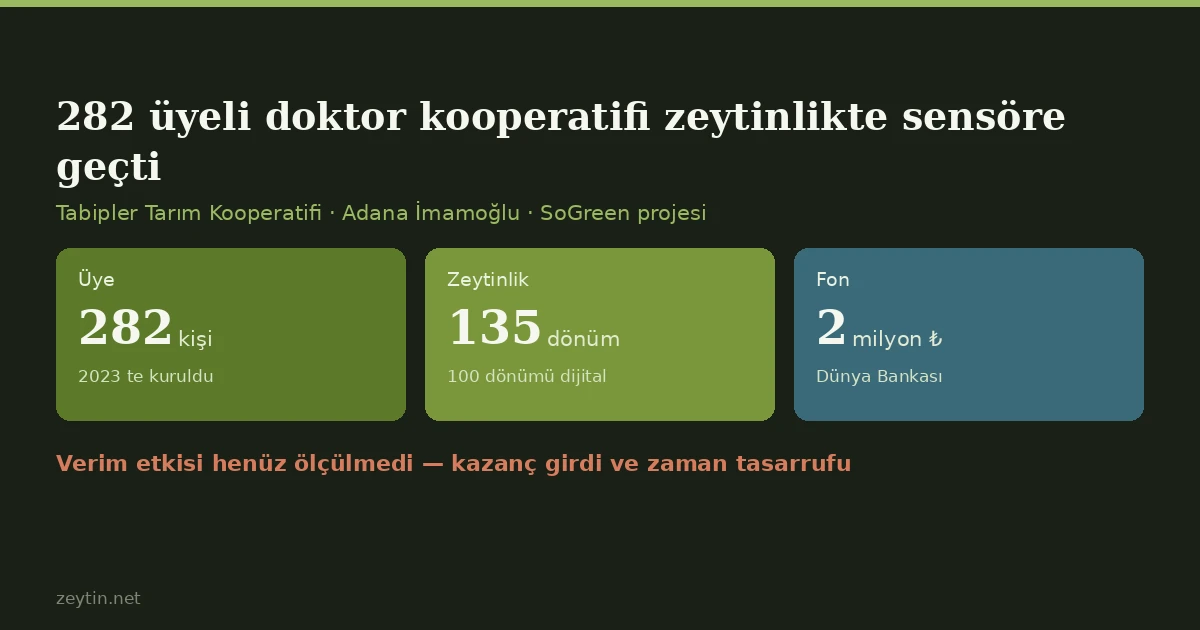
A cooperative founded by doctors in Adana is monitoring water and fertiliser with buried sensors across 100 of its 135 dönüm of bearing olive grove, funded with 2 million lira.
Article
A 282-member doctors' cooperative puts sensors in the olive grove
A cooperative founded by doctors in Adana is monitoring water and fertiliser with buried sensors across 100 of its 135 dönüm of bearing olive grove, funded with 2 million lira.
 Article
3,200 trees and 72 varieties on 14 hectares of stone: the cooperative turning Dalmatian karst into groves
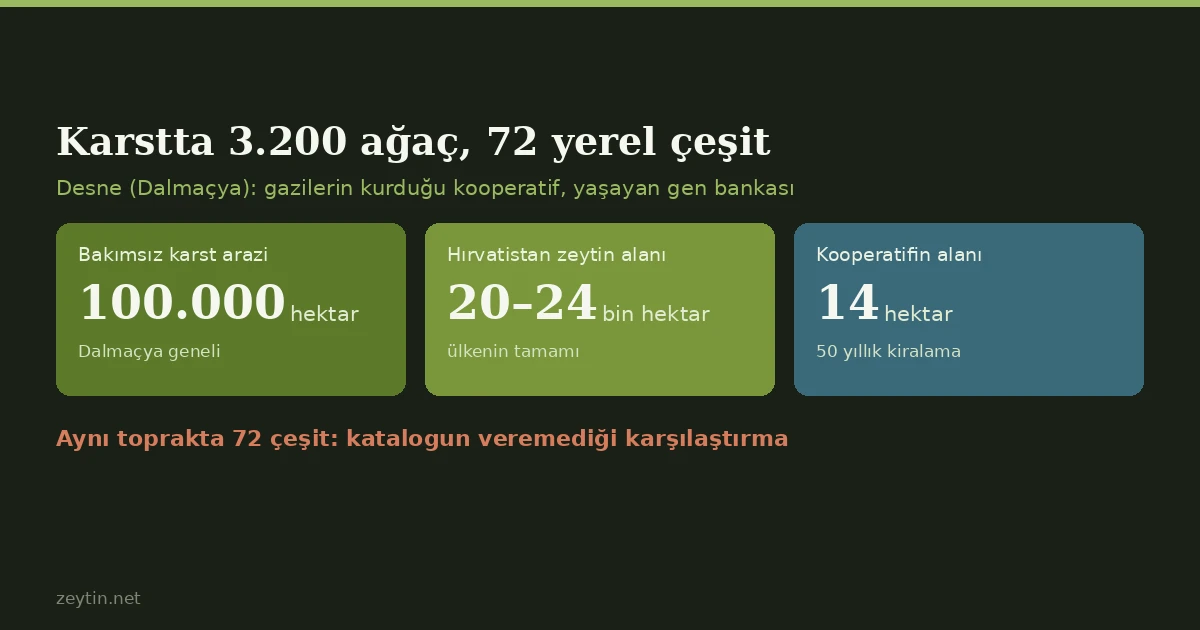
Some 100,000 hectares of karst lie neglected in Dalmatia while all of Croatia has 20,000–24,000 hectares under olives. In Desne a veterans' cooperative has grown 3,200 trees of 72 native varieties on 14 hectares of rock — a grove that doubles as a natural laboratory for climate resilience.
Article
3,200 trees and 72 varieties on 14 hectares of stone: the cooperative turning Dalmatian karst into groves
Some 100,000 hectares of karst lie neglected in Dalmatia while all of Croatia has 20,000–24,000 hectares under olives. In Desne a veterans' cooperative has grown 3,200 trees of 72 native varieties on 14 hectares of rock — a grove that doubles as a natural laboratory for climate resilience.