Edremit olive oil geographical indication applications open 12-23 November 2026: a 12-day window against last year's 21
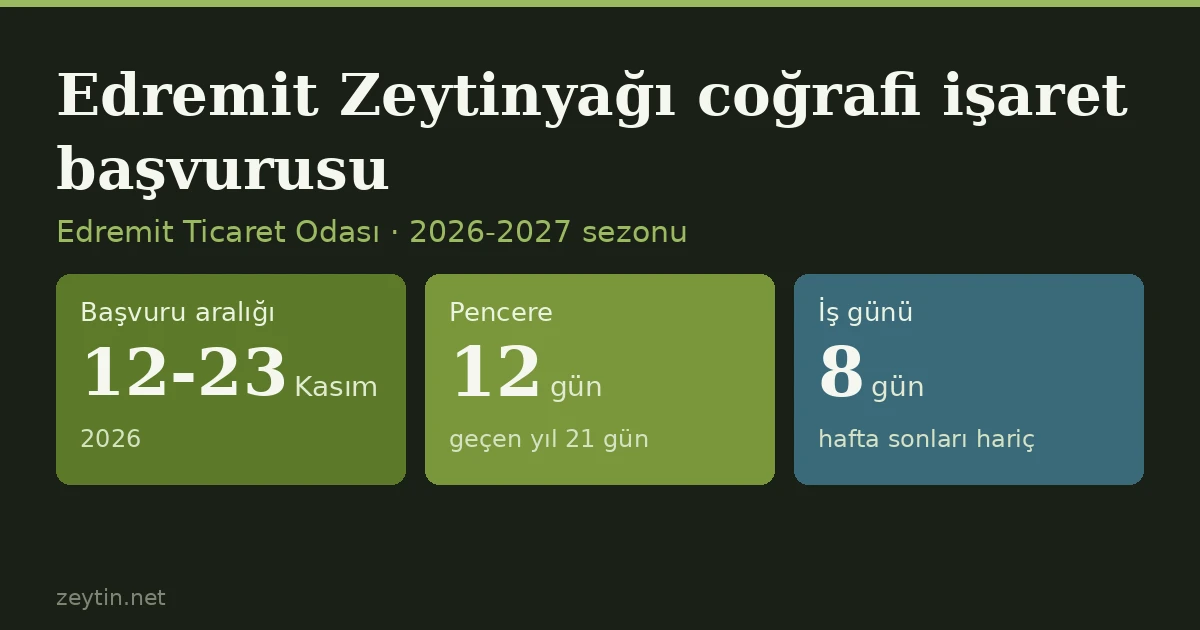
The Edremit Chamber of Commerce will take Edremit Zeytinyağı geographical indication applications for 2026-2027 from 12 to 23 November 2026. Last year's first period was 21 days; this year's window is 12 calendar days, eight working days. The report gives neither the sampling calendar nor the document list.
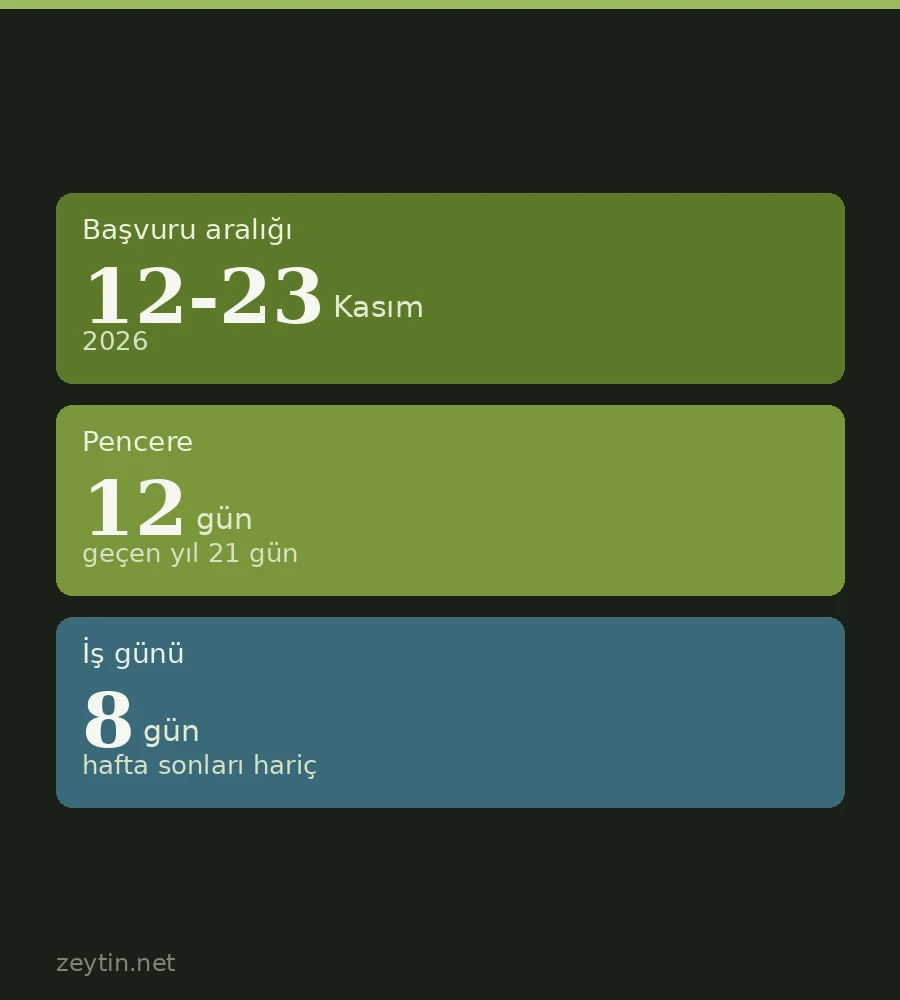
The Edremit Chamber of Commerce will accept applications for the Edremit Zeytinyağı (Edremit Olive Oil) geographical indication for the 2026-2027 season from 12 to 23 November 2026. The announcement was made on 11 November 2026. Producers and brand-owning firms that want to benefit from the right to use the geographical indication must prepare the requested documents in full and hand them in to the chamber on those dates. The application undertaking and the application petition will be drawn up at the chamber during the application.
The report stresses that complete paperwork matters if the process is to finish smoothly and quickly. It does not list the documents one by one.
The window is shorter than last year's
The chamber's announcement for the previous season was reported on 17 November 2025. Putting the two side by side shows the difference:
| Season | Application window | Calendar days | Sampling |
|---|---|---|---|
| 2025-2026, first period | 5-25 November 2025 | 21 | 25 November-25 December 2025 |
| 2025-2026, second period | 5-25 May 2026 | 21 | 25 May-25 June 2026 |
| 2026-2027 | 12-23 November 2026 | 12 | Not in the report |
The day counts are our own calculation, end dates included. Because 12 November is a Thursday and 23 November a Monday, weekends leave eight working days in the window: 12, 13, 16, 17, 18, 19, 20 and 23 November. Last year's 5-25 November 2025 window was 21 calendar days.
One limit on this comparison: last year's announcement covered both Edremit Zeytinyağı and the Edremit Körfezi Yeşil Çizik olive and gave two application periods. This year's report covers only the olive oil, and it does not say whether there is a second period or when samples will be taken. So the shorter window may or may not mean there is only one period this year; the report does not let us tell.
What right is being applied for?
Edremit Zeytinyağı is a designation of origin registered in the name of the Edremit Chamber of Commerce: registration number 273, registered on 13 December 2017. Because the name is registered to the chamber, a producer or brand owner that wants to use it on a product applies to the chamber; the report's phrase "right of use" describes this. The announcement does not spell out what the applicant receives at the end (a certificate, a registration or a labelling right).
The registration document does not only protect a name, it also ties down production: harvest from mid-October to the end of February, at most ten hours from picking to pressing, and no use of fruit that has fallen on the ground. How these conditions are checked at application, meaning the details of the sampling and document process, is known from last year's calendar report rather than from this year's announcement.
Which documents were requested last year?
The 17 November 2025 report listed these for Edremit Zeytinyağı: a current farmer registration system (ÇKS) certificate from the Edremit district office of the Ministry of Agriculture and Forestry, a pressing-certificate (tasiriye) invoice, contract-pressing and contract-bottling agreements, a producer receipt, a trademark registration certificate and business registration documents. Production traceability records were also required for both products. This year's announcement does not say whether the list is unchanged; anyone planning to apply should confirm the current list with the chamber.
Why it matters
At the start of the season, the volume of oil that may carry the region's registered name is set by these applications. Edremit is already in the sector's news this season: the chamber had called for support of at least 50 lira per litre, and the accreditation of the region's tasting laboratory, ETOLAB, was reported as well. A short window carries a risk for unprepared producers of missing this part of the season; the report does not discuss that risk, so it is our own reading.
Not in the report
- The current document list and any application fee.
- Sampling dates and whether a second period exists.
- A separate calendar for the Yeşil Çizik olive.
- The number of applications, or how many producers qualified last season.
What to watch
If the chamber publishes application results and the sampling calendar, it will become clear why the window was shortened and whether the second period continues. The production conditions of the registration document are set out on our Edremit Zeytinyağı page.
One rating per visitor; you can change yours at any time. Ratings are real reader votes — no seeded or default scores.
Related
 Article
"Jewels of the Adriatic": four countries choose to compete on quality, not volume
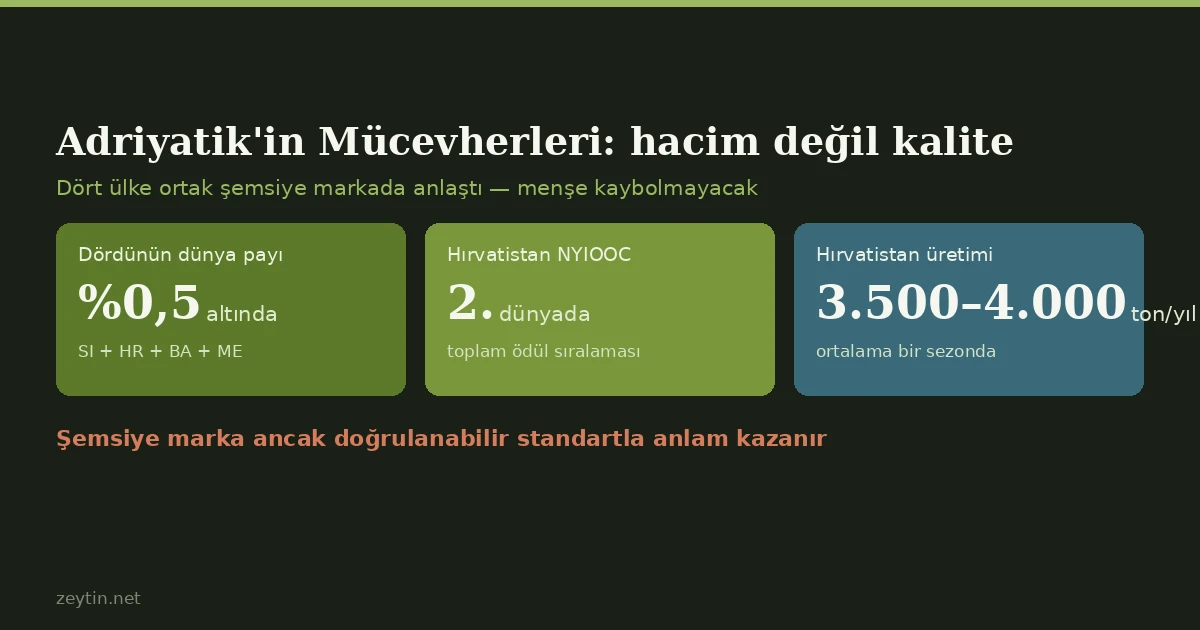
Slovenia, Croatia, Bosnia and Herzegovina and Montenegro together produce under 0.5% of the world's olive oil — yet Croatia finished second worldwide at the NYIOOC. A panel in Mostar proposed a shared umbrella brand: origin stays, common rules are the condition.
 Article
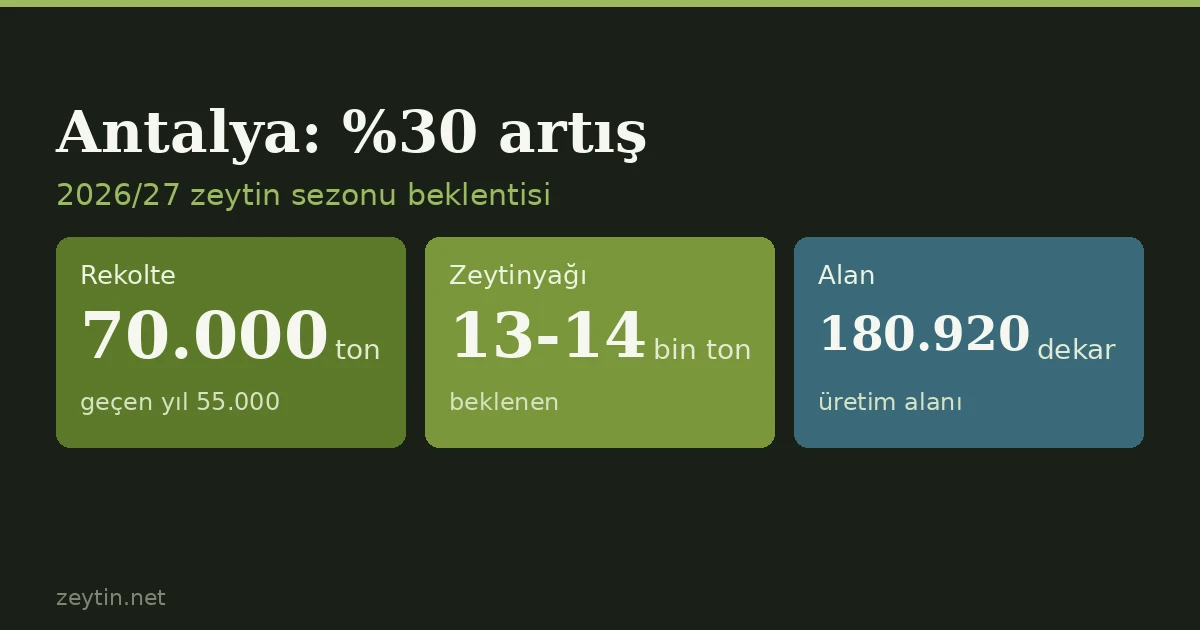
Antalya's crop is up 30%: of 70,000 tonnes of olives, 55,000-60,000 head for the mill
According to the Antalya Commodity Exchange, the province's olive crop is rising about 30% from some 55,000 tonnes last season to around 70,000 tonnes, with 13,000-14,000 tonnes of olive oil and 10,000-15,000 tonnes of brined fruit expected. Harvest opened on 15 September. There is movement on the registration front too: an EU application has been filed for the Tavşan Yüreği olive, and a geographical indication file is under way for the Beylik variety.
 Article
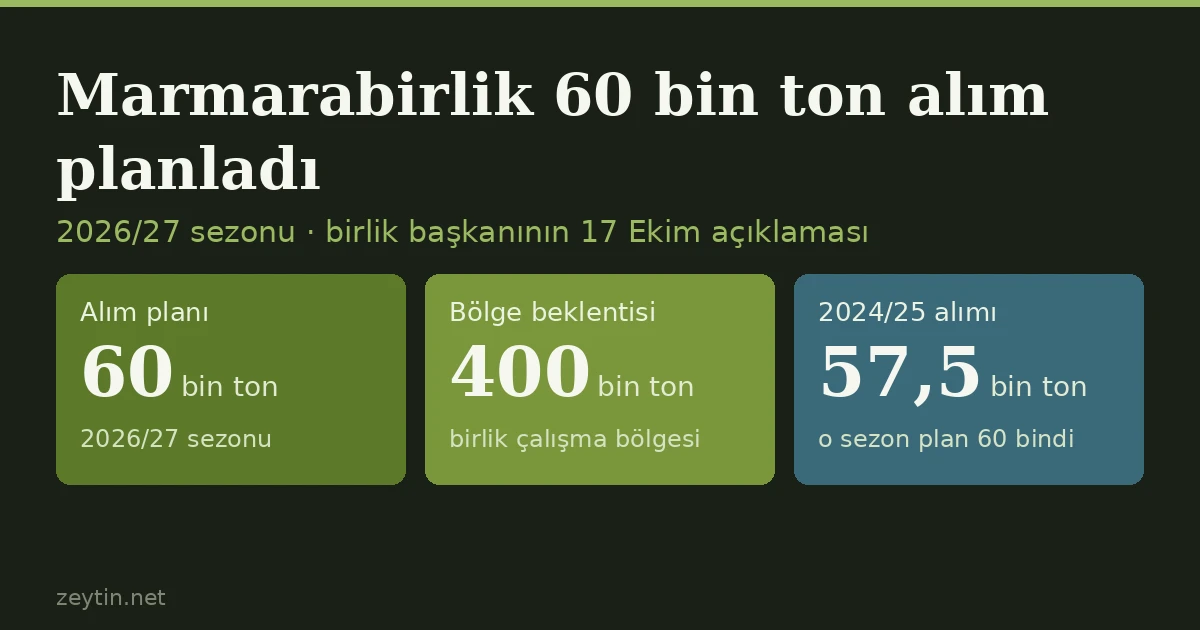
Marmarabirlik plans to buy 60,000 tonnes of olives: 15 per cent of the 400,000 tonnes expected in its region
According to a statement by chairman Ali Yıldız on 17 October, Marmarabirlik plans to buy about 60,000 tonnes of olives from growers this season, while its region expects 400,000 tonnes. The union set the same target in 2024/25 and closed that campaign at 57,500 tonnes. Crop declarations close on 23 October; the purchase price has not been announced.
 Article
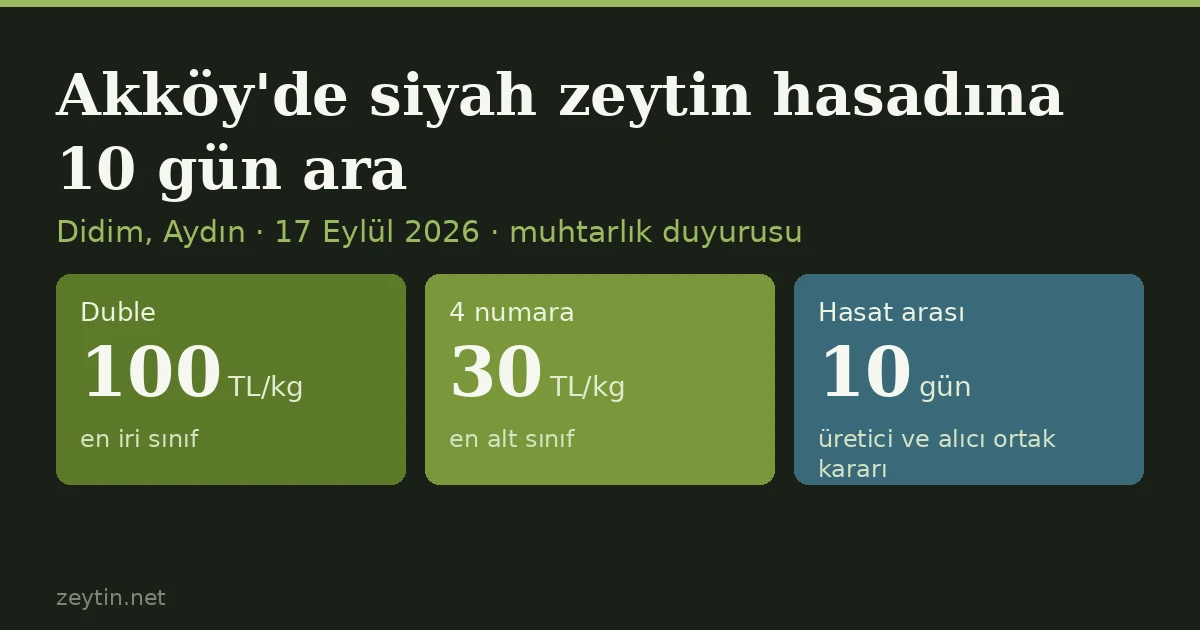
Black olive harvest paused for ten days in Akköy, Didim: a price ladder from 30 to 100 lira
In Akköy, a village in the Didim district of Aydın, growers and olive buyers have jointly agreed to suspend black olive harvesting and buying for ten days, saying announced prices do not cover costs. The price ladder published by the village headman's office runs from 100 lira a kilo for the largest grade down to 30 lira for the smallest. Growers say picking costs alone exceed the price on the lower grades.