Kahramanmaraş harvests olives on 112,000 decares and expects 26,000 tonnes, with an oil yield of 1 in 7
Kahramanmaraş's provincial agriculture director Ramazan Bilir said olives are being harvested on 112,000 decares this season and about 26,000 tonnes are expected. That is about 3.2 times our 2025-2026 record, while the oil yield a producer quoted, about 14.3 percent, is below the recorded 20 percent.
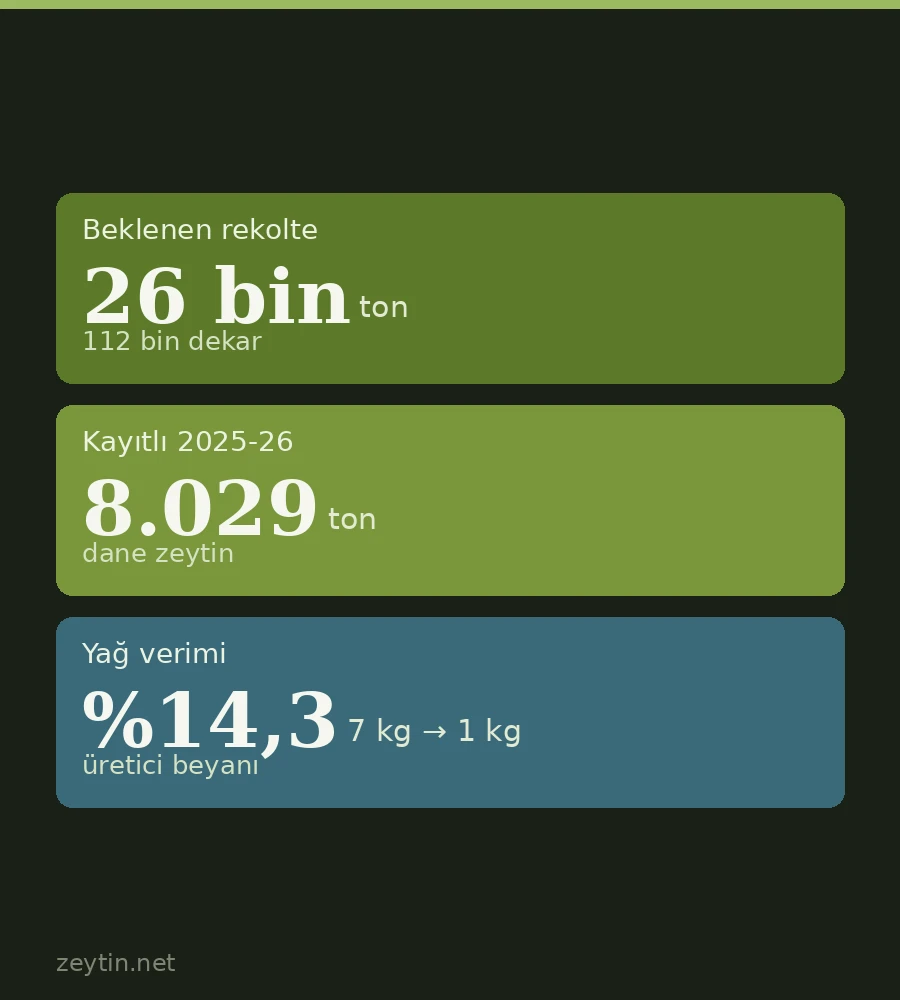
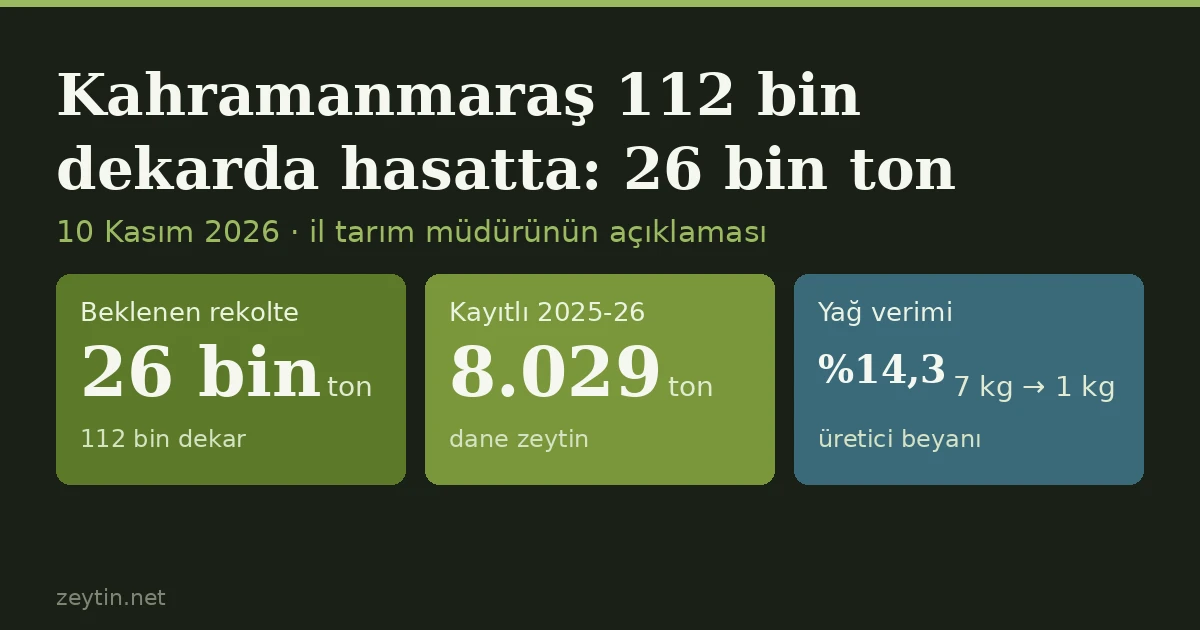
In Kahramanmaraş, in southern Türkiye, olives are being harvested this season on 112,000 decares (about 11,200 hectares), and the province expects roughly 26,000 tonnes of crop. The figures were given on 10 November 2026 by the Kahramanmaraş provincial director of agriculture and forestry, Ramazan Bilir. While the harvest continues, growers are taking their olives to the oil mills. The report does not split the crop between table and oil olives; we read the 26,000 tonnes as a fruit tonnage, because the oil yield is described separately.
| Item | Value |
|---|---|
| Harvest area | 112,000 decares |
| Expected crop | 26,000 tonnes |
| Oil yield (producer's statement) | 1 kg of oil from 7 kg of olives |
| 18-20 litre tin of extra virgin (producer's statement) | about 5,000 TL |
| 18-20 litre tin of natural virgin (producer's statement) | about 4,500 TL |
| Olive trees in the province (producer's statement) | over 6 million |
| Trees already bearing (producer's statement) | about 4.5 million |
About 232 kilograms per decare
Dividing 26,000 tonnes by 112,000 decares gives roughly 232 kilograms per decare (our calculation, a blended average across trees of different age and spacing). In December 2024 the same director had said the province expected 6,200 tonnes of table olives and 18,500 tonnes of oil olives, a total of 24,700 tonnes, from 117,000 donum. A donum and a decare are the same unit, so the area has shrunk by about 4.3 percent while the expectation has risen by about 5.3 percent; the per-decare expectation moves from 211 to 232 kilograms. These are expectations for two different seasons, not outcomes.
About 3.2 times the recorded output
The 2025-2026 season on our Kahramanmaraş olive growing page is recorded as follows: 8,029 tonnes of olives (6,022 tonnes for oil and 2,007 tonnes for the table), 1,204 tonnes of olive oil, and 1.93 million bearing trees. Set against that record, 26,000 tonnes is about 3.2 times as much. But 2025-2026 was an off year across Türkiye, and the olive is a tree that swings between heavy and light crops over a two-year cycle. The report does not say how much of the gap comes from the on-year and how much from optimism in the forecast. An expectation and a recorded output should not be weighed on the same scale.
The oil yield is low
Olive oil producer Abdurrahim Kırkgeçit said the crop had not finished ripening, so 1 kilogram of oil is being obtained from 7 kilograms of olives. That is an oil yield of about 14.3 percent. The figures in the December 2024 report implied about 20 percent (3,700 tonnes of oil from 18,500 tonnes of oil olives), and our record for 2025-2026 matches: 1,204 divided by 6,022 is 20.0 percent. The yield quoted this season is therefore lower by about 5.7 percentage points. It is, however, one producer's observation at his own mill, not a provincial season average, and it may change as the harvest advances.
Two calculations for scale. If all 26,000 tonnes went to oil, a 7-to-1 yield would give at most about 3,700 tonnes of oil. If the oil share were about three quarters, as in 2024, the oil would come to roughly 2,800 tonnes. Neither is a forecast; they are conditional products of the figures in the report, which does not give the oil share.
The tin price
The prices Kırkgeçit gave are about 5,000 TL for an 18-20 litre tin of extra virgin and about 4,500 TL for natural virgin. Depending on whether the tin holds 18 or 20 litres, that works out at roughly 250-278 TL per litre for extra virgin and 225-250 TL for natural virgin (our calculation). The report does not say whether this is a producer's ex-mill price or a retail price, nor on what date it applies. The extra virgin registration at the Edremit commodity exchange on 6 November 2026 stands at 273.92 TL per kilogram in our data; that is a single registration, not an average, and it is quoted per kilogram. We do not compare a litre price directly with a kilogram price.
The tree count still does not match
Kırkgeçit said the province has more than 6 million olive trees, that about 4.5 million of them are bearing, and that 150,000 to 200,000 new trees are planted every year. In the speech reported at the opening of the Doğukent plant the number of bearing trees was given as 4 million; in this report it is 4.5 million. In the recorded series the bearing trees number 1.93 million, so the figure in the speech is about 2.3 times as high. We cannot say whether the difference comes from the date of the count, from its scope, or from recent plantings.
What the report does not contain
- The split of the 26,000 tonnes between table and oil olives, and the total oil expected.
- The method and the date used to calculate the crop forecast.
- The sales level to which the tin prices belong.
What to watch
The official outturn published after the season will show how close the expectation came. The second question is the oil yield: does the 7-to-1 ratio change as the harvest moves on, or does it remain the province's figure for this season?
One rating per visitor; you can change yours at any time. Ratings are real reader votes — no seeded or default scores.
Related
 Article
Co-op branding in the adulteration list: one name, four separate announcements
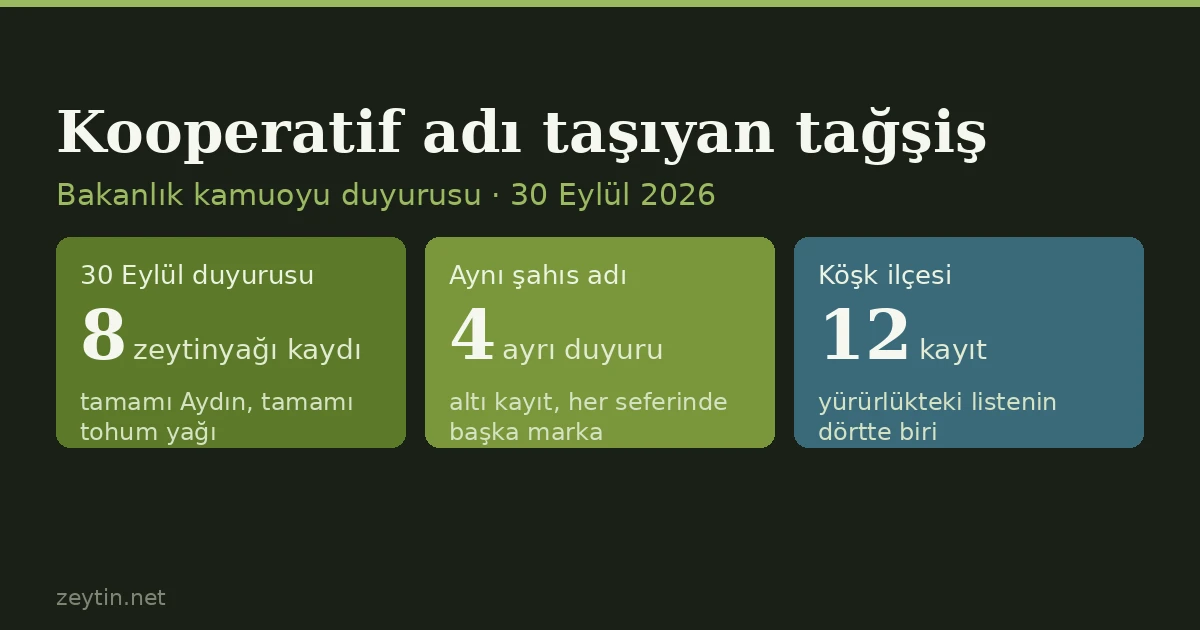
All eight olive oil entries in Turkey's 30 September 2026 food-fraud announcement come from a single province, Aydın, and all eight carry the same finding: seed oil blended into oil sold as extra virgin. The brand names tell a second story — three of them invoke a cooperative or a producers' union. Read as a time series, the live list shows one trader's name across four separate announcements, under a new brand each time.
 Article
Tunisian banks lent 3.3 billion dinars to the olive oil season; the 2027 draft budget earmarks bulk export duties for a sector fund
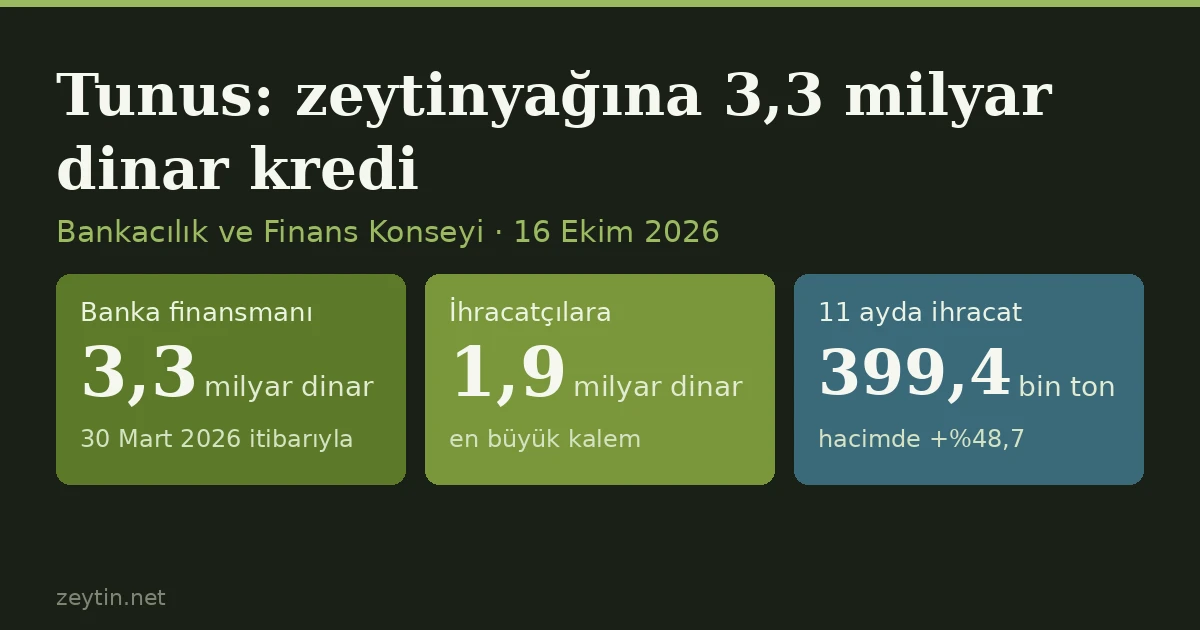
According to Néji Ghandri, president of the Tunisian Banking and Financial Council, banks extended 3.2-3.3 billion dinars to the 2025/26 olive oil season by 30 March, up from 2.2 billion the season before; 1.9 billion went to exporters. Tunisia exported 399,400 tonnes in eleven months. The 2027 draft budget opens a 100-million-dinar credit line for small growers and earmarks 10 per cent of bulk export duty revenue for a sector fund; it is not a new tax.
 Article
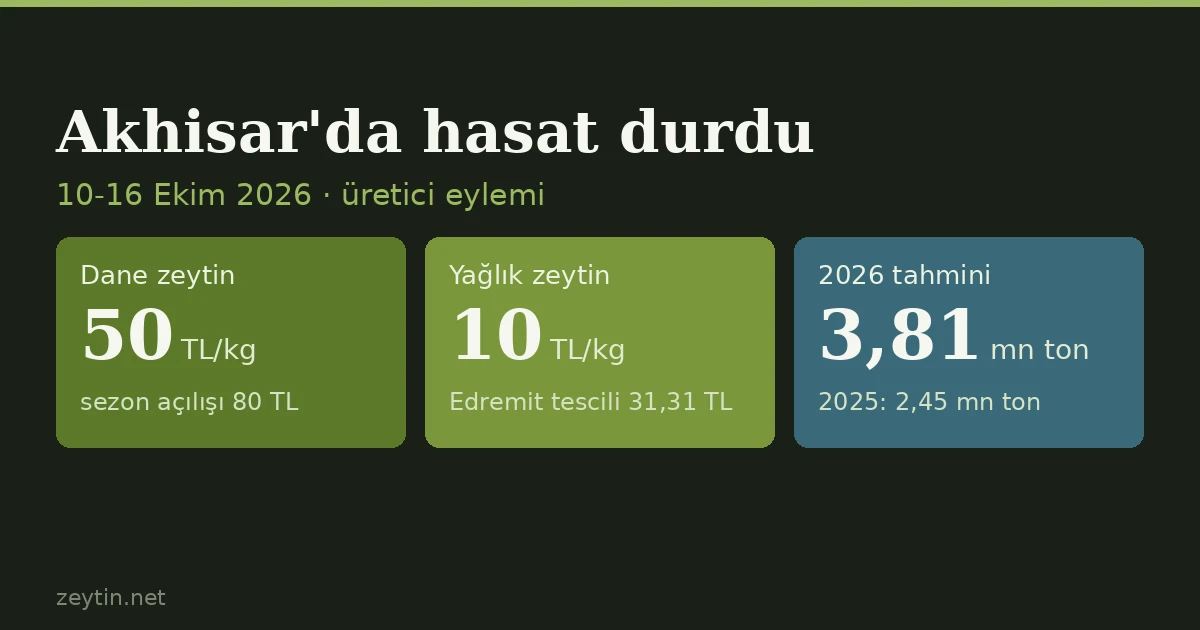
Harvest halted amid a record forecast: 50 lira for table olives in Akhisar, 10 for oil
Growers in Akhisar halted the harvest for a week on 10 October. Table olive prices that opened the season at 80 lira fell to 50, and oil olives to 10 — below last season's table olive floor. In the same days the official first estimate puts production at 3.8 million tonnes.
 Article
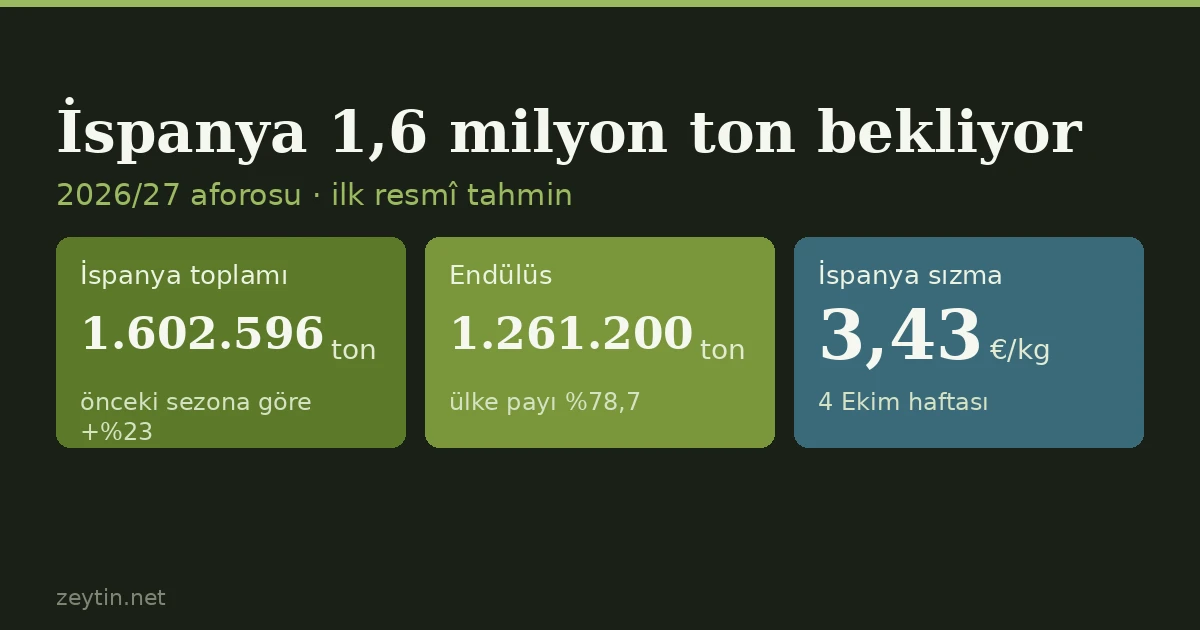
Spain's official estimate: 1.6 million tonnes, and prices have already fallen
Spain's agriculture ministry has published its first official 2026/27 crop estimate: 1,602,596 tonnes of olive oil, 23% above last season. Andalusia alone expects 1.26 million tonnes. Producer prices did not wait for the estimate — Spanish extra virgin has slipped to 3.43 euros a kilo.