Bursa expects 290,000 tonnes of olives, with the biggest share going to oil in 12 seasons
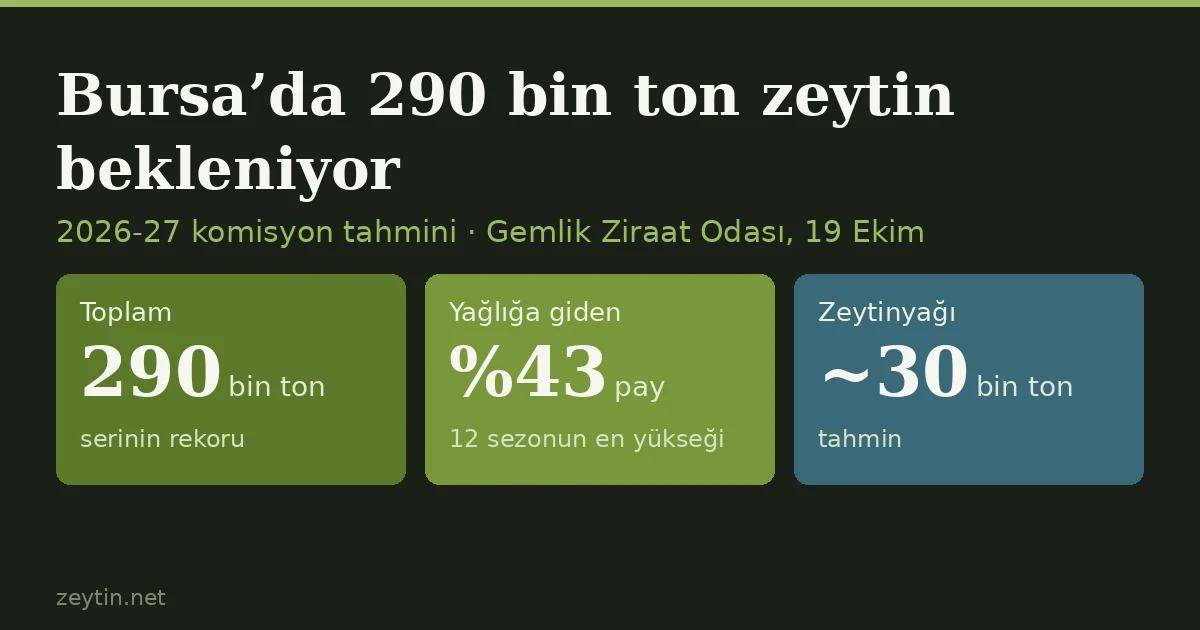
According to a provincial commission estimate shared by the Gemlik Chamber of Agriculture on 19 October, Bursa expects 290,000 tonnes of olives this season: 165,000 tonnes of table olives, 125,000 tonnes of oil olives and about 30,000 tonnes of olive oil. The crop is a record for the series, and the 43 percent share going to oil is the highest in 12 seasons. Early-harvest olives are fetching 45-60 lira per kilo.
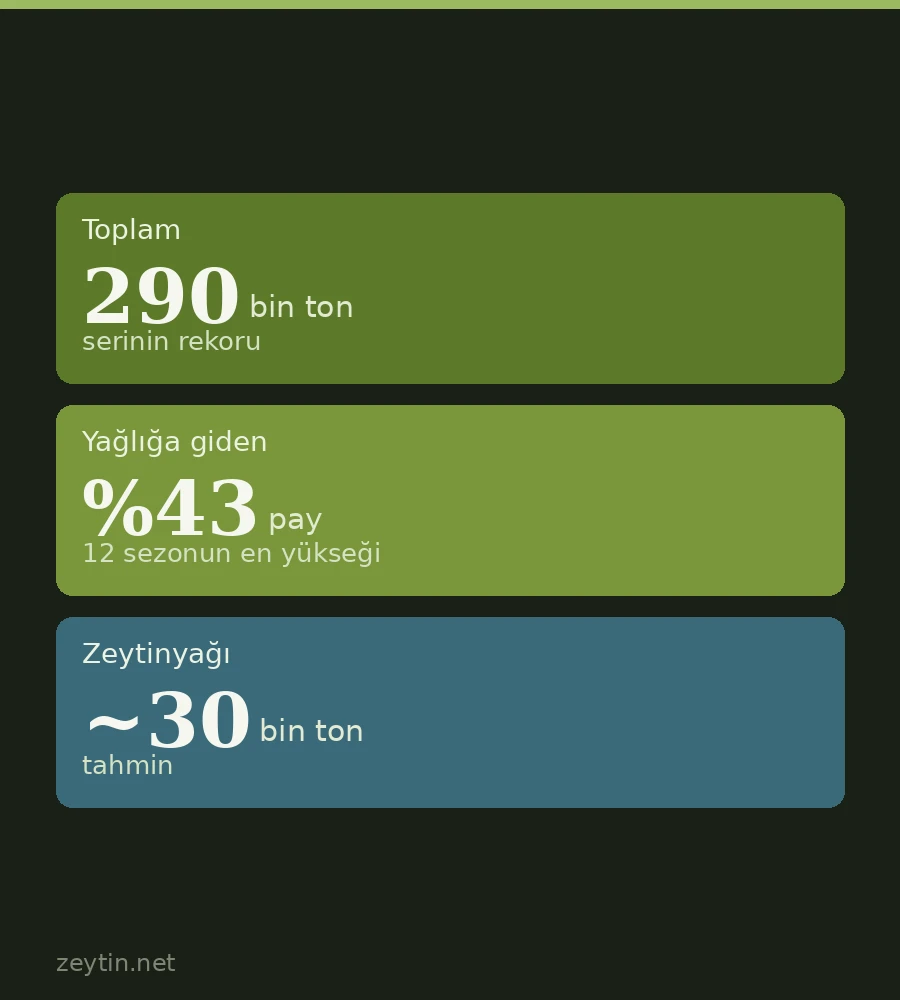
Bursa, the province best known in Türkiye for its table olives, expects to harvest about 290,000 tonnes of olives this season. According to the estimate shared on 19 October by Ercan Barutçuoğlu, president of the Gemlik Chamber of Agriculture, 165,000 tonnes will go to table olives and 125,000 tonnes to oil olives, and the oil olives are expected to yield roughly 30,000 tonnes of olive oil. The figures come from the work of a provincial commission made up of the Ministry of Agriculture and Forestry, chambers of agriculture, cooperatives and academics.
The headline number is large, but the more interesting part is where the fruit is going. In a province whose olive economy is built on the table, more than four in every ten olives will be pressed for oil this year.
The figures
| Item | 2026-27 estimate | 2025-26 | 2024-25 |
|---|---|---|---|
| Total olives | 290,000 | 140,847 | 280,720 |
| Table olives | 165,000 | 107,055 | 170,491 |
| Oil olives | 125,000 | 33,792 | 110,229 |
| Olive oil | ~30,000 | 8,192 | 25,127 |
| Share going to oil | 43% | 24% | 39% |
2026-27: provincial commission estimate (Gemlik Chamber of Agriculture statement, 19 October 2026). 2025-26 and 2024-25: provincial series of Türkiye's National Olive and Olive Oil Council (UZZK). The share going to oil is our calculation.
The largest crop in the series
The series we keep on our olive growing in Bursa page is built from UZZK's province-level crop estimates and goes back to the 2014-15 season. Across those 12 seasons, Bursa's highest figure was 280,720 tonnes in 2024-25. This year's 290,000 tonnes would beat that record by about 3 percent, and it is roughly double last season's 140,847 tonnes.
Behind the jump is the olive tree's familiar rhythm, alternate bearing: a tree loads heavily one year and rests the next. Bursa's series shows the pattern clearly — 251,000 tonnes in 2022-23, 120,000 in 2023-24, 281,000 in 2024-25 and 141,000 in 2025-26. The 2026-27 season is an "on" year again.
The oil share passes 40 percent for the first time
Most of Bursa's olives normally end up on the table. In the series, the table share sits between 70 and 80 percent in most seasons, and it was 96 percent in 2014-15. In this season's estimate the table share falls to 57 percent and the oil share rises to 43 percent. That is the highest oil share in the series; the previous high was 39 percent in 2024-25, which was also an on year.
The volume of table olives barely moves. At 165,000 tonnes it is slightly below the 170,000 tonnes of 2024-25. The entire increase is on the oil side: 125,000 tonnes of oil olives is 13 percent more than in 2024-25 and 3.7 times last season's figure.
The most likely explanation is fruit size. In an on year the tree spreads the same water and nutrients across far more fruit, so each olive stays smaller. For table olives the price is set largely by caliber, the number of fruits per kilogram, and fruit that misses the table grades is sent to the mill instead. In September the Orhangazi district directorate of agriculture reported the same trend, expecting the share of its crop going to oil to rise from 10 percent to 40 percent (our Orhangazi report). The picture is similar in the district that gave its name to the Gemlik olive: of the 65,000-70,000 tonnes expected there, about 35,000 tonnes will be table olives, which means close to half the crop will go to oil.
Oil yield: 4.2 kilos of olives per kilo of oil
Producing 30,000 tonnes of oil from 125,000 tonnes of oil olives works out at roughly 4.2 kilograms of olives for every kilogram of oil, an extraction yield of about 24 percent. That is consistent with the 4.1-4.4 range in Bursa's last two seasons (for the arithmetic behind these ratios, see how much olive oil comes from one kilo of olives). At 30,000 tonnes the province would also pass the 25,127-tonne peak in the series, so Bursa is heading for a record season in oil as well as in fruit.
Early harvest: 45-60 lira per kilo of olives
The main harvest has not started in Bursa yet. What is being picked now is mostly fruit that households take home to crack and cure themselves. According to Barutçuoğlu, some mills that make early-harvest oil from green olives have announced purchase prices of 45-50 lira per kilogram of olives, and in some areas the price reaches 60 lira.
That price feeds straight into the cost of the oil. Early-harvest fruit usually yields 12-16 percent oil (is early harvest expensive or valuable?). In that band it takes 6.25 to 8.3 kilograms of olives to make one kilogram of oil, so at 45-60 lira per kilo of fruit the raw material alone costs 280-500 lira per kilogram of oil. For comparison, extra virgin olive oil was registered on the Edremit Commodity Exchange at 274-330 lira per kilogram between 12 and 19 October. In other words, oil pressed from olives bought at these prices only makes money if it can be sold at an early-harvest premium. On the same exchange, 525 tonnes of oil olives changed hands on 12 October at an average of 31.31 lira per kilogram.
The districts
Bursa's production is concentrated in Orhangazi, Gemlik, Mudanya and İznik. Barutçuoğlu says output has fallen in Osmangazi as farmland shrinks, while in Karacabey it has risen in recent years.
A season in which the table volume holds steady while the oil volume nearly quadruples compared with last year is a reminder that "record crop" headlines say little on their own. For a table-olive province, what reaches the market — and what growers are paid — depends on how the fruit is graded at harvest, not only on how much of it there is.
Reading notes
⚠ 290,000 tonnes is an estimate; the actual figure will become clearer as the harvest progresses. Marmarabirlik's crop declarations from its member growers close on 23 October (our report on the declarations).
⚠ The earlier seasons come from UZZK's provincial series and the 2026-27 figure from the provincial commission; the two methods may not be identical.
⚠ The oil share, the extraction yield and the cost ranges are our own calculations. The 45-60 lira figure is the announced purchase price for early-harvest fruit, not the main-harvest price.
One rating per visitor; you can change yours at any time. Ratings are real reader votes — no seeded or default scores.
Related
 Article
Two pressures before the harvest: costs and 100,000 tonnes carried over
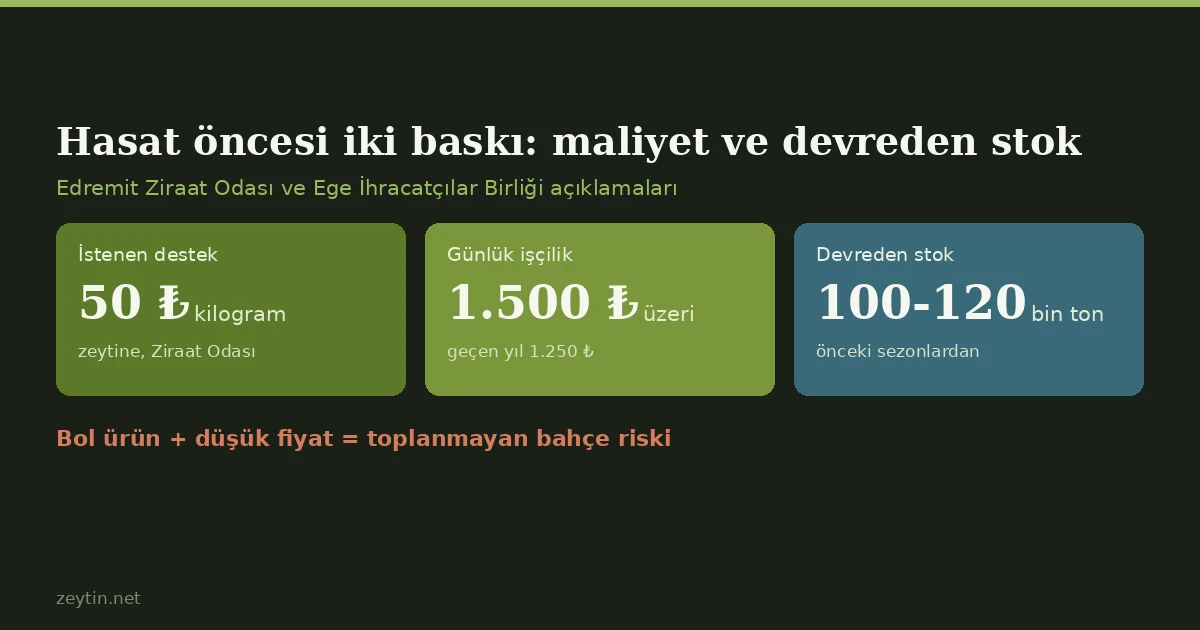
The chamber of agriculture wants 50 lira per kilo; daily labour has passed 1,500 lira. Exporters report 100,000-120,000 tonnes carried over from previous seasons.
 Article
Skilled operators for olive mills: training ends in Milas, Muğla trains women operators
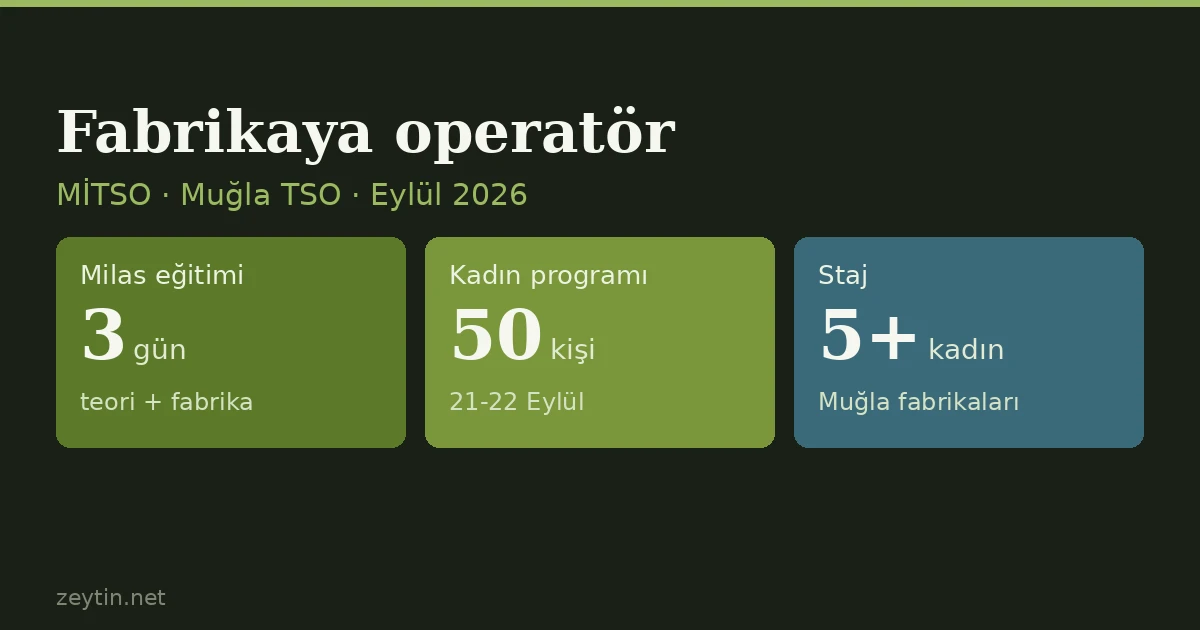
Ahead of the harvest, two training programmes in Muğla focus on operators, the most critical link in olive mills. A three-day operator course run by MİTSO, Milas Tariş and HAUS Makine has ended in Milas, and the Muğla Chamber of Commerce and Industry is launching a 50-place "Women's Hands in Industry" programme to train women as mill operators.
 Article
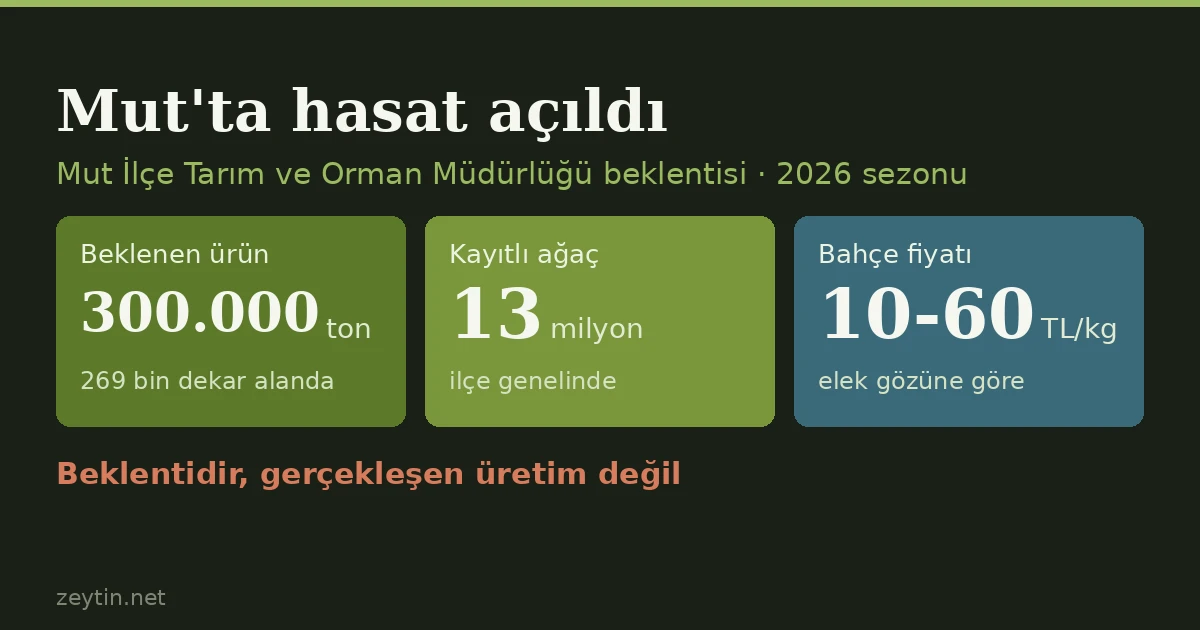
Harvest opens in Mut: 300,000 tonnes expected, orchard prices start at 10 lira
Mut's district agriculture directorate reports 300,000 tonnes expected from 269,000 decares, with orchard prices ranging from 10 to 60 lira by sieve size. Yield is high but growers are unhappy with prices. Set against our own Mersin figures the tonnage leaves an unresolved measurement gap, and we report it as such.
 Article
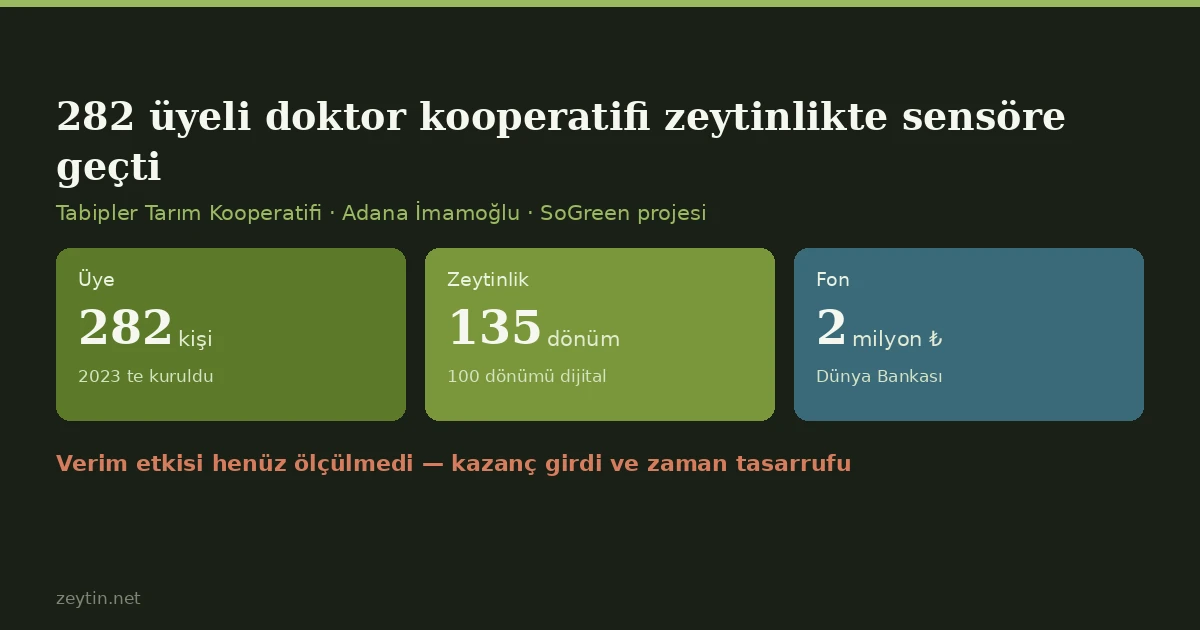
A 282-member doctors' cooperative puts sensors in the olive grove
A cooperative founded by doctors in Adana is monitoring water and fertiliser with buried sensors across 100 of its 135 dönüm of bearing olive grove, funded with 2 million lira.