Why is my olive tree not bearing fruit? 9 causes and what to do
Behind an olive tree that flowers but sets no fruit, fills one year and stays empty the next, or has never cropped at all, there is usually more than one cause. From the tree's age and lack of grafting to missing pollinators, insufficient chilling, drought and the wrong fertiliser or pruning, here is how to diagnose by symptom and what to do.
"My tree flowers but sets no fruit", "It was full last year and doesn't have a single olive this year", "It has been in the ground for five years and I still haven't seen any fruit." These are the complaints heard most often from olive growers and people with a few olive trees in the garden. There is rarely a single reason an olive tree does not bear fruit; several factors usually overlap. This guide lists the nine most common causes with their symptoms and explains what can be done about each.
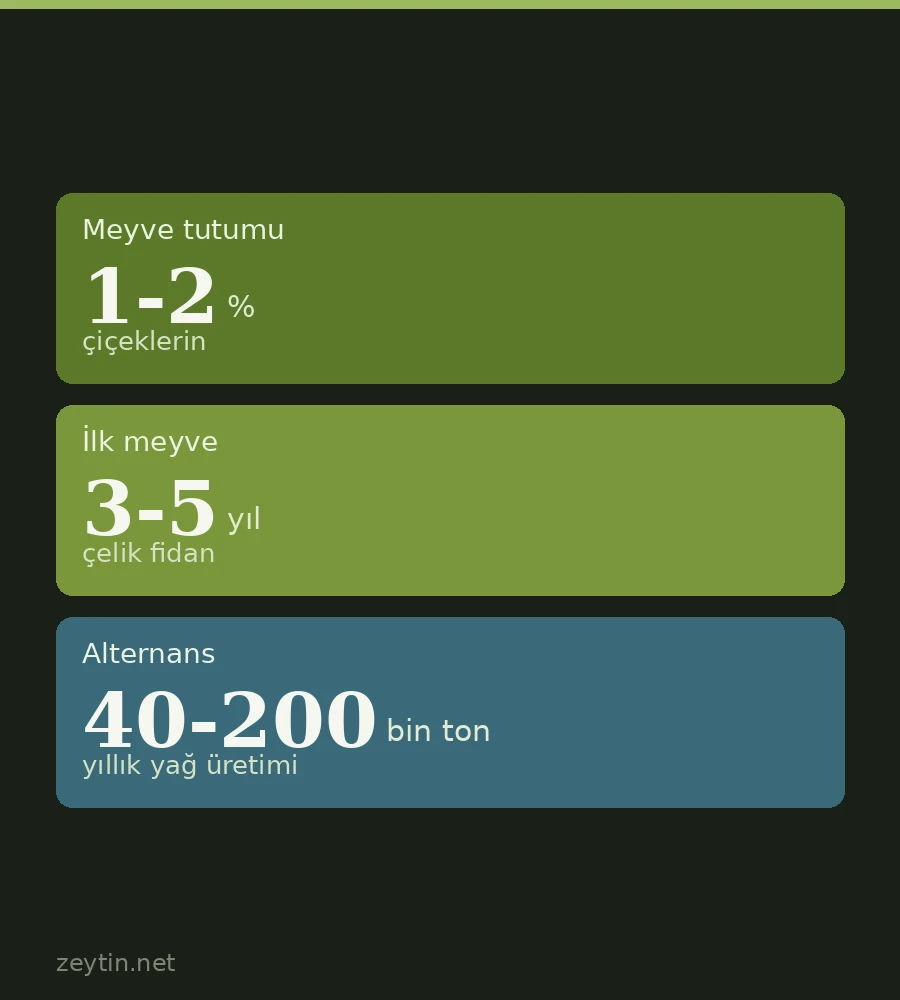
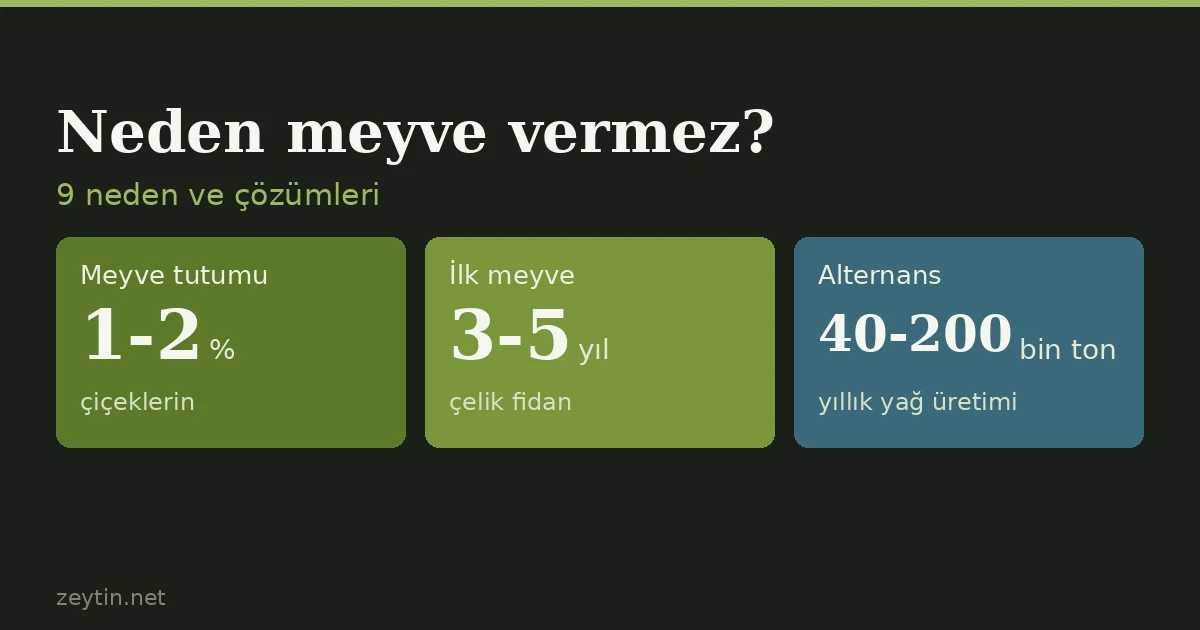
First, one fact to know: in olives, 98% of flowers drop and only 1-2% set fruit. It is therefore normal for the ground under a tree in an on-year to be covered with fallen flowers. The problem is when even that small share does not set.
1. The tree is still young
Symptom: the tree is healthy and growing but shows no flowers or fruit.
A cutting-propagated sapling of a cultivated variety usually gives its first fruit in 3-5 years and reaches full yield later. Trees grown from seed have a much longer juvenile phase. Below that age, a lack of fruit is not a problem but what you should expect. Forcing a young tree with too much fertiliser and hard pruning can delay flowering even further. We explain planting and care in the first years in how to plant an olive sapling.
2. The tree is ungrafted (wild)
Symptom: the tree is old and occasionally gives small fruit with large stones, or hardly any at all.
Self-sown or seed-grown ungrafted trees (known in Türkiye as delice) can flower and set fruit, but their olives are small, have little flesh and yield poorly. Rather than removing such a tree, top-working it with a cultivated variety is the fastest way to benefit from a root system decades old; a top-worked tree usually starts cropping in its third year. You will find the method in our guide how to graft olive trees.
3. The "off-year": alternate bearing
Symptom: the tree is heavily laden one year and almost empty the next; the cycle has repeated for years.
This is called alternate bearing. A tree that fruits heavily spends most of its energy on the crop, and developing fruit suppresses the formation of next year's flower buds. Across Türkiye the swing is so large that olive oil output can fall to 40,000 tonnes one year and rise to 200,000 tonnes the next.
What to do: the swing cannot be eliminated but can be softened: harvest on time without leaving fruit on the tree, prune regularly every year and replace the nutrients the tree used in its on-year. Details are in our article on alternate bearing in olives.
4. No pollinator variety
Symptom: the tree flowers abundantly every year, but fruit set stays poor year after year; there is only one variety in the grove.
Olives are wind-pollinated; they do not need bees. But many varieties are self-incompatible: pollen from the same variety cannot fertilise the flower, or does so only weakly. In a single-variety grove, or a lone tree with no other olives nearby, fruit set can therefore stay low. Research shows that pollen from another variety increases fruit set even in varieties considered self-fertile.
What to do: plant a pollinator variety with a matching flowering time, or graft a pollinator onto some of the existing trees. We explain which variety pollinates which in pollination and pollinator varieties in olive.
5. The winter was not cold enough
Symptom: after a mild winter, flowering is sparse and uneven; the grove is coastal or in a very warm area.
Olives need a period of cool winter temperatures to form flower buds. This chilling requirement varies by variety. After very mild winters, or when a variety with a high requirement is planted in a warm area, flowering weakens. The problem is appearing more often with climate change. We cover it on our page on chilling requirement in olives.
What to do: there is little to be done for an existing tree; for new plantings the variety should be chosen to suit the area's winters.
6. Water shortage at critical stages
Symptom: a dry spring; few flowers, or fruit sets and then drops soon after.
"Olives tolerate drought" is true, but tolerating is not the same as cropping. The two stages where water stress does most harm are:
- Before flowering (April-May): water shortage at this stage directly reduces the number of flowers that year.
- Fruit set and early growth (May-June): the 4-6 weeks after fertilisation are when fruit cells divide; water shortage here permanently reduces fruit numbers.
What to do: if possible, irrigation that gives priority to these two stages. We explain irrigation timing in olive irrigation and drip systems.
7. Wrong fertilisation: too much nitrogen, too little boron
Symptom: the tree is very lush with long, green shoots but few flowers; or flowers are abundant but fruit set is poor.
- Excess nitrogen produces lots of shoots and shade; flower buds decrease and fruit set falls. The thinking "the tree isn't cropping, let's give it more fertiliser" can therefore make the problem worse.
- Boron deficiency directly affects pollen viability and fruit set. But boron has the narrowest gap between adequate and toxic of any element; no boron should be applied without analysis.
What to do: leaf and soil analysis instead of guesswork, and a programme based on measurement. Details are on our olive fertilisation and soil analysis page.
8. Pruning mistakes
Symptom: either a tree pruned very hard that keeps throwing strong upright shoots, or one unpruned for years, dark inside, with fruit only on the outer shell.
Olives bear fruit on shoots formed the previous year. That is why:
- Over-hard pruning removes the shoots that would fruit and pushes the tree to produce wood instead of fruit.
- No pruning leaves the inside of the canopy in shade; branches that get no light form no flower buds, and the crop is squeezed into a thin outer shell.
- Mistimed pruning (after shoots have broken) wastes the energy the tree has spent.
What to do: a balanced production pruning every year that lets light into the canopy. You will find the method in our guide olive pruning: how and when.
9. Diseases, pests and weather
Symptom: flowers or young fruit are damaged; leaves have dropped; unusual weather occurred during flowering.
- The flower generation of the olive moth feeds on flower clusters and can reduce fruit set. We describe the moth's three generations in the year in our article on the olive moth.
- Diseases that cause leaf drop, such as peacock spot, reduce the leaf area that feeds flowers and fruit; details are on our olive peacock spot page.
- Prolonged rain or hot, dry winds during flowering can interfere with pollination and fertilisation. Nothing can be done about it, but knowing the cause prevents the wrong response.
- Trees hit by frost damage may also fail to crop for a year or two.
Quick diagnosis by symptom
| What you see | Cause to check first |
|---|---|
| No flowers, young tree | Age (1) |
| No flowers, lush green tree | Excess nitrogen (7), hard pruning (8) |
| Few flowers after a mild winter | Chilling (5) |
| Plenty of flowers but no fruit set; single variety | No pollinator (4), boron (7) |
| Fruit set but dropped early | Water stress (6) |
| Full one year, empty the next | Alternate bearing (3) |
| Small fruit, large stone, always low yield | Ungrafted tree (2) |
| Dark inside, fruit only on the outer shell | Lack of pruning (8) |
| Leaf drop, damage to flowers | Disease and pests (9) |
The most common mistake with fruitless trees is to fix on a single cause and respond with a drastic intervention: more fertiliser, harder pruning, random spraying. The right path is usually to assess the tree's age, variety and surroundings first, then move forward with small, measurement-based corrections. You will find the olive tree's general structure and care on our olive tree page.
One rating per visitor; you can change yours at any time. Ratings are real reader votes — no seeded or default scores.
Related
 Article
Where does an olive sapling come from? From cutting to laboratory
Most table olive varieties will not root, and those that do are clones of one another — defenceless against disease. Tissue culture reports up to 85% success in vitro, but zeatin is expensive.
Article
Where does an olive sapling come from? From cutting to laboratory
Most table olive varieties will not root, and those that do are clones of one another — defenceless against disease. Tissue culture reports up to 85% success in vitro, but zeatin is expensive.
 Article
Frost damage in olive trees: signs, risk factors and what to do after a frost
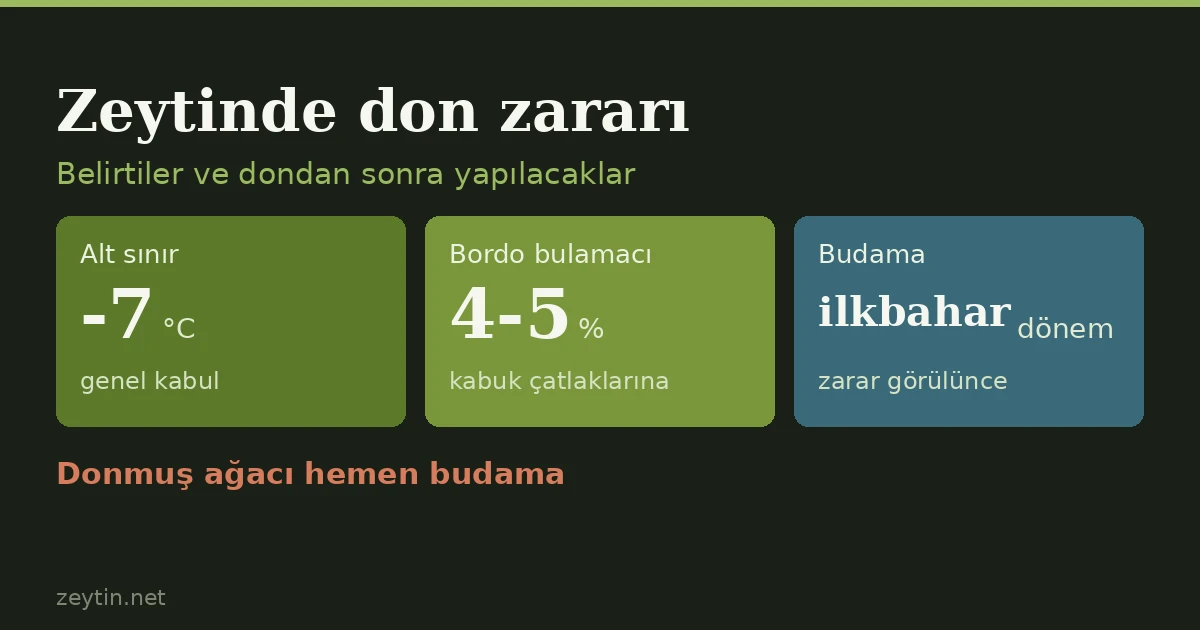
The generally accepted lower limit for olives is around -7 °C, but damage does not depend on the thermometer alone: how long the cold lasts, sudden drops, humidity, tree age and nutrition all matter. Here are the signs of frost damage on leaves, shoots, bark and fruit, ways to reduce the risk and which job to do when after a frost.
Article
Frost damage in olive trees: signs, risk factors and what to do after a frost
The generally accepted lower limit for olives is around -7 °C, but damage does not depend on the thermometer alone: how long the cold lasts, sudden drops, humidity, tree age and nutrition all matter. Here are the signs of frost damage on leaves, shoots, bark and fruit, ways to reduce the risk and which job to do when after a frost.
 Article
Nutrient deficiencies in olive: from symptom to element
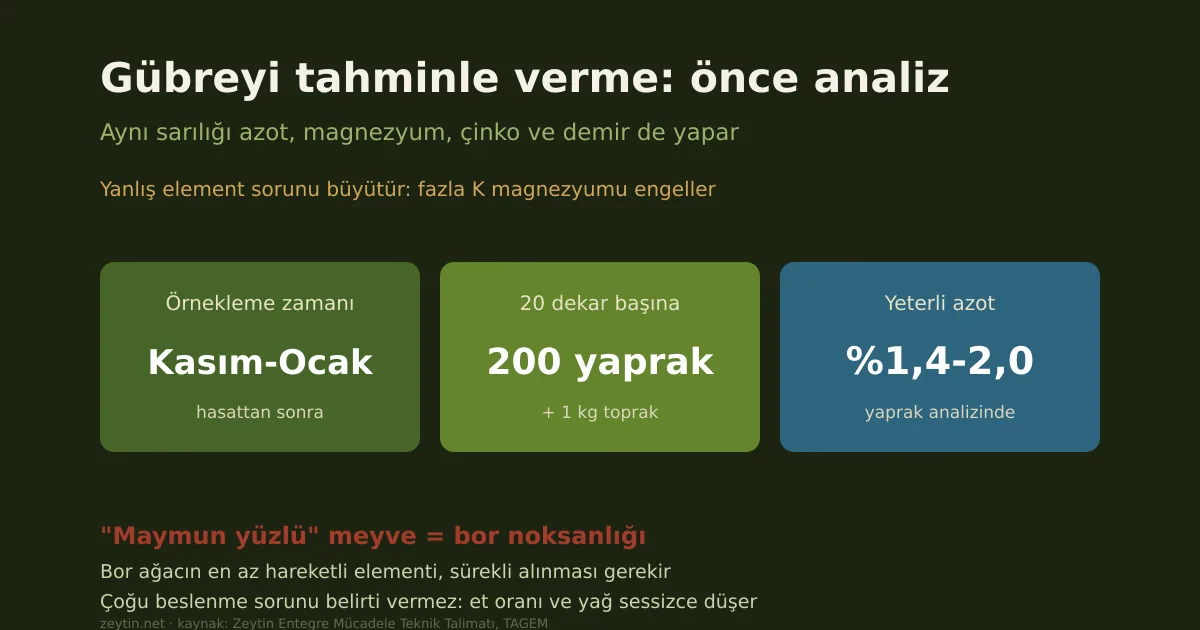
The same yellowing can mean nitrogen, magnesium, zinc or iron, and the wrong element makes it worse. Standard leaf analysis values, symptom-to-element matching and the boron schedule.
Article
Nutrient deficiencies in olive: from symptom to element
The same yellowing can mean nitrogen, magnesium, zinc or iron, and the wrong element makes it worse. Standard leaf analysis values, symptom-to-element matching and the boron schedule.
 Article
Olive Pruning: Why, When and How
Why olives are pruned, when to do it, formative and production pruning, rejuvenation and high-density systems.
Article
Olive Pruning: Why, When and How
Why olives are pruned, when to do it, formative and production pruning, rejuvenation and high-density systems.