Who protects the olive tree? Three layers, from the IOC to Law 3573
We have cited the International Olive Council in 23 articles without ever saying what it is. The three orders that protect the olive: trade standards, landscape conventions, and Türkiye's 1939 Law No. 3573.
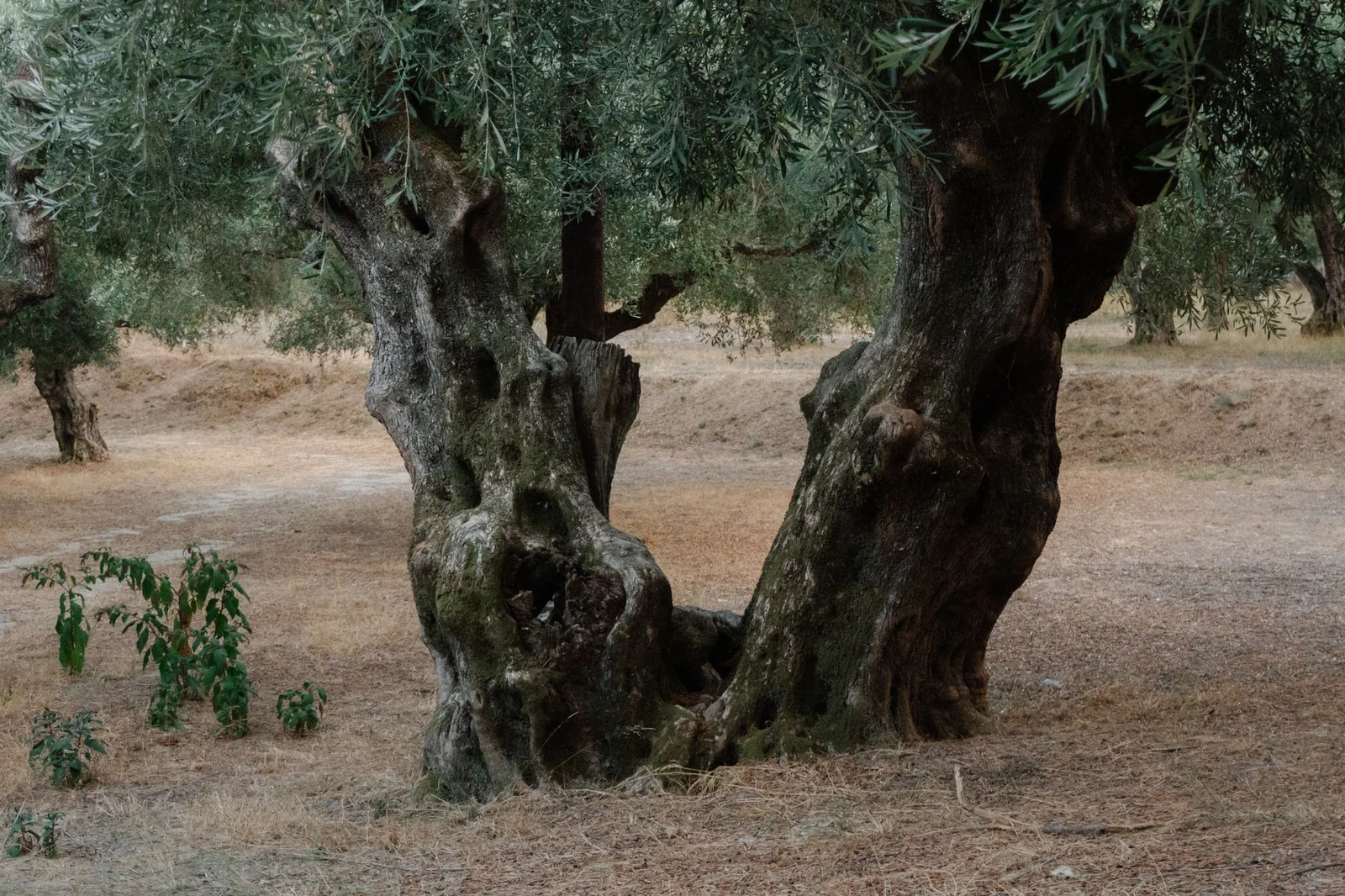
On this site, the International Olive Council appears in 23 separate articles. We lean on it when quoting harvest figures, comparing prices across countries, explaining what makes an oil "extra virgin". Yet not one of those articles ever said what the Council actually is, who founded it, or where Türkiye stands in it.
This article fills that gap. The texts that protect the olive tree are not gathered in one place; they sit in three distinct layers and they do different jobs. Much of the public argument runs in circles precisely because these layers get conflated: a trade standard is not a substitute for an environmental convention.
Layer one: the trade standard
The oldest international body concerned with olives is the International Olive Council (IOC). The decision to found it was taken in Madrid in 1956, under the auspices of the United Nations; it has been operating since 1959, still headquartered in Madrid.
Its core task is to administer one agreement: the International Agreement on Olive Oil and Table Olives. What it does is replace scattered national practice with a common vocabulary — from what may be called "extra virgin" to the criteria by which table olives are graded. That is why even a discussion of the price gap between extra virgin and riviera is, underneath, a discussion in the Council's definitions. The European Union is itself a member and keeps its own standards aligned with the Council's rules.
Türkiye's membership history is not a straight line. It joined in 1963. It withdrew in 1998 for political reasons. Its membership was accepted again in 2010. That twelve-year absence meant one of the world's four largest table-olive producers was not at the table while the international standard for its own product was being written.
A boundary is worth drawing here. The Council is a standards and promotion body. It does not stop trees being felled, does not grant or refuse development permits on olive groves, does not fine anyone. Mistaking it for a protection authority is exactly the misunderstanding this article set out to correct.
Layer two: landscape and plant health
The texts that concern the tree itself sit elsewhere.
The European Landscape Convention (Council of Europe, 2000) governs the protection, management and planning of landscapes and aims to organise cooperation between states. Olive groves fall within its scope as a defining element of the Mediterranean landscape and of maquis terrain. The grove is protected here not as an agricultural parcel but as part of the view — the idea that what is lost when a grove goes is not only a crop finds its legal expression in this text.
On plant health there is the International Plant Protection Convention (IPPC). Signed in 1951 by a substantial share of the members of the UN Food and Agriculture Organization, revised in November 1997, it became one of the broadest multilateral agreements on the protection of agricultural products, with 183 states party to it. The entire quarantine apparatus against cross-border spread of pests and disease rests on this framework.
A third marker is cultural: 26 November, World Olive Tree Day, declared by the UNESCO General Conference in 2019. Its purpose is to draw attention to the protection of olive trees as a shared heritage of humanity. It carries no binding provision, but it is an official record moving the olive out of the category of agricultural commodity and into the category of heritage.
Two countries, two protective instincts
Spain puts commercial value at the centre. Producers are supported through the EU's Common Agricultural Policy and local measures, and more productive systems are encouraged; the result is cereal land converting to olive groves. In the rural districts of Córdoba known as the Campiña, olive area rose from 7,997.8 hectares to 16,447.6 hectares between 2005 and 2018 — more than doubling in thirteen years.
But growth brings its own problem. Drought followed by sudden rainfall leaves groves and maquis exposed to erosion. The remedy Gómez (2017) proposes is agronomic rather than technological: cover crops. Not leaving the soil bare answers water management and erosion control at once. That detail matters when discussing the effect of climate change on the olive: the risk is not only in temperature but in the regime of rainfall.
Montenegro looks at it from the opposite end. Its economy rests on tourism and services, and the great majority of its olive producers are family holdings working by traditional methods. The country prioritises protecting its historic landscape and its trees from disease, and has placed certain monumental trees under direct statutory protection: Stara Maslina in the Bar region, believed to be over 2,000 years old, and Velja Maslina near Budva.
The contrast matters. Spain expands the area; Montenegro protects the individual tree. The question of what instrument Türkiye has for the monumental olive trees of Edremit is precisely the question of that second model.
Layer three: olive law in Türkiye
The principal Turkish text protecting the olive is Law No. 3573 on the Improvement of Olive Cultivation and the Grafting of Wild Olives. It dates to 1939, and it carries a notable distinction: it is the first law ever enacted in Türkiye for any tree. It is the concrete residue of the effort put into developing olive growing immediately after the founding of the Republic.
The law has been revised twice: in 1995 by Law No. 4086, and in 2008 by Law No. 5728. The 2008 amendment updated the penalties, setting an administrative fine of 60 TL per tree for felling without permission. That is a 2008 figure — administrative fines in Türkiye are revalued annually — but it remains the starting point of every argument about deterrence.
The most contested provision is Article 20: within olive grove areas, and within at least 3 kilometres of them, no facility discharging chemical waste or emitting dust and smoke such as to impede the vegetative and generative development of the groves may be built or operated, olive oil factories excepted. How that article has been worn down over the past twenty years is recorded chronologically in a separate piece: olive groves and mining — the legislative record from 3573 to 7554.
Secondary regulation sits alongside the law: the Regulation on the Improvement of Olive Cultivation and Grafting of Wild Olives (establishing groves in ecologically suitable areas, raising yield and quality), the Regulation on the National Olive and Olive Oil Council, the Environmental Impact Assessment Regulation, and the regulation on associations for combating olive pests and diseases.
The scale being protected is not small. Following the support and allocation programmes run between 2005 and 2013, Türkiye's olive tree stock rose to roughly 180 million. Production is spread across six regions — Marmara, Southern Aegean, the Gulf, Coastal and Eastern Mediterranean, Gediz and the Eastern Black Sea.
The distance between paper and ground
All three layers are in place. Olive groves are nonetheless under pressure, and the reason is not in the paper but in the priorities.
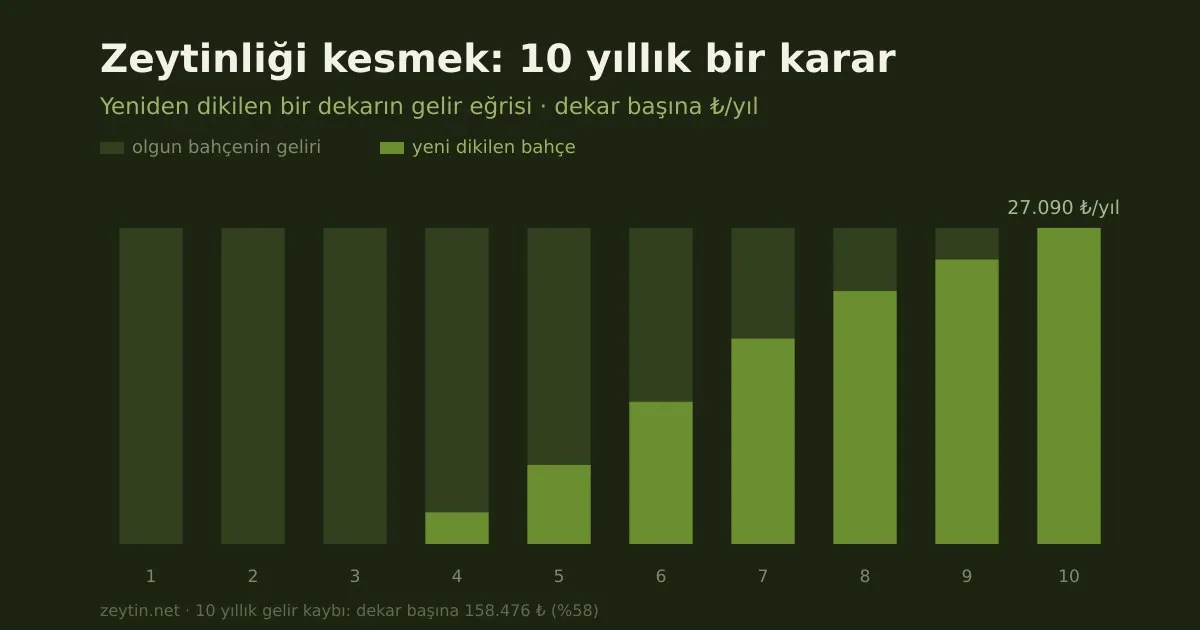
The need for development pushes energy, industry, tourism and construction investment to the front; those investments repeatedly meet olive groves, and on grounds of public interest the olive comes second. Unplanned urbanisation and the opening of agricultural land and tourism zones to development produce the same result. The loss is irreversible: when a grove is built over, what is lost is not only the trees but the fifteen to twenty years needed to replace them. We set out the arithmetic of that decision in felling a grove — the arithmetic of a ten-year decision, and the structural problems of Turkish olive growing shows the same picture from the producer's side.
Protection outside the state: associations, museums, festivals
Protection does not run on legislation alone, and in recent years most of the movement has been on the civil side.
The Zeytin Dostu Derneği (Friends of the Olive Association) is the sector's oldest and strongest civil society organisation, running olive oil awareness and tasting programmes. TEMA's Olive School in Karaburun, İzmir, the Zeytince Association, and the Boutique Olive and Olive Oil Producers Association in İzmir work the same ground. The National Olive and Olive Oil Council's cooperation with the İzmir Commodity Exchange, and the celebration of World Olive Day in İzmir, are signs of Türkiye becoming visible internationally again.
On the cultural side, museums are multiplying: the Evren Ertür Olive Oil Museum in Edremit was founded by an olive oil company and focuses on production technology. The Ancient Klazomenai Project in Urla runs on the site of the earliest known olive oil workshop — the present-day counterpart of the archaeological layer described in the olive oil workshops of Antiokheia and the olive oil trade in the ancient world. The Urla Olive Harvest Festival does the same work through local development, with cookery competitions, soap-making workshops and harvest training — which is oleotourism in the plainest sense.
Restoring abandoned old presses, making use of historic workshops in other regions and spreading similar festivals are the shared recommendations of the sources. Geographical indication registrations serve the same logic by another instrument: protecting a product by binding it to its place.
In short
There is no single text protecting the olive. There are three separate orders, each protecting something different:
| Layer | Text / institution | What it protects |
|---|---|---|
| Trade | IOC, International Agreement on Olive Oil and Table Olives | The definition and standard of the product |
| Environment / culture | European Landscape Convention, IPPC, UNESCO 26 November | Landscape, plant health, heritage value |
| National law | Law No. 3573 and its regulations | Area, tree, distance |
The weak link is not the texts but enforcement. Türkiye was a country capable of passing a law for a single tree in 1939; today's argument is not about what that law says, but about how far it is applied.
One rating per visitor; you can change yours at any time. Ratings are real reader votes — no seeded or default scores.
Related
 Article
Felling an olive grove: the arithmetic of a ten-year decision
The ten-year cost of clearing a grove for another crop: establishment, years to bearing and forgone income, per decare.
Article
Felling an olive grove: the arithmetic of a ten-year decision
The ten-year cost of clearing a grove for another crop: establishment, years to bearing and forgone income, per decare.
 Article
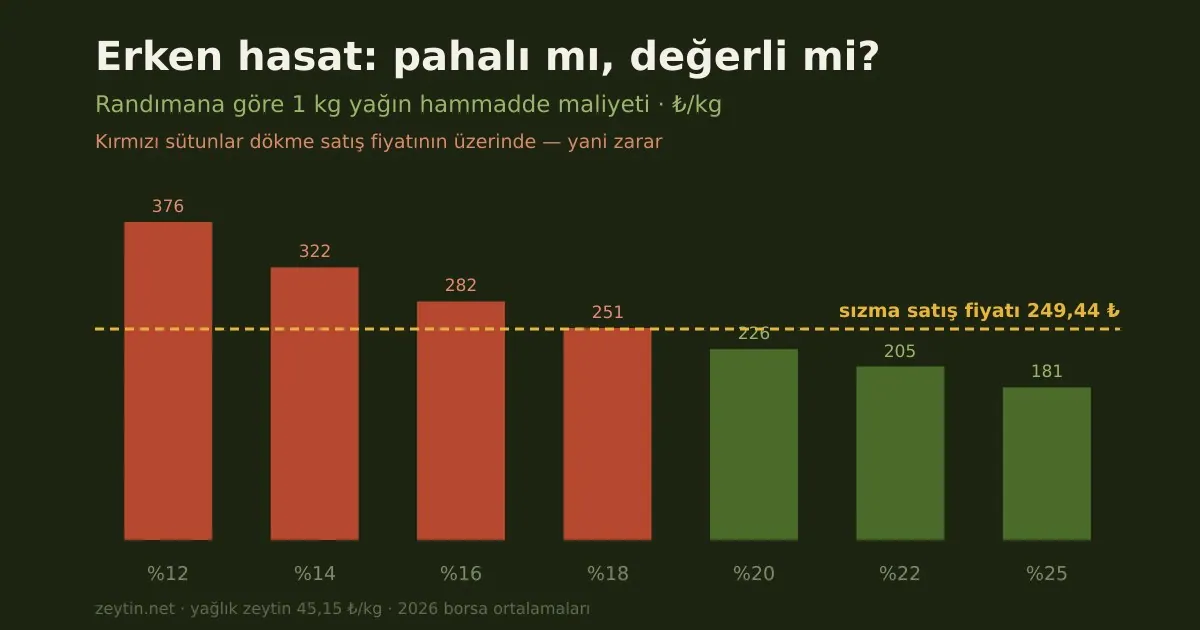
Early harvest: expensive or valuable? The arithmetic of yield
Below 18% yield the raw material costs more than the bulk price. Early-harvest oil needs a 43% premium to break even.
Article
Early harvest: expensive or valuable? The arithmetic of yield
Below 18% yield the raw material costs more than the bulk price. Early-harvest oil needs a 43% premium to break even.
 Article
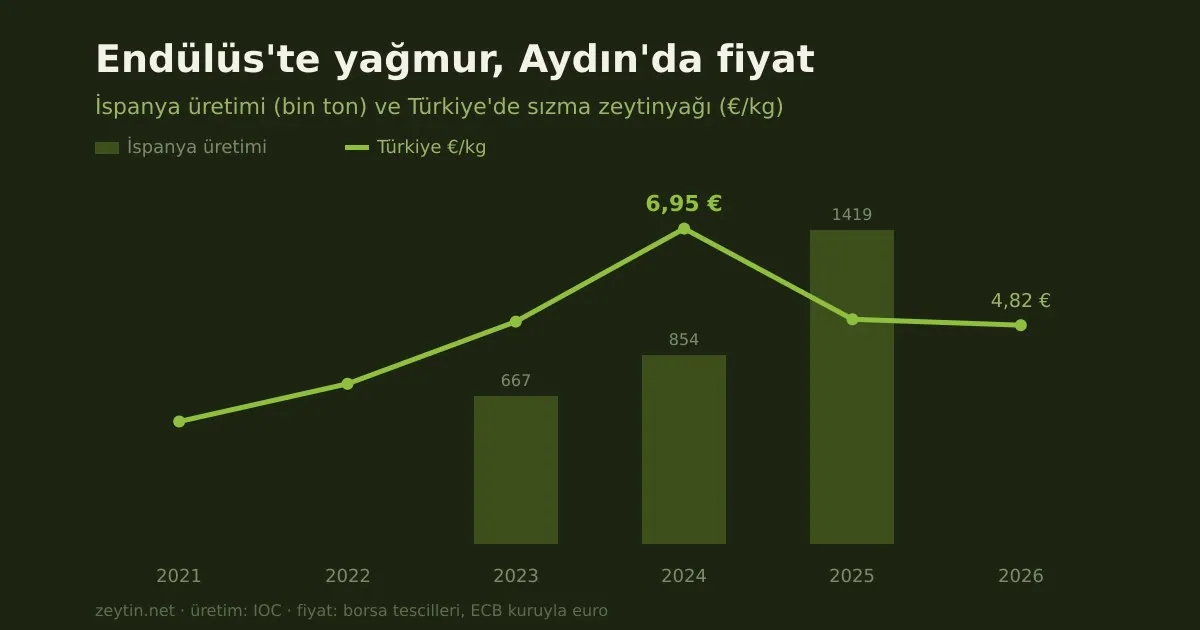
Rain in Andalusia, prices in Aydın: how Spain's drought set the price in Türkiye
Spain makes 40% of the world's olive oil. Its output halved in 2022/23 and Türkiye's euro price went from €2.70 to €6.95.
Article
Rain in Andalusia, prices in Aydın: how Spain's drought set the price in Türkiye
Spain makes 40% of the world's olive oil. Its output halved in 2022/23 and Türkiye's euro price went from €2.70 to €6.95.
 Article
Why is high-polyphenol olive oil expensive, and why do its producers still struggle?
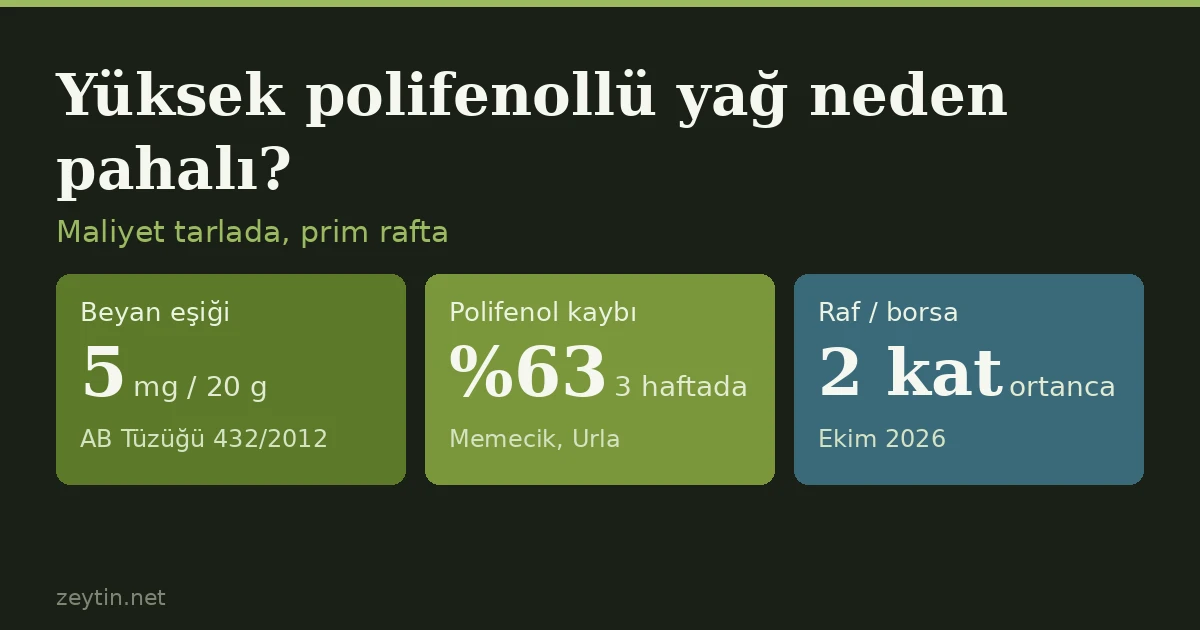
The EU's only olive oil health claim requires 5 mg of hydroxytyrosol per 20 g. In Memecik, total polyphenols drop 63% in three weeks, the regulation names no test method, and the shelf median is twice the bulk price: the premium forms on the shelf, the cost in the grove.
Article
Why is high-polyphenol olive oil expensive, and why do its producers still struggle?
The EU's only olive oil health claim requires 5 mg of hydroxytyrosol per 20 g. In Memecik, total polyphenols drop 63% in three weeks, the regulation names no test method, and the shelf median is twice the bulk price: the premium forms on the shelf, the cost in the grove.