Which soil do olives grow in? Why heavy ground where water stands is the real risk, not lime or stones
Olives grow in many soils; what decides the outcome is whether the soil holds water. The article reads the UC IPM and CDFA guidelines, the FAO salinity table and two Spanish studies on calcareous soil, and sets out which measurements are asked for before planting and which numbers are not given.
Short answer: Olives grow in a wide range of soils; what decides the outcome is less the soil type than whether the soil holds water. The University of California pest management guidelines (UC IPM) advise against planting olives in low-lying areas and in heavy clay soils. Calcareous (limy) soil is not a barrier in itself: in a study in southern Spain, leaf chlorophyll was only weakly related to the amount of carbonate in the soil. This article rests on five sources we read, and it says plainly which numbers those sources do not give.
Where do the roots work?
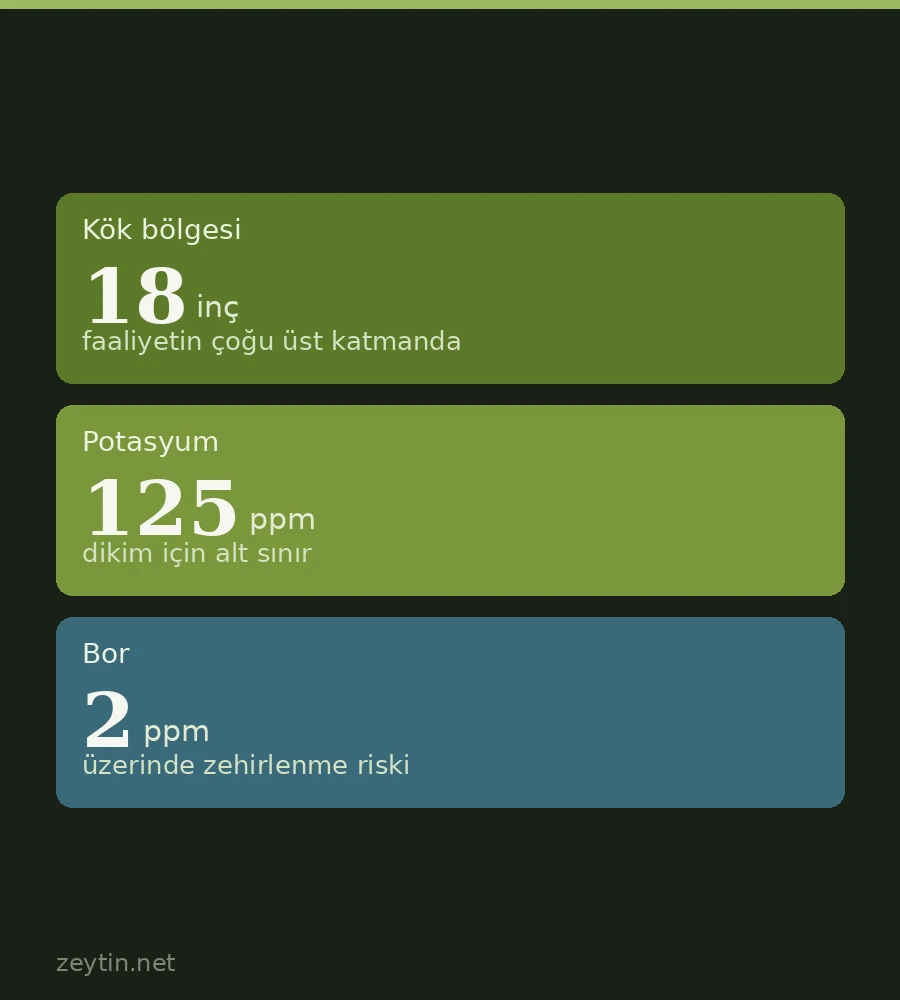
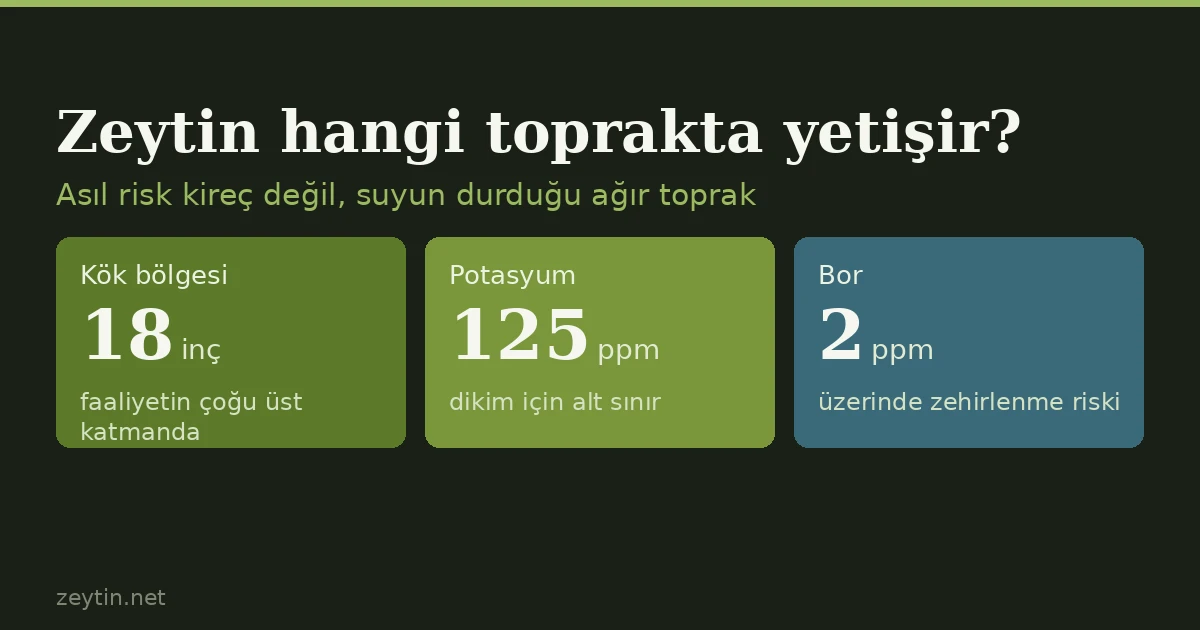
The California Department of Food and Agriculture (CDFA) olive fertilization guidelines state that in irrigated olives most root activity is in the top 18 inches of soil (about 46 cm). Our botany article describes roots that usually concentrate in the first metre and spread beyond the canopy. The two do not conflict: one describes the layer where the roots work hardest, the other the spread. Our own inference is that whether the top half metre of soil gets air matters more than what lies deeper.
The real risk: heavy soil where water stands
The UC IPM page on Phytophthora root and crown rot of olive says the disease develops under "frequent and prolonged periods of soil water saturation", from over-irrigation, excessive rainfall or poor drainage. Its recommended measures: plant trees on berms, shorten irrigation times, keep emitters away from the trunk, and "avoid planting olive trees in low areas and in heavy clay soils". The same page notes that resistant rootstocks are not available, so protection lies more in choosing the site than in choosing the tree.
One more clue from the CDFA guidelines: in California, low phosphorus values are usually caused by poor drainage, and in that case improving drainage is more appropriate than applying phosphorus fertilizer. A low figure on a lab sheet can therefore be a sign of airless soil. For the effect of flooding see our flooded olive tree article, and for the fungi that attack roots and root crowns our root rots article.
What to measure before planting
The CDFA guidelines ask for soil tests for pH, salinity, chloride and boron toxicity before new orchards are planted. They give no numerical range for pH or salinity, and we do not invent one. The figures they do give:
| Measurement | What the source says | Source |
|---|---|---|
| Drainage | Avoid low areas and heavy clay soils; plant on berms if needed | UC IPM |
| Potassium | New orchards should be planted in soil with at least 125 ppm potassium | CDFA |
| Boron | Above 2 ppm in the saturated paste extract or in irrigation water, excess boron may become a problem | CDFA |
| pH, salinity, chloride | Test before planting; the guidelines give no numerical range | CDFA |
| Lime, clay, iron | Carbonate alone is not decisive; tolerance is mainly set by the rootstock | Benitez 2002; Alcántara 2003 |
For the leaf side of measurement see our leaf analysis article, and for the fertilizer programme our fertilisation and soil analysis article.
Sandy soil and potassium
The CDFA guidelines write that potassium deficiency is more common in California in the Butte County foothills and in sandy soils. The symptoms listed: shoots stay short, the distance between leaves on the shoot is shorter than normal, leaves are first pale green, tips and sides are burned (most evident in early spring), and fruits are smaller. The guideline's planting threshold of 125 ppm is therefore one of the figures to measure before planting. On sandy land, having this measured before planting is an easier route than looking for the shortage after symptoms appear.
Boron: a two-sided risk
Boron comes up in site choice from both directions. According to CDFA, deficiency shows first as chlorotic tips on the youngest leaves, then the tips die and yellow bands form. Boron matters for pollen tube formation; deficiency reduces fruit set, immature fruits may drop in July-August, and severely affected fruits can become misshapen. In a July leaf sample the sufficient range for boron is 19-150 ppm, and above 185 ppm counts as excessive. Boron above 2 ppm in the soil or the irrigation water carries a toxicity risk. In short, both too little and too much of the same element can cause trouble; on land to be irrigated from a well, the boron level of the water should be tested too.
Questions to ask, in order, when choosing soil
Following the shared logic of the sources we read, a pre-planting sequence could be:
1. Is the plot low-lying or heavy clay? If so, plant on berms or choose other land.
2. How long does water stand after rain or irrigation? Aeration of the top half metre is critical.
3. Has a laboratory measured pH, salinity, chloride, boron and potassium?
4. If the land is calcareous, which rootstock is the sapling on, and is there a history of chlorosis?
5. Are the boron and salt values of the irrigation water known?
This list is not an official protocol; it is our own ordering of findings from the sources.
Is calcareous soil a problem?
Benitez and colleagues studied the cultivars Hojiblanca, Manzanillo and Picual on highly calcareous soils in southern Spain, in a 2002 paper in Nutrient Cycling in Agroecosystems. Leaf chlorophyll was measured three times during the growing season with a SPAD meter. The result: chlorophyll was poorly correlated with the carbonate content and reactivity of the soil, but significantly correlated with clay content and with the iron extracted with oxalate. The soil test levels separating chlorotic from non-chlorotic trees were reported as 300 g/kg of clay and 0.35 g/kg of oxalate-extractable iron. The abstract does not spell out the direction of the relationship, so we do not state one. The three cultivars did not differ significantly in susceptibility to chlorosis.
The 2003 study by Alcántara, Cordeiro and Barranco (Journal of Plant Physiology) tested different cultivars and scion-rootstock pairings in containers of calcium-rich soil under two regimes, with and without an iron chelate (FeEDDHA). The authors' conclusion: tolerance is mainly determined by the genotype of the rootstock. For calcareous land this means asking which rootstock the sapling is on, not only which cultivar it is; for rootstocks see our articles on wild-olive rootstock and grafting.
Salinity
In the annex to FAO Irrigation and Drainage Paper 29 (1985 revision, updated with Maas and Grattan 1999 data), olive is rated "moderately tolerant", based on seedling growth and fruit yield. The data in the table give no numerical salinity threshold or yield-loss slope for olive. The paper's caveat matters too: the tables hold in the absence of specific-ion toxicities such as chloride or sodium. For detail see our saline soil article.
Read with care
- All the sources come from California and Spain; this article has no measurements for Turkish soils.
- We give no pH figure because the guidelines we read give none.
- 18 inches (46 cm) covers most of the root activity, not the whole root system.
- The phosphorus-drainage link is written for Californian conditions.
Summary
- For olives, drainage comes before soil type: avoid low-lying and heavy clay ground.
- Most roots work in the top half metre; aeration of that layer is critical.
- Test pH, salinity, chloride and boron before planting; a lower limit of 125 ppm is given for potassium.
- Lime alone is not the problem; chlorosis appears to depend on the rootstock, the clay and the form of the iron.
- On salinity olive is moderately tolerant; specific-ion toxicity is a separate risk.
One rating per visitor; you can change yours at any time. Ratings are real reader votes — no seeded or default scores.
Related
 Article
Will a burned olive tree grow back? What to do in an olive grove after a fire
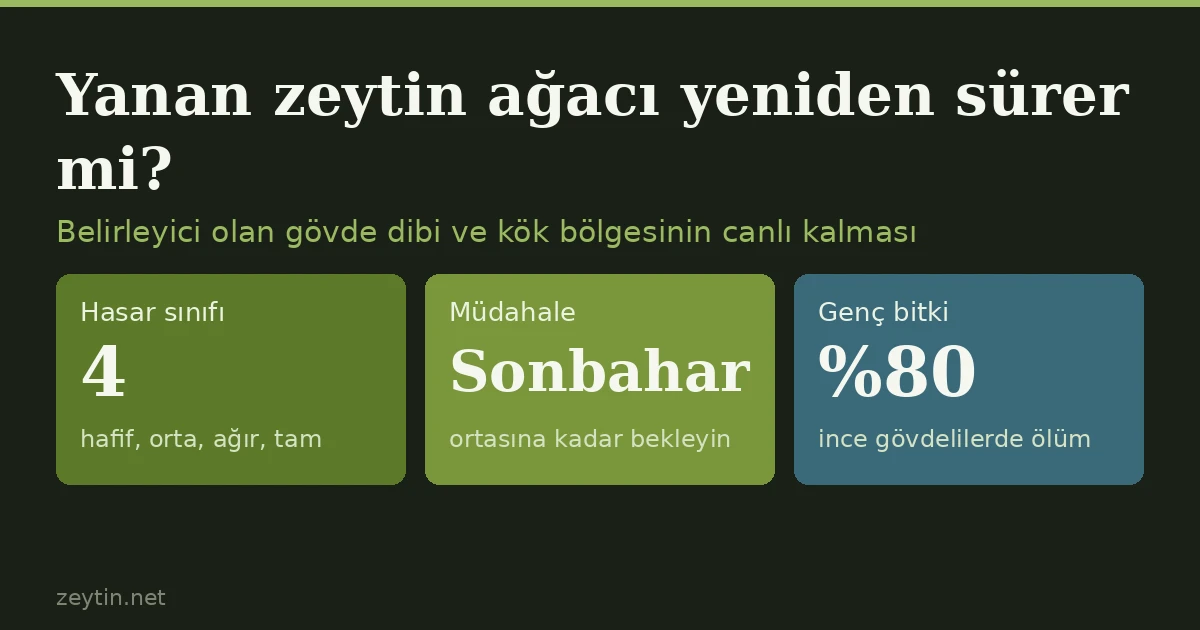
Thanks to the lignotuber at the base of its trunk, an olive usually resprouts after a fire. What matters is whether the root zone survived. Damage classes, why to wait, the graft union, watering before feeding, the law on cutting olive trees and insurance.
 Article
Choosing certified olive saplings: labels, documents and variety
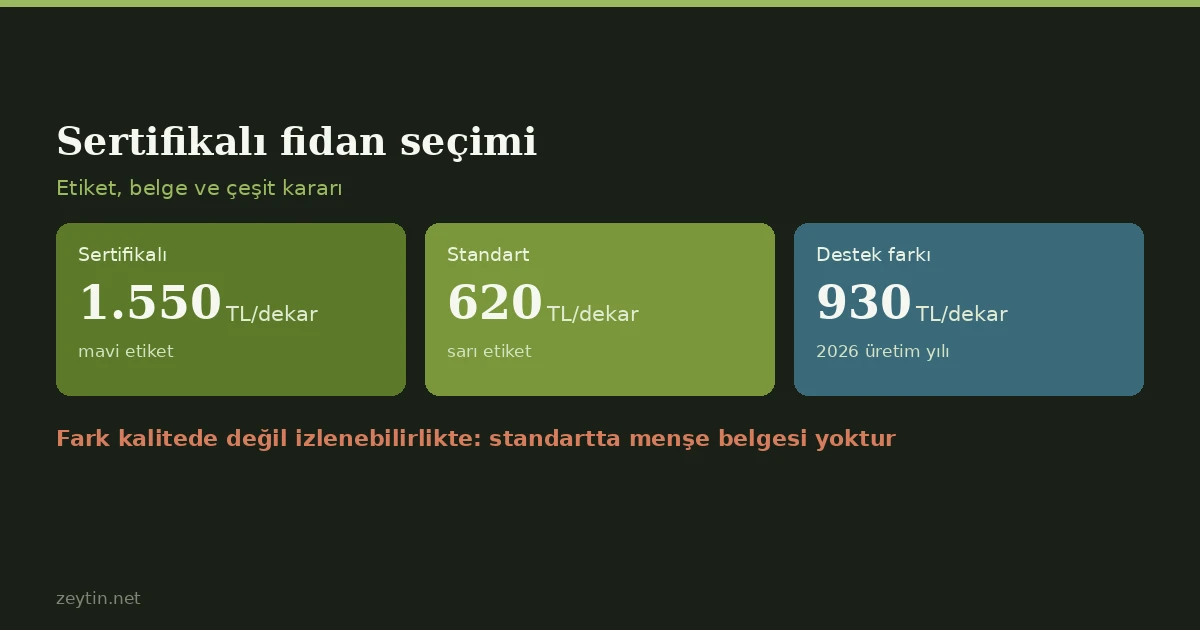
Label colour shows the certificate class: blue certified, yellow standard. The difference is traceability, not quality. The support gap is 930 lira per decare. Four questions that settle variety choice.
 Article
Where does an olive sapling come from? From cutting to laboratory
Most table olive varieties will not root, and those that do are clones of one another — defenceless against disease. Tissue culture reports up to 85% success in vitro, but zeatin is expensive.
 Article
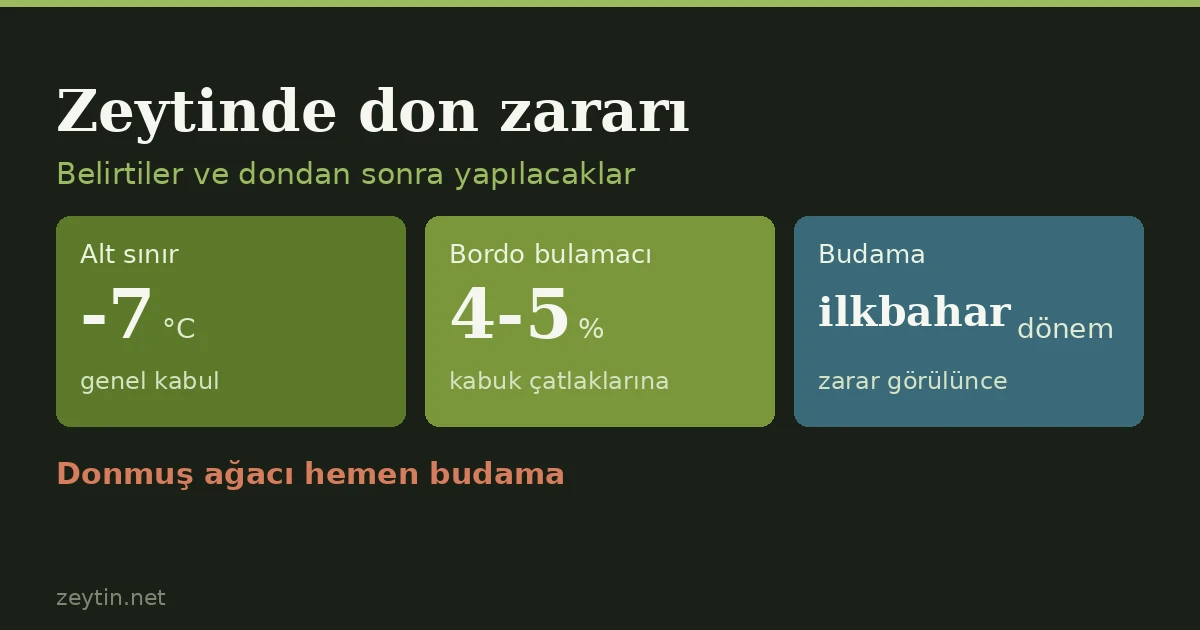
Frost damage in olive trees: signs, risk factors and what to do after a frost
The generally accepted lower limit for olives is around -7 °C, but damage does not depend on the thermometer alone: how long the cold lasts, sudden drops, humidity, tree age and nutrition all matter. Here are the signs of frost damage on leaves, shoots, bark and fruit, ways to reduce the risk and which job to do when after a frost.