If spring runs warm, do olive trees flower earlier? In young trees warmed by 3-4 °C in Argentina, flowering came 8.5-18.5 days sooner
In young olive trees whose spring was warmed by 3-4 °C in Argentina, the flowering stages came 8.5-18.5 days earlier and flowering shortened; fruit set fell in Coratina and did not in Arbequina in one year. The article reads the 2026 study and states plainly the limits of young potted trees.
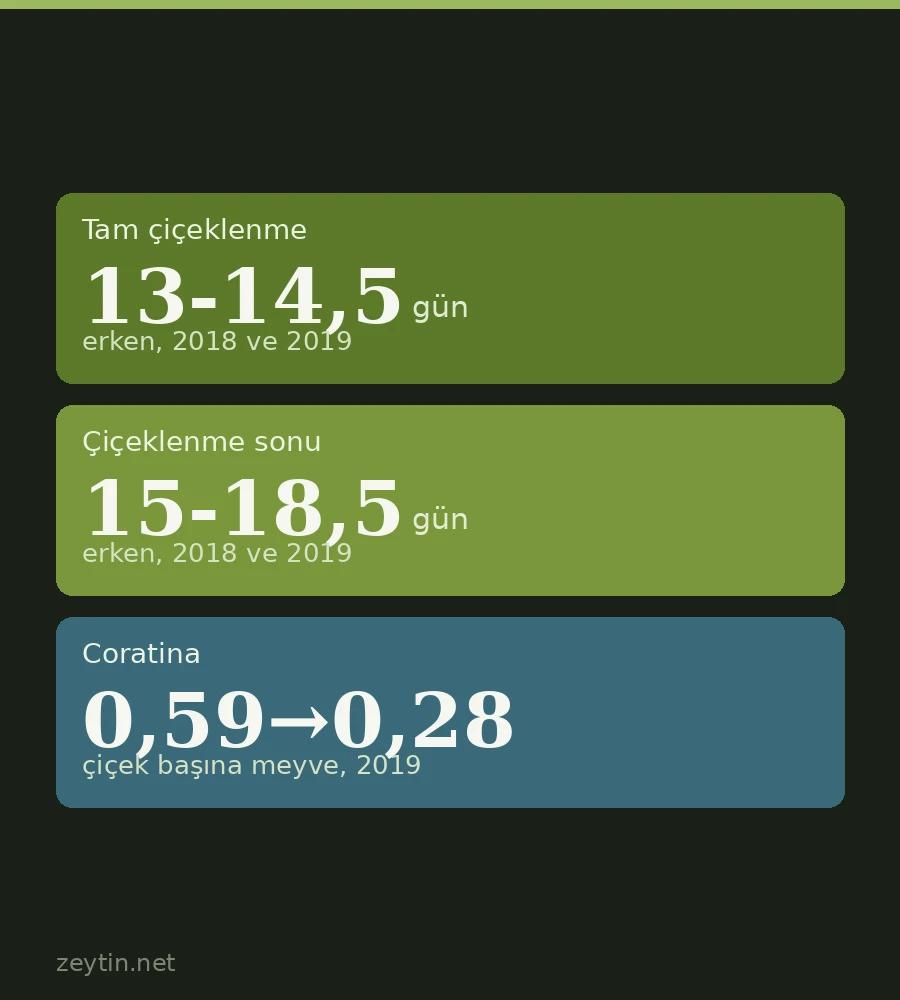
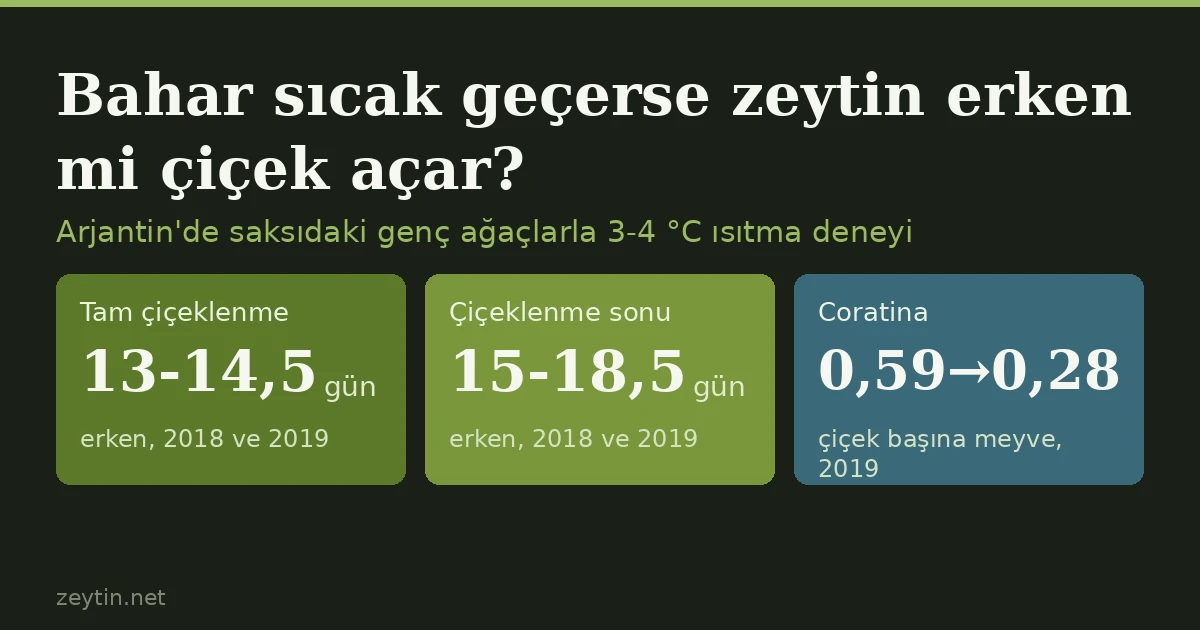
Short answer: In the experiment, yes: in young olive trees whose spring was warmed by four degrees, the flowering stages came 8.5-18.5 days earlier, the flowering period got shorter and pit hardening ended earlier. The cost showed in fruit set: on the hottest days fruit set fell in the cultivar Coratina, while in Arbequina it did not fall in one of the years. This article reads a study published in Plants in 2026 (Hamze, Searles, Iglesias and Rousseaux). It was run in Argentina on two- and three-year-old potted trees, so carrying its results straight over to a mature orchard would not be right.
How was the experiment set up?
The researchers worked with open-top chambers at the experimental station in La Rioja (Argentina, latitude 28°48' south, 1,325 m above sea level). The climate there is continental; temperatures range from frost to 40 °C and annual rainfall is 100-400 mm. Two cultivars were chosen: Arbequina and Coratina. The trees stood in 30-litre pots and were irrigated daily and fertilised monthly. In 2018 the trees were 2 years old and in 2019 (a new group of trees) 3 years old.
Each cultivar and temperature combination had four chambers, 16 in all. Control chambers (T0) were kept near outside air; warmed chambers (T+) were heated to 4 °C above the control. Heating ran through the late-winter and spring period of the southern hemisphere, from mid-August (15 August in 2018, 9 August in 2019) to 4 December 2018 or 29 November 2019. August-December in the southern hemisphere corresponds to roughly February-June in the northern one; that matching is our own interpretation. Heating began only after the chilling requirement was met (931 chilling units in 2018 and 1,200 in 2019). The difference actually achieved was 4.0 °C in 2018 and 3.2 °C in 2019 (daily means of 24.0 against 20.0 °C and 22.2 against 19.1 °C). We explain chilling in our chilling requirement article.
How much earlier did flowering come?
Warming pulled forward almost every stage from flower bud to flowering. Averaged over the two cultivars:
| Stage | 2018 (2 years old) | 2019 (3 years old) |
|---|---|---|
| First flowers open | 8.5 | 11 |
| Full flowering (half the flowers open) | 14.5 | 13 |
| End of flowering, fruit set | 18.5 | 15 |
The effect accumulated as spring went on: small at the bud stage, large by the end of flowering. Flower bud opening came 10 days earlier in Arbequina and 7 in Coratina in 2019. The flowering period shortened too: the time from first flower to end of flowering was 10 days shorter in 2018 and 3 days shorter in 2019.
On the fruit side, in 2019 the start of pit hardening came 6 days earlier in Arbequina and 9 in Coratina, and its end 10 and 12 days earlier respectively. The authors link the end of pit hardening to the start of oil accumulation and say this points to oil synthesis possibly starting earlier with warming. That is an inference, not a measurement; oil content was not measured in this study.
Why did fruit set fall?
In 2018 the trees were two years old and flowered very little: fewer than 2.5 percent of buds produced inflorescences (62 percent in 2019). The warmed chambers saw maxima of 40.6 °C (Arbequina) and 42.2 °C (Coratina) during fruit set. As a result, no fruit remained on the warmed trees at the December harvest; control trees averaged 56 fruits per tree. Fruits per inflorescence fell from 1.94 to 0.12 in Arbequina and from 0.63 to 0.12 in Coratina.
In 2019 the picture split by cultivar. The highest temperature in the warmed chambers during fruit set was 38.2 °C (Arbequina) and 37.7 °C (Coratina). In Arbequina fruits per inflorescence were 0.35 (control) and 0.41 (warmed), with no difference. In Coratina it fell from 0.59 to 0.28, more than half. Warmed Coratina trees carried many parthenocarpic, that is seedless and small, fruits. The authors attribute this to reduced pollen fertility at high temperature and say it was "likely", so they did not measure the cause directly. The paper also cites earlier studies reporting that temperatures above 30 °C reduce pollen fertility.
For Arbequina being unaffected, the authors offer one more possibility: fruit set in the warmed trees fell on clear, sunny days, while in control trees it fell mostly on cloudy days, and low sunlight is known to reduce fruit set. So the cultivar difference may not come from the cultivar alone.
Why did shoot and trunk growth not change?
In some years warming brought leaf bud opening forward by about two weeks, but shoot elongation, trunk thickening and total plant mass did not increase. The authors therefore conclude that "reproductive development is more sensitive to warming than vegetative growth" in young olive trees. The dry weight of individual fruits, measured two months later, was higher in warmed trees in both cultivars.
What does this mean for an orchard?
Our readings are limited to what was measured:
- The flowering calendar can shift. An Italian study mentioned in the paper's discussion reports that, across seven sites over six years, the periods before and during flowering shortened at higher temperatures. A field study in Argentina is also cited, finding that each 1 °C rise in mean temperature shortened the time from bud opening to flowering by 4.3 days. These come from the paper's references.
- Overlap with the pollinator cultivar matters. The authors say shorter flowering periods may affect flowering overlap between cultivars, which matters for cross-pollination. What pollinators do is explained in our pollination article.
- The cultivar matters. Under the same warming Coratina lost fruit set and Arbequina did not in one year. A two-cultivar experiment cannot show that "this cultivar is tolerant"; the authors say more cultivars and regions need to be tested.
- For the wider climate picture see our climate change and the olive article.
Limits of the study
- Potted, regularly irrigated and fertilised trees aged two to three, not a mature rainfed orchard.
- Only four chambers per combination; two years, two cultivars.
- Flowering was very weak in 2018, so the fruit set figures that year are fragile; the authors attribute the low flowering to tree age and possibly insufficient chilling.
- Oil content, harvest date and yield were not measured.
- This is not an experiment from Turkey or the northern hemisphere.
Summary
- Warming spring by about 3-4 °C pulled flowering stages forward by 8.5-18.5 days in young olive trees and shortened flowering.
- Pit hardening also ended earlier; this suggests oil synthesis could start earlier but it was not measured.
- Fruit set varied by cultivar: it fell in Coratina and did not in Arbequina in one year.
- Shoot and trunk growth did not increase with warming.
- The results apply to young potted trees and cannot be applied directly to an orchard.
One rating per visitor; you can change yours at any time. Ratings are real reader votes — no seeded or default scores.
Related
 Article
How to Grow an Olive Tree
Soil, climate, watering, pruning and patience. A basic care guide for anyone planting an olive tree.
 Article
What does strong wind do to an olive tree? Broken branches, drying wind, salinisation and protection
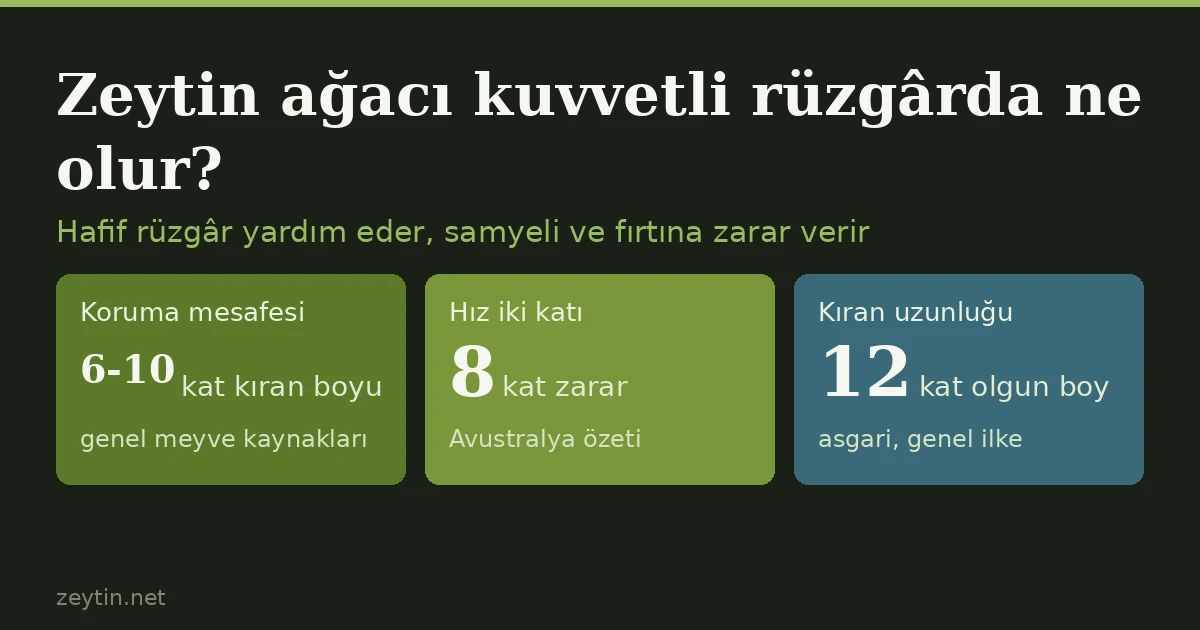
Wind both helps and harms olives depending on the season: a light breeze in April and early May aids fertilisation, the drying samyeli of late May spoils it, storms break branches and topple trees, and sea wind salinates the soil. The article rests on a review from the Olive Research Institute and states plainly that no olive-specific windbreak dimensions were found.
 Article
Do olive groves store carbon? The carbon balance of 24 groves in southern Spain: what is put into the soil makes the difference
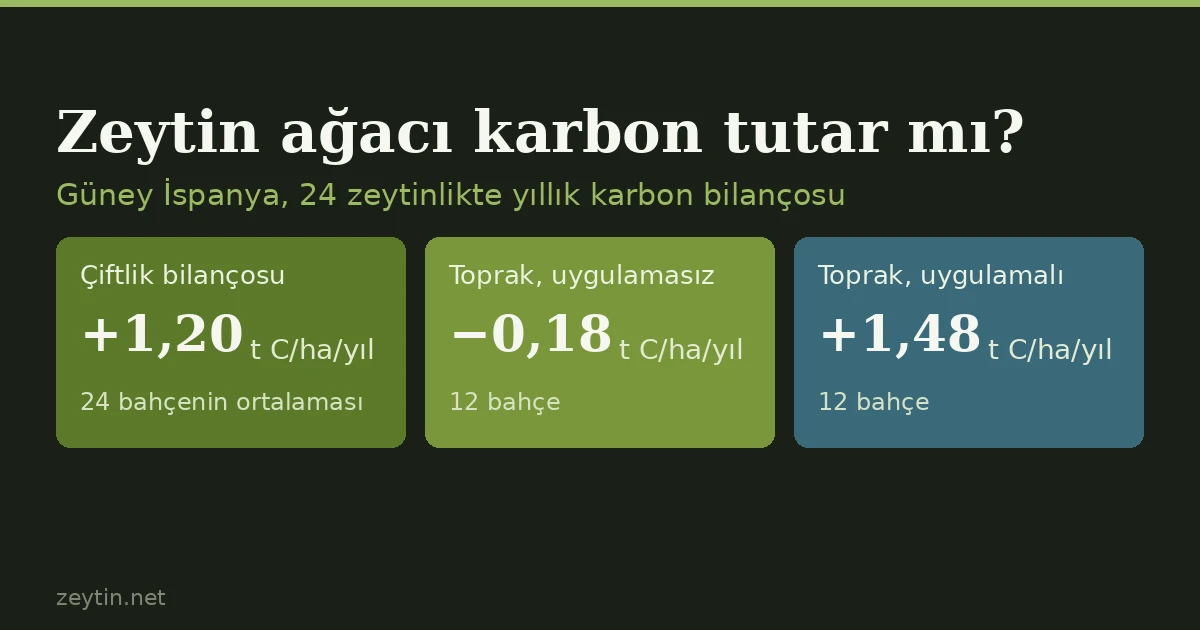
In 24 olive groves in Andalusia the farm-level carbon balance averaged +1.20 tonnes per hectare per year; but in groves that gave the soil no organic matter the soil was losing carbon (−0.18), while in those that did it was gaining (+1.48). The article reads the 2023 study by Torrús-Castillo and colleagues, the tree's share, the role of cover crops and pruning residue, and the study's limits.
 Article
Cold-hardy olive varieties: Gemlik, Ayvalık and the other candidates in the data
In our variety data, Gemlik, Ayvalık, Coratina, Picual and Hojiblanca are recorded with high cold adaptation or hardiness; Kalamata, Leccino, Memecik and Domat are medium, Frantoio moderately sensitive and Saurani low. But variety alone is not enough: tree age, the duration of the cold and the site of the grove also decide.