What is a blend in olive oil, and how does it differ from a single-variety oil?
A blend is the combination of several olive oils of the same grade: by variety, grove, lot or year. It is legal and on its own says nothing about quality. Mixing olive oil with other vegetable oils is not blending but adulteration; the Turkish Food Codex prohibits it outright, while the EU permits it if the label says so. Why blends are made, what a single variety gives you, and what the label does and does not tell you.
The oil inside a bottle labelled "extra virgin" is, more often than not, not the oil of a single grove or a single variety. Combining several oils in set proportions is called a blend, or coupage. But the word covers two very different practices, and one of them is strictly prohibited in Türkiye.
The short answer
A blend is the combination of several olive oils of the same grade: different varieties, different groves, different lots. It is legal, it is widespread, and on its own it says nothing about quality.
Mixing olive oil with other vegetable oils such as sunflower, canola or soy is not blending. That is adulteration, and Turkish product legislation forbids it in a single explicit sentence.
Three different "mixtures" worth separating
1) Variety blend. Oils from varieties such as Ayvalik, Memecik or Gemlik are combined in set proportions. The bottle shows only the grade name; if no variety is named, it is most likely a blend.
2) Lot and region blend. Lots of the same variety from different groves, different days, even different harvest years are combined. One variety, still a blend.
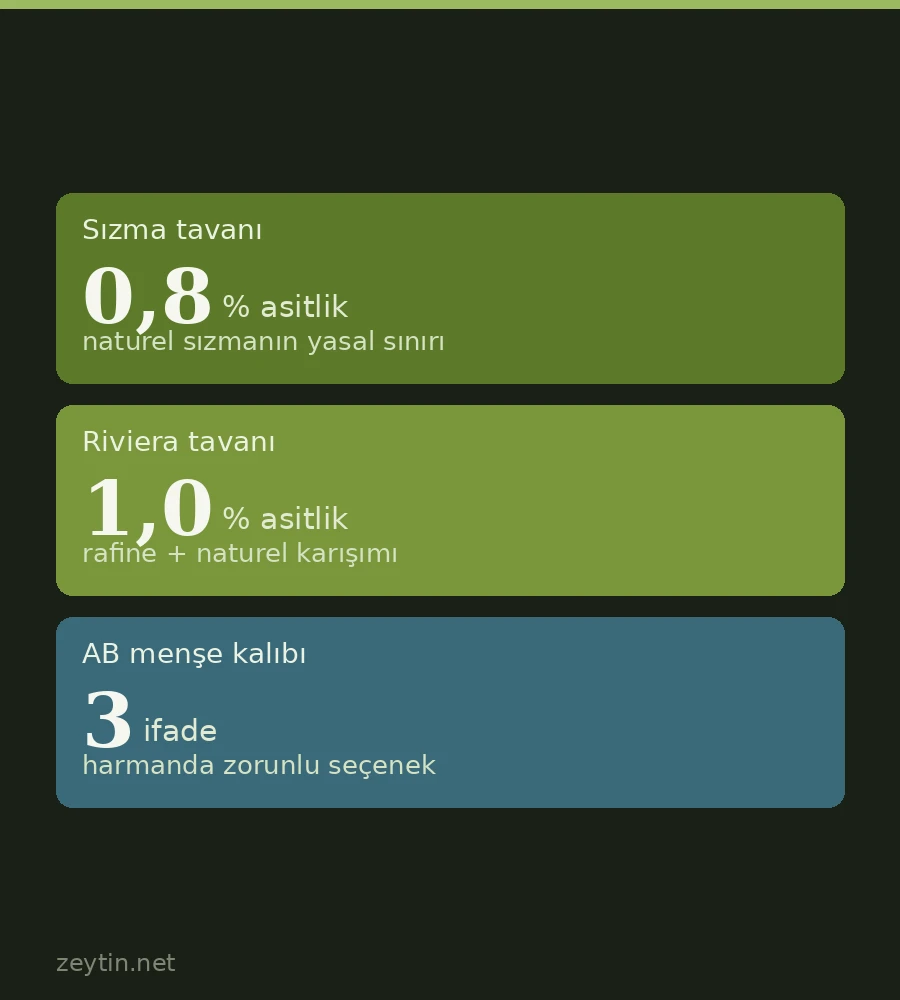
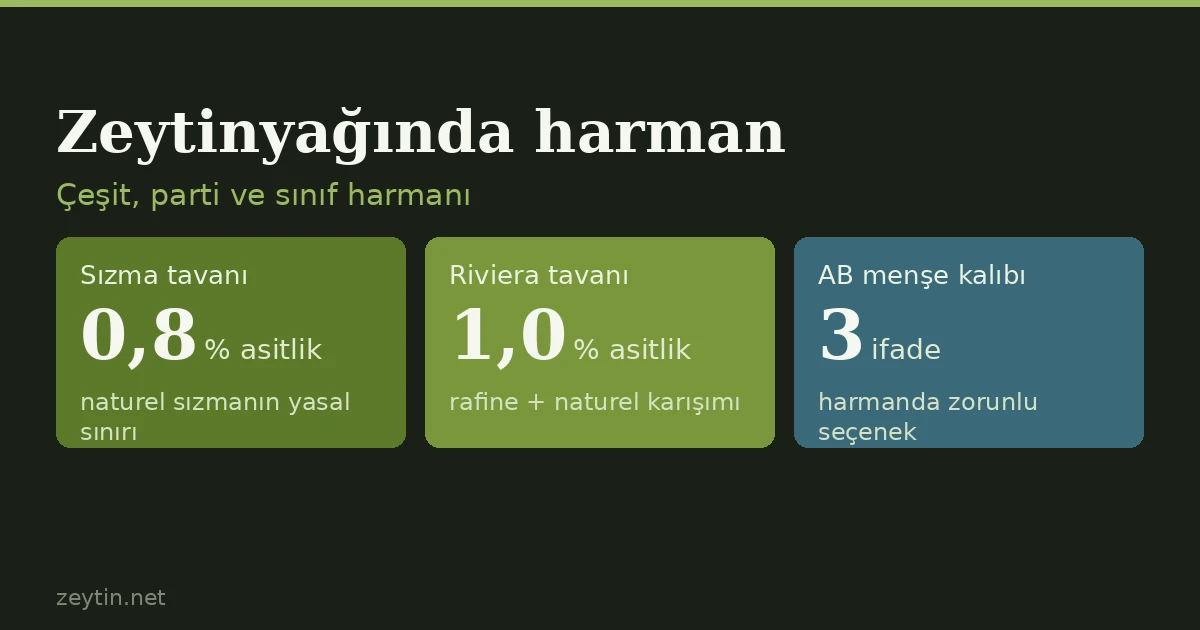
3) Grade blend. Legislation defines two mixed products by name: riviera olive oil — a mixture of refined olive oil and virgin oils fit for direct consumption, with acidity not above 1.0% — and olive-pomace oil, a mixture of refined pomace oil and virgin oils. These are not sold as "blends" but under their own grade names.
The Turkish rule is stricter than the EU's
The Turkish Food Codex Communiqué on Olive Oil and Olive-Pomace Oil (2017/26), in Article 5 on product characteristics, states: "Olive oil shall not be mixed into other liquid oils, and other liquid oils shall not be mixed into olive oil."
Under the European Union's marketing standards, by contrast, mixtures of olive oil with other vegetable oils are possible, provided the label states it clearly and the olive oil used belongs to a grade that may be sold to the final consumer. The same product can therefore sit legally on a shelf in Europe and illegally on a shelf in Türkiye.
⚠ In practice this means there is no such legal product as an "olive oil blend with other oils" in Türkiye. If you come across one, either the label is wrong or the product breaks the rules.
Why blends are made
Balance of taste. Varieties can sit at the extremes of bitterness, pungency and fruitiness. Bitterness and pungency are positive attributes in olive oil rather than defects, but when they dominate, part of the market walks away. Blending is the shortest route to balance.
Consistency. A brand wants the same taste every year. A single-grove, single-variety oil changes from season to season: alternate bearing, temperature and harvest date all write themselves into the flavour.
Volume. A bottler supplying shelves all year cannot find enough oil in one grove.
Cost. The share of a scarce or expensive variety is reduced and the volume made up with a more abundant one.
Blending is the olive oil equivalent of coupage in wine, and it is not a fault in itself. Quality is set by grade and measurement — acidity, peroxide value, sensory assessment — not by whether an oil is blended.
What a single variety gives you
In a monovarietal oil the taste is the signature of the variety: repeatability falls, character rises. This is why protected designations tie the name to the variety. Ayvalik Olive Oil must be extra virgin, from named districts, from a named variety, milled the same day. The Gemlik registration fixes which plant the name may come from by listing them: Gemlik, Gemlik 21 and Gemlik 27.
⚠ "Single variety" does not automatically mean "better". A monovarietal oil that was badly harvested and milled late will lose against a well-managed blend.
What the label says, and what it does not
- The communiqué does not require a label to declare that an oil is a blend. What is compulsory is the grade name: extra virgin, virgin, riviera, olive-pomace oil.
- Only extra virgin and virgin olive oils may carry a geographical indication (Article 14/b).
- A riviera label may carry the phrase "contains refined olive oils and virgin oils obtained directly from olives". That sentence is the official acknowledgement that the product is a grade blend.
- For export the rules change. In the EU, origin must be declared on virgin oils, and where oils of more than one country are mixed the label must use one of three set forms: "blend of olive oils of European Union origin", "blend of olive oils not of European Union origin", or "blend of olive oils of European Union origin and not of European Union origin". These three wordings are listed in the Commission's marketing-standards regulation that took effect in 2022.
How a blend is actually built
Blending is not pouring lots together at random. The sequence runs roughly like this:
- Lots are kept apart. Every lot coming off the mill stays in its own tank, with variety, grove and harvest day recorded.
- Every lot is measured. Acidity, peroxide value and sensory assessment are done lot by lot. Acidity alone is not enough: a defective lot can ruin a blend while showing low acidity.
- Proportions are trialled. Several ratios are prepared in small volumes, tasted, and the one closest to the target profile is chosen.
- The blend is fixed and measured again. The mixture's own acidity and peroxide value behave roughly like the average of its components; the sensory result does not. A defect in one lot can be perceived across the whole blend even when its share is small.
- That last point is the real risk of blending: a blend does not rescue good lots, a bad lot drags the good ones down.
Which one in the kitchen
A single-variety oil earns its place where its taste will be noticed: salads, bread, a finishing drizzle, raw use. A balanced blend is easier as the everyday oil, where dominant bitterness will not take over the dish.
⚠ Heat tolerance has to do with grade and freshness, not with blending. We have written separately on which oil suits frying.
What to check when buying a blend
1. Grade. Extra virgin or riviera? We have written separately on the differences between grades.
2. Harvest year. Does the label give a year or a harvest season? A blend can combine two years, which ties its freshness to the oldest lot.
3. Numbers. If acidity is printed, the communiqué requires peroxide value and ultraviolet absorbency to appear in the same size. It helps to know how to read a lab report.
4. Taste. Any defects? Musty, fusty, winey or heated notes are what most damages a blend; the list of defects is here.
5. If you want a variety, its name has to be printed. If it is not, assume a blend.
Blending and price
The least discussed side of blending is price. When a bottler reduces the share of an expensive or scarce variety and makes up the volume with a more abundant one, it can hold the shelf price steady. This is why marked price differences show up within the same grade, among bottles that all say extra virgin: the difference usually comes not from the grade but from what is in the blend, when it was harvested, and the profile the brand is aiming at.
It is also why single-variety and protected-designation oils cost more: the producer has tied volume, variety and milling calendar to a registration document and has no room to adjust the blend. We have separately measured the price gap between extra virgin and riviera and the gap from olive to oil.
Points of caution
⚠ "Blend" is a market term, not a legal grade name. Do not look for it on the label; its absence proves nothing.
⚠ The EU origin and blend wordings do not bind a product sold in Türkiye. They do bind you if you export.
⚠ Blend proportions are commercial secrets. No producer is obliged to tell you "60% Ayvalik, 40% Memecik".
One rating per visitor; you can change yours at any time. Ratings are real reader votes — no seeded or default scores.
Related
 Article
Soma Olive Oil: how a cooler climate lifts yield in a lignite basin
Registered in 2023. Mean temperature 15.3 °C; the certificate ties that relative coolness to yields reaching 796 kg/da. Free acidity 0.18-0.55.
 Article
How to Store Olive Oil
Light, heat, air and time — the four enemies of olive oil. Why the bottle next to your stove is in the worst possible place.
 Article
Burhaniye Olive Oil: two thousand years attested by the Adramytteion excavations
Registered in 2021. The certificate grounds two thousand years of olive growing in the excavation of an ancient city, and sets separate sensory thresholds for early and ripe harvest.
 Article
Erdek Kapıdağ Olive Oil: an oil whose grade changes in dry years
Registered in 2024. The certificate admits something rare: in dry periods the oil can fall from extra virgin to virgin grade.