In Spain the cost sits above the price: €5.31 in a traditional grove, €3.46 at the gate
Olive cultivation costs have risen 57% in six years and reach €5.31 per kilogram in the most traditional groves, according to an AEMO study. The same week, Spain's producer price was €3.46. The Andalusian cooperative federation, with 342,000 members, is asking not for aid but for a change to the Food Chain Law.
In Spain the two ends of an olive grower's balance sheet are pulling apart: cultivation costs have risen by roughly 57 percent in six years, while producer prices remain low. Cooperativas Agro-alimentarias de Andalucía, the Andalusian federation of agri-food cooperatives, has called on the Spanish government and the European Union on behalf of more than 342,000 members. What it is asking for is not direct aid, but a legal correction of bargaining power inside the food chain.
The numbers
| Item | Value |
|---|---|
| Rise in cultivation costs (6 years) | ~57% |
| Cost in the most traditional groves | €5.31/kg of oil |
| Spain, extra virgin producer price (30.08.2026) | €3.46/kg |
| Jaén, extra virgin producer price (30.08.2026) | €3.31/kg |
| July shipments | 135,312 t |
| Above the five-year July average | ~20,000 t |
| Stocks on 31 July | 568,700 t |
| Stock drawdown in one month | 113,000+ t |
| Members represented by the federation | 342,000+ |
Where costs have got to
The federation's evidence is the Olive Cultivation Cost Study published by the Spanish Association of Olive-Growing Municipalities (AEMO). It found average cultivation costs up by approximately 57 percent over the past six years, with wide variation by growing method: in the most traditional groves, the cost of the oil produced reaches as much as €5.31 per kilogram.
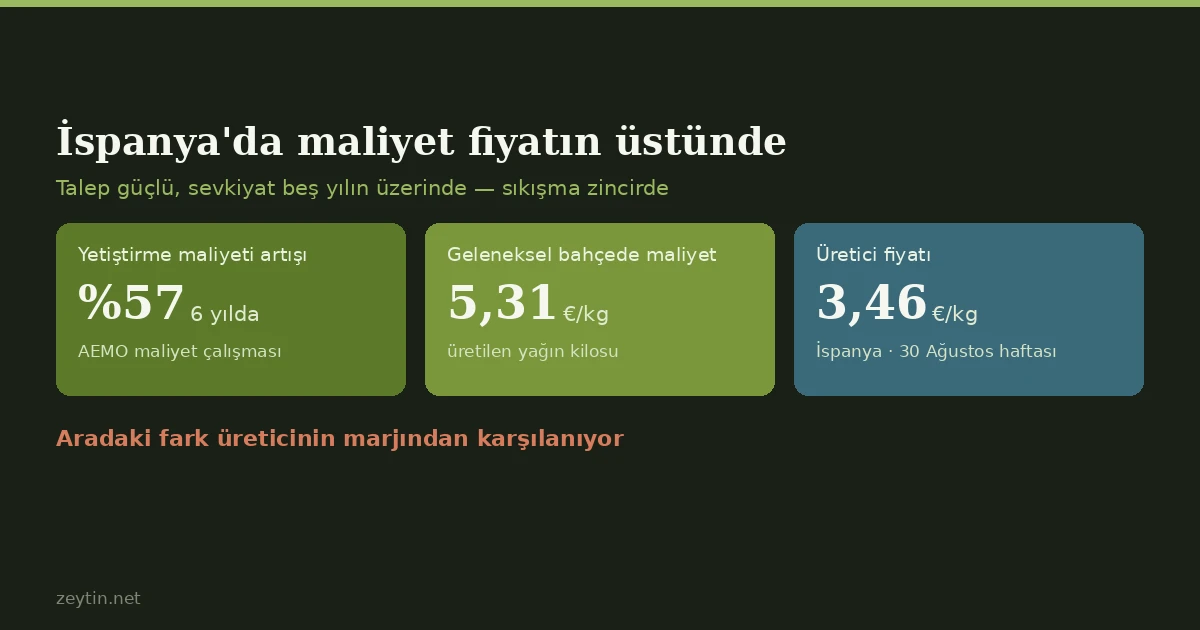
The weight of that figure appears when it is set against the same week's price. In the week of 30 August 2026, the extra virgin producer price stood at €3.46/kg in Spain and €3.31/kg in Jaén. A traditional grove is therefore selling some two euros below its own cost.
One distinction matters: €5.31 is not "Spain's cost" but the cost of the traditional grove. In hedgerow and super-high-density plantings it is markedly lower. The squeeze is not hitting all of Spain; it is hitting the large-canopied, often sloping, machine-unfriendly groves — the kind that resemble most of Türkiye's.
The demand is legal, not fiscal
While other Spanish farming associations have pressed for tax relief and direct assistance, the federation pointed somewhere else: the Food Chain Law. In its reading, the law does not resolve producers' problems and in some respects deepens them. As long as growers hold weak bargaining power against processors and retailers, rising costs do not pass into prices; they are absorbed entirely by the grower's margin.
Its second demand concerns trade: tighter control of olive oil entering the EU from third countries, particularly volumes arriving under duty-free quotas and the inward processing regime. The federation argues that more oversight and transparency in these mechanisms would stop imports exerting artificial downward pressure on prices paid to EU producers. We covered Andalusia's move against North African imports separately; this call continues it.
Demand is not the problem
The striking part of the picture is that the market is not stagnant. July shipments reached 135,312 tonnes, roughly 20,000 tonnes above the five-year average for that month. Stocks fell to 568,700 tonnes on 31 July, down by more than 113,000 tonnes in a single month. The oil is moving, and demand is there.
That invalidates the easy explanation that prices fell because nothing is selling. Goods are leaving — but the share left behind for the grower does not cover the cost. This is precisely the ground for the federation's legislative demand: the problem is not weak demand but where the value settles along the chain.
Italy at €4.85 the same week
The four European boxes in our price band belong to the same week: Spain €3.46, Jaén €3.31, Italy €4.85, Bari €4.55. The €1.39 gap between Italy and Spain is not random. Italy cannot cover its own consumption from its own production; it is a net importer, and its price reflects that deficit. The country that sets the floor of the world price is Spain — and Andalusia alone accounts for roughly 75 percent of Spanish output.
That share turns the federation's appeal into something other than a local complaint. When a body of 342,000 members says "we are below cost" in the region where the world olive oil price is formed, the sentence is about the market's floor, not about Andalusia. Where the price turns will likewise be decided largely by the same region's October crop.
Seen from Türkiye
A comparison needs an exchange rate. Extra virgin olive oil was registered at 254.33 TL/kg on the Edremit exchange (25 August 2026); at the European Central Bank rate of 4 September (€1 = 56.2995 TL) that is about €4.52/kg. In euro terms, the price reaching the Turkish grower is therefore above Spain's current level.
That looks like good news but cannot be read on its own. Spain has a regular cost study: cost per kilogram is published and can be set against price. Türkiye has no equivalent, regularly published olive cultivation cost series. So the question "does 254 lira cover the cost?" has no public answer — the debate runs on impressions rather than figures.
A second point: Spain's squeeze is not automatically Türkiye's opportunity. The same low price is a competitor's price in export markets. It should be read together with costs and carry-over stock before the harvest.
What to watch
Three things: whether a concrete amendment to the Food Chain Law is tabled; whether the new season opens in October above or below €3.50; and whether the demands for oversight of duty-free quotas and the inward processing regime find any response at the Commission. All three bear directly on price — and all three indirectly set Türkiye's export price.
One rating per visitor; you can change yours at any time. Ratings are real reader votes — no seeded or default scores.
Related
 Article
The International Olive Council grows: Iraq joins, Brazil and South Africa apply
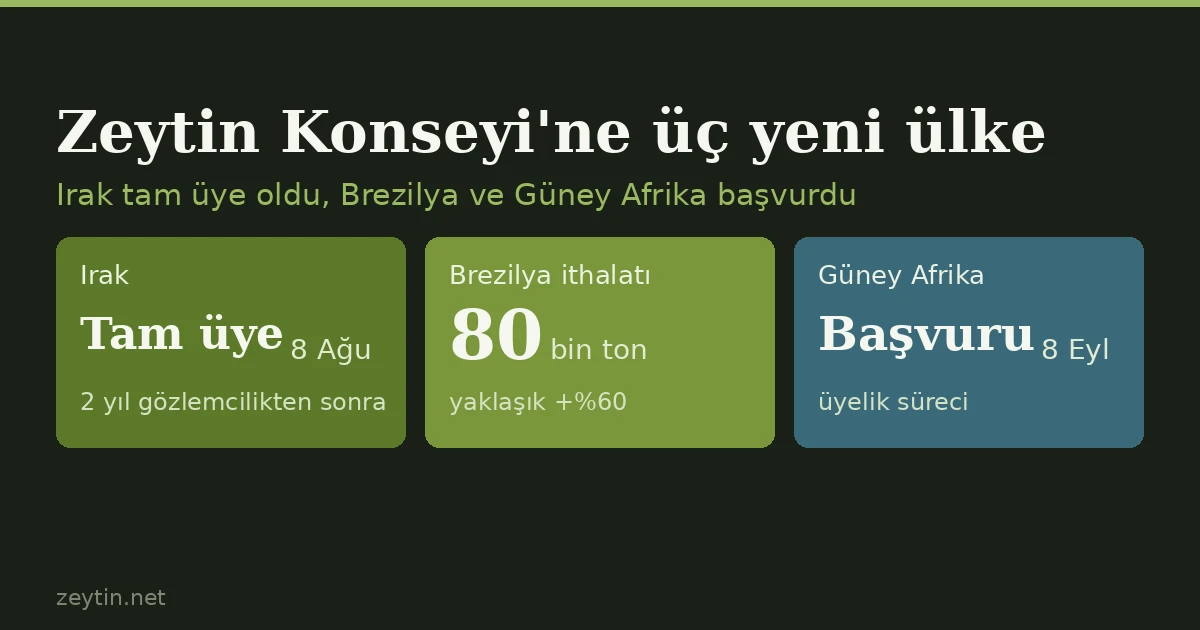
The International Olive Council (IOC) saw three developments in a month: Iraq became a full member on 8 August, South Africa submitted its membership request on 8 September and Brazil on 9 September. The expansion reflects olive oil's shift towards production and consumption areas beyond the Mediterranean.
Article
The International Olive Council grows: Iraq joins, Brazil and South Africa apply
The International Olive Council (IOC) saw three developments in a month: Iraq became a full member on 8 August, South Africa submitted its membership request on 8 September and Brazil on 9 September. The expansion reflects olive oil's shift towards production and consumption areas beyond the Mediterranean.
 Article
Bursa expects 290,000 tonnes of olives, with the biggest share going to oil in 12 seasons
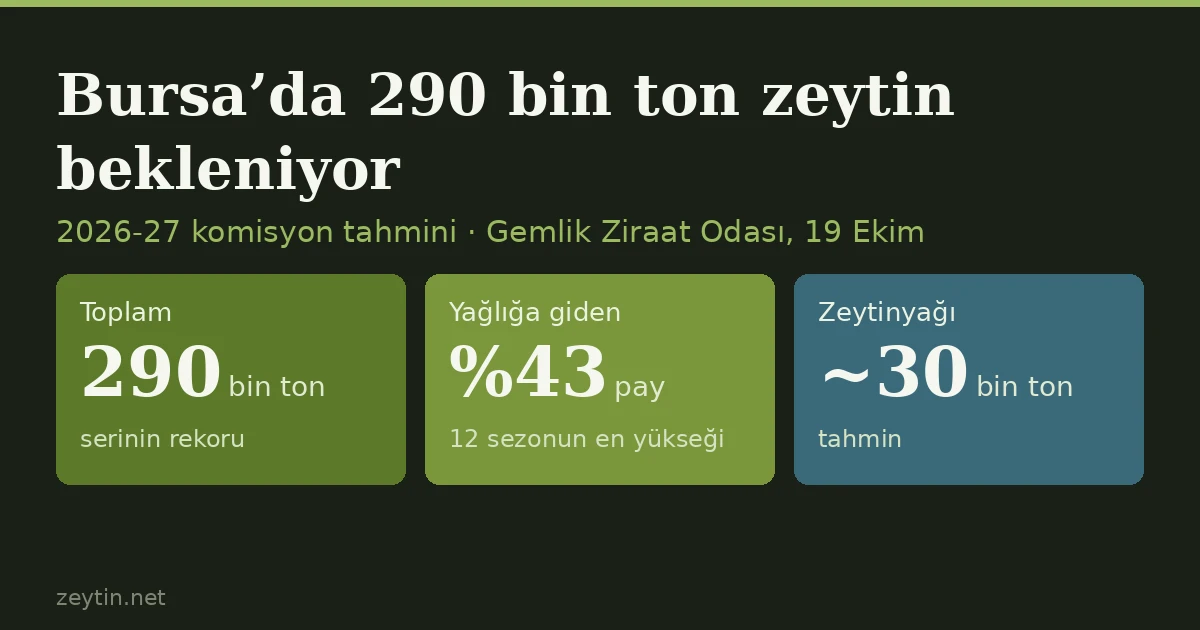
According to a provincial commission estimate shared by the Gemlik Chamber of Agriculture on 19 October, Bursa expects 290,000 tonnes of olives this season: 165,000 tonnes of table olives, 125,000 tonnes of oil olives and about 30,000 tonnes of olive oil. The crop is a record for the series, and the 43 percent share going to oil is the highest in 12 seasons. Early-harvest olives are fetching 45-60 lira per kilo.
Article
Bursa expects 290,000 tonnes of olives, with the biggest share going to oil in 12 seasons
According to a provincial commission estimate shared by the Gemlik Chamber of Agriculture on 19 October, Bursa expects 290,000 tonnes of olives this season: 165,000 tonnes of table olives, 125,000 tonnes of oil olives and about 30,000 tonnes of olive oil. The crop is a record for the series, and the 43 percent share going to oil is the highest in 12 seasons. Early-harvest olives are fetching 45-60 lira per kilo.
 Article
Gaza's olive report: 150,000 trees left of two million, production down 87.5%
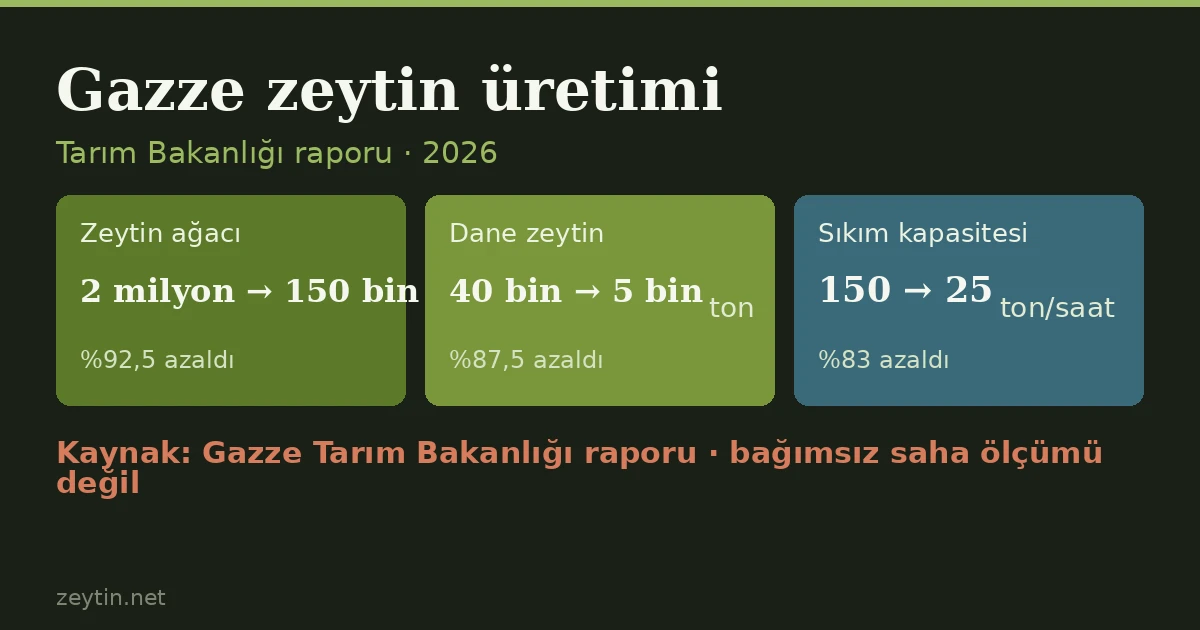
According to a report from Gaza's Ministry of Agriculture, olive groves have shrunk from 50,000 dunums to 5,000 and the olive crop from 40,000 tonnes to 5,000. The loss is not confined to the grove: milling capacity has fallen from 150 tonnes an hour to 25, and the number of growers from 20,000 to 1,000.
Article
Gaza's olive report: 150,000 trees left of two million, production down 87.5%
According to a report from Gaza's Ministry of Agriculture, olive groves have shrunk from 50,000 dunums to 5,000 and the olive crop from 40,000 tonnes to 5,000. The loss is not confined to the grove: milling capacity has fallen from 150 tonnes an hour to 25, and the number of growers from 20,000 to 1,000.
 Article
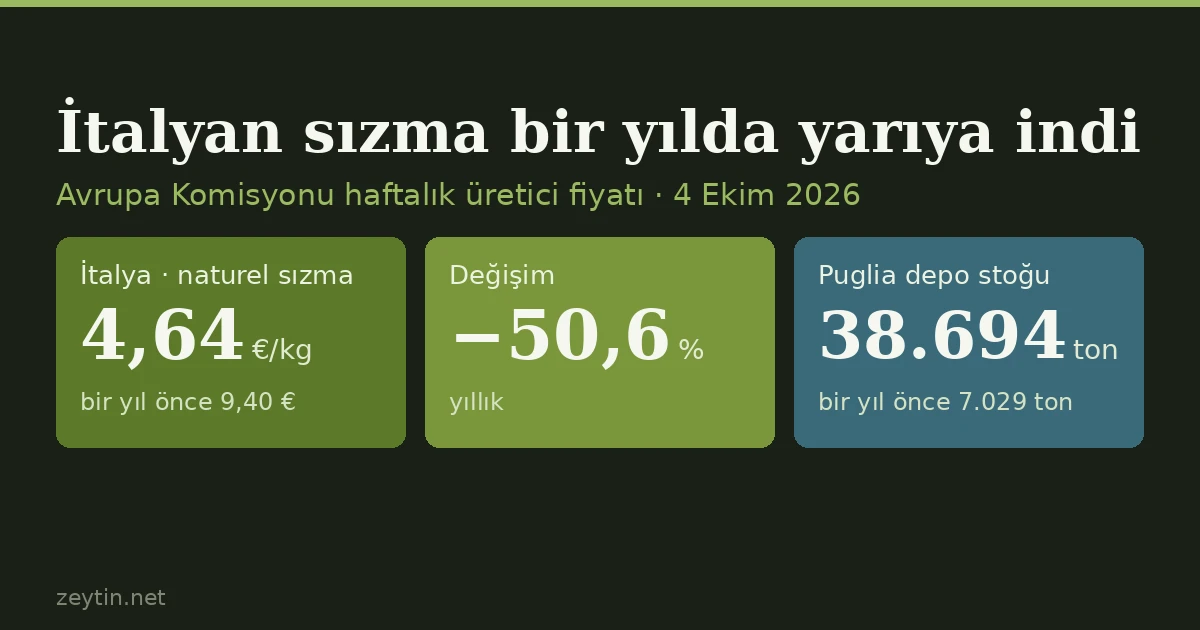
Italian extra virgin has halved in a year: growers in Puglia set a Monday noon deadline
According to the European Commission's weekly producer prices, Italian extra virgin olive oil fell to €4.64 a kilo in the week of 4 October; a year earlier, in the same week, it was €9.40. Growers in Puglia have taken to the streets in the opening days of the harvest, holding sit-ins in Corato and Bitonto and giving the government until noon on 12 October to respond. Italian extra virgin stored in the region's warehouses has risen fivefold in a year.
Article
Italian extra virgin has halved in a year: growers in Puglia set a Monday noon deadline
According to the European Commission's weekly producer prices, Italian extra virgin olive oil fell to €4.64 a kilo in the week of 4 October; a year earlier, in the same week, it was €9.40. Growers in Puglia have taken to the streets in the opening days of the harvest, holding sit-ins in Corato and Bitonto and giving the government until noon on 12 October to respond. Italian extra virgin stored in the region's warehouses has risen fivefold in a year.