Sat olive
Sat is a recorded variety of the Black Sea. No measured pomological data published.
Sat is one of the recorded olive varieties of the Black Sea.
Characteristics
Oil content is moderate. The fruit is large and the stone big; the stone separates from the flesh with difficulty.

Where it grows
Sat is recorded in the Black Sea. The provinces growing olives in this region: Artvin, Trabzon, Sinop, Samsun, Ordu, Kastamonu, Tokat, Bartın, Rize and Zonguldak — output is concentrated in Artvin (740 t); elsewhere the scale is very small.
Regional conditions, varietal spread and output: olive growing in the Black Sea
Measured values
Satı's measurements were published alongside Butko and Otur in the study of eastern Black Sea cultivars, from fruit collected in the Yusufeli district of Artvin.
| Property | Value |
|---|---|
| Fruit weight | 2.08 g |
| Fruit length × width | 18.87 × 12.51 mm |
| Stone weight | 0.52 g |
| Flesh ratio | 75.0% |
| Fruits per kilogram | 481 |
Satı sits in the middle of the three: a little larger than Butko (1.83 g), distinctly smaller than Otur (3.93 g). Its flesh ratio, at 75.0%, is likewise in between.
Its fruit shape index is 1.51 — the length half again the width, a long oval. All three cultivars fall in that group; it is the shared form of the eastern Black Sea varieties.
Other varieties of the region
Butko · Gölvala · Marantelli · Otur · Patos
Locally
Sat is one of the local varieties around Artvin; sources also give it as Satı. The genotypes Otur, Butko Yağlık and Görvele are recorded in the same area.
Grown in the microclimate of the Çoruh Valley, these varieties mark the northernmost edge of Turkish olive growing — the region yields 0.2% of national output but is rich in varietal diversity.
More: olive growing in Artvin
Source
- Şeker, M., Gündoğdu, M. A., Gül, M. K. & Kaleci, N. (2012) — Pomological Characteristics of Local Olive Varieties at Eastern Blacksea Region, Zeytin Bilimi 3(2)
- Efe, R., Soykan, A., Cürebal, İ. & Sönmez, S. (2016) — Characteristics and Geographical Distribution of Olive Varieties Grown in Turkey, Zeytin Kitabı, pp. 37-80
- Olive map of Turkey
Where it stands among measured varieties
çeşit sayfası
çeşit sayfası
çeşit sayfası
çeşit sayfası
Values are those published on each variety's own page; the comparison covers only varieties with a measured figure, so it is a comparison of what is known — not of every Turkish variety. See the full ranking and how it is built →
One rating per visitor; you can change yours at any time. Ratings are real reader votes — no seeded or default scores.
Related
 Article
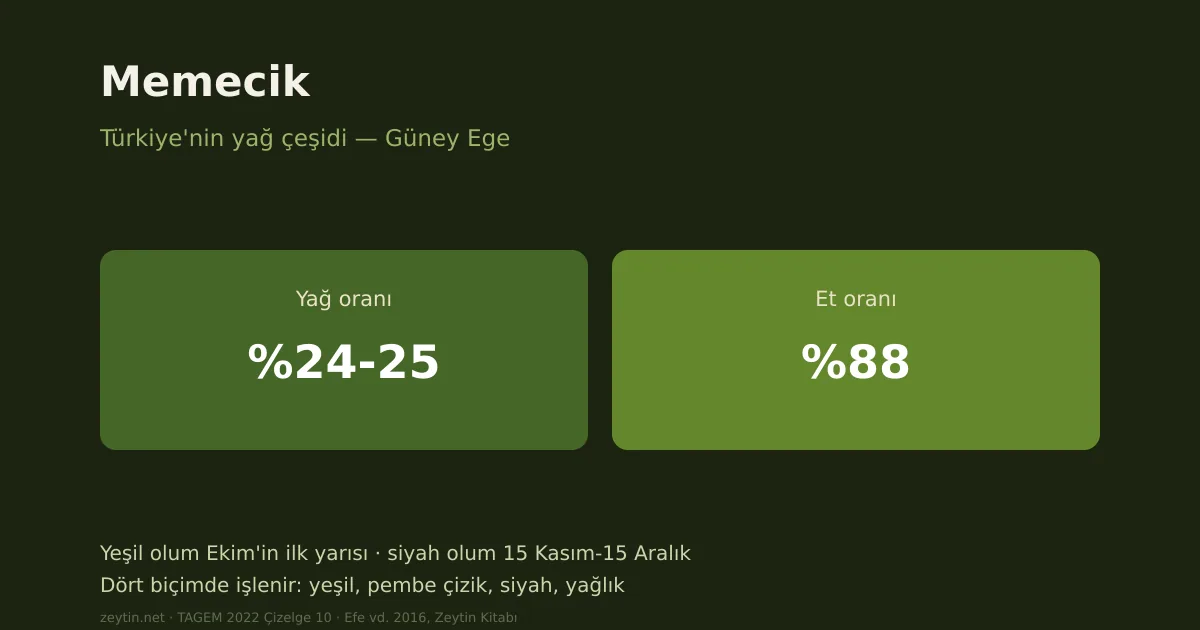
The Memecik olive: Türkiye's oil variety
Between 19% and 45% of the tree stock. 24-25% oil, 88% flesh. Green maturity in early October, two months after Gemlik.
Article
The Memecik olive: Türkiye's oil variety
Between 19% and 45% of the tree stock. 24-25% oil, 88% flesh. Green maturity in early October, two months after Gemlik.
 Article
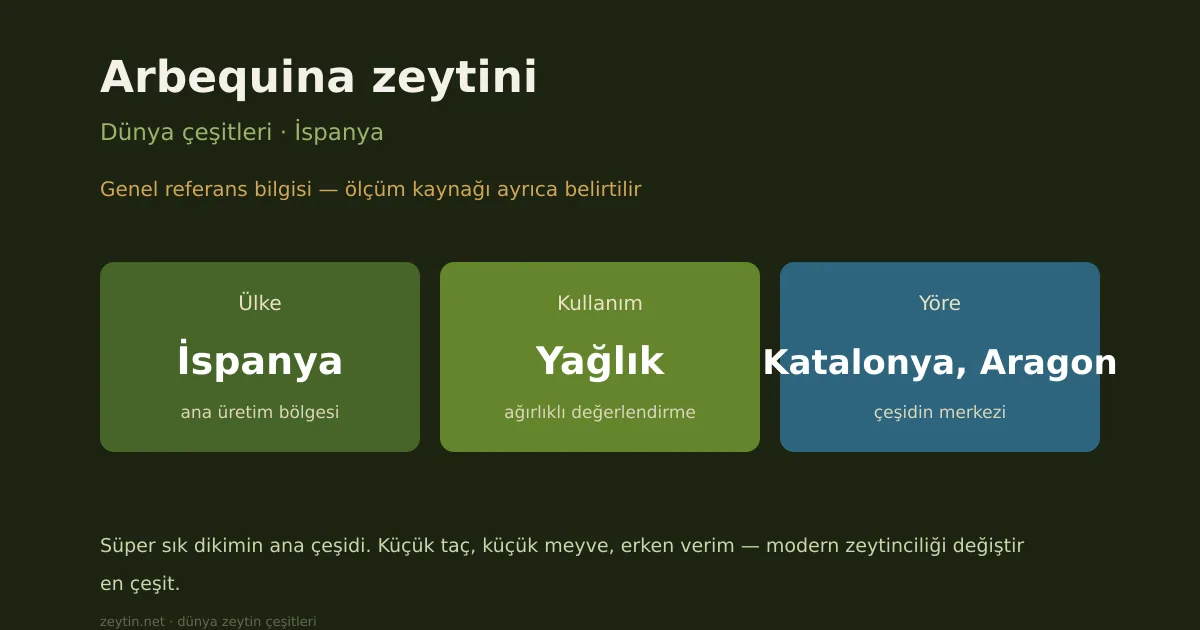
Arbequina olive: Spain's oil variety
The mainstay of super-high-density planting. Small canopy, small fruit, early bearing — the variety that changed modern olive growing.
Article
Arbequina olive: Spain's oil variety
The mainstay of super-high-density planting. Small canopy, small fruit, early bearing — the variety that changed modern olive growing.
 Article
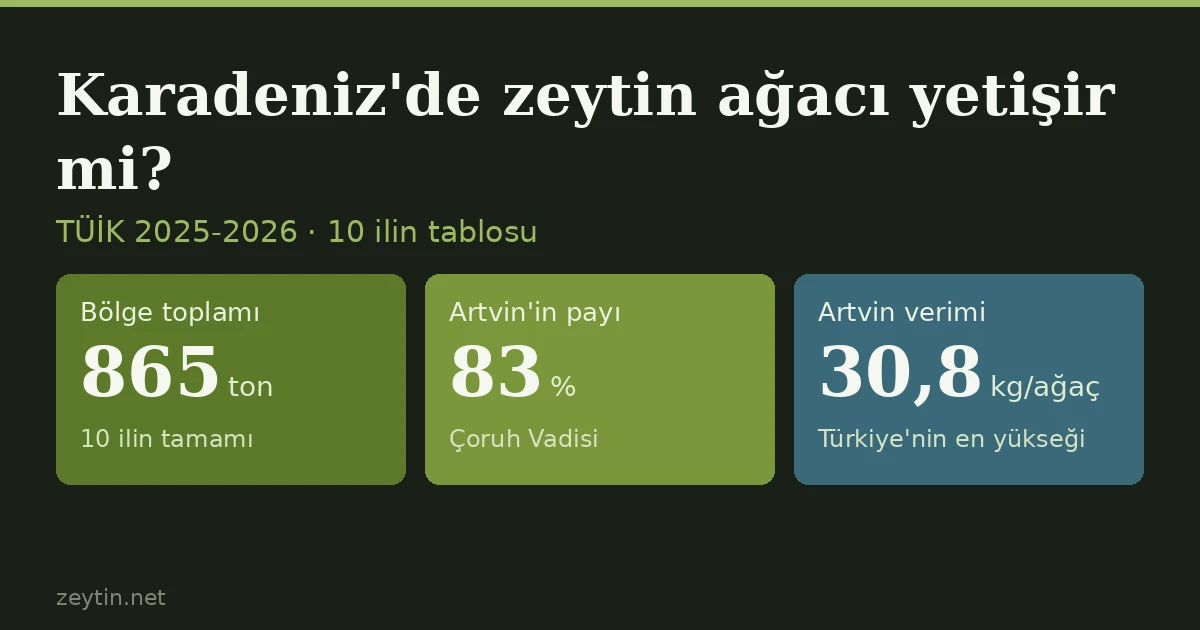
Do olive trees grow on the Black Sea coast?
Ten Black Sea provinces produce 865 tonnes between them, 83 per cent of it in Artvin. Trabzon gets 98 tonnes from 36,000 trees; Samsun none from 13,000. The obstacle is humidity, not cold.
Article
Do olive trees grow on the Black Sea coast?
Ten Black Sea provinces produce 865 tonnes between them, 83 per cent of it in Artvin. Trabzon gets 98 tonnes from 36,000 trees; Samsun none from 13,000. The obstacle is humidity, not cold.
 Article
The Olive Calendar: The Olive Year Month by Month
When to prune, when it flowers, which olives are picked when — the year of the tree and the grower, month by month.
Article
The Olive Calendar: The Olive Year Month by Month
When to prune, when it flowers, which olives are picked when — the year of the tree and the grower, month by month.