Twenty trees per decare, or 250? The density debate
15-25 trees per decare in Türkiye, 200-300 in super-intensive systems. Payback falls from 15 years to 8 — but the densest is not the most profitable.
How many trees go into a decare of olive grove?
The usual answer in Türkiye is 15 to 25. In Spain, Italy and Israel the same area takes 200 to 300 saplings. The difference is not a matter of preference; these are two entirely different production models.
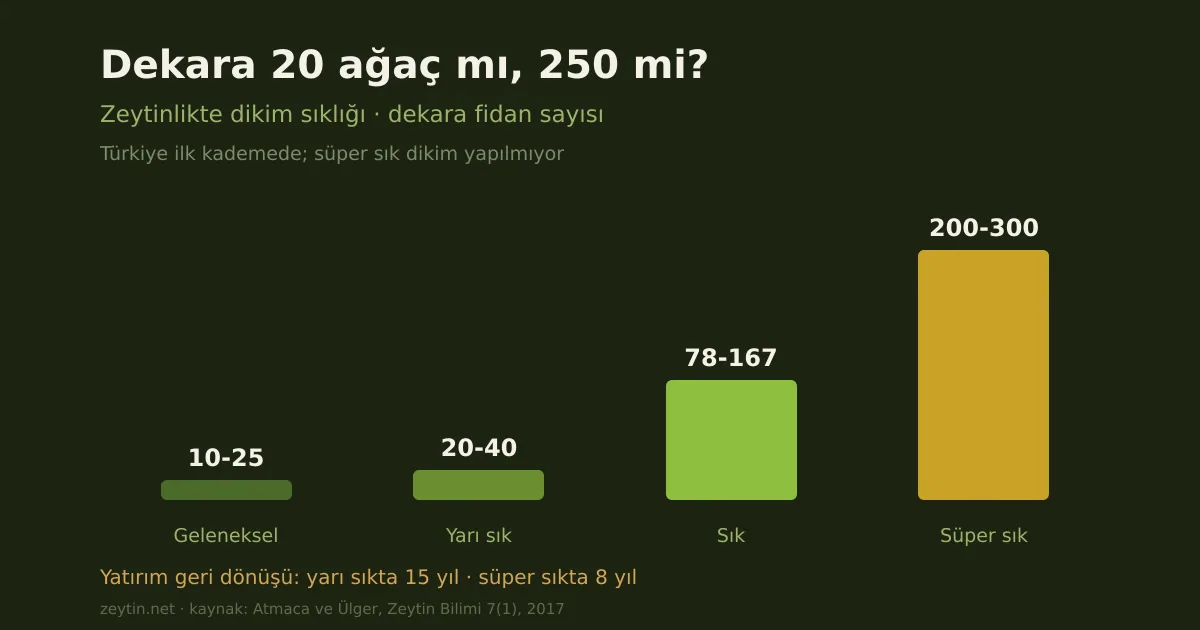
This article sets out both, and the economics between them.
Four levels of density
| Model | Trees per decare | Harvest | Where it prevails |
|---|---|---|---|
| Traditional | 10-25 | By hand, pole or shaker | Türkiye, Greece, most of the Mediterranean |
| Semi-intensive | 20-40 | Mechanical shaker | Began in the 1970s-80s |
| Intensive | 78-167 | Mechanical | Spain, Italy |
| Super-intensive | 200-300 | Continuous harvester | Spain, Italy, USA, Israel, Australia |
Source: Atmaca and Ülger (2017). Under irrigation, traditional planting can reach 20-40 trees per decare; without irrigation, 15-25 is recommended. A decare is 1,000 m².
In super-intensive planting, trees are set at spacings like 3 × 1.35 metres, lined up much as a vineyard is. What is grown is not a tree but a hedge; harvesting is done with continuous harvesters resembling grape machines.
The real difference: how fast the money comes back
The most striking figure in the study is this:
| Model | Payback period |
|---|---|
| Semi-intensive | 15 years |
| Super-intensive | 8 years |
Seven years is a serious difference over a working life. The reason is simple: a densely planted grove comes into bearing earlier and yields more per unit of land.
One caution: these figures come from Spain and comparable conditions. There is no guarantee of the same result in Türkiye — and the reason follows below.
The most profitable density is not the highest one
In a trial reported in the same study, comparing several densities, the highest economic return came at 31.2 trees per decare.
So "denser is always better" does not hold. As density rises, yield per tree falls, shading increases, and pruning and irrigation become obligatory. Past a point, each added tree eats into the yield of the ones before it.
The logic of super-intensive planting is not yield but cost: making mechanical harvesting possible. Where labour is expensive, that changes everything.
Why doesn't Türkiye do it?
At the time the source study was written, Türkiye was a country where super-intensive olive growing was not practised.
That has since changed. High-density planting — known in the Turkish market as "dwarf olive" — has become a commercial form of cultivation: Arbequina and Arbosana saplings are sold as standard nursery stock, dedicated information sites exist, and over-the-row harvesters are now built by domestic manufacturers as well.
But the part of the finding that concerns the cause still holds — and that is the valuable part.
Trials exist but their results have been poor — and the reason is a technical one: groves planted with Spanish varieties suited to super-intensive systems were grown on small plots by traditional methods. Super-intensive planting is not a choice of variety but a system: without the machinery, irrigation, pruning regime and plot size arriving together, it does not work.
The second obstacle is variety. The varieties used worldwide in these systems are mainly small-canopied, early-bearing ones like Arbequina, Arbosana and Koroneiki. Türkiye's principal varieties — Memecik, Edremit, Gemlik — have not been bred for it. Every country runs breeding programmes to find which of its own varieties suit the system; that is long work.
What about our own calculation?
We previously calculated the cost of clearing an olive grove on this site, assuming 20 trees per decare.
This study confirms that assumption: traditional unirrigated planting is recommended at 15-25 trees per decare. So the calculation rests on the right ground for Türkiye's prevailing model.
But it also shows something: the same calculation would come out completely differently for super-intensive planting. In a grove of 250 saplings per decare, neither the establishment cost, nor the time to bearing, nor the loss from clearing is the same. Our figure holds for Türkiye's present reality; it changes with the model.
The hidden costs of dense planting
It is easy to read the table and say everyone should plant densely. But the model has sides that do not show:
Irrigation is obligatory. A traditional grove can grow unirrigated; super-intensive planting cannot be conceived without water. In a dry region that is the first disqualifier.
Machinery investment. A continuous harvester is expensive and only pays on plots above a certain size. On small, fragmented groves it makes no sense — and that is largely how olive holdings are structured in Türkiye.
Shorter life. A traditional olive tree lives for centuries. Super-intensive groves are planned like an orchard and replanted after a shorter economic life. The idea of "my grandfather's grove" does not exist in this model.
Variety dependence. The varieties suited to the system are largely imported. That is a separate discussion in terms of geographical indications and local variety diversity.
Summary
- Traditional planting in Türkiye is 10-25 trees per decare; super-intensive planting worldwide is 200-300.
- Investment is recovered in 8 years under super-intensive planting against 15 under semi-intensive.
- But the highest return is not always at the highest density — one trial found 31.2 trees per decare most profitable.
- The aim of super-intensive planting is not yield but mechanical harvesting; it makes sense where labour is costly.
- Türkiye does not use the model. Trials failed because the system was set up by traditional methods.
- The obstacle runs both ways: variety (Memecik and Gemlik do not suit) and structure (small, fragmented, unirrigated groves).
Source
t; Atmaca, S. and Ülger, S. (2017). Türkiye ve Dünyada Sık Dikim Zeytin Yetiştiriciliği [Olive High Density Planting in Turkey and the World]. Zeytin Bilimi, 7(1): 17-24.
Related reading: Felling an olive grove: a ten-year decision · Olive varieties · Early harvest · How to grow an olive tree
One rating per visitor; you can change yours at any time. Ratings are real reader votes — no seeded or default scores.
Related
 Article
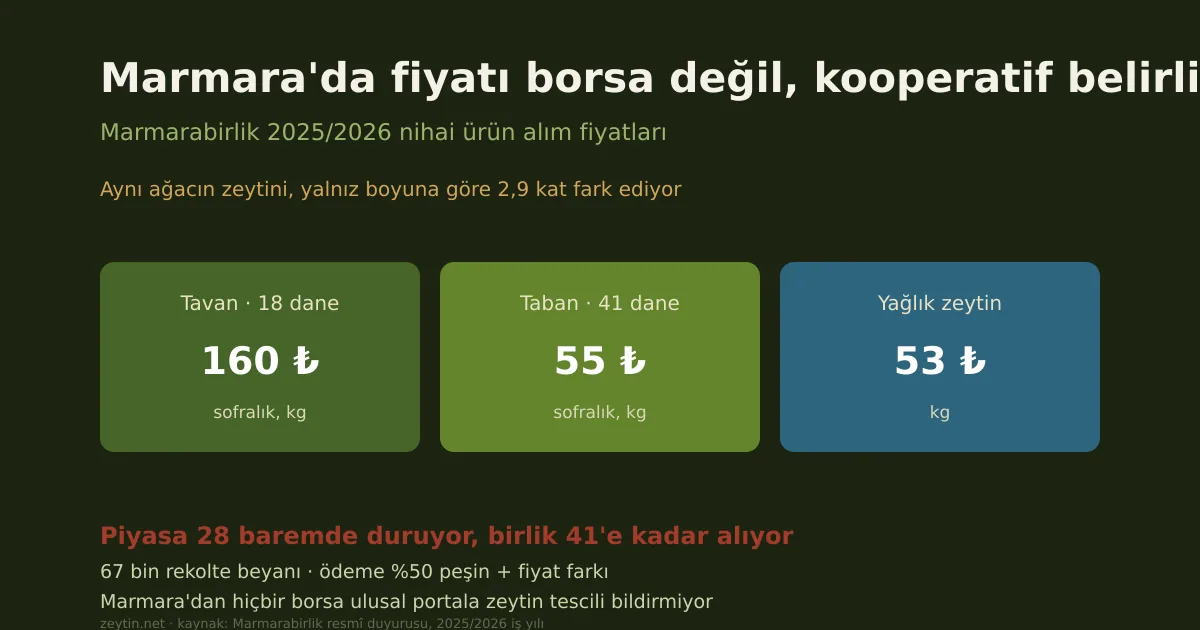
Marmarabirlik purchase prices: what the grower actually receives in Marmara
The 2025/2026 season: 160 ₺ for calibre 18, 55 ₺ for calibre 41, 53 ₺ for oil fruit. Size alone changes the price 2.9×, and the union buys down to calibre 41 where the market stops at 28.
Article
Marmarabirlik purchase prices: what the grower actually receives in Marmara
The 2025/2026 season: 160 ₺ for calibre 18, 55 ₺ for calibre 41, 53 ₺ for oil fruit. Size alone changes the price 2.9×, and the union buys down to calibre 41 where the market stops at 28.
 Article
Who protects the olive tree? Three layers, from the IOC to Law 3573
We have cited the International Olive Council in 23 articles without ever saying what it is. The three orders that protect the olive: trade standards, landscape conventions, and Türkiye's 1939 Law No. 3573.
Article
Who protects the olive tree? Three layers, from the IOC to Law 3573
We have cited the International Olive Council in 23 articles without ever saying what it is. The three orders that protect the olive: trade standards, landscape conventions, and Türkiye's 1939 Law No. 3573.
 Article
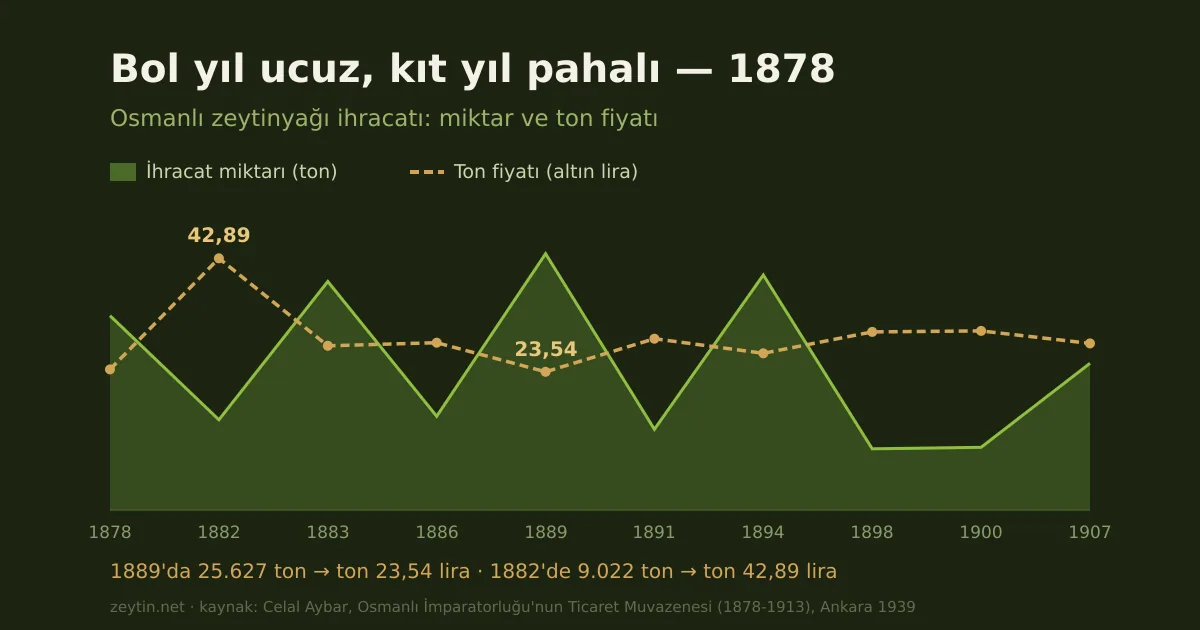
Olive oil trade in the Ottoman Empire: Britain the buyer, the crop the price
25,627 tonnes exported in 1889 at 23.54 lira a tonne; 9,022 tonnes in 1882 at 42.89. The crop-price inverse held a century ago too.
Article
Olive oil trade in the Ottoman Empire: Britain the buyer, the crop the price
25,627 tonnes exported in 1889 at 23.54 lira a tonne; 9,022 tonnes in 1882 at 42.89. The crop-price inverse held a century ago too.
 Article
The nameless olives of southeast Anatolia: Mardin, Şırnak and the pollinator problem
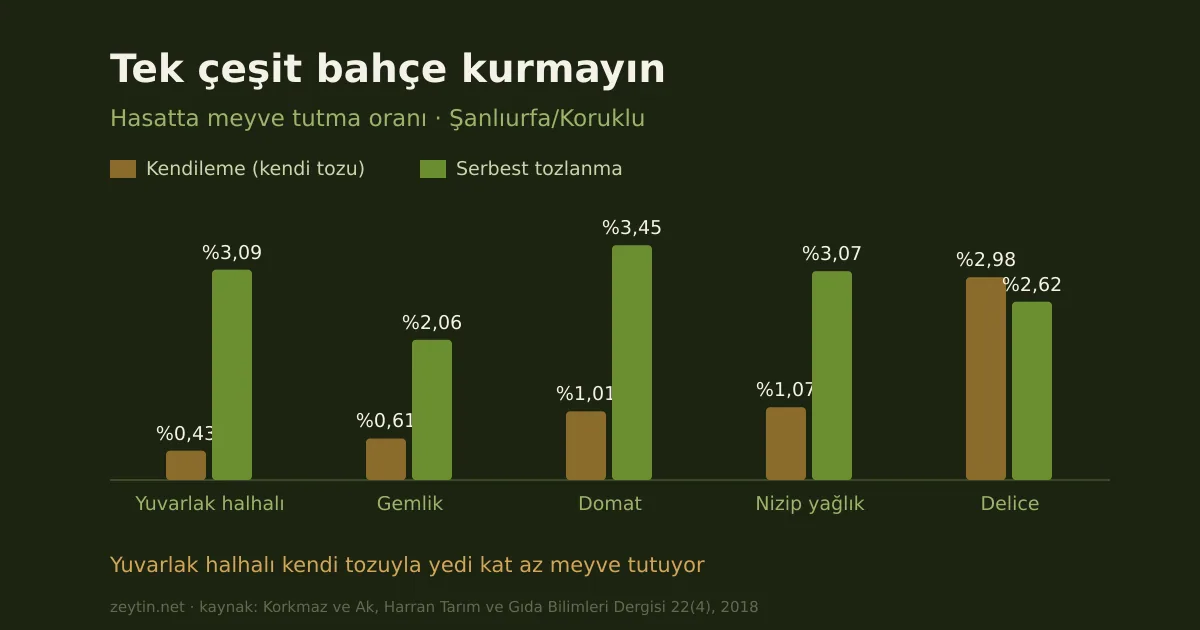
Kumçatı and Derik genotypes beat Ayvalık and Gemlik on flesh ratio. Yuvarlak halhalı sets only 0.43% of its flowers with its own pollen.
Article
The nameless olives of southeast Anatolia: Mardin, Şırnak and the pollinator problem
Kumçatı and Derik genotypes beat Ayvalık and Gemlik on flesh ratio. Yuvarlak halhalı sets only 0.43% of its flowers with its own pollen.