How much is deducted when you sell olives? Withholding tax, the producer receipt and the social security cut
Growers selling olives to a trader or cooperative have 4% of the price withheld as income tax, or 2% if the sale is registered on a commodity exchange; below 4,500 trees this is the final tax. Farmers with premium arrears also face a 2% social security deduction. The producer receipt, exchange fees and a worked example with Akhisar prices.
The harvest has started, the buyer has come to the grove and a price has been agreed. But the money you receive is not simply the price multiplied by the kilos. Three items explain the gap: income tax withholding, the social security premium deduction and, if the sale is registered on a commodity exchange, the exchange registration fee. This article uses official Turkish texts to explain which deductions a grower selling olives to a trader, a mill or a cooperative will face, which of them never comes back, and why the receipt in your hand matters.
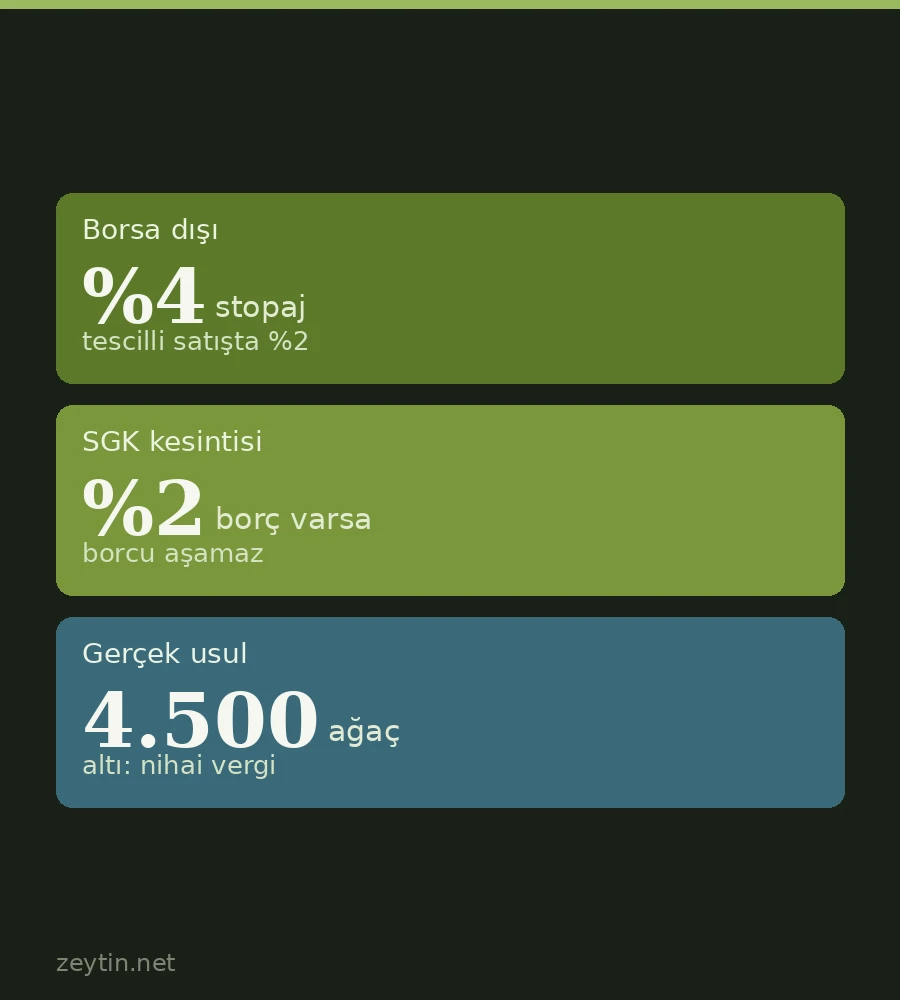
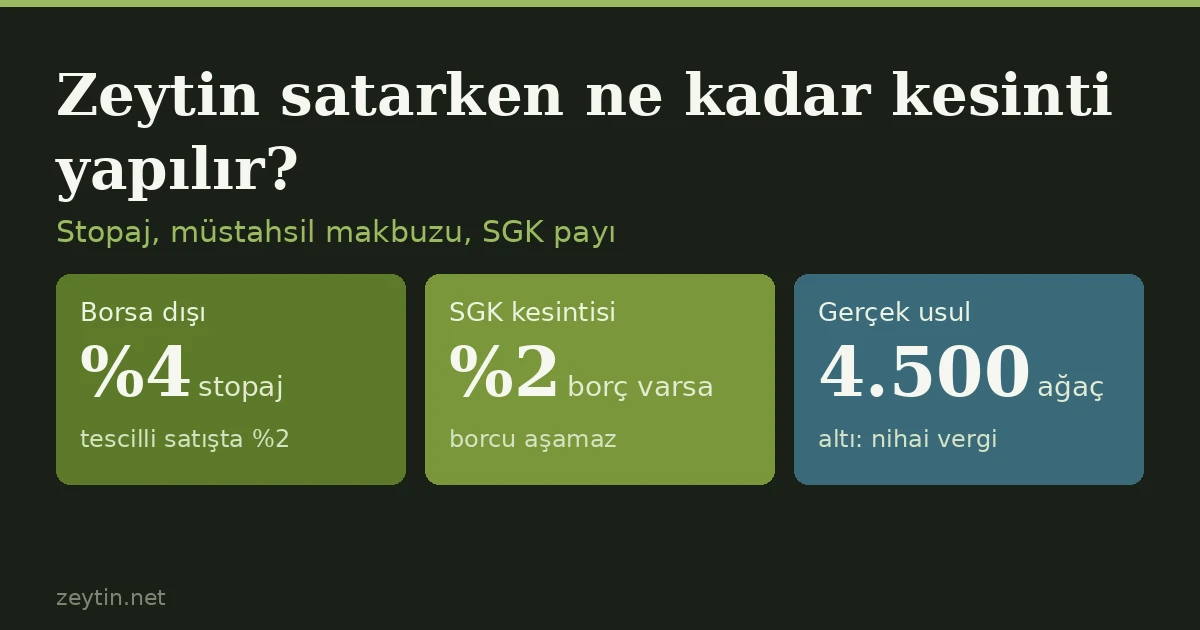
Short answer: on a sale not registered on an exchange, 4% of the price is withheld as income tax; on a registered sale, 2%. If the farmer owes social security premiums, a further 2% is deducted. The exchange registration fee is at most 0.2%.
What is withholding, and who deducts it?
Article 94(11) of the Turkish Income Tax Law requires anyone buying farm produce from a farmer to withhold tax at the time of payment. The rates were set by Council of Ministers Decision 2009/14592 and appear unchanged in the Agricultural Income Guide published by the Revenue Administration (GİB) on 25 February 2026:
- Crop products (olives fall under "other agricultural produce"): 4%, or 2% when bought through registration on a commodity exchange
- Livestock and animal products: 2%, or 1% when registered on an exchange
The buyer withholds, not the seller. The guide lists who must do so: public bodies, trading companies, cooperatives, associations and foundations, farmers who keep books, and traders and professionals who declare their actual income. Withholding also applies to advance payments, at the moment they are paid.
The exceptions are equally clear: if you sell olives to another small farmer, to a consumer who is not a taxpayer, or to a shopkeeper taxed under the simplified regime, nothing is withheld.
Does the withheld money come back?
For most growers, no, and that is not bad news. For a farmer who is not taxed on actual income, withholding is the final tax: no return is filed and nothing more is due at the end of the year. The 2% or 4% withheld is the whole tax on the olive income.
The switch to actual-income taxation is measured by tree count. In the business size table in Article 54 of the law, the threshold for olive groves of bearing age is 4,500 trees. A farmer above that number, or one who owns a combine harvester or more than two tractors up to ten years old regardless of tree count, is taxed on actual income: they keep a farm ledger, file an annual return and offset the tax withheld against the tax calculated.
The producer receipt: your only written proof
When the buyer withholds tax, it documents this with a producer receipt (müstahsil makbuzu, Tax Procedure Law Article 235). The receipt is issued when payment is made, and one copy goes to the farmer. Buyers covered by General Communiqué No. 509 on the Tax Procedure Law issue it electronically.
The receipt matters for three reasons. First, it records that the tax withheld will be paid to the state in your name. Second, the gross amount, kilos and unit price on it are the only figures you can check against the weighbridge ticket. Third, the rate shows on the receipt: if 4% was withheld on a sale said to be registered on an exchange, either the registration did not happen or the rate is wrong.
If you have your olives pressed at a mill and take back the oil, the situation is different: the pressing fee you pay is a service charge, not a sale of produce. How that fee is negotiated is covered in our mill pressing checklist.
Social security deduction: only from those in arrears
The second deduction is not a tax. Under the Social Security Institution's communiqué of 1 March 2013 (Law 5510, Article 88), companies, cooperatives and public bodies buying farm produce deduct an amount from the price against the farmer's unpaid premiums. The rate has been 2% since 1 January 2014.
This deduction has three limits:
- It cannot exceed the debt; nothing is deducted from a farmer with no premium arrears.
- Nothing is deducted from farmers whose debt has been restructured or put into instalments.
- People insured through another job, those receiving a pension or disability benefit, and those holding an Agricultural Deduction Exemption Certificate from the Institution are exempt.
Nor is this deduction a loss to the farmer; it is set against the premium debt. But a farmer who does not show the certificate to the buyer may face the deduction even with no debt. Under the communiqué's transitional article, produce delivered to a licensed warehouse is exempt; a 2024 amendment extended this exemption to 31 December 2028.
Exchange registration: the price of the 2-point gap
A sale registered on an exchange halves the withholding, but registration also has a fee. According to the Ministry of Trade, the registration fee is at most 0.2% of the value of the goods; each exchange's assembly sets the rate. Whether buyer or seller pays depends, under the Exchange Transactions Regulation, on the custom of that exchange.
The arithmetic is simple: a fee of up to 0.2% buys a 2-point cut in withholding. Registration has another benefit: the recorded price enters the series we explain in how to read olive oil exchange prices, and becomes a reference for everyone bargaining in the region.
Example: a calculation with Akhisar prices
In Akhisar, the first purchase prices of the 2026/27 season formed in early October at 60 TL per kilo for large Domat olives and 10 TL for olives sent to oil (Akhisar opening prices). Take a grower selling 2 tonnes of large Domat and 3 tonnes of oil olives at these prices.
| Item | Off-exchange sale | Exchange-registered sale |
|---|---|---|
| Gross price | 150,000 TL | 150,000 TL |
| Income tax withholding | 6,000 TL (4%) | 3,000 TL (2%) |
| Exchange registration fee (maximum) | — | 300 TL (0.2%) |
| Social security deduction (only with arrears) | 3,000 TL (2%) | 3,000 TL (2%) |
| Net received, no arrears | 144,000 TL | 146,700 TL |
| Net received, with arrears | 141,000 TL | 143,700 TL |
Even in the worst case, with the grower paying the whole registration fee, registration makes a difference of 2,700 TL in this example. For where the cost per kilo comes from, what does a kilo of olives cost to produce breaks down farm costs in the Aegean.
Four questions to ask before selling
1. Will the sale be registered on an exchange? If so, withholding should be 2%.
2. Will a producer receipt be issued, and will I get a copy?
3. Do I owe premiums? If not, or if the debt is restructured, get a certificate from the Institution and show it to the buyer.
4. Do the kilos on the receipt match the weighbridge ticket?
In numbers
| Item | Value | Source |
|---|---|---|
| Withholding, off-exchange sale | 4% | Income Tax Law Art. 94(11); GİB Agricultural Income Guide (Feb 2026) |
| Withholding, exchange-registered sale | 2% | Same guide |
| Social security deduction (with arrears) | 2% | Social Security communiqué (2013), since 2014 |
| Exchange registration fee | at most 0.2% | Ministry of Trade |
| Actual-income threshold, olive groves | 4,500 trees | Income Tax Law Art. 54 |
| Licensed warehouse exemption from social security deduction | until 31.12.2028 | Social Security communiqué, 2024 amendment |
| Akhisar first purchase, large Domat | 60 TL/kg | October 2026 |
In short
- When olives are sold, the buyer withholds 4% of the price as income tax (2% if registered on an exchange); for farmers below 4,500 trees this is the final tax.
- The deduction is documented with a producer receipt; always get it and check it against the weighbridge ticket.
- The 2% social security deduction is taken only from farmers with premium arrears, and never more than the debt.
- Exchange registration halves withholding in return for a fee of at most 0.2%.
One rating per visitor; you can change yours at any time. Ratings are real reader votes — no seeded or default scores.
Related
 Article
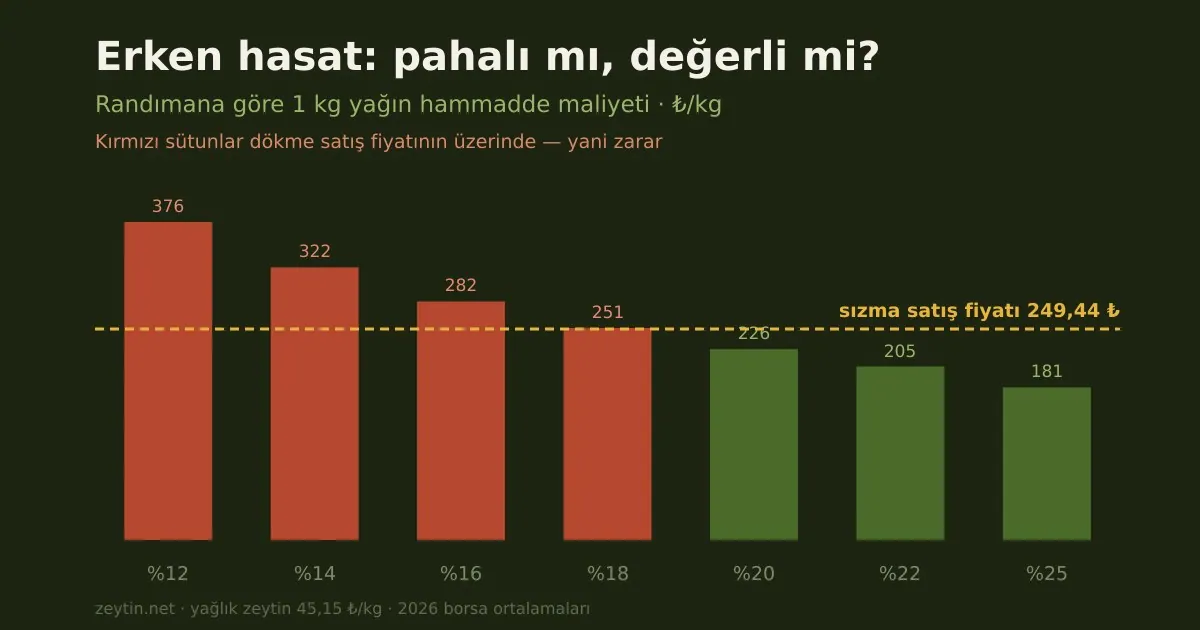
Early harvest: expensive or valuable? The arithmetic of yield
Below 18% yield the raw material costs more than the bulk price. Early-harvest oil needs a 43% premium to break even.
 Article
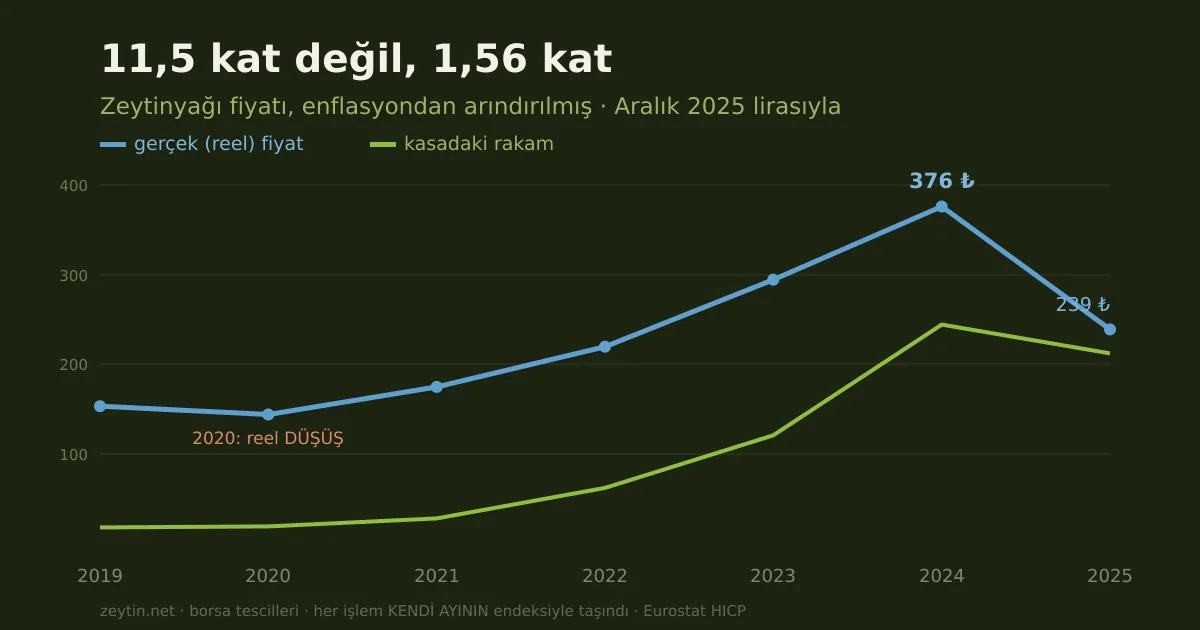
The real price of olive oil: the inflation-adjusted calculation
The lira price rose 11.5-fold, inflation 7.6-fold. The real increase is 1.56-fold — and it matches the euro-based calculation.
 Article
Rain in Andalusia, prices in Aydın: how Spain's drought set the price in Türkiye
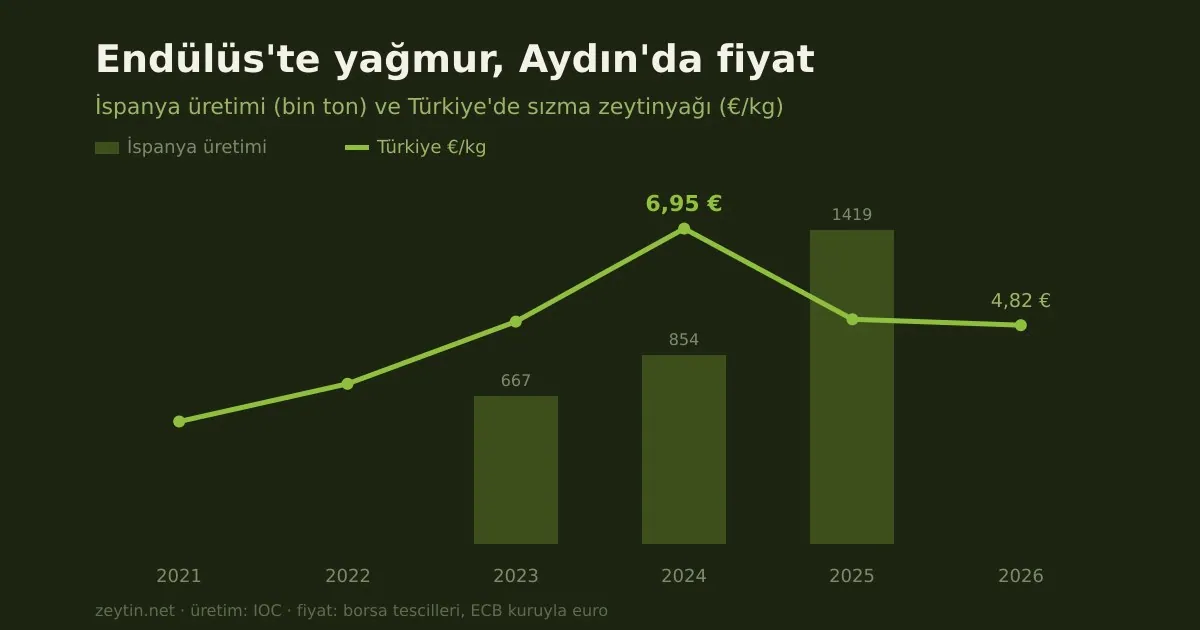
Spain makes 40% of the world's olive oil. Its output halved in 2022/23 and Türkiye's euro price went from €2.70 to €6.95.
 Article
Why do small olive growers sell at harvest? What do licensed warehouses and electronic receipts offer?
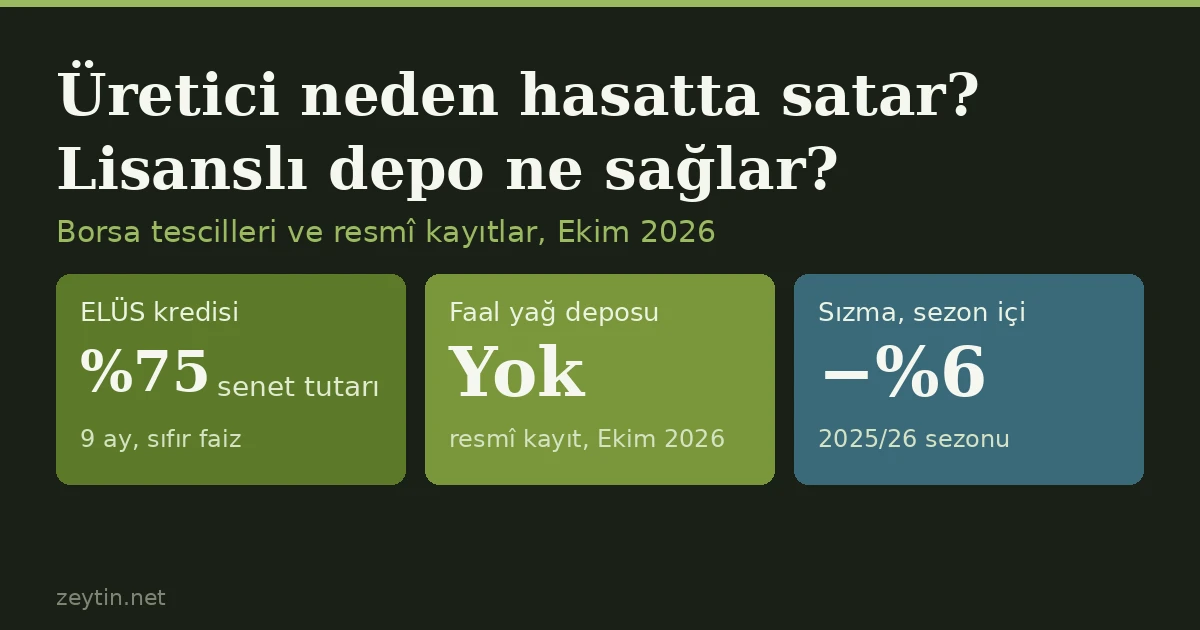
Exchange records show that prices do not bottom out at harvest every year; the real issue is the cost of waiting. Licensed warehouses and electronic receipts (ELÜS) are the legal way to raise cash without selling the oil: interest-free loans up to 75% of the receipt, storage fee support and tax exemptions. But as of October 2026, official records show no licensed olive oil warehouse with an operating permit.