Olive Oil Prices: Week 39 of 2026
Week 39 of 2026: Turkish exchange prices, European producer prices and exchange rates side by side.
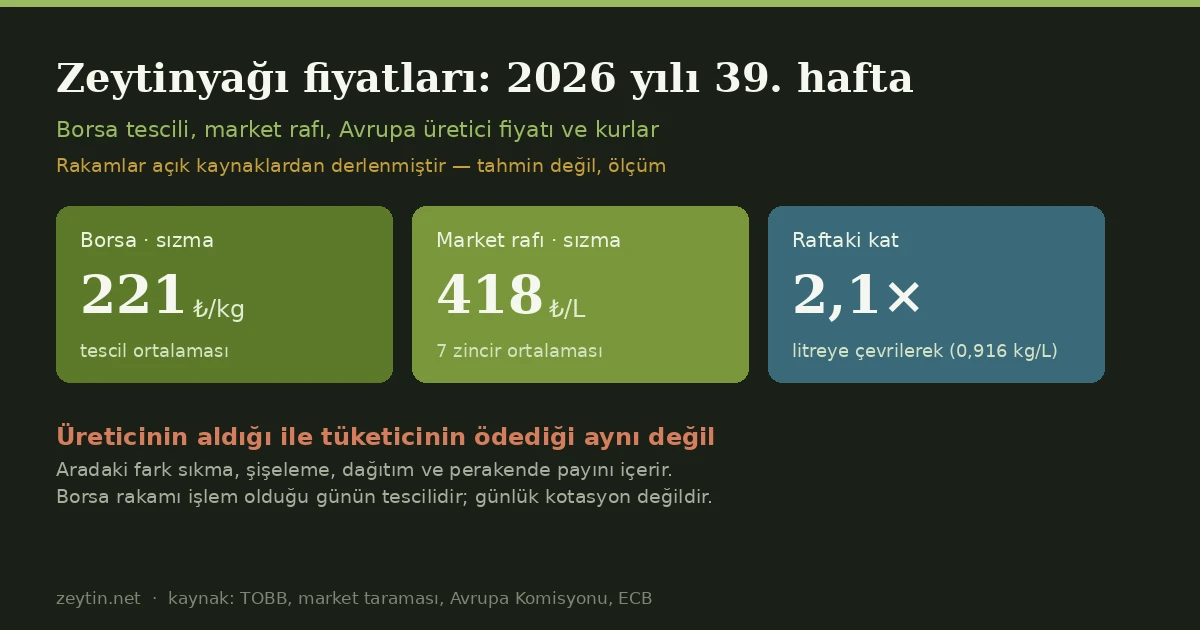
This bulletin brings together current prices from four open sources: trades registered at Turkish commodity exchanges (TOBB), retail prices on Turkish supermarket shelves, weekly producer prices in Europe (European Commission) and exchange rates (European Central Bank). The figures below are those available when the bulletin was prepared.
Turkey: registered exchange prices
| Product | Exchange | Average TL/kg | Trade date |
|---|---|---|---|
| Extra virgin olive oil | Aydın | 234,44 | 18.09.2026 |
| Extra virgin olive oil | Edremit | 225,00 | 17.09.2026 |
| Extra virgin olive oil | Nazilli | 202,37 | 10.09.2026 |
| Crude olive oil | Aydın | 168,45 | 17.09.2026 |
| Crude olive oil | Edremit | 158,40 | 30.07.2026 |
| Crude olive oil | Gaziantep | 186,77 | 17.09.2026 |
| Crude olive oil | Nazilli | 255,36 | 14.09.2026 |
| Olive oil (cooking) | Edremit | 225,00 | 19.08.2026 |
| Black olives, extra-extra | Edremit | 270,00 | 19.06.2026 |
| Green olives, special | Aydın | 70,00 | 14.05.2026 |
| Green olives, special | Edremit | 168,37 | 17.09.2026 |
| Olives for oil | Edremit | 38,00 | 26.06.2026 |
| Black olives, brined | Aydın | 97,84 | 06.04.2026 |
| Black olives, brined | Edremit | 150,00 | 03.09.2026 |
⚠ These are not daily quotations but prices registered on the day that product actually traded; dates differ because the olive is seasonal.
Turkey: supermarket shelf
| Product | Unit | Lowest | Average | Highest | Chains |
|---|---|---|---|---|---|
| Black table olives | ₺/kg | 99,50 | 309,21 | 614,29 | 5 |
| Extra virgin olive oil | ₺/L | 249,00 | 417,87 | 639,95 | 6 |
| Green table olives | ₺/kg | 124,86 | 334,68 | 1293,82 | 6 |
| Riviera olive oil (refined blend) | ₺/L | 199,00 | 369,47 | 879,60 | 4 |
| Olive paste | ₺/kg | 225,00 | 478,35 | 1073,16 | 3 |
Prices are stripped of package size and shown per unit: oils by the litre, table olives and paste by the kilogram. Surveyed on 20.09.2026. The exchange price is what the producer receives; this is what the shopper pays, and the gap covers milling, bottling, distribution and retail margin.
Europe: weekly producer prices (extra virgin)
| Country | €/kg | Weekly change | Week ending |
|---|---|---|---|
| Spain | 3,47 | ▼ %-0,5 | 13.09.2026 |
| Italy | 4,82 | ▼ %-0,6 | 13.09.2026 |
| Portugal | 3,70 | ▲ %2,1 | 13.09.2026 |
| Croatia | 12,38 | ▲ %17,8 | 13.09.2026 |
Exchange rates (18.09.2026)
- 1 EUR = 55,9077 TRY
- 1 EUR = 1,1460 USD
- 1 USD = 48,7851 TRY (cross rate)
What stands out this week
The lira gained against the euro, so the import reference got cheaper. EUR/TRY eased from 56.3329 to 55.9077 (−0.8%). In the same week the Spanish extra virgin producer price was almost flat at €3.47/kg (−0.5%). Together these move the lira equivalent of the Spanish figure from ₺196.6 to ₺194.0/kg. Registered extra virgin trades in Türkiye sit between ₺225.00 and ₺234.44 — that is 16% to 21% above the Spanish reference. Last week the gap in Aydın was 10%; it is widening.
On the exchanges there is no single direction, only trade-level volatility. Extra virgin rose in Aydın from ₺216.71 to ₺234.44 (+8.2%) while falling in Edremit from ₺251.99 to ₺225.00 (−10.7%). Nazilli has registered no new extra virgin trade since 10 September. This table does not support a sentence like "prices rose by X": each row is a single registered trade on the day it happened. Trading thins out in the weeks before harvest, and one lot can swing the average.
Shelf averages fell, but the basket shrank too. The average for extra virgin dropped from ₺456.82/L to ₺417.87/L (−8.5%), with similar declines for black (−8.7%) and green (−8.6%) table olives. The number of retailers with a visible price also fell, however: from 7 to 6 for extra virgin, from 6 to 5 for black olives. Part of the decline may be a change of basket rather than a discount — and indeed the cheapest shelf price for extra virgin held at ₺249.00/L, so the floor did not move.
The largest move in Europe was Croatia: €10.50/kg to €12.38/kg, a jump of 17.8%. Croatia is a thin market, and a one-week jump there should not be read as a regional trend. Spain, Italy and Portugal all stayed within ±2%.
A note on comparison
The Turkish and European figures are not directly comparable: the European data is a weekly average producer price, the Turkish data the price of individual registered trades. Anyone comparing them must also account for the exchange rate and the difference in dates.
For current tables see the market page.
One rating per visitor; you can change yours at any time. Ratings are real reader votes — no seeded or default scores.
Related
 Article
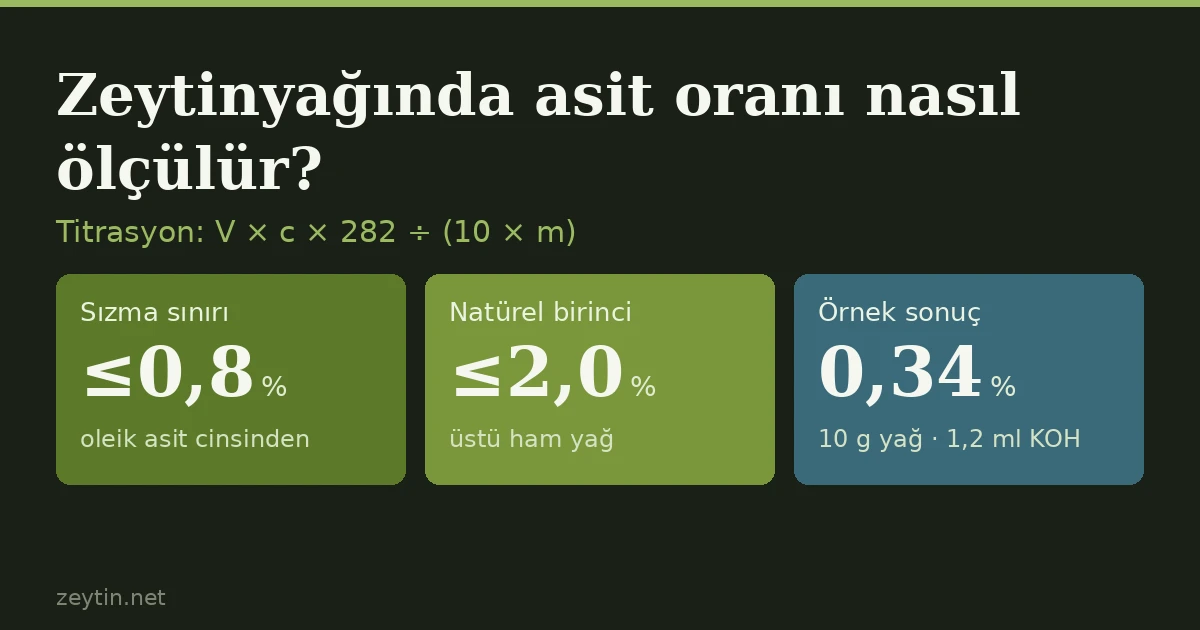
How is olive oil acidity measured? Titration, the formula and taking a sample
Olive oil acidity is measured in a laboratory by titration: the oil is dissolved in a solvent, free fatty acids are neutralised with potassium hydroxide, and the percentage is calculated as oleic acid from the amount used. The formula, a worked example, sampling and the limits of home test kits.
Article
How is olive oil acidity measured? Titration, the formula and taking a sample
Olive oil acidity is measured in a laboratory by titration: the oil is dissolved in a solvent, free fatty acids are neutralised with potassium hydroxide, and the percentage is calculated as oleic acid from the amount used. The formula, a worked example, sampling and the limits of home test kits.
 Article
How to Read an Olive Oil Label
Grade, harvest year, acidity, origin and bottling place: which statements on a label are binding and which are just marketing — with a quick checklist.
Article
How to Read an Olive Oil Label
Grade, harvest year, acidity, origin and bottling place: which statements on a label are binding and which are just marketing — with a quick checklist.
 Article
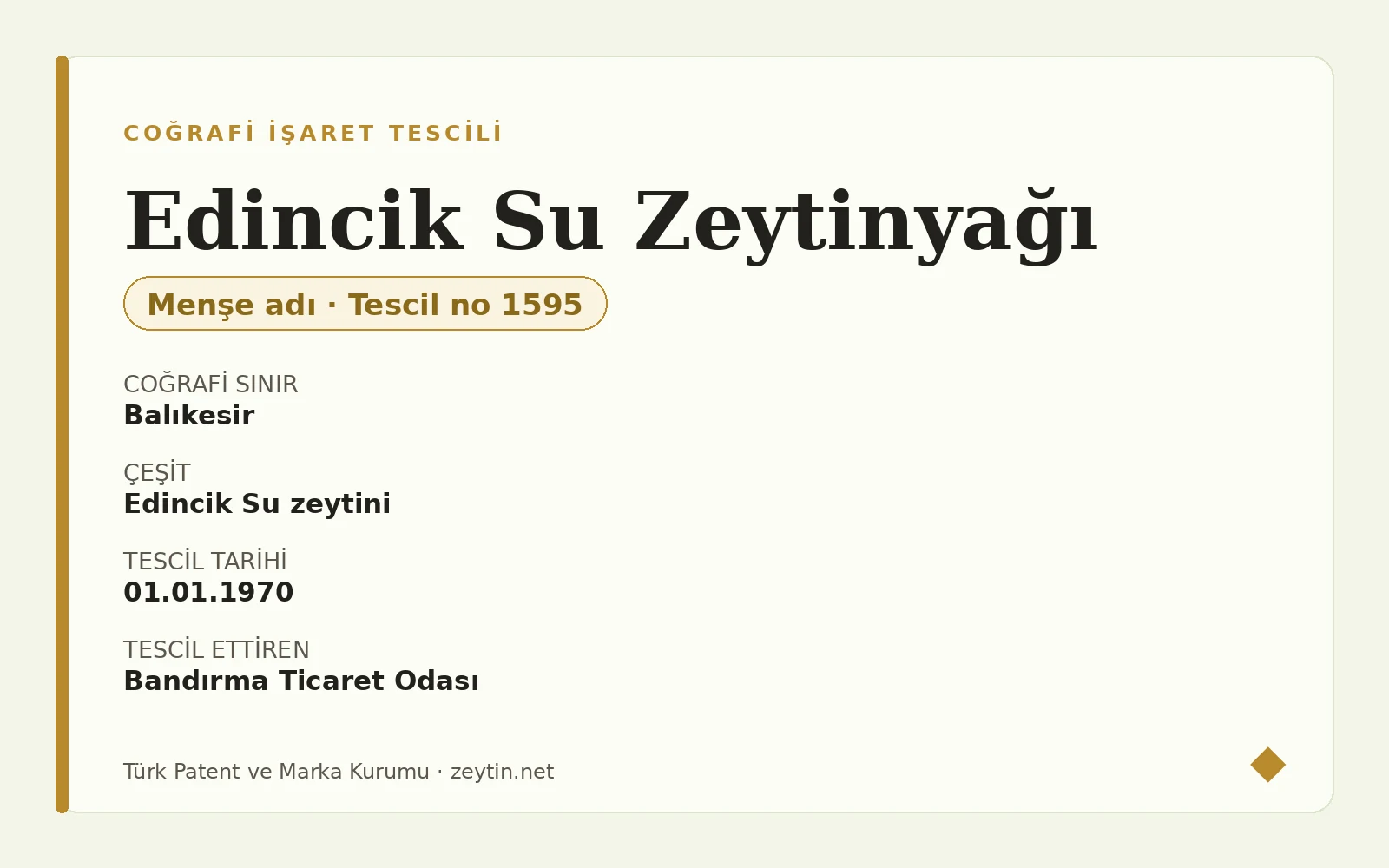
Edincik Su Olive Oil: ripening slowed by the sea
Registered in 2024. The certificate attributes aroma intensity to one cause: near the Erdek gulf the olives develop slowly and ripen late.
Article
Edincik Su Olive Oil: ripening slowed by the sea
Registered in 2024. The certificate attributes aroma intensity to one cause: near the Erdek gulf the olives develop slowly and ripen late.
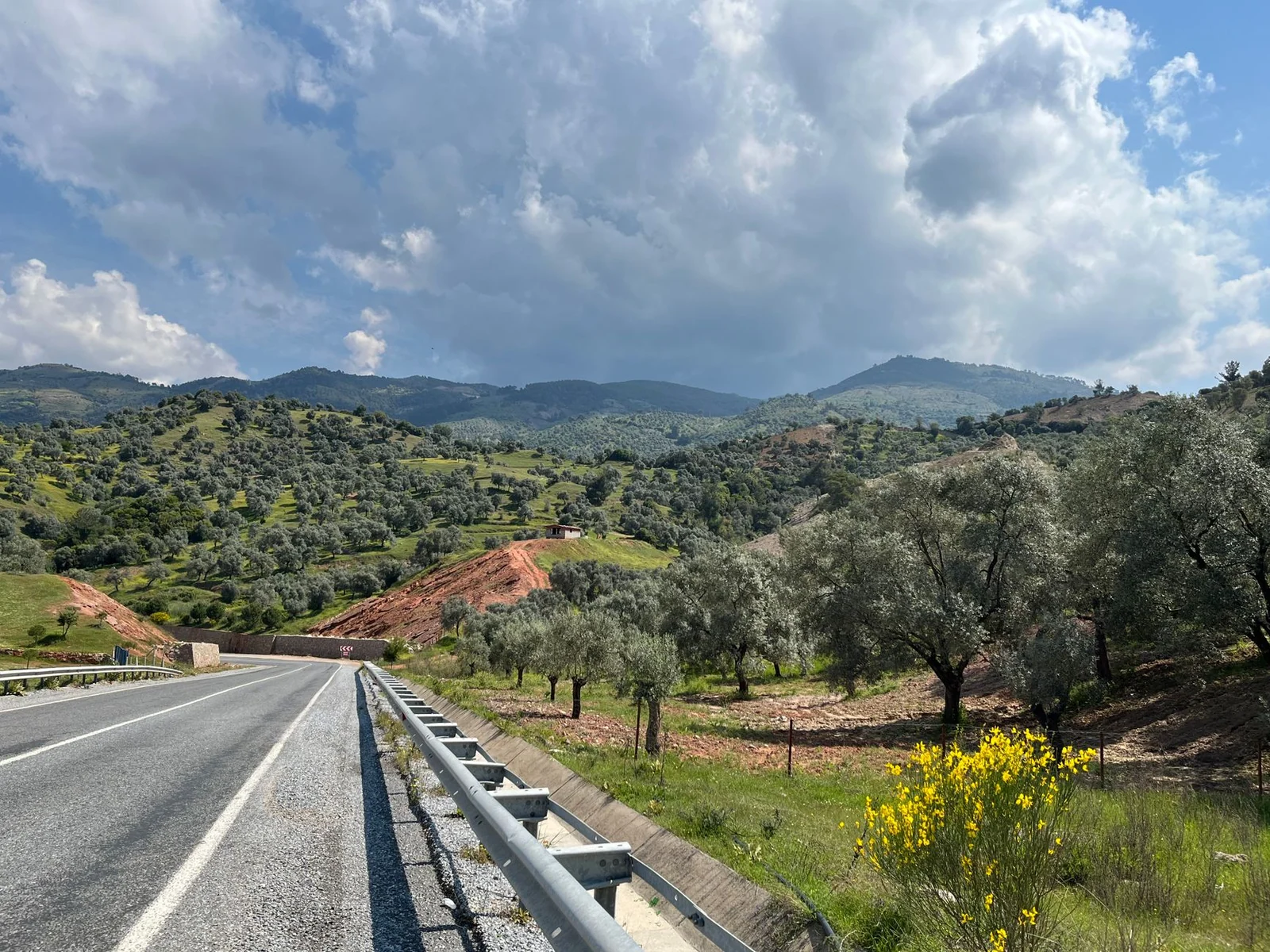 Article
Güney Ege Olive Oils: a designation of origin across three provinces
Registration no 79, published in the Official Gazette in 2004, covers more than thirty-three districts across İzmir, Aydın and Muğla. The reasoning is not administrative but varietal: the region holds almost all of Türkiye's Memecik trees.
Article
Güney Ege Olive Oils: a designation of origin across three provinces
Registration no 79, published in the Official Gazette in 2004, covers more than thirty-three districts across İzmir, Aydın and Muğla. The reasoning is not administrative but varietal: the region holds almost all of Türkiye's Memecik trees.