What is the white cottony tuft on an olive branch? Telling the cottony scale, the psyllid and the wound scale apart
A white cottony tuft on an olive branch can come from one of two insects, the cottony scale or the psyllid, while the orange wound scale dries out branches. Based on the Ministry of Agriculture's farmer booklet, the article shows how to tell the three apart, what damage they do and which cultural measures apply.
Finding a white, cotton-like tuft on an olive branch often alarms the owner of the orchard. But two different insects can lie behind that sight, and they are not the same: the olive cottony scale (Philippia oleae, "zeytin pamuklu koşnili" in Turkish) and the olive psyllid (Euphyllura spp., "pamuklubit"). A third scale, the olive wound scale (Pollinia pollini, "yara koşnili"), does not look like cotton but dries out branches. This article relies on the information in the booklet Farmer Training Series: Olive of the General Directorate of Food and Control at Turkey's Ministry of Agriculture and Forestry. The best-known scale of the olive, the black scale, and the sooty mould that follows it have their own article: black scale and sooty mould.
Olive cottony scale (Philippia oleae)
How to recognise it
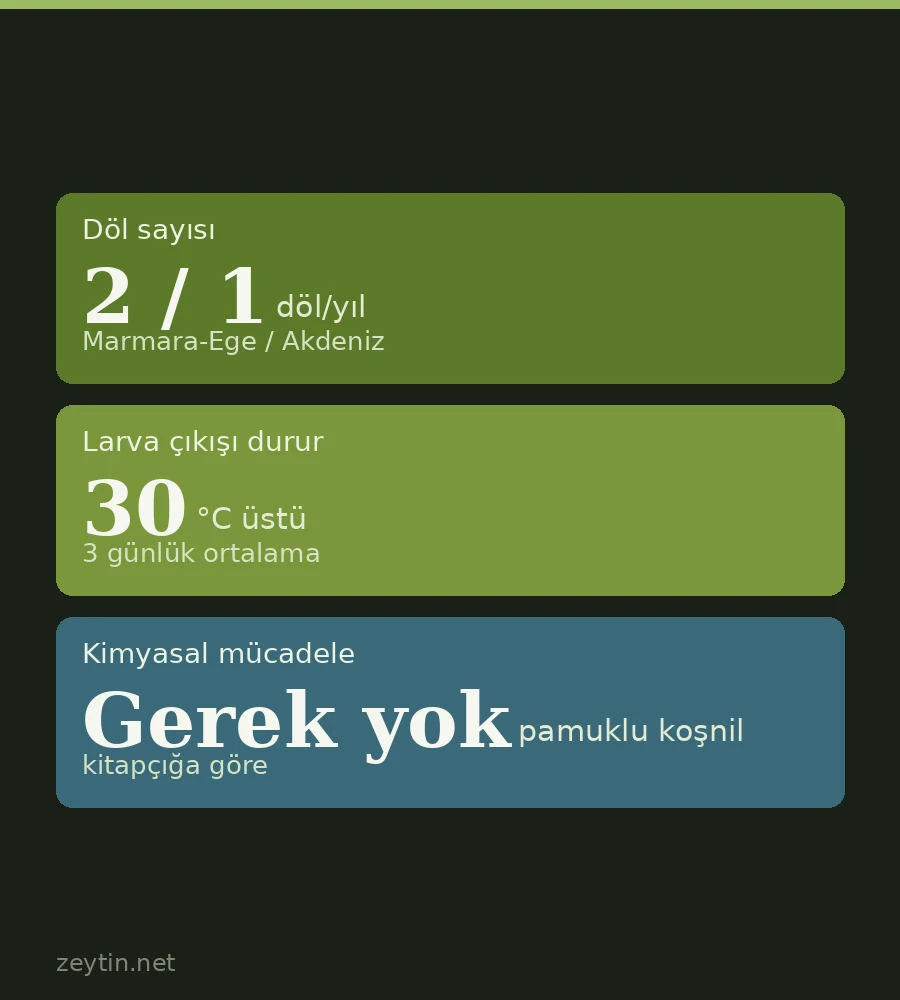
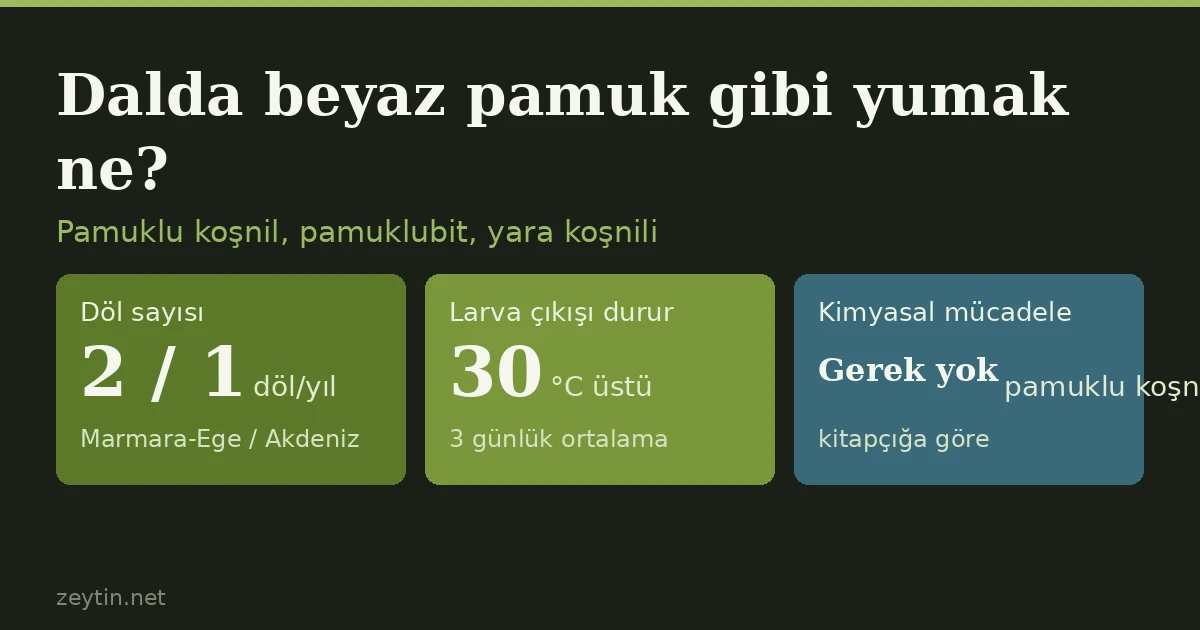
According to the booklet the adults look white and cottony at first glance. In nearly all olive-growing areas the pest spends the winter as a young adult female, on the underside of leaves and on shoots. It is known to have two generations a year in the Black Sea, Aegean and Marmara regions and one generation in the Mediterranean region. Its only host is the olive.
What damage does it do?
It harms the tree by sucking sap, and the sweet substance it secretes leads to the formation of sooty mould. When the density is high, trees show general weakening and thin twigs dry out. The booklet describes the pest as spread across all the regions where olives are grown.
Where does it turn up?
The booklet gives a useful clue here: the pest is usually found on the skirt branches and basal shoots of olive groves along roadsides, and it does its damage there.
What is done about it?
The booklet's recommendations are cultural:
- The booklet says that measures should be taken against "dusting" (tozlanma). Given that the pest is found in groves beside roads, we assume this means reducing the dust that rises from the road and settles on the trees; the text does not say so explicitly, so this is our interpretation.
- Basal shoots should be cut.
- Where the density is low, branches showing cotton-like clusters should be pruned.
On chemical control the booklet is clear: "chemical control is not needed." So the first move when you see a white tuft should not be to buy a product but to prune and clear the shoots. For how to prune, see our article on olive pruning.
Olive psyllid (Euphyllura spp.)
The psyllid is the second insect that is confused with the cottony scale. According to the booklet, the young nymphs are yellow or light green; they secrete a honey-like substance made of very fine threads, and the threads gather in clusters like a heap of cotton. It spends the winter as an adult under the bark, in cracks and crevices of the trees, and even in the shoots and leaf axils; adults become active from mid-February.
Its damage is concentrated in the flowering period: the larvae suck sap in the flower clusters, on the stalks of buds and on shoot tips; trees and shoots weaken, and flowers and flower buds drop. The honey-like substance also reduces flowering and fruit set. The booklet says that damage rises as density rises, and that at low density it is hardly felt. The pest typically appears in damp, unpruned groves after a rainy spring, in the flowering period. Besides olive and wild olive it lives on Phillyrea species.
The booklet's approach to treatment is measured: if a treatment against the flower generation of the olive moth has been made in the same period, no separate treatment is needed for the psyllid; in orchards where no such treatment was made, only the heavily damaged flower clusters should be treated, so that natural enemies are protected. For details see our article on other olive pests.
Olive wound scale (Pollinia pollini)
How to recognise it
It is orange-coloured, not cottony. The adult female is spherical or pear-shaped, usually more domed on the back; the inner part of the shell is white and smooth, the outer part grey and wrinkled. The adult male is reddish brown with a partly transparent abdomen. It generally spends the winter as a second-stage female larva or adult female on the branches. It has one generation a year. Its only hosts are cultivated olive and wild olive.
How does weather affect it?
The details the booklet gives are interesting: if it rains while the mobile larvae are starting to emerge, large numbers die. If the three-day average temperature in this period stays above 30 °C, larval emergence stops; if it rises above 40 °C, first-stage larvae die in large numbers. Those that enter winter as first-stage larvae die in large numbers when minimum temperatures fall below 0 °C. So the density of this pest can swing greatly from year to year depending on the weather.
What damage does it do?
The damage begins by drying out the terminal buds. In heavy infestations, the tree, which makes a constant effort to put out shoots in spring, has shorter shoots, growth lags and the tree often fails to set fruit. On shoots where the insect settles in the leaf axils, leaves drop and the shoots dry out. According to the booklet, in heavy infestations three-year-old branches dry out within one to two years; the pest population then declines, because it cannot survive on a tree without new shoots.
What is done about it?
Here too the booklet leans on cultural measures:
- Trees that have been weakened should be strengthened, since the wound scale has less chance of surviving on a vigorous tree.
- Dry branches should be cut, the inside of the tree pruned so that it receives air and light, and fertilisation done properly.
- Pruning plays an important role; especially after cold damage the population should be reduced by pruning. For the timing of pruning after cold damage see our frost damage article, which advises against hurrying.
- The booklet makes no recommendation for chemical control.
In our frost article we advise waiting before pruning, because cutting while it is still unclear which parts of the tree are alive can do harm. For the wound scale the booklet recommends pruning after cold damage. A sensible way to reconcile the two is to clear dry and infested branches once the living parts have become clear; this is our interpretation. If you are not sure, consult the provincial or district directorate.
Where to look in the orchard
Putting the booklet's clues together gives an order of inspection. If the white tuft is on the skirt branches and basal shoots of trees beside a road, think of the cottony scale and check the underside of leaves and the shoots. If the tuft is on shoot tips and flower clusters during flowering, especially in a damp, unpruned orchard after a rainy spring, think of the psyllid. If there are small orange spheres, not white, on the branches and the terminal buds are drying, suspect the wound scale.
Telling the three apart
| Feature | Cottony scale | Psyllid | Wound scale |
|---|---|---|---|
| Appearance | White, cottony adults | Clusters of fine threads like a heap of cotton | Orange sphere or pear shape |
| Where | Underside of leaves, shoots; skirt branches and basal shoots by roads | Flower clusters, bud stalks, shoot tips | Branches, terminal buds, leaf axils |
| Damage | Sooty mould, weakening, thin twig dieback | Flower and bud drop, poor fruit set | Dry terminal buds, short shoots, dieback of three-year-old branches |
| Chemical control | Not needed | No separate treatment if the moth was treated | No recommendation |
Summary
A white, cottony look on an olive can be one of two insects: the cottony scale on branches and shoots, particularly in roadside groves, or the psyllid on shoot tips and flower clusters in the flowering period. For both, the first intervention is pruning, clearing basal shoots and keeping the orchard ventilated. The wound scale is not cottony but orange; it shows itself by drying terminal buds and branches and becomes worse on weak trees. For all three the booklet either finds chemical control unnecessary or gives no recommendation; where a treatment is needed, the provincial or district directorate sets the product and the timing.
One rating per visitor; you can change yours at any time. Ratings are real reader votes — no seeded or default scores.
Related
 Article
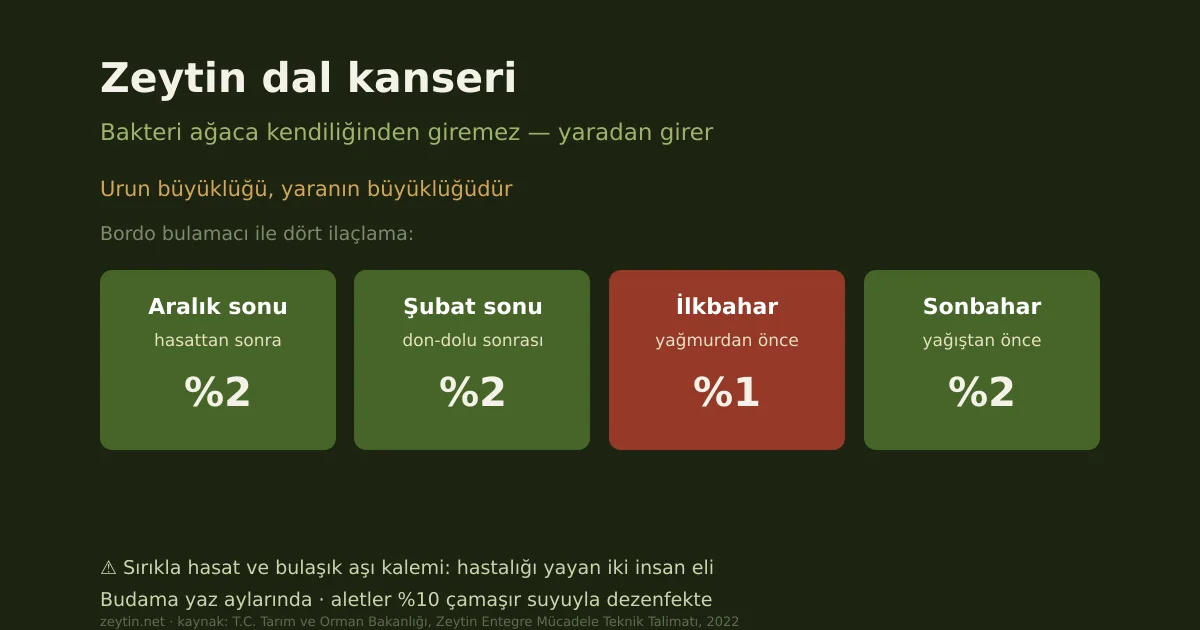
Olive knot: galls, warts and a bacterium that enters through wounds
The bacterial canker among olive tree diseases that enters through wounds: galls and warts. Pole harvest and pruning errors spread it.
 Article
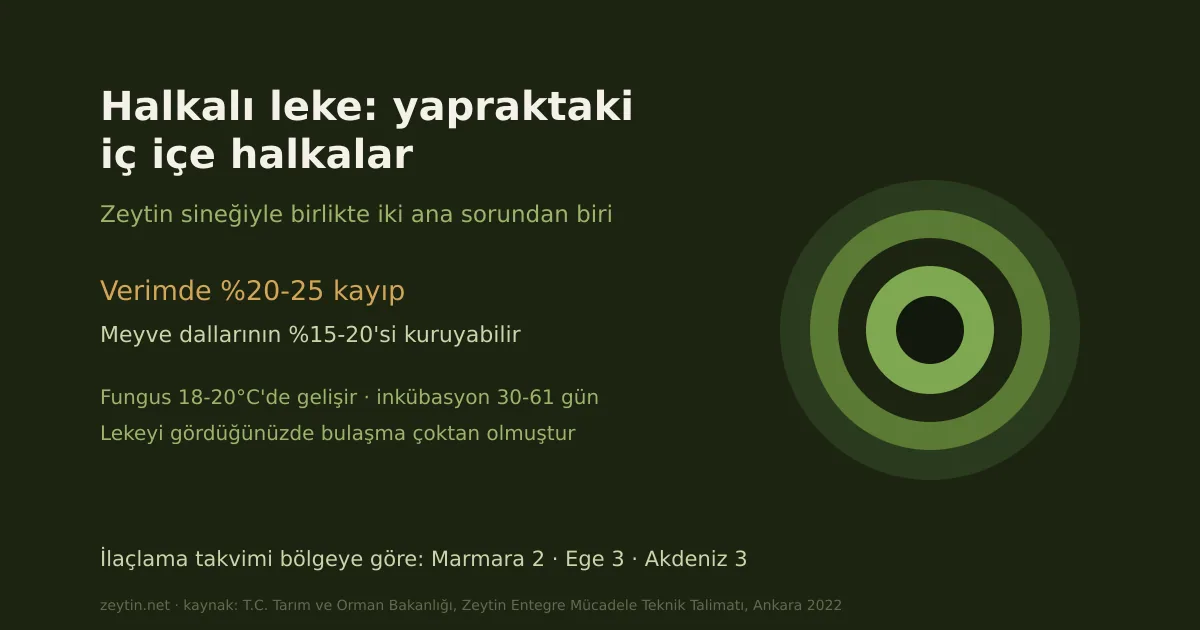
Olive peacock spot: symptoms and a region-by-region spray calendar
The commonest of olive tree diseases: concentric rings on the leaf, shedding, a shrubby tree. Yield falls 20-25%; spray timing varies by region.
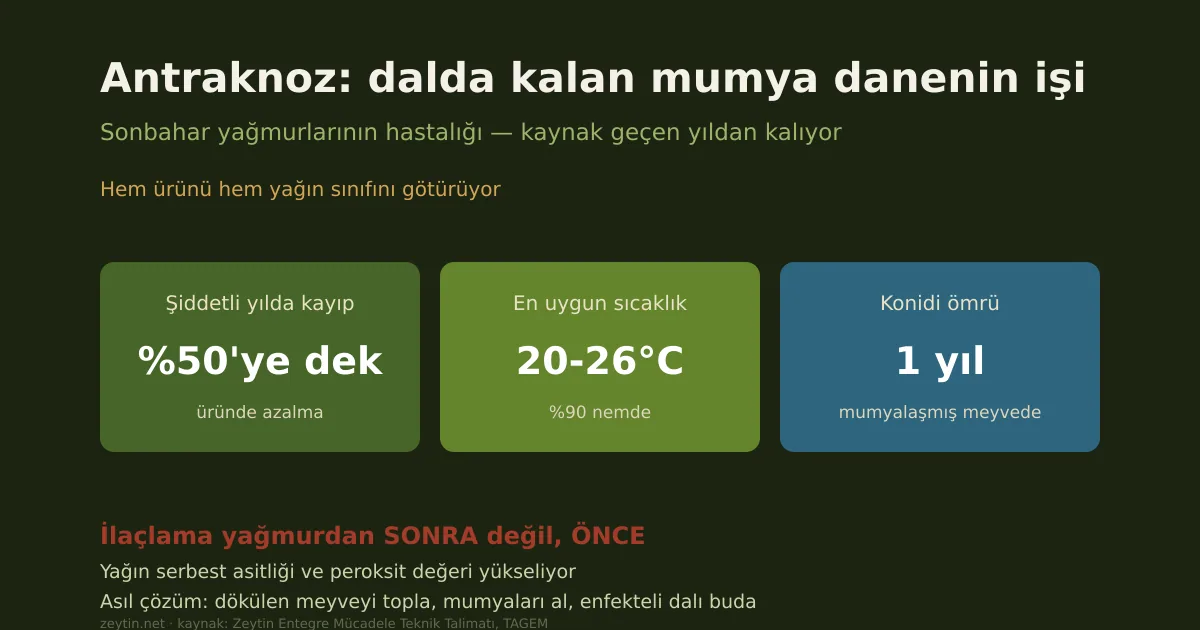 Article
Olive anthracnose: the disease of the mummified fruit left on the branch
Up to 50% crop loss in bad years. The source is last year's mummified fruit still on the branch, and the spray goes on before the autumn rains, not after.
 Article
Herbicide-free weed management in olive groves: from cover crops to autonomous robots
Managing weeds rather than eliminating them: cover crops, mulch, grazing, flame weeding and AI-assisted precision farming — five tools and a practical order for combining them.