North Aegean Olive Oils: a registration stricter than the food codex
The mark of ten localities rather than one district — and unusually, it sets tighter limits than the national standard on peroxide, FAEE, waxes and K270.
This registration differs from the others in two ways. First, it is a geographical indication (mahreç işareti) rather than a designation of origin. Second, some of the quality limits it sets are stricter than the Turkish Food Codex.
The second is unusual, and it is the subject of this article.
The record
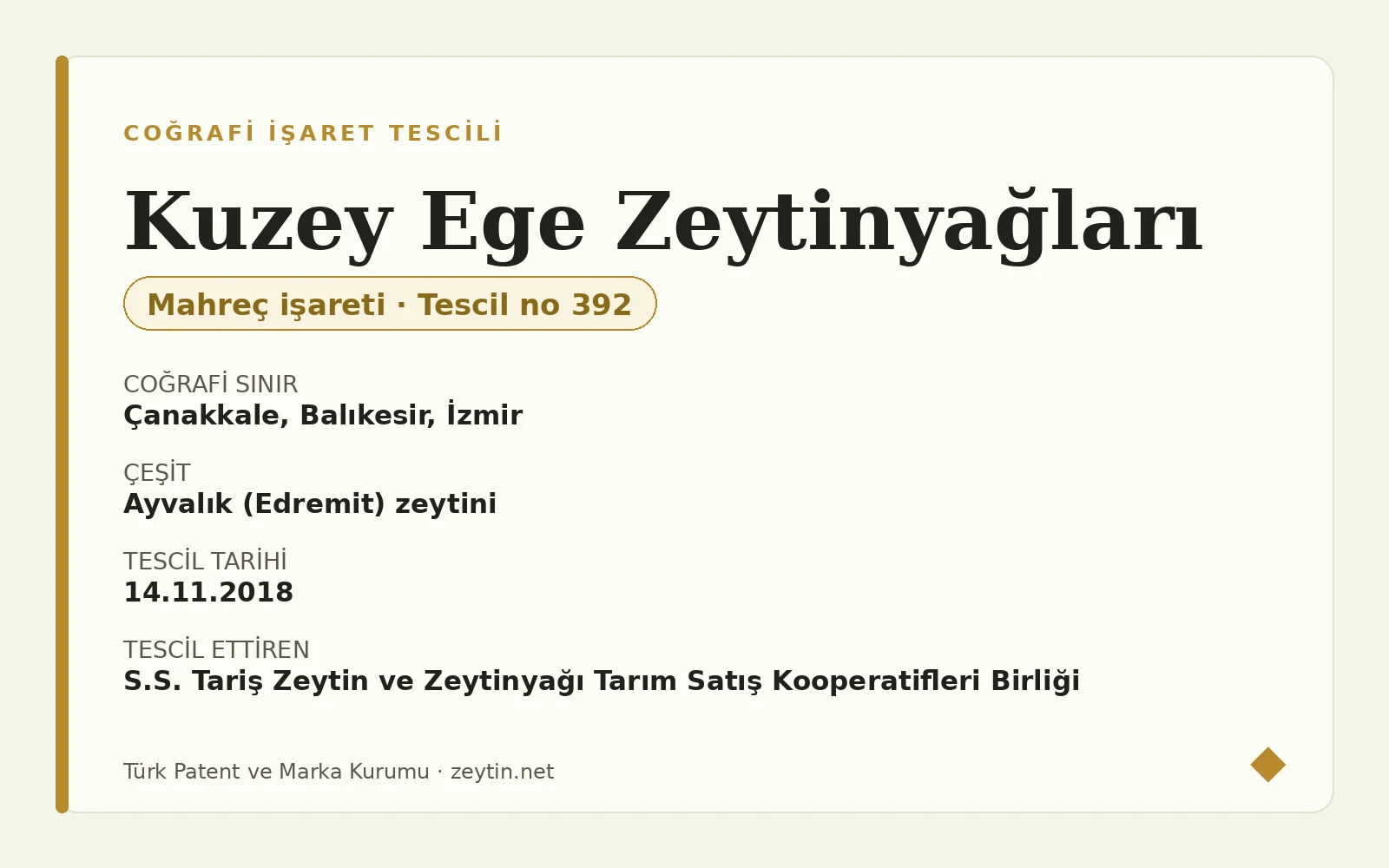
| Registration no | 392 |
| Registration date | 14.11.2018 |
| Application | C2016/111 · 16.12.2016 |
| Type | Geographical indication |
| Registered by | S.S. Tariş Olive and Olive Oil Agricultural Sales Cooperatives Union |
What a geographical indication means here
Under a designation of origin, every stage takes place within the defined area. Under a geographical indication, at least one stage does and the rest may happen elsewhere — a more flexible commitment. We set out the difference in detail.
That is why North Aegean is not tied to a single district as Ayvalık Olive Oil is.
The area: ten localities
The certificate defines the boundary as the region enclosed by the Kaz and Madra mountains, and names the settlements individually:
Ezine · Ayvacık (Küçükkuyu) · Edremit (Altınoluk) · Havran · Burhaniye · Gömeç · Ayvalık (Altınova) · Dikili · Bergama (Zeytindağ) · Aliağa (Şakran)
A strip running from Çanakkale to İzmir. What they share is not administrative but topographic: lying between two mountain ranges.
One cultivar
The product is extra virgin olive oil from the Ayvalık (Edremit Yağlık) cultivar, whose origin is known to be Edremit. For the cultivar itself: the Ayvalık (Edremit) olive.
The limits stricter than the codex
This is the certificate's most striking feature. The registration sets narrower ranges than the national standard allows:
| Criterion | North Aegean limit | Food Codex limit |
|---|---|---|
| Peroxide value (meq O₂/kg) | ≤ 18 | ≤ 20 |
| K270 | ≤ 0.2 | ≤ 0.22 |
| Fatty acid ethyl esters (mg/kg) | ≤ 25 | ≤ 35 |
| Waxes (mg/kg) | ≤ 100 | ≤ 150 |
| Oleic acid (%) | ≥ 69 | 55 – 83 |
The last line is the sharpest: where the codex allows a broad 55-83% for oleic acid, the registration requires at least 69%. Many oils that satisfy the codex therefore cannot carry this mark.
There is also a requirement with no codex counterpart: alpha-tocopherol of at least 150 mg/kg. Alpha-tocopherol is the principal form of vitamin E and contributes to the oil's oxidative stability.
Free acidity sits at the extra virgin ceiling: ≤0.8%.
The sensory profile
The certificate gives a list for fruitiness: almond, apple, flowers, grass, green, greenish fruity, olive leaf, ripe fruity, soft fruity and tomato. At least one must be present at low (<3.0) or moderate (<5.0-5.5) intensity.
Bitterness and pungency are low to moderate (<4.0). And in the certificate's own words the oil has a characteristic feel that is "lightly flowing and generally described as water-like".
That last description is interesting: most registrations praise density, while this one treats fluidity as distinctive.
In short
North Aegean Olive Oils is a geographical indication covering the oil of a single cultivar grown across ten localities between two mountain ranges. What distinguishes it lies less in the geography than in the thresholds: below the national standard on peroxide, FAEE, waxes and K270, and distinctly above it on oleic acid.
So the mark does not only say "it came from here" — it says "it is above this line".
The criteria the document binds
The registration does not only protect a name; it defines the product numerically:
| Criterion | Value in the document |
|---|---|
| Peroxide value | 18 meq O₂/kg (max) |
| Harvest-to-pressing window | max 48 saat |
Limiting the time from harvest to pressing binds the operation rather than the outcome: free fatty acidity rises while the fruit waits. The document also bars windfall olives — fruit picked off the ground is the main source of mould and fermentation defects.
The area as the document defines it
The short line in the record does not give the registration's full boundary. The document's own definition reads:
t; Kazdağları ve Madra ile çevrelenen; Ezine, Ayvacık (Küçükkuyu); Edremit (Altınoluk), Havran, Burhaniye, Gömeç, Ayvalık (Altınova), Dikili, Bergama (Zeytindağ) ve Aliağa-Şakran’ı kapsayan bölgedir.
The production steps in the document
The registration describes production step by step. The document's own sequence:
1. Zeytinlerin Hasadı — Zeytinin hasadı Ekim ortalarında başlar ve Şubat sonuna kadar devam edebilir.
2. Zeytinlerin Saklama ve Taşıma Koşulları — Zeytin, gıda ile temasa uygun, temiz, tercihen plastik kasalarda, hava alacak şekilde depolanmalı ve taşınmalıdır.
3. Zeytinlerin Temizlenmesi ve Yıkanması — Yaprak ayırma ve yıkamanın amacı, yaprak, toprak vb.
4. Zeytinlerin Kırılması ve Ezilmesi — Kırma meyvenin kırılarak yağ fazının ayrılacağı hamurun elde edilmesi işlemidir.
5. Zeytinlerin Yoğurulması (malaksasyon) — Kuzey Ege zeytinyağlarının üretiminde zeytinlerin yoğrulması; katı sıvı faz ayrımını kolaylaştırmak amacıyla yağ damlalarının birleştirilmesinde önemli bir fonksiyona sahiptir.
6. Zeytin ezmesinden yağın ekstraksiyonu — Kuzey Ege Zeytinyağlarının ekstraksiyonunda aşağıdaki yöntemler kullanılmaktadır: a) Hidrolik presleme: elle veya mekanik olarak daha önceden tasiriye torbaları içine yayılmış zeytin hamuru üzerine hidrolik basınç uygulanarak yağ ve…
7. Karasuyun Zeytinyağından Ayrılması — Karasuyun ayrılması; yoğunluk farkına dayanan geleneksel sistemde doğal çökme yöntemiyle ya da santrifüj kullanılarak yapılır.
8. Zeytinyağının Depolanması — Kuzey Ege Zeytinyağının depolanmasında gıda ile temasa uygun malzeme kullanılmalıdır.
That this sequence is binding is what separates a geographical indication from a trade mark: a mark says who produced something, a geographical indication also sets down how it must be produced.
The cultivar behind it, measured
The registration is granted to a place, but the cultivar the definition rests on has measurable values:
| Property | Value |
|---|---|
| Meyve ağırlığı | 4,98 g |
| Et oranı | %85 |
| Yağ oranı | %23-26 |
| Hasat | Ekim-Kasım |
| Kendine verimlilik | yok |
| Periyodisite | az |
| Soğuğa dayanım | yüksek |
| Kullanım | yağlık · çizik · siyah sofralık |
| Meyve boyu | 23,09 mm |
| Meyve eni | 18,85 mm |
| Meyve iriliği | orta-iri |
At 23-26% the oil content sits mid-range; yield alone is not the argument here, aroma is. The cultivar is not self-fertile — a pollinator is required in the grove. The planting the registration describes is therefore never single-cultivar in practice. Alternate bearing is low: the year-to-year swing in yield is smaller than is usual in olives.
Its place in İzmir's olive production
| Item | Value |
|---|---|
| Fruit production | 485,275 t |
| — for oil | 440,096 t |
| — for the table | 45,179 t |
| Olive oil production | 70,767 t |
| Trees | 18,177 thousand |
| Yield per tree | 26.7 kg |
91% of the province's fruit goes to oil. An oil-based registration matches how the province actually produces.
One rating per visitor; you can change yours at any time. Ratings are real reader votes — no seeded or default scores.
Related
 Article
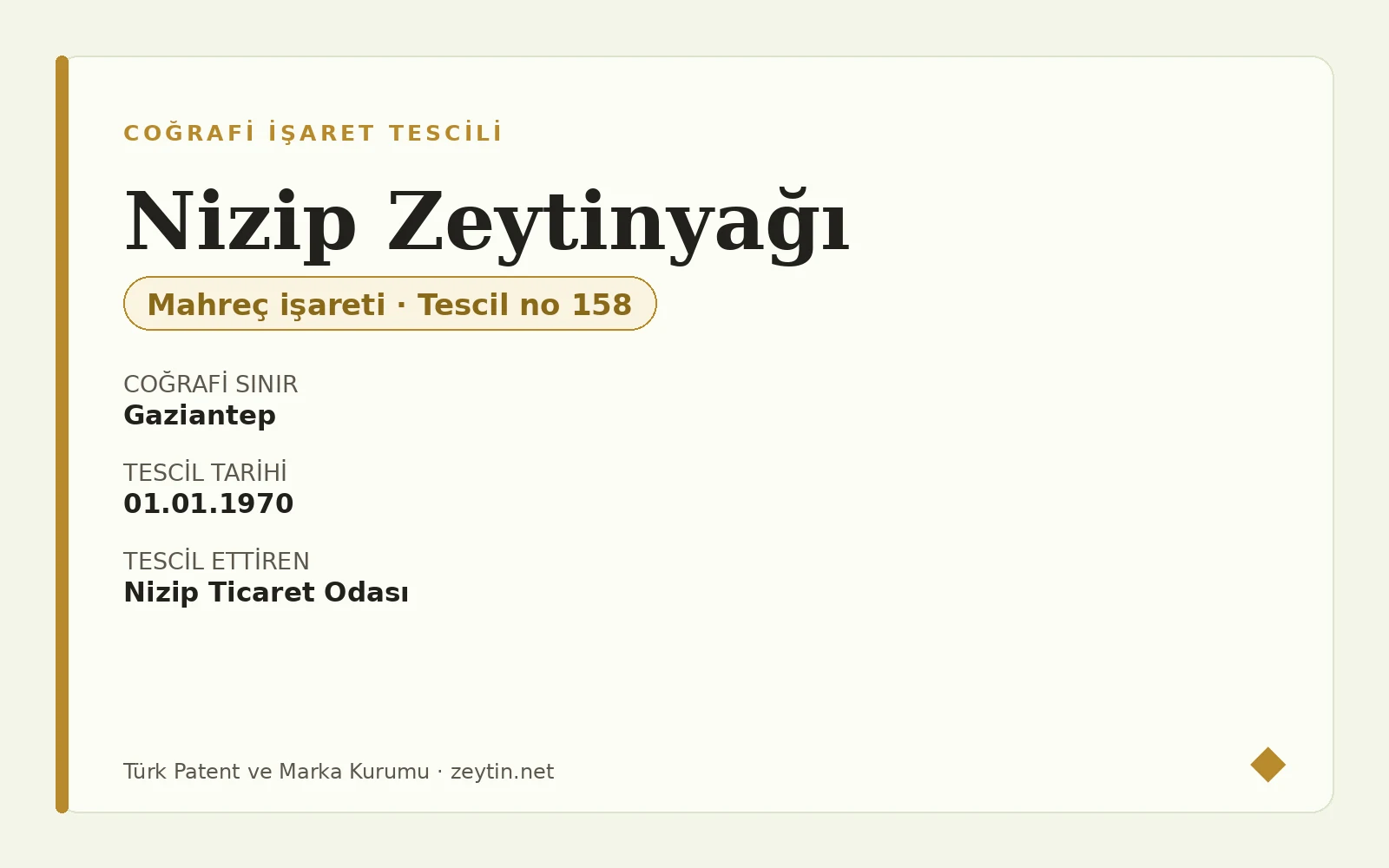
Nizip Olive Oil: a registration that sets a floor for its raw material
Registered in 2011. The certificate sets conditions on the fruit, not just the oil: 15-17 mm wide, 19-20 mm long, at least 25% oil. Fruit outside that cannot be used.
Article
Nizip Olive Oil: a registration that sets a floor for its raw material
Registered in 2011. The certificate sets conditions on the fruit, not just the oil: 15-17 mm wide, 19-20 mm long, at least 25% oil. Fruit outside that cannot be used.
 Article
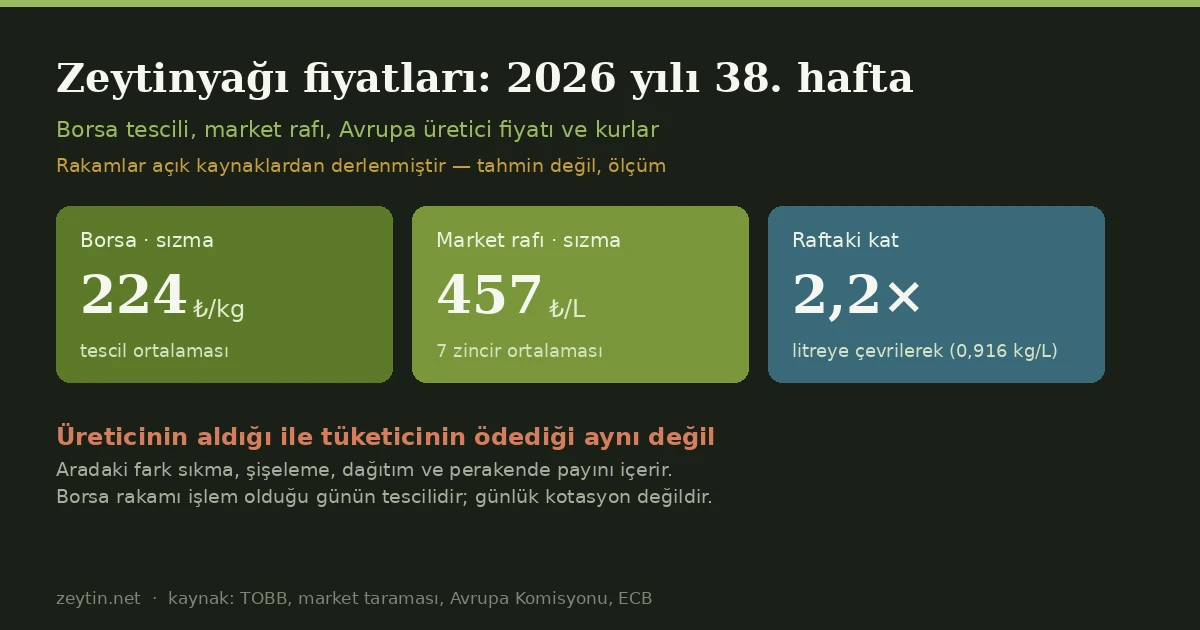
Olive Oil Prices: Week 38 of 2026
Week 38 of 2026: Turkish exchange prices, European producer prices and exchange rates side by side.
Article
Olive Oil Prices: Week 38 of 2026
Week 38 of 2026: Turkish exchange prices, European producer prices and exchange rates side by side.
 Article
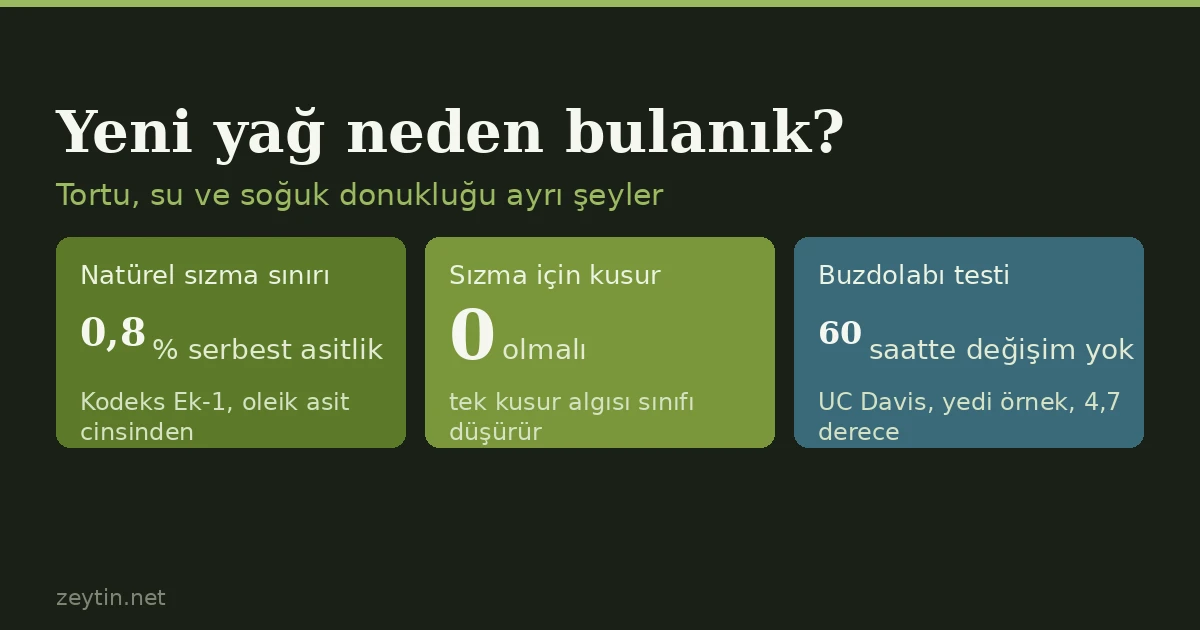
Why is freshly pressed olive oil cloudy, and should you wait for it to settle?
Oil straight from the mill is cloudy for a simple reason: droplets of water and fragments of fruit stay suspended in it. Cloudiness on its own is neither a mark of quality nor a defect. What matters is how long the sediment stays in contact with the oil, because that is where the actual defect is born.
Article
Why is freshly pressed olive oil cloudy, and should you wait for it to settle?
Oil straight from the mill is cloudy for a simple reason: droplets of water and fragments of fruit stay suspended in it. Cloudiness on its own is neither a mark of quality nor a defect. What matters is how long the sediment stays in contact with the oil, because that is where the actual defect is born.
 Article
The Ayvalık Olive Oil designation of origin: the chemical profile in the certificate
Registered in 2007. The certificate carries tables of fatty acids, sterols and phenolics — the ranges within which an oil counts as Ayvalık Olive Oil are set out in figures.
Article
The Ayvalık Olive Oil designation of origin: the chemical profile in the certificate
Registered in 2007. The certificate carries tables of fatty acids, sterols and phenolics — the ranges within which an oil counts as Ayvalık Olive Oil are set out in figures.