Mut Olive Oil: a landscape that needs no pesticide
The certificate's real claim rests on altitude and humidity: 10-40% relative humidity keeps out both the olive fly and peacock spot. That is why organic production is straightforward here.
Geographical indication certificates usually describe how good a product tastes. Mut Olive Oil's describes the absence of a disease — and that is its central claim.
The record
| Registration no | 367 |
| Registration date | 06.09.2018 |
| Type | Designation of origin |
| Area | The Mut district of Mersin |
| Product | Extra virgin olive oil |
Why no pesticide is used
Mut lies at the foot of the Taurus range, on the Taşeli plateau cut through by the Göksu river. The district centre sits at 300 m, and olives are grown between 200 and 700 m.
The consequence of that altitude is this: relative humidity runs between 10 and 40%. In the certificate's words, this means "harmful insects and fungal/bacterial diseases do not occur. Consequently no agricultural spraying is carried out."
The three greatest problems in world olive growing — the olive fly, the olive moth and peacock spot — are absent here. On peacock spot the certificate is even more definite: under Mut's climatic conditions the disease cannot establish infection in olive trees.
The economic consequence is large. Where organic production is a costly and risky choice elsewhere, in Mut it is close to the default. The certificate says so plainly: organic production here is "easier and more economical than would be possible anywhere else in Türkiye".
Climate figures
| Measurement | Value |
|---|---|
| Mean annual temperature | 18.1 °C |
| Total annual rainfall | 367.6 mm |
| Wettest month (January) | 74.6 mm |
| Driest month (August) | 2.2 mm |
| Relative humidity | 10 – 40% |
| District centre altitude | 300 m |
2.2 mm of rain in August means the ripening season passes dry. The certificate ties this to quality.
There is a positional advantage too: at latitude 37, on the crossing point between central Anatolia and the Mediterranean, Mut has a microclimate, sheltered from the prevailing northerlies that harm olive growing. Since flowering escapes frost and cold, there is no crop fluctuation problem either — weak alternate bearing in the region follows from this.
Production weight
Mut alone accounts for 56.22% of Mersin's olive production and 5.64% of Türkiye's. An extraordinary share for a single district. We looked at the province as a whole in olive growing in Mersin.
The historical record
The certificate rests its claim on three documents:
The Salname of AH 1316. "From the wild olives grafted in the district come most excellent olives and olive oil. What exceeds their needs they export to the surrounding districts and to Karaman." — so by the end of the 19th century Mut was already exporting. On the technique: grafting olives.
A 1300-year-old monument tree. The olive tree in the Haydar quarter was registered as a monument tree by decision 5577 of the Ministry of Culture and Tourism, dated 23.12.2009.
A Roman-era press. Archaeological excavations in the village of Geçimli uncovered an olive press bed cut into the bedrock.
In short
The Mut registration defines an oil not by its chemical profile but by the conditions in which it grows. Low humidity, a sheltered position and altitude together remove the need for spraying — and that is precisely what the certificate advances as the distinguishing feature.
The criteria the document binds
The registration does not only protect a name; it defines the product numerically:
| Criterion | Value in the document |
|---|---|
| Peroxide value | 8.93 meq O₂/kg (max) |
The document also bars windfall olives — fruit picked off the ground is the main source of mould and fermentation defects.
The production steps in the document
The registration describes production step by step. The document's own sequence:
1. Zeytinlerin kırılması — kırıcıdan geçirilen zeytinler kontinü sistemlere ait olan kırıcı üniteleri tarafından kırılır ve hamur haline getirilir.
2. Zeytinyağının Depolanması — Üretilen natürel zeytinyağı ambalajlama işleminden önce tanklarda depolanmaktadır.
3. Fidan Üretimi — Mut yöresinde zeytin fidanı üretimi kalın dal çelikleriyle ya da yapraklı yeşil çeliklerle yapılır.
4. Dikim — Dikimi yapılacak zeytin fidanlarının en az 1,5 cm çapında olmalarına özen gösterilir.
5. Hastalıkla mücadele — Yörede her ne kadar zeytin hastalık ve zararlıları çok fazla ekonomik zarar oluşturmasada; Zeytin dal kanseri, zeytin solgunluğu, halkalı leke hastalığı, armillaria kök çürüklüğü ve antroknoz önemli zeytin hastalıklarıyla; ve zeytin…
6. İşleme — Mut Zeytinyağı elde etmek için ilçede zeytinlerin, hasattan hemen sonra işlenmesi sağlanır, bu şekilde zeytinyağının kalitesinin bozulmasının önüne geçilir.
7. Depolama — Mut zeytinyağının özellikle düşük peroksit değerlerine sahip olması ve uzun süre peroksit sayısının artış göstermemesi sayesinde, depolama 24 ay ve daha fazla sürelerde uluslararası standartlar bakımından sağlanabilmektedir.
That this sequence is binding is what separates a geographical indication from a trade mark: a mark says who produced something, a geographical indication also sets down how it must be produced.
Its place in Mersin's olive production
| Item | Value |
|---|---|
| Fruit production | 305,159 t |
| — for oil | 227,098 t |
| — for the table | 78,061 t |
| Olive oil production | 34,938 t |
| Trees | 11,201 thousand |
| Yield per tree | 27.2 kg |
74% of the province's fruit goes to oil. An oil-based registration matches how the province actually produces.
One rating per visitor; you can change yours at any time. Ratings are real reader votes — no seeded or default scores.
Related
 Article
North Aegean Olive Oils: a registration stricter than the food codex
The mark of ten localities rather than one district — and unusually, it sets tighter limits than the national standard on peroxide, FAEE, waxes and K270.
Article
North Aegean Olive Oils: a registration stricter than the food codex
The mark of ten localities rather than one district — and unusually, it sets tighter limits than the national standard on peroxide, FAEE, waxes and K270.
 Article
How to read an olive oil lab report: acidity, peroxide, K232, K270 and ΔK
The rows of figures on an olive oil lab report look cryptic at first. What do free acidity, peroxide value, K232, K270, ΔK, ethyl esters and sensory analysis measure, what are the limits for extra virgin and virgin grades, and how do you interpret a report using a worked example?
Article
How to read an olive oil lab report: acidity, peroxide, K232, K270 and ΔK
The rows of figures on an olive oil lab report look cryptic at first. What do free acidity, peroxide value, K232, K270, ΔK, ethyl esters and sensory analysis measure, what are the limits for extra virgin and virgin grades, and how do you interpret a report using a worked example?
 Article
Güney Ege Olive Oils: a designation of origin across three provinces
Registration no 79, published in the Official Gazette in 2004, covers more than thirty-three districts across İzmir, Aydın and Muğla. The reasoning is not administrative but varietal: the region holds almost all of Türkiye's Memecik trees.
Article
Güney Ege Olive Oils: a designation of origin across three provinces
Registration no 79, published in the Official Gazette in 2004, covers more than thirty-three districts across İzmir, Aydın and Muğla. The reasoning is not administrative but varietal: the region holds almost all of Türkiye's Memecik trees.
 Article
Tasting olive oil: defects and positive attributes
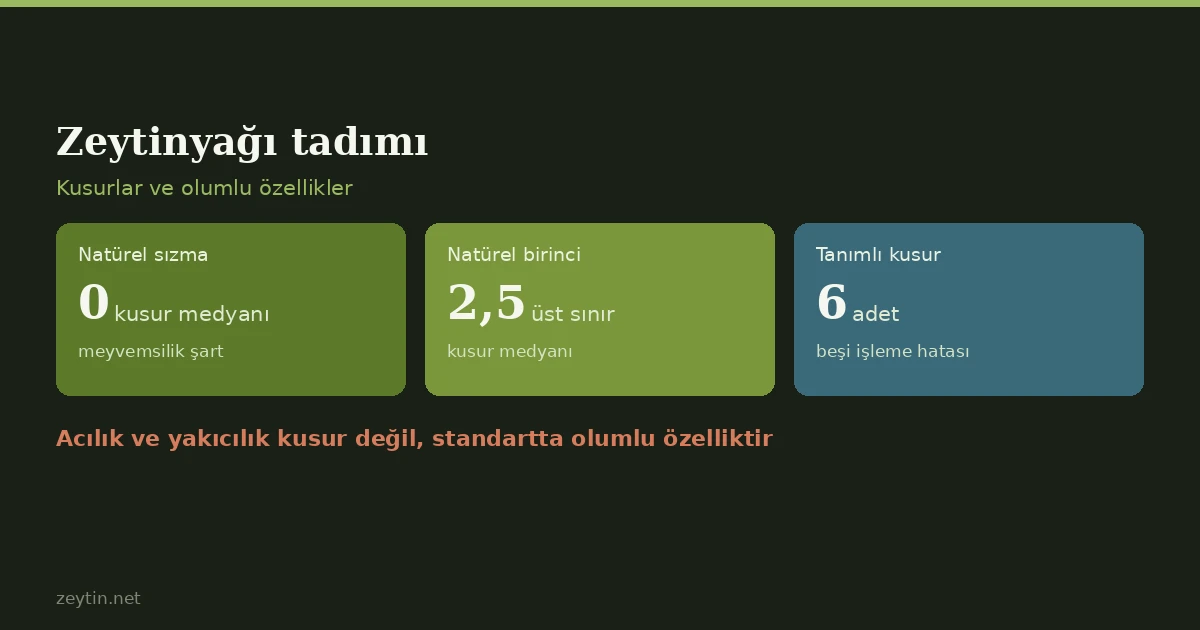
Laboratory tests alone do not make an oil extra virgin — it must pass a tasting panel. The three positive attributes, the six defects in the standard, and what each one says about how the oil was made.
Article
Tasting olive oil: defects and positive attributes
Laboratory tests alone do not make an oil extra virgin — it must pass a tasting panel. The three positive attributes, the six defects in the standard, and what each one says about how the oil was made.