A 2,000-year-old olive grove endowment in Antalya: 600 trees, “never to be cut or sold”
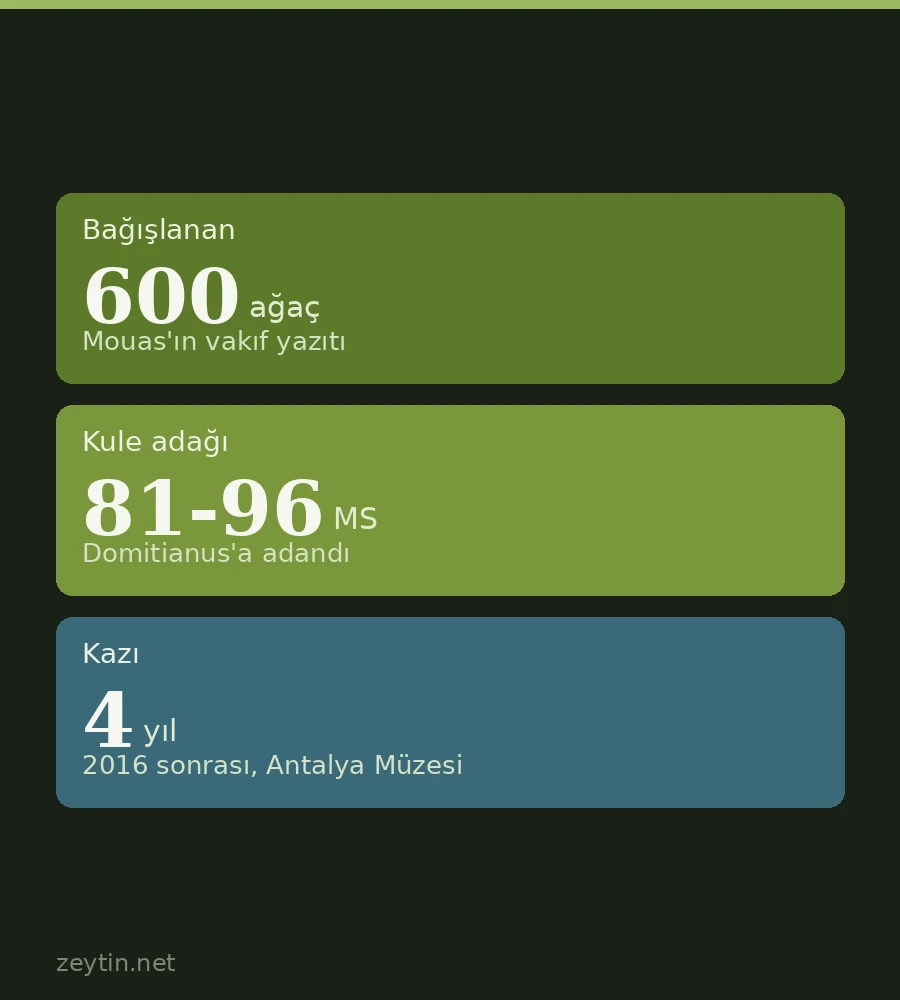
The excavation results from Lyrboton Kome in Antalya have been presented. Inscriptions record a family endowing its farm and 600 olive trees in perpetuity, with an explicit clause: these trees can never be cut, sold or put to another use.
The results of the excavation at Lyrboton Kome, an ancient settlement in the Kepez district of Antalya in southern Turkey, have been presented — and they describe a problem the olive sector still argues about, solved in writing two thousand years ago: how to protect an olive grove permanently, without relying on the goodwill of whoever happens to own it.
According to Prof. Dr. Nevzat Çevik of the Department of Archaeology at Akdeniz University, who directed the excavation, the endowment inscription found at the site carries an unambiguous clause: “These trees can never be cut, sold or used for any other purpose.”
A settlement named after olives
The site had a second name, Elaibaris. As Çevik puts it, “‘Elaia’ means olive and ‘baris’ means farm.” The place was identified by its crop in its own name — an unusually direct piece of evidence about what the local economy rested on.
Administratively Lyrboton Kome was not an independent city but a kome, a village dependent on Perge, one of the major cities of Pamphylia. Inscriptions attach it to Perge — “the Lyrboton of Perge” — rather than to the nearer coastal city of Attaleia, modern Antalya. The excavation team's reading is that revenue generated from olive oil production here contributed to the financing of Perge's monumental buildings. In other words this was not a subsistence hamlet but a production unit feeding a city's public budget.
What the inscriptions record
The epigraphic record covers one family across two generations and two separate acts of dedication.
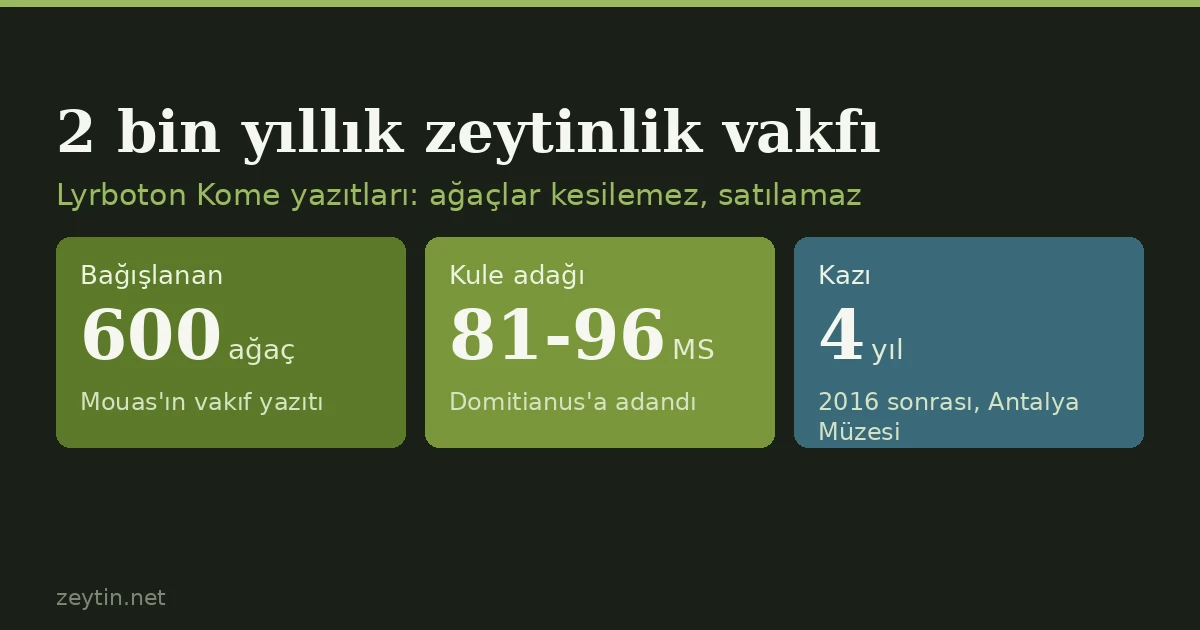
Arete, daughter of Demetrios and a priestess of Demeter, paid from her own resources for the construction of a two-storey tower, which she dedicated to the emperor Domitian and to Artemis of Perge. Because Domitian reigned from 81 to 96 CE, the building sits firmly in the last quarter of the first century CE. The tower is read as a structure tied to the production and storage of oil rather than as a purely ornamental monument.
A generation later Arete's grandson Mouas — son of her daughter Kille — dedicated his farm together with 600 cultivated olive trees to the emperor Hadrian (117-138 CE) and to Apollo of Lyrboton. The terms of the endowment were written down as well: the grove was to remain with his mother Kille for the duration of her life; after her death the komarkhos, the village headman, was to administer the endowment; and every year on 3 September a festival was to be held in honour of Apollo, with the people supplied adequately with food and drink.
| Item | Record |
|---|---|
| Settlement | Lyrboton Kome (Elaibaris), Kepez / Antalya |
| Dependent on | Perge |
| Funder of the tower | Arete, daughter of Demetrios, priestess of Demeter |
| Tower dedicated to | Emperor Domitian (81-96 CE) and Artemis of Perge |
| Donor of the grove | Mouas, son of Kille, grandson of Arete |
| Endowment dedicated to | Emperor Hadrian (117-138 CE) and Apollo of Lyrboton |
| Endowed property | 600 olive trees + the farm |
| Lifetime right of use | Kille, the donor's mother |
| Administrator thereafter | Komarkhos (village headman) |
| Annual obligation | Festival of Apollo on 3 September, food and drink for the people |
| Excavation | Four years from 2016, Antalya Museum |
That list of terms is the part worth pausing on. This is not a gesture of piety recorded for display. It defines a transfer of property, a lifetime right of use, a named successor administrator for the moment the family line steps back, and a recurring annual obligation attached to the revenue. Functionally it is a foundation: the protection of the trees does not depend on any individual remaining alive, solvent or well-intentioned. That is precisely the difference between a promise and an institution, and it is the difference modern olive-grove protection law is still trying to secure.
How many presses? The number depends on the source
No single figure can honestly be given for the number of oil workshops at the site. Çevik speaks of “dozens of workshops and installations pointing to large-scale production.” Site inventories count eleven complete presses. Some published accounts refer to more than eighty workshops and cisterns.
These three numbers may not be counting the same thing. A fully preserved press, an isolated press stone and a storage or settling basin are separate categories, and surveys differ in what they admit as a unit. We therefore stay with the excavation director's wording rather than adopting the largest available figure. What the sources do agree on is the comparative point: no other settlement in the region has yielded presses at this density.
Not a new discovery but a completed reading
The news should be placed correctly. The inscriptions of Lyrboton Kome were first recorded in 1910. Survey work in the 1990s established the extent of the settlement. The excavation under the direction of the Antalya Museum began in 2016 and ran for four years; the site was opened to visitors in 2018. What was announced this week is not a fresh find but the combined reading of those four years of work — which is the more useful kind of announcement, because it reports conclusions rather than first impressions.
Women's names in the record
The second conclusion Çevik emphasises concerns who held production and administration. “We see women as active,” he says. “And where women are present, strong economic activity and solid, fine production-based work also appear.” Arete, who established the endowment; Kille, who held the grove for her lifetime; and Plancia Magna, the documented benefactor of Perge, belong to the same social world.
This matters beyond the anecdote. Endowment inscriptions are legal documents. A woman named as the funder of a building and as the founder of a perpetual foundation is evidence of legal and financial capacity, not merely of social prominence — and in an agricultural economy that capacity is exercised over land, trees and the income they produce.
Where it connects to the present
Read in today's language, the clause is a protection order: it detaches the tree from its owner and attaches it to a permanent status. In Turkey that work is now done by statute and by international frameworks; we set out that three-layered structure in who protects the olive tree. The legal history of olive-grove land against mining claims is recorded in olive groves and mining.
Nor is the overlap between ancient production and the modern map unique to Lyrboton. The 43 ancient olive oil workshops documented around Antakya show the same continuity, and how far back the olive goes in Anatolia is covered in the history of the olive in Anatolia. Antalya, for its part, expects a crop of 70,000 tonnes this season — two thousand years later, largely on the same slopes.
One rating per visitor; you can change yours at any time. Ratings are real reader votes — no seeded or default scores.
Related
 Article
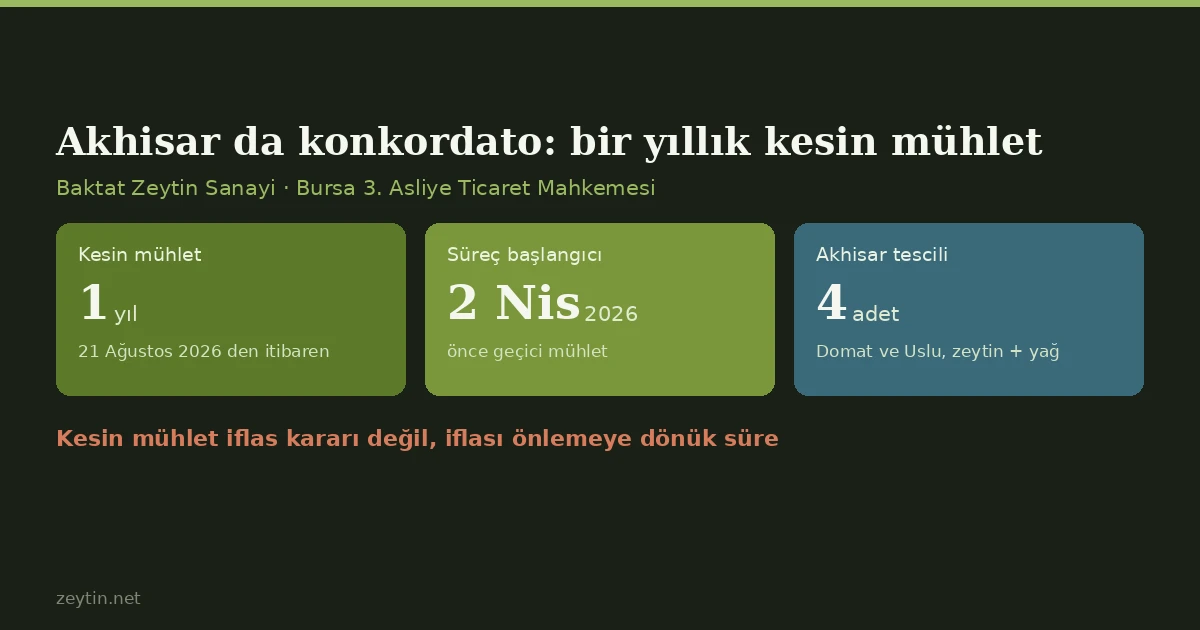
Concordat in Akhisar: a one-year moratorium for Baktat Zeytin
A Turkish commercial court has granted a one-year definitive moratorium to Baktat Zeytin, a table-olive processor in Akhisar. We set out what the ruling means and why it matters for the sector.
Article
Concordat in Akhisar: a one-year moratorium for Baktat Zeytin
A Turkish commercial court has granted a one-year definitive moratorium to Baktat Zeytin, a table-olive processor in Akhisar. We set out what the ruling means and why it matters for the sector.
 Article
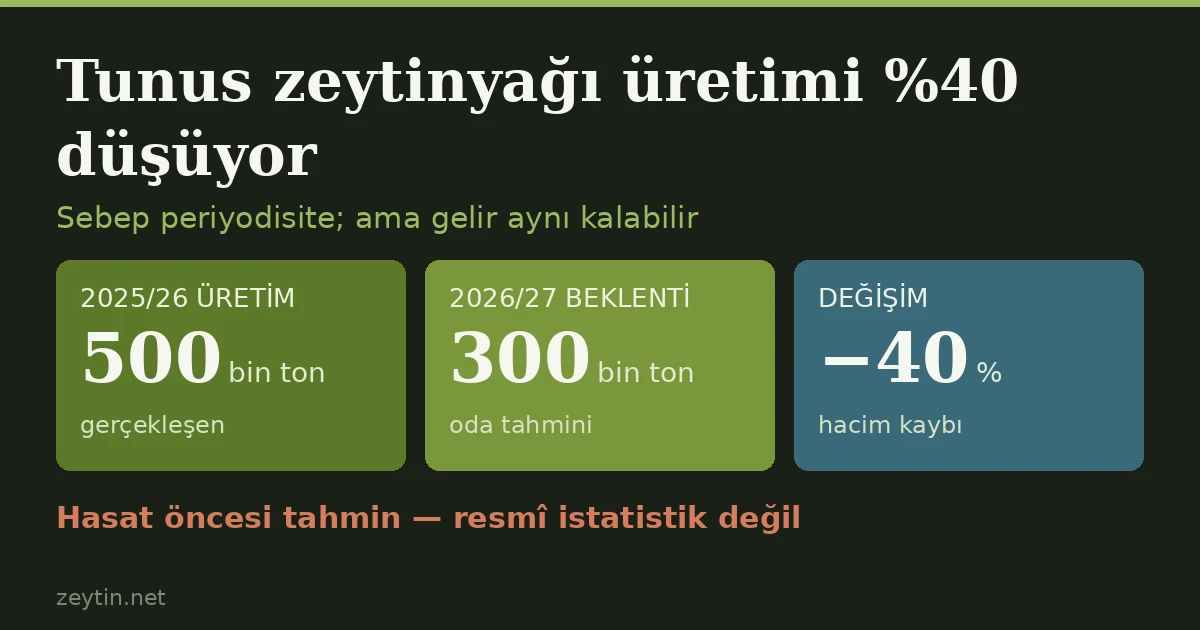
Tunisia's output falls from 500,000 to 300,000 tonnes — revenue may hold
Tunisia's National Chamber of Olive Producers expects olive oil output to fall from 500,000 to 300,000 tonnes in 2026/27, citing alternate bearing. Revenue is still expected to match last season because prices are higher. Türkiye's most direct bulk competitor is shrinking.
Article
Tunisia's output falls from 500,000 to 300,000 tonnes — revenue may hold
Tunisia's National Chamber of Olive Producers expects olive oil output to fall from 500,000 to 300,000 tonnes in 2026/27, citing alternate bearing. Revenue is still expected to match last season because prices are higher. Türkiye's most direct bulk competitor is shrinking.
 Article
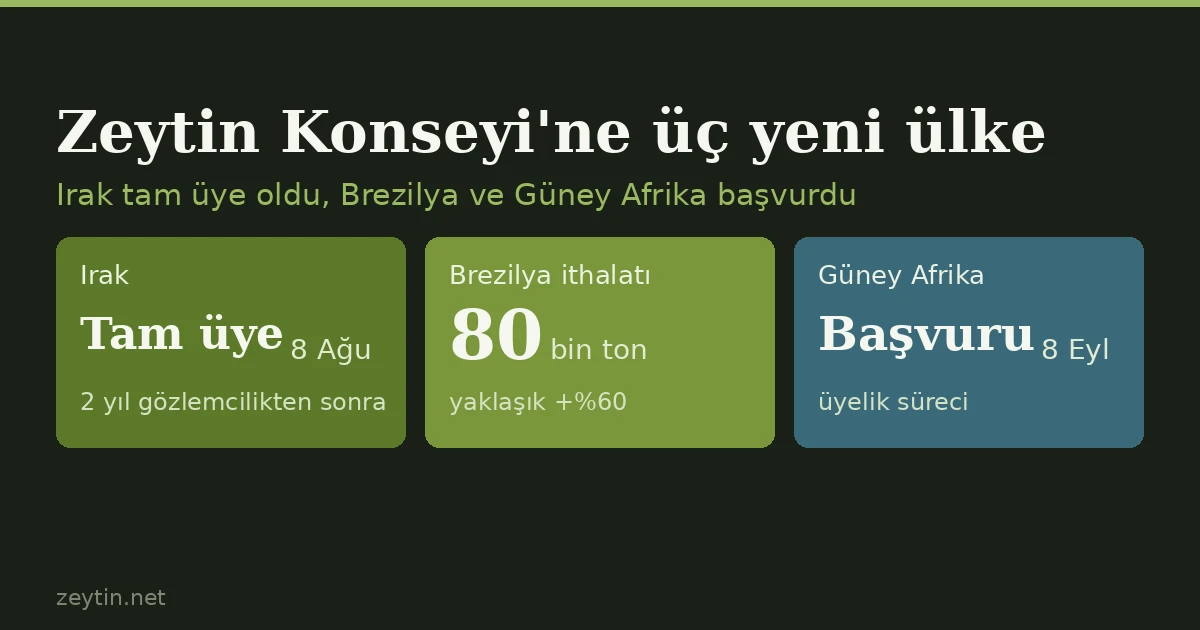
The International Olive Council grows: Iraq joins, Brazil and South Africa apply
The International Olive Council (IOC) saw three developments in a month: Iraq became a full member on 8 August, South Africa submitted its membership request on 8 September and Brazil on 9 September. The expansion reflects olive oil's shift towards production and consumption areas beyond the Mediterranean.
Article
The International Olive Council grows: Iraq joins, Brazil and South Africa apply
The International Olive Council (IOC) saw three developments in a month: Iraq became a full member on 8 August, South Africa submitted its membership request on 8 September and Brazil on 9 September. The expansion reflects olive oil's shift towards production and consumption areas beyond the Mediterranean.
 Article
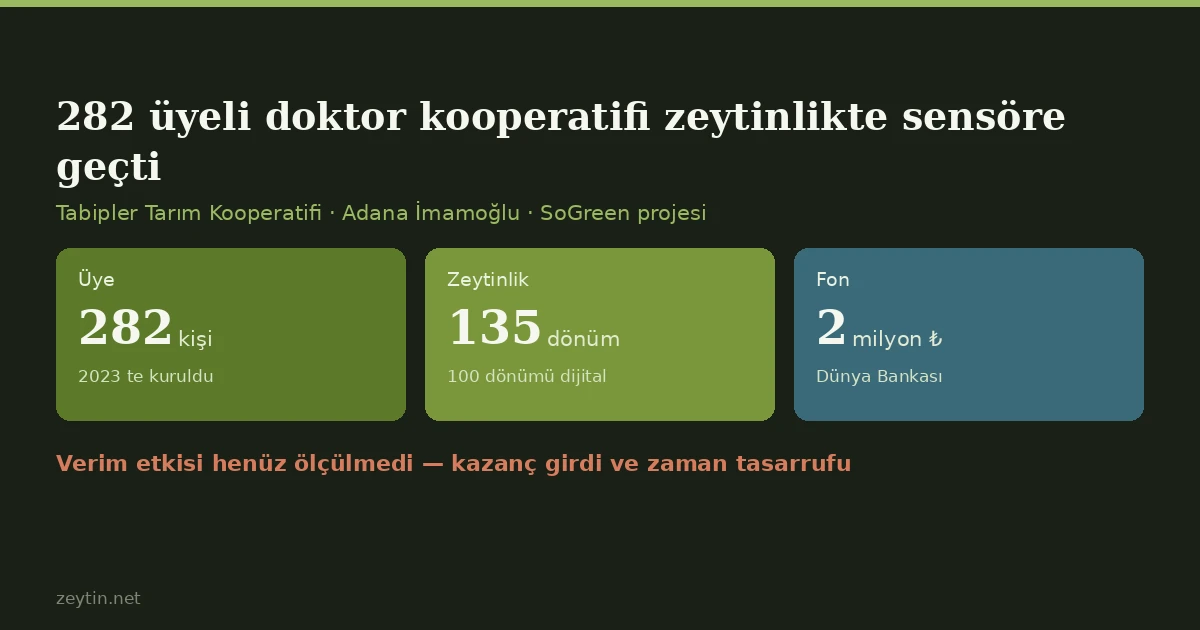
A 282-member doctors' cooperative puts sensors in the olive grove
A cooperative founded by doctors in Adana is monitoring water and fertiliser with buried sensors across 100 of its 135 dönüm of bearing olive grove, funded with 2 million lira.
Article
A 282-member doctors' cooperative puts sensors in the olive grove
A cooperative founded by doctors in Adana is monitoring water and fertiliser with buried sensors across 100 of its 135 dönüm of bearing olive grove, funded with 2 million lira.