Second seizure on the same Köşk road: 4,000 litres of adulterated olive oil, 36 days after 5,300 litres
On 13 November 2026 gendarmes in Köşk, Aydın seized 4,000 litres of counterfeit and adulterated olive oil from a vehicle stopped on the Aydın-Denizli highway; two people face proceedings. On 8 October the same road yielded 5,300 litres: 9,300 litres across the two seizures.
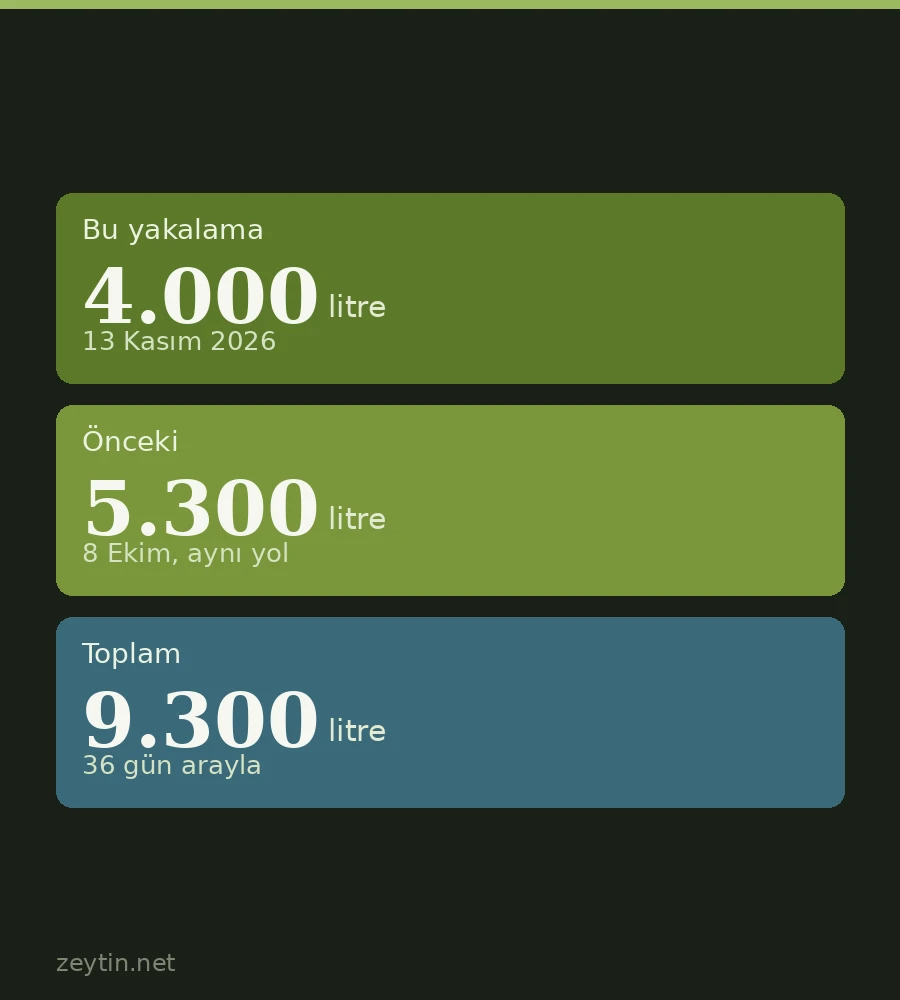
On 13 November 2026, gendarmes in Köşk, a district of Aydın, seized 4,000 litres of counterfeit and adulterated olive oil from a vehicle they stopped on the Aydın-Denizli highway. Teams from the Köşk District Gendarmerie Command, part of the Aydın Provincial Gendarmerie Command, carried out the operation. The two men in the vehicle, identified as A.Y. (43) and M.Ü. (46), were apprehended, and criminal and administrative proceedings were opened against both. The statement as reported says the oil was harmful to health and ready to be put on the market.
What the statement says, and what it leaves out
| Item | Stated |
|---|---|
| Date | 13 November 2026 |
| Place | Köşk, Aydın-Denizli highway |
| Seized | 4,000 litres |
| People charged | 2 |
| Nature of the oil | counterfeit / adulterated |
The statement does not say what the oil had been mixed with, what kind of vehicle carried it, what value was put on the load, or how large the administrative fine will be. The calculations below rest only on the stated 4,000 litres and on this site's own price measurements; we do not fill the gaps with guesses.
The same road, a second seizure
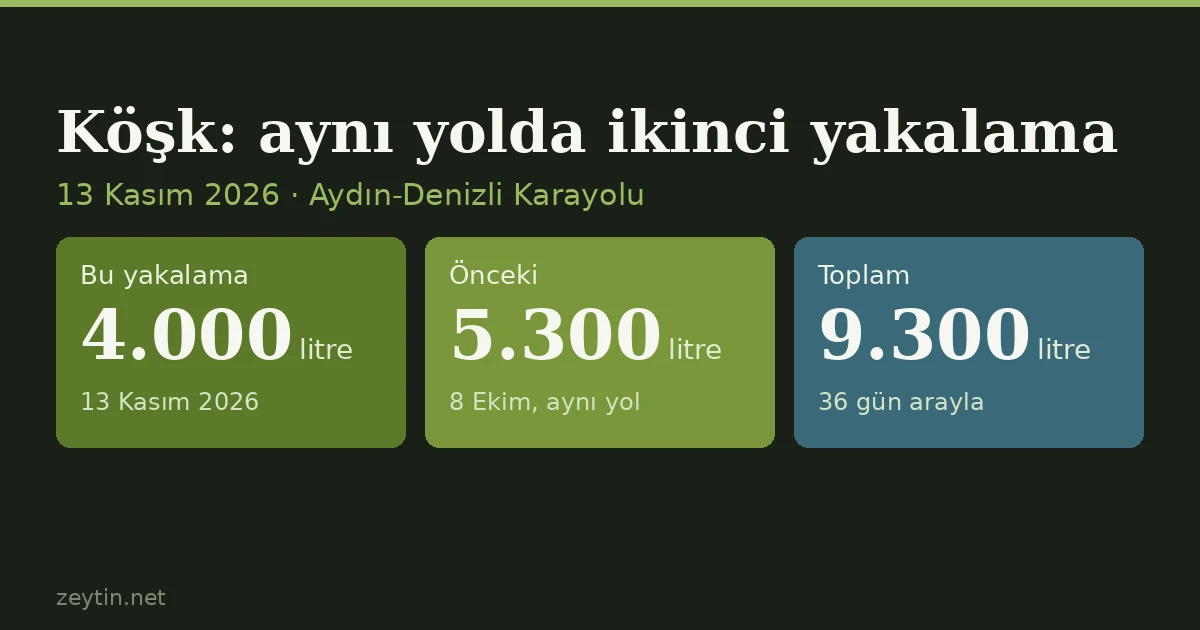
This is the second large seizure in a short time on Köşk's stretch of the Aydın-Denizli road. On 8 October, a van stopped on the same highway was carrying 5,300 litres of counterfeit and adulterated oil. The two events are 36 days apart and add up to 9,300 litres. The suspects' initials differ (M.O. and K.Ş. in October), and no link between the two cases has been announced, so we do not draw one.
There is another way to gauge the scale. According to the Aydın Police Department, five separate operations across the province between 1 and 15 September turned up a combined 4,063 litres of adulterated oil; we wrote up that tally at the time. The 4,000 litres from a single vehicle in Köşk this time equal roughly 98 per cent of that fortnight's total. The two figures come from different agencies and may not have been counted the same way, but they show how large a single consignment can be.
What 4,000 litres is worth
No value has been announced for this case, but the site's own data allows a floor to be drawn. On the Edremit exchange, which reports to the Turkish Union of Chambers and Commodity Exchanges (TOBB), extra virgin olive oil was registered on 13 November at 245.30 lira a kilogram. Taking the density of olive oil as about 0.916 kilograms a litre, that is roughly 225 lira a litre, or about 900,000 lira for 4,000 litres. This is not the value of the adulterated oil; it is what the same volume of genuine extra virgin would fetch wholesale.
At retail, in this site's survey on the morning of 13 November, the cheapest one-litre extra virgin label was 249 lira. An exchange registration is a single data point and not a hard threshold for consumers, but the question for any oil sold as extra virgin well below the wholesale cost is plain: how can genuine oil be produced at that price?
One note on scale: in the 8 October case the authorities valued 5,300 litres at 1.6 million lira, about 302 lira a litre. Applying the same rate to this load would give roughly 1.2 million lira, but that is our assumption; no such value was announced for this case.
Counterfeit and adulterated are not the same thing
The statement uses the two words together, but they are defined separately. Adulteration means mixing in a substance that does not belong to the product, or otherwise spoiling its composition; in olive oil it usually means a cheap seed oil blended into extra virgin. Counterfeiting means selling a product under the name, brand or packaging of another. A load can be both: oil diluted with seed oil and filled into the tin of a well-known brand is adulterated and counterfeit at once. The Köşk statement says "counterfeit/adulterated" without separating the two; only the laboratory result and the indictment will show which applies.
Why Aydın appears so often
Aydın does not turn up in these reports by chance. According to the 2025-2026 season table for provinces on this site, the province is Türkiye's largest olive province, with 439,278 tonnes of olives and 22.4 million bearing trees; 296,027 tonnes of that fruit went to oil. In a province where raw material, pressing capacity and the trade in loose oil are all concentrated, an unlabelled load may find it easier to blend into genuine bulk traffic. Where the load was going and where it came from have not been announced; all that is known is that the road runs toward Denizli, out of the province.
What it means for the reader
The Köşk load was stopped before it reached the market, so it appears that none of this batch got to a consumer. Even so, early in the season, when trade in loose oil and tins is at its busiest, the practical test is the same: avoid loose oil that carries no label, batch number or bottling date, and check whether the brand appears on the ministry's adulteration lists. The methods are explained in more detail in our piece on fraud and adulteration in olive oil; for the latest pattern in the ministry lists, see the 27 October notice.
The outcome of the case is not yet known. When the laboratory finding, the administrative fine and the judicial step are announced, this report will need to be completed with those figures. For now, the verified facts are the date, the place, the volume and the two people named by their initials; everything else in this article is arithmetic on public figures, labelled as such.
One rating per visitor; you can change yours at any time. Ratings are real reader votes — no seeded or default scores.
Related
 Article
The 2026/27 season opens: first harvests in Ayvalık, Gemlik and Bozcaada
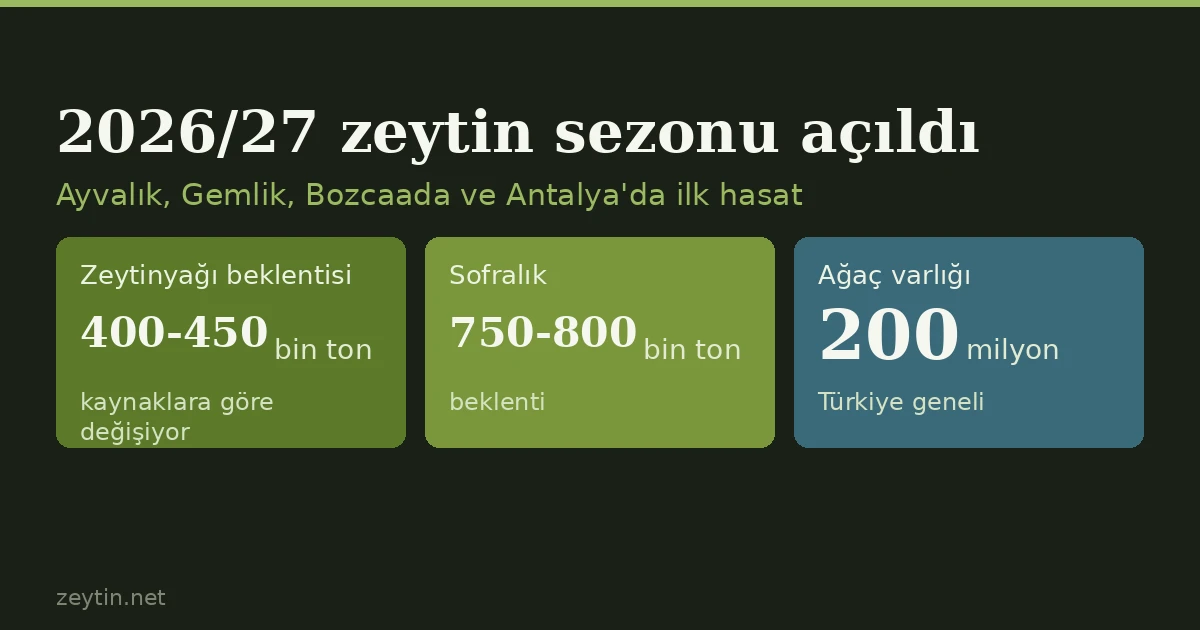
The new olive season opened with three events on 11-13 September. In Ayvalık, an on-year forecast of 400,000-450,000 tonnes of olive oil was voiced; in Gemlik the first olives were picked during the festival; and on Bozcaada the island's first olive oil was pressed with a portable system.
 Article
Field study for Şarköy olive oil: Tekirdağ's pick for "81 Provinces 81 Products"
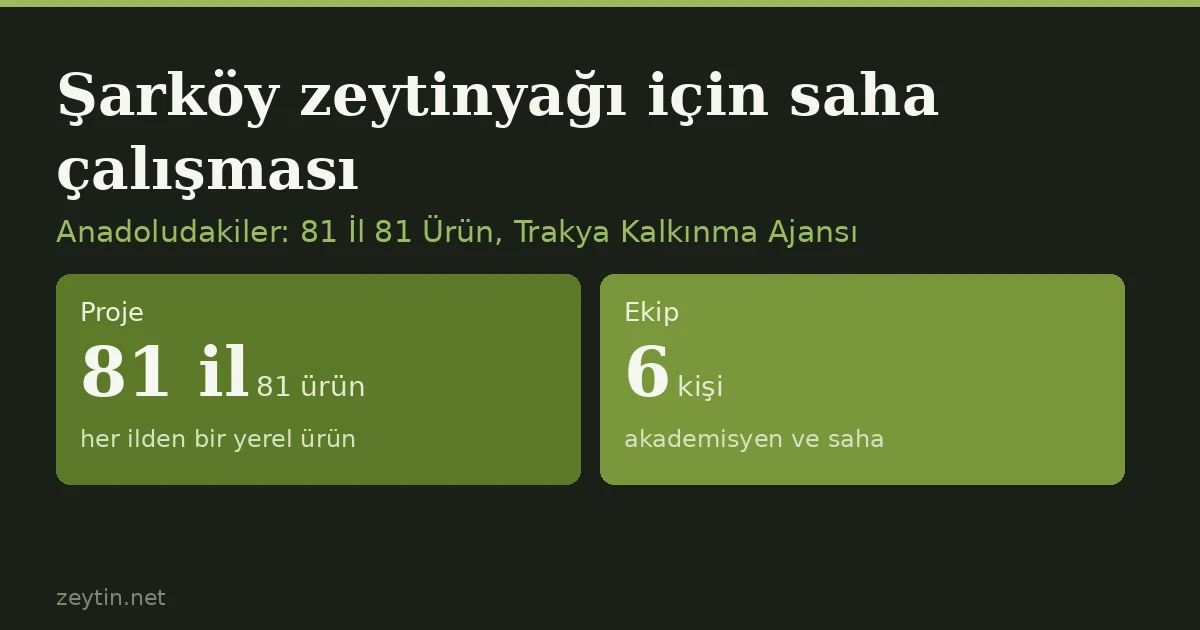
Şarköy olive oil has been chosen as Tekirdağ's product in the "Anatolians: 81 Provinces 81 Products" programme coordinated by the Ministry of Industry and Technology. The Thrace Development Agency and Namık Kemal University surveyed growers and businesses to map the value chain. The goal is branding; there is no geographical indication registration yet.
 Article
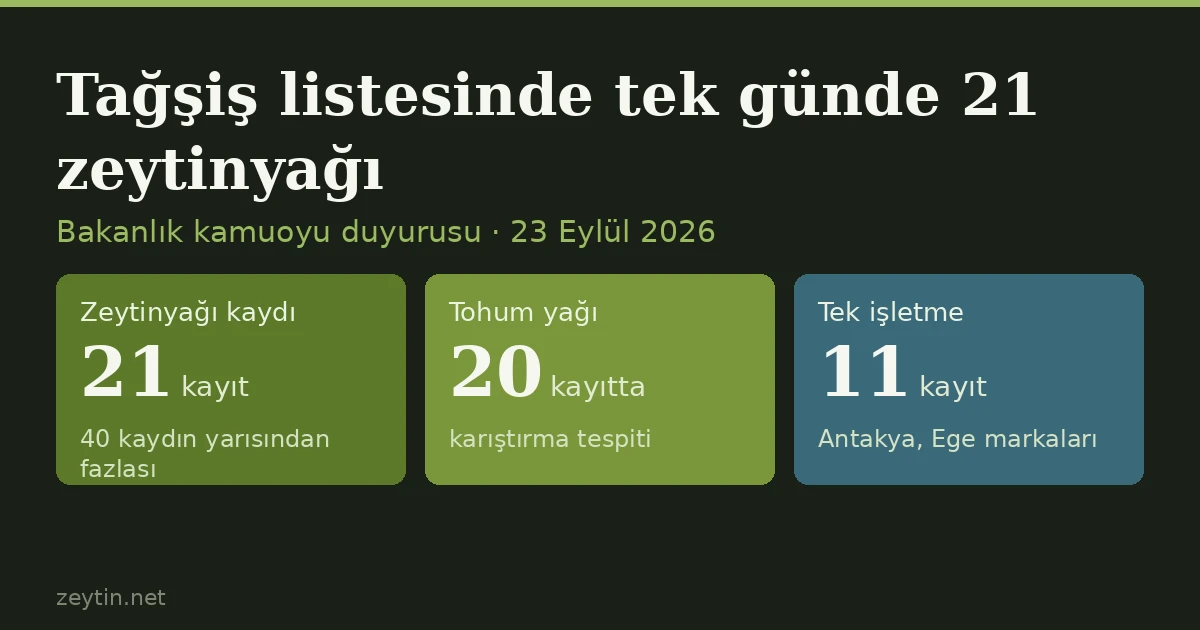
Twenty-one olive oils on the ministry's adulteration list in one day, eleven from a single Antakya business
Of the 40 records added to Turkey's counterfeit-and-adulteration list on 23 September 2026, 21 are olive oil, and 20 of those were found to contain seed oil. Eleven records belong to a single business registered in Antakya, marketing under Aegean origin names such as Ayvalık, Akçay-Altınoluk and Kazdağları. Sixteen of the containers were five litres.
 Article
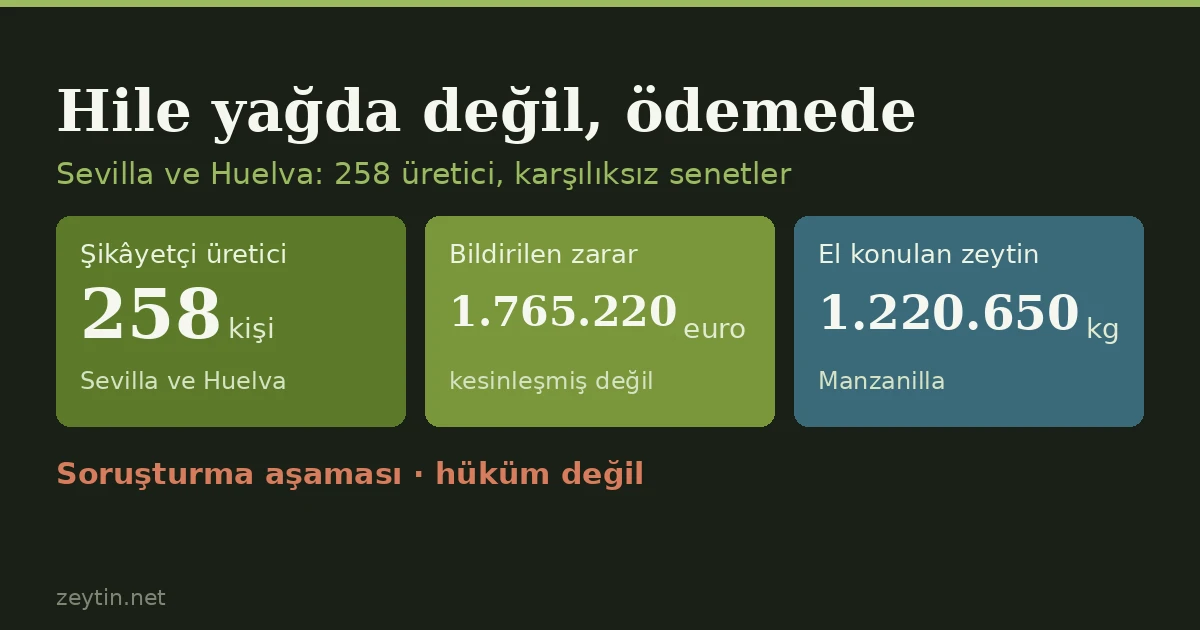
258 growers, €1.77 million: in Spain the fraud was not in the oil, it was in the payment
Spain's Guardia Civil has detained a table olive trader accused of defrauding 258 growers in Seville and Huelva of €1,765,220. The olives were real and the sales were real; the money never reached the producers. Investigators seized 1,220,650 kilos of Manzanilla olives.