Edincik Su Olive Oil: ripening slowed by the sea
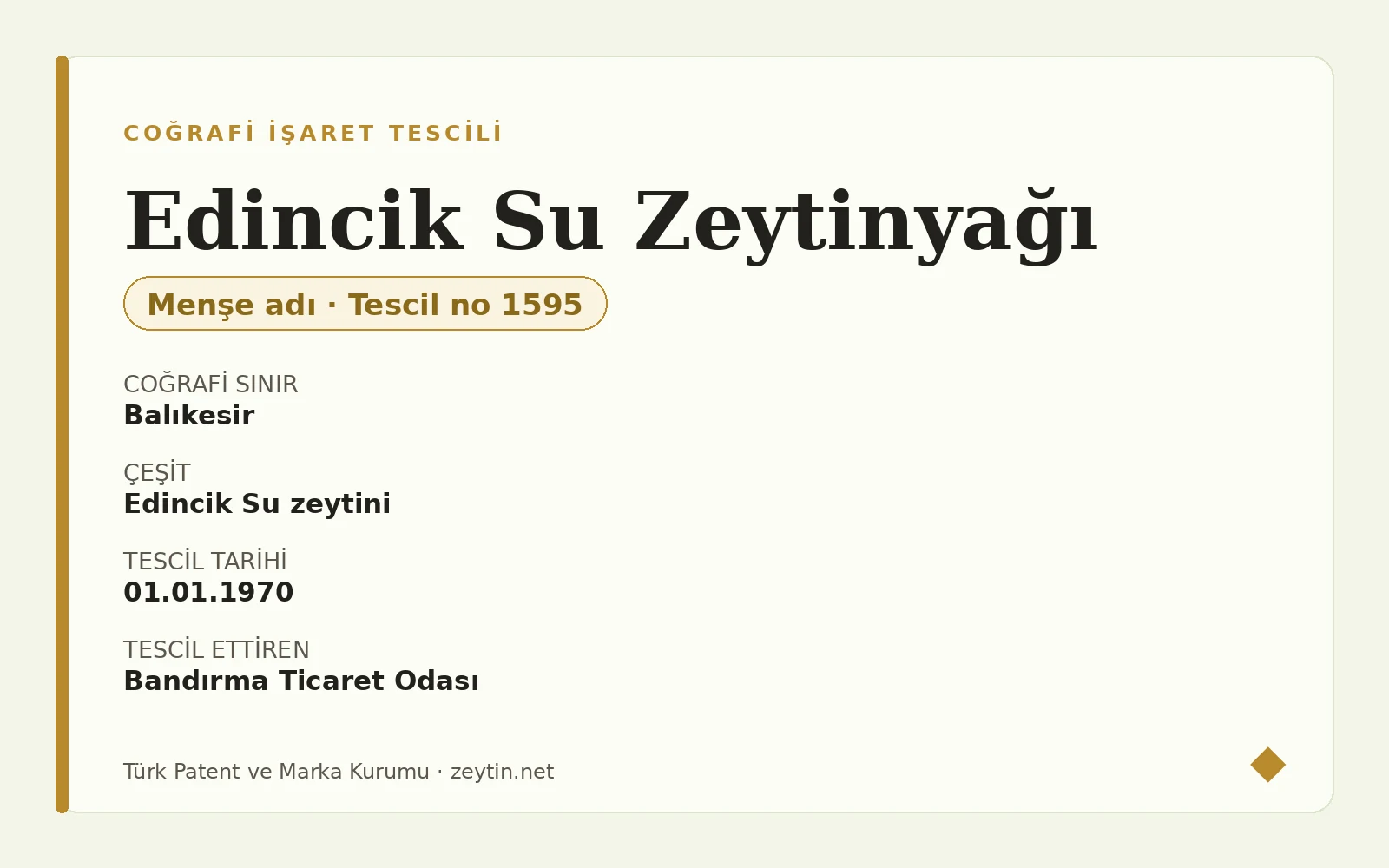
Registered in 2024. The certificate attributes aroma intensity to one cause: near the Erdek gulf the olives develop slowly and ripen late.
An oil registration is not what you expect from a high-water cultivar that goes to the table. Edincik Su Olive Oil makes its case on geography.
The record
| Registration no | 1595 |
| Registration date | 03.06.2024 |
| Application | C2022/000026 · 10.02.2022 |
| Type | Designation of origin |
| Registered by | Bandırma Chamber of Commerce |
| Area | The Bandırma district of Balıkesir |
| Cultivar | Edincik Su |
The sea's effect
The link the certificate draws:
t; Olives in the areas near the Erdek gulf, under the mild influence created by the sea and the rain-bearing wind, develop slowly and ripen late. For this reason their aroma compounds are synthesised in greater quantity and intensity.
Slow ripening means longer for aroma compounds to accumulate. The same logic appears in the Milas Oil-Cured Olive certificate — dry farming there, the sea's moderating effect here.
The definition
Clear and lightly flowing at room temperature, colour running green to yellow, with high fruitiness; extra virgin.
Bitterness and pungency vary with harvest timing:
| Harvest | Bitterness and pungency |
|---|---|
| Early | higher |
| Late | moderate |
Two registrations, one locality
The Bandırma Chamber of Commerce registered both the table olive and the oil of the same cultivar: Edincik Olive (1556) and this oil (1595). A high-water cultivar going in two directions is an interesting case — water is an advantage on the table and a disadvantage in oil; the certificate defends the oil side on aroma.
The criteria the document binds
The registration does not only protect a name; it defines the product numerically:
| Criterion | Value in the document |
|---|---|
| Free acidity (as oleic acid) | max %0.8 |
The free acidity limit of 0.8% is the codex ceiling for extra virgin olive oil. Here the registration restates the codex; what distinguishes the product is the other criteria below.
Inspection. Members: Bandırma Ticaret Odası, Bandırma İlçe Tarım ve Orman Müdürlüğü, Bandırma Ticaret Borsası, Bandırma Ziraat Odası. Results are reported under Industrial Property Law no. 6769 and submitted to the Turkish Patent and Trademark Office.
The production steps in the document
The registration describes production step by step. The document's own sequence:
1. Zeytinlerin taşınması ve depolanması — Zeytinlerin fabrikalara taşınması gıda ile temasa ve havalandırmaya uygun plastik kasalar ile yapılır.
2. Zeytinlerin temizlenmesi ve yıkanması — Hasat sonrası zeytinlerde mevcut olabilecek ince dal, toprak, toz, taş ve diğer bitkisel materyaller gibi yabancı maddeler hava akımı ve basınçlı su (içilebilir nitelikte) sirkülasyonu ile ayıklanır.
3. Zeytinlerin kırılması — Kırma işlemi, meyvenin kırılarak yağ fazının ayrılacağı hamurun elde edilmesi işlemidir.
4. Zeytinlerin yoğrulması — Kırıcıdan çıkan zeytin hamuru yoğurucuya aktarılır ve burada hamurun bünyesinde yer alan küçük yağ damlacıklarının birleşerek büyümesi sağlanır.
5. Sıvı ve katı fazın ayrılması — Zeytin hamuru içindeki katı ve sıvı fazların yoğunluklarına göre ayrımını sağlayan yatay santrifüj dekantörleri, merkezkaç kuvveti ile faz ayrımı yapar ve zeytin hamurundan sürekli olarak yağ çıkarır.
6. Karasuyun zeytinyağından ayrılması — Santrifüj sistemi ile elde edilen yağ-karasu karışımındaki karasuyun ayrılması için separatör (dikey santrifüj dekantörü) kullanılır.
7. Zeytinyağının depolanması — Edincik Su Zeytinyağının depolanmasında genellikle paslanmaz çelik veya krom nikel kaplı tanklar kullanılır.
8. Zeytinyağının ambalajlanması ve etiketlenmesi — Ambalajlama için, tercihen laklı teneke veya amber/yeşil renkli cam şişe kullanılır.
That this sequence is binding is what separates a geographical indication from a trade mark: a mark says who produced something, a geographical indication also sets down how it must be produced.
The cultivar behind it, measured
The registration is granted to a place, but the cultivar the definition rests on has measurable values:
| Property | Value |
|---|---|
| Meyve ağırlığı | 2,5-6 g |
| 1 kg’daki tane sayısı | 200 |
| Et oranı | %89 |
| Yağ oranı | %17 |
| Ana kullanım | siyah sofralık |
| Meyve boyu | 22 mm |
| Meyve eni | 18 mm |
| Sofralık sıralamasındaki yeri | ilk dokuz |
| Yöre | Balıkesir · Bandırma · Edincik |
At 17% the oil content sits mid-range; yield alone is not the argument here, aroma is.
Its place in Balıkesir's olive production
| Item | Value |
|---|---|
| Fruit production | 314,189 t |
| — for oil | 268,283 t |
| — for the table | 45,905 t |
| Olive oil production | 47,618 t |
| Trees | 11,345 thousand |
| Yield per tree | 27.7 kg |
85% of the province's fruit goes to oil. An oil-based registration matches how the province actually produces.
One rating per visitor; you can change yours at any time. Ratings are real reader votes — no seeded or default scores.
Related
 Article
Olive Oil
The difference between extra virgin, virgin, refined and riviera; what acidity means, how cold pressing works and how to store oil.
Article
Olive Oil
The difference between extra virgin, virgin, refined and riviera; what acidity means, how cold pressing works and how to store oil.
 Article
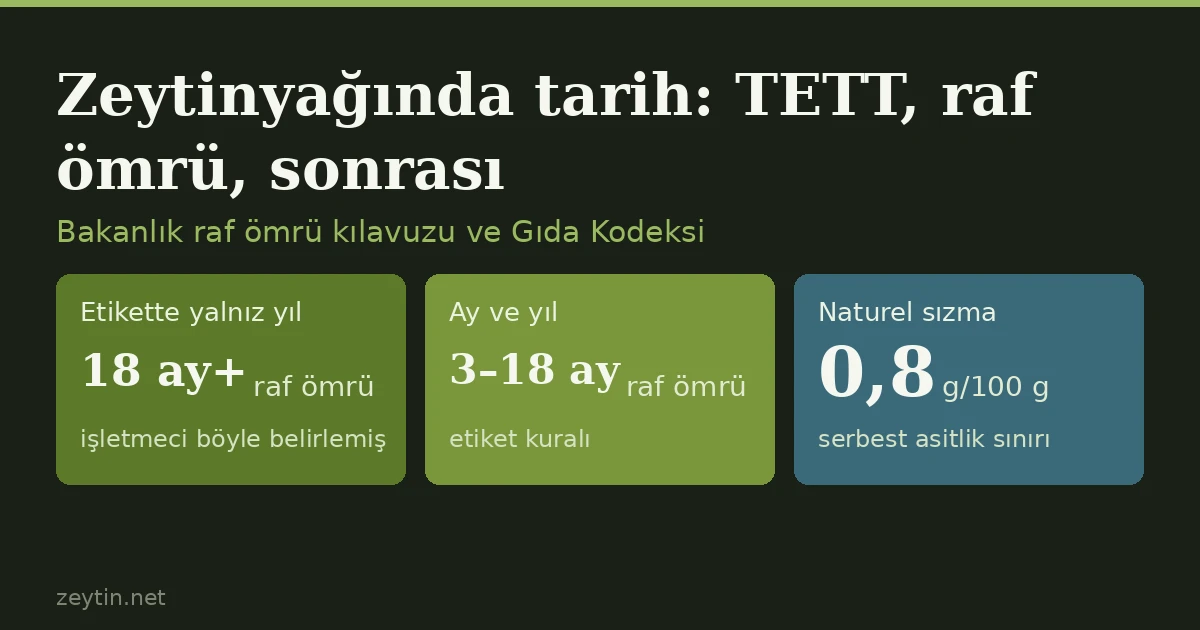
Does olive oil have a use-by date? Best-before dates, shelf life and oil past its date
Olive oil carries a best-before date, not a use-by date. Under the Turkish ministry's shelf-life guideline, oil past that date may be consumed, sold or donated if it was stored properly and its appearance, smell and taste are normal. Shelf life is set by the operator rather than by legislation — and even the format of the date reveals how long it is.
Article
Does olive oil have a use-by date? Best-before dates, shelf life and oil past its date
Olive oil carries a best-before date, not a use-by date. Under the Turkish ministry's shelf-life guideline, oil past that date may be consumed, sold or donated if it was stored properly and its appearance, smell and taste are normal. Shelf life is set by the operator rather than by legislation — and even the format of the date reveals how long it is.
 Article
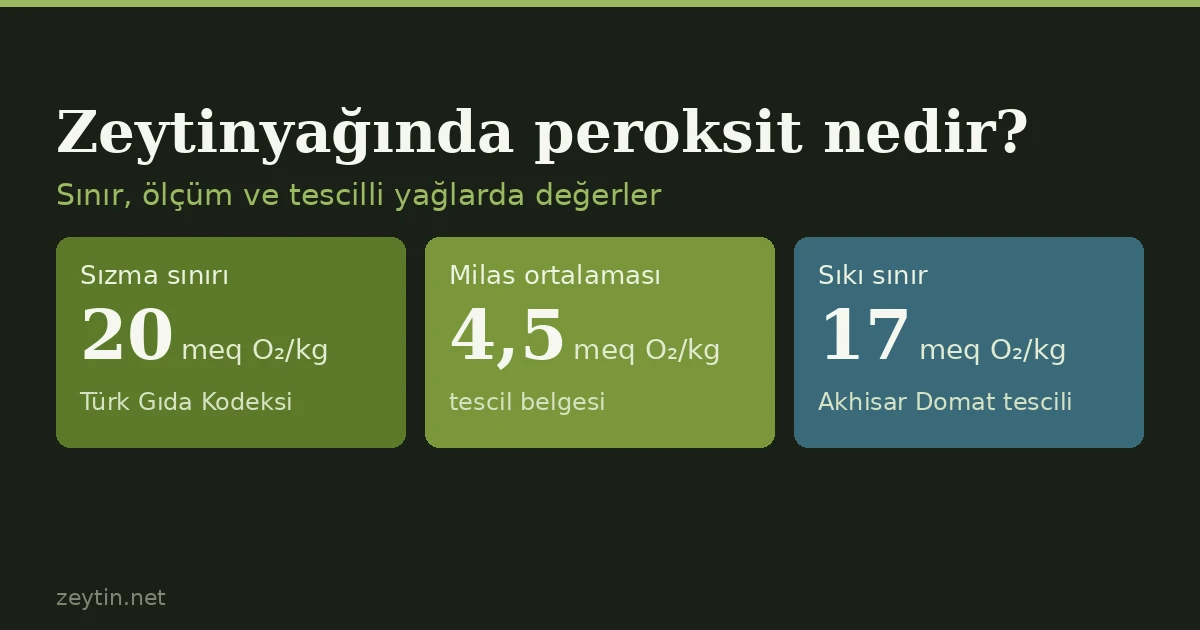
What is the peroxide value of olive oil? Is a high value harmful?
The peroxide value shows that oil has begun to oxidise; the limit for extra virgin is 20 meq/kg. Registered Turkish oils measure 4.5-9.3 on average.
Article
What is the peroxide value of olive oil? Is a high value harmful?
The peroxide value shows that oil has begun to oxidise; the limit for extra virgin is 20 meq/kg. Registered Turkish oils measure 4.5-9.3 on average.
 Article
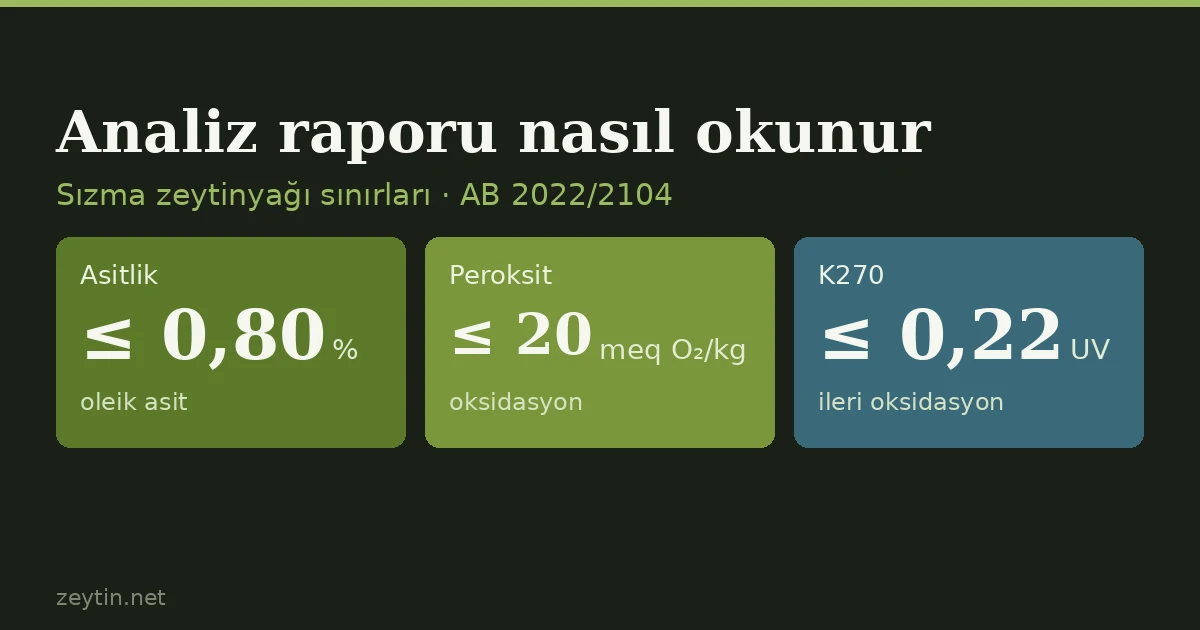
How to read an olive oil lab report: acidity, peroxide, K232, K270 and ΔK
The rows of figures on an olive oil lab report look cryptic at first. What do free acidity, peroxide value, K232, K270, ΔK, ethyl esters and sensory analysis measure, what are the limits for extra virgin and virgin grades, and how do you interpret a report using a worked example?
Article
How to read an olive oil lab report: acidity, peroxide, K232, K270 and ΔK
The rows of figures on an olive oil lab report look cryptic at first. What do free acidity, peroxide value, K232, K270, ΔK, ethyl esters and sensory analysis measure, what are the limits for extra virgin and virgin grades, and how do you interpret a report using a worked example?