Do olive trees grow on the Black Sea coast?
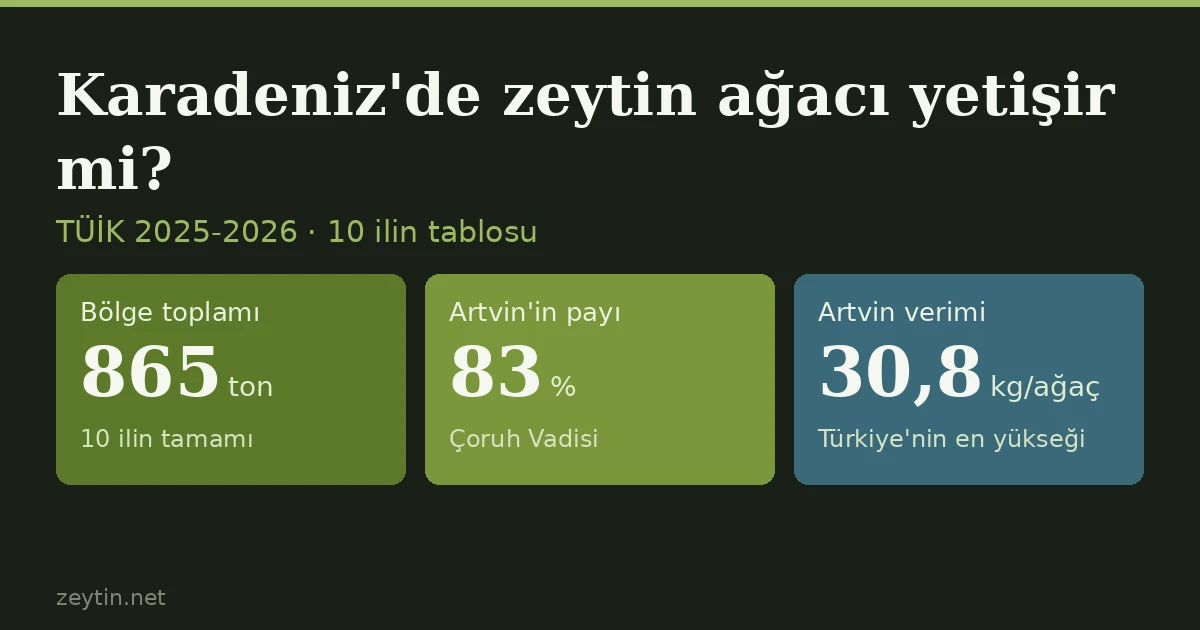
Ten Black Sea provinces produce 865 tonnes between them, 83 per cent of it in Artvin. Trabzon gets 98 tonnes from 36,000 trees; Samsun none from 13,000. The obstacle is humidity, not cold.
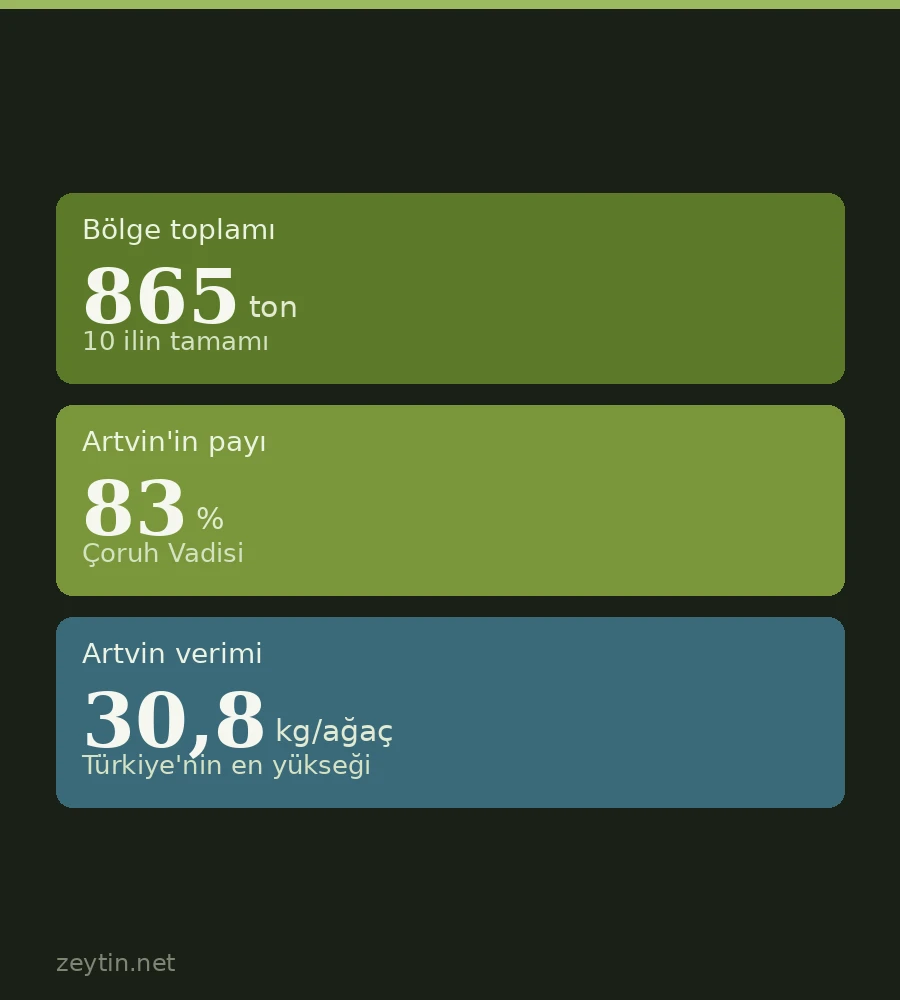
Short answer: yes, but very little and in only four provinces. In the 2025-2026 season the ten Black Sea provinces together produced 865 tonnes of olives, less than a single mid-sized district in the Aegean.
Which provinces report production?
| Province | Olives | Trees | Per tree |
|---|---|---|---|
| Artvin | 717 t | 23,000 | 30.8 kg |
| Trabzon | 98 t | 36,000 | 2.7 kg |
| Sinop | 28 t | 16,000 | 1.8 kg |
| Kastamonu | 22 t | 6,000 | 3.5 kg |
Artvin accounts for 83 per cent of the regional total. Rize, Ordu, Samsun, Zonguldak, Bartın and Tokat report no commercial production at all.
Why is Artvin the exception?
The most striking figure in the table is Artvin's yield per tree: 30.8 kilograms. That is the highest in Turkey, ahead of İzmir's 20.3 and Aydın's 19.6.
The reason is geography. Artvin's groves are not on the coast but in the Çoruh Valley. The valley floor sits inland, ringed by mountains and at low elevation; together these produce a microclimate with mild winters and dry summers. Artvin's olives do not grow in a "Black Sea climate" but in a Mediterranean pocket inside the Black Sea region.
The groves around Yusufeli and Borçka have been there for centuries. This is a local tradition, not agriculture introduced later.
Trabzon and Samsun: trees but no crop
Two provinces are especially instructive. Trabzon has 36,000 trees but produces 98 tonnes, a yield of 2.7 kilograms per tree, one eleventh of Artvin's. Samsun has 13,000 registered trees and zero production.
This shows that "will an olive tree survive here" and "will it bear a crop here" are different questions. Trees are planted, take root and grow, but either set no fruit or produce fruit that never reaches harvestable quality.
The obstacle is humidity, not cold
The Black Sea's problem for olives is usually not winter cold, as often assumed. Winters on the coastal strip are already mild; Rize's January average sits well above the thresholds at which olives suffer damage.
The real obstacle is persistent summer humidity and frequent rain:
- Olives need summer drought. Constant moisture encourages fungal disease on fruit and leaf.
- Humid, mild summers are ideal for the olive fruit fly. The larvae feed inside the fruit, which then drops or yields poor oil.
- Rain during flowering prevents pollination. Olives are wind-pollinated and rain washes the pollen away.
Together these mean the tree lives but does not produce commercially. Trabzon's 2.7 kilogram yield is exactly that, expressed as a number.
Can olives be planted on the Black Sea coast?
At garden scale, in the right spot, yes. What matters:
- Site selection is decisive. Prefer inland valleys and south-facing, wind-exposed positions over slopes facing the sea where humidity never breaks.
- Elevation and aspect. As in the Çoruh case, inland valleys have harder winters but drier summers, a trade the olive likes.
- Variety choice. Tolerance of humidity and disease pressure varies between cultivars.
- Realistic expectations. A tree on the coastal Black Sea will not give Aegean yields. Possible for ornamental and household use, risky as a commercial grove.
Do olives grow in Rize?
No. Rize appears on the list with zero tonnes and zero trees. Of the six provinces reporting nothing, Rize is the clearest case, because some of the others at least have trees: 13,000 in Samsun, a thousand each in Ordu and Tokat. Rize has no registered commercial olive trees at all.
The reason lies in its climate profile. Rize is the wettest province in Turkey, humidity is high year round and summer drought is almost absent. All three conditions work against olives. Since the same climate is ideal for tea, the land is already committed to another crop.
An olive can be planted as an ornamental and may well survive; but fruit set, and fruit reaching harvestable ripeness, cannot be reliably expected.
Which varieties are worth trying on the Black Sea?
Even where commercial scale is not the goal, variety choice changes the outcome. Three criteria matter:
- Disease tolerance. In a humid climate this is decisive; oil content is secondary.
- Early ripening. A variety that reaches harvest before the autumn rains intensify has a better chance of saving its crop. Late varieties are left hanging in a wet autumn.
- Cold tolerance. Not an issue on the coast, but decisive in inland valleys and at altitude. For measured figures see cold-hardy olive varieties.
Local types that have grown in the Çoruh Valley for centuries meet all three criteria by selection; imported varieties should not be expected to match them.
What the numbers say
The regional picture comes down to three sentences. First, olives do grow on the Black Sea, but as an exception, and that exception is inland rather than coastal. Second, the gap between planting a tree and harvesting a crop is nowhere more visible: Trabzon's 36,000 trees yield about a seventh of what Artvin's 23,000 produce. Third, the boundary is drawn not by winter cold but by summers that never dry out.
For the wider picture
The Black Sea does not supply even four in a thousand tonnes of Turkey's olive crop. For other regions and comparisons: Where do olives grow in Turkey?
Provinces with no production and the reasons why: Which provinces in Turkey grow no olives?
Figures come from the Turkish Statistical Institute's provincial crop production statistics for the 2025-2026 season.
One rating per visitor; you can change yours at any time. Ratings are real reader votes — no seeded or default scores.
Related
 Article
Olives and Olive Oil: Frequently Asked Questions
Does the fridge test work, what separates extra virgin from riviera, can you fry with olive oil? The 18 most common questions, answered briefly.
Article
Olives and Olive Oil: Frequently Asked Questions
Does the fridge test work, what separates extra virgin from riviera, can you fry with olive oil? The 18 most common questions, answered briefly.
 Article
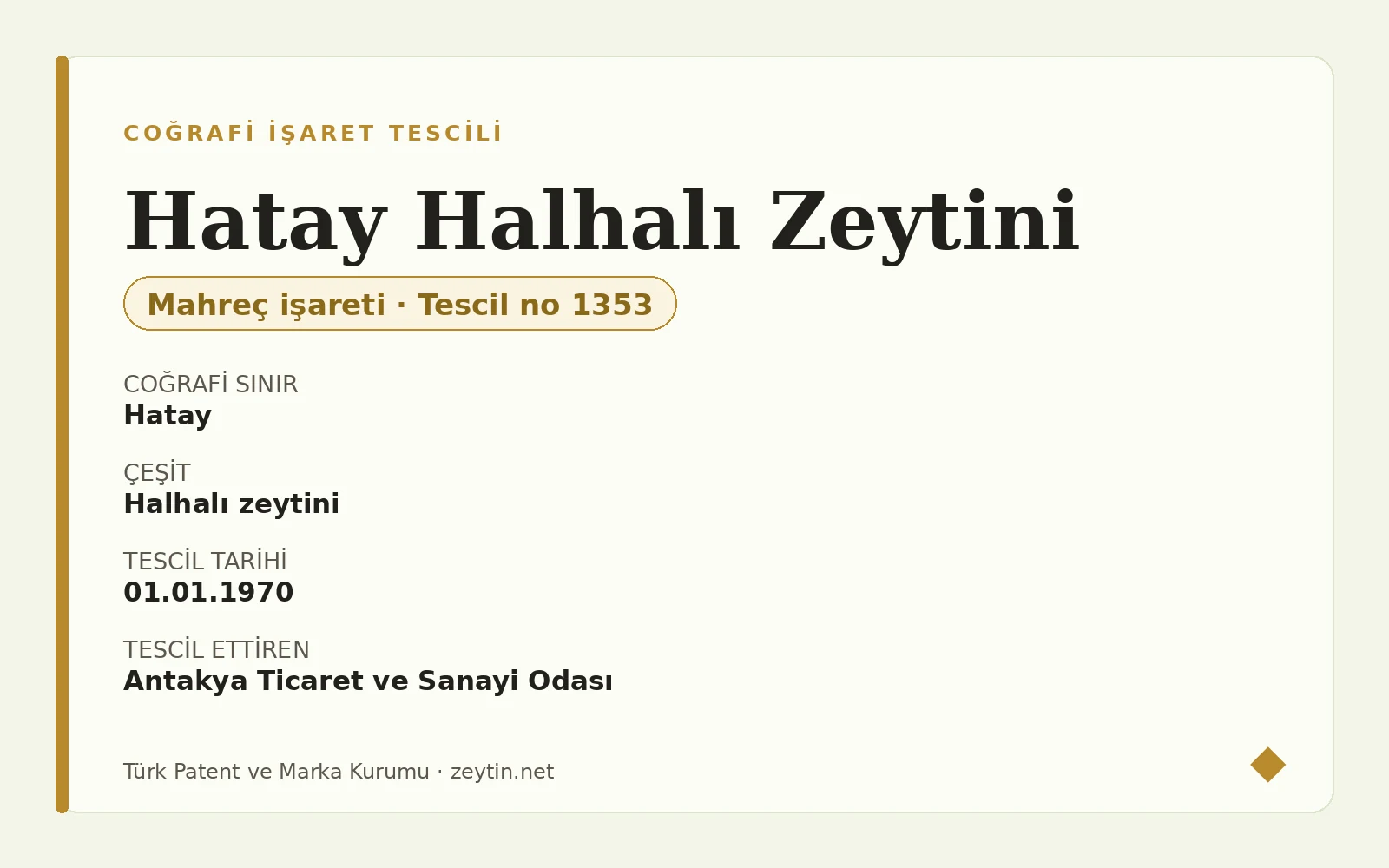
Hatay Halhalı Olive: what long sunshine hours do to phenol content
Registered in 2023. The certificate ties the high phenol content (322-525 mg/kg) directly to long sunshine hours, and defines two separate debittering methods.
Article
Hatay Halhalı Olive: what long sunshine hours do to phenol content
Registered in 2023. The certificate ties the high phenol content (322-525 mg/kg) directly to long sunshine hours, and defines two separate debittering methods.
 Article
Gaziantep Green Olive Pastry: a registration that turns a recipe into a rule
The only prepared dish among olive geographical indications. The document binds the half-moon shape, the 14-15 cm diameter, the filling gram by gram, the sheep breed, and inspection twice a year. The olives used are oil-type, not table.
Article
Gaziantep Green Olive Pastry: a registration that turns a recipe into a rule
The only prepared dish among olive geographical indications. The document binds the half-moon shape, the 14-15 cm diameter, the filling gram by gram, the sheep breed, and inspection twice a year. The olives used are oil-type, not table.
 Article
The Gemlik olive: small fruit, six times the flesh
Turkey s only olive cultivar with a geographical indication: 3.7 g fruit, a 6.4 flesh-to-pit ratio, 29-30% oil. Self-fertility measurements, chilling requirement, and why it is still picked by hand.
Article
The Gemlik olive: small fruit, six times the flesh
Turkey s only olive cultivar with a geographical indication: 3.7 g fruit, a 6.4 flesh-to-pit ratio, 29-30% oil. Self-fertility measurements, chilling requirement, and why it is still picked by hand.