Can you put olive oil on your hair? What the evidence says on dandruff, hair loss and lice
It can go on the hair shaft: it coats the surface and partly passes into the fibre. The only regrowth evidence is a mouse study with pure oleuropein. Oleic acid can irritate a dandruff-prone scalp, and olive oil did not kill lice in the lab.

Short answer: you can put it on the hair shaft, but it works no miracles. Olive oil leaves a film on the outer surface of the hair and makes the strand look softer and glossier; laboratory measurements also suggest that some of it gradually passes into the fibre. On the other hand, there is no human study showing that it stops hair loss, makes hair grow longer or kills lice. And for people prone to dandruff, oiling the scalp may make the problem worse. This article takes each claim in turn, together with the study behind it.
What does it do to the hair shaft?
The outermost layer of a hair is the cuticle, made of overlapping scales laid like roof tiles. When oil coats that surface, friction between strands drops, combing gets easier and light is reflected more evenly. That is why hair looks shinier and feels softer right after oiling. The effect does not last: once shampoo removes the oil, the feeling goes with it.

The more interesting question is whether the oil gets inside the fibre. In a study published in the Journal of Cosmetic Science in 2005 (Keis, Persaud, Kamath and Rele), the researchers measured the adhesion force between oiled hair fibres. With coconut, olive and sunflower oil this force fell over time; with mineral oil it did not. The authors put this down to part of the oil moving from the surface film into the fibre; separate measurements with coconut and sunflower oil confirmed that as the film thinned, the cuticle scales became visible again. Mineral oil stayed on the surface.
Hot oil treatments may find some support here. In the same study, heating further reduced the adhesion between fibres for coconut and sunflower oil but not for mineral oil, which suggests that warm application may speed up the uptake of oil into the hair. The abstract does not report the effect of heat for olive oil separately. Anyone who wants to warm the oil should simply stand the bottle in warm water for a while; overheated oil can burn the scalp.
But "getting in" is not the same as "repairing". In a 2003 study from the same research circle, Rele and Mohile measured how oil applied before and after washing affected protein loss from hair. Of the three oils tested, coconut oil was the only one that markedly reduced protein loss; sunflower and mineral oil did not help at all. The researchers attributed sunflower oil's failure to the bulky molecular shape created by its double bonds. Olive oil was not part of that test. Oleic acid, the main fatty acid in olive oil, has a single double bond; where olive oil would land in that measurement can only be known by testing it.
Does it stop hair loss?
The claim that olive oil regrows hair usually traces back to a South Korean study published in PLoS One in 2015. Tong, Kim and Park of Yonsei University applied oleuropein, the bitter compound found in olive leaves and fruit, to mouse skin. In mice given 0.4 milligrams of oleuropein per mouse per day, resting hair follicles moved into the growth phase sooner and the follicles grew larger. In the laboratory, human hair follicle cells also multiplied faster.
That study does not show that olive oil grows hair in people. The experiment was done in mice; the substance used was purified oleuropein, not olive oil; and the measurements were made on healthy mouse skin, not on people with hair loss. In olive oil, oleuropein is present mostly as breakdown products, and the phenol content varies widely from one oil to another (oleocanthal and polyphenols). We could not find a controlled trial measuring the effect of olive oil on hair loss in humans.
Is it good for dandruff?
A warm olive oil scalp massage is a common dandruff tip. The science points the other way. One of the main players in dandruff and seborrhoeic dermatitis is Malassezia, a group of yeasts that live on the scalp and feed on oil.
A study published in the Journal of Investigative Dermatology Symposium Proceedings in 2005 (DeAngelis and colleagues) showed that dandruff develops through the irritating free fatty acids these yeasts release as they break down skin oil. The researchers used oleic acid to represent these harmful fatty acids and, in this way, showed the role of individual susceptibility. The same paper stresses that antifungal agents such as zinc pyrithione reduce flaking and itch by cutting the yeast population and, with it, the free fatty acids.
Oleic acid is the main fatty acid in olive oil; under international standards it makes up between 55% and 83% of olive oil's fatty acids. That does not mean olive oil on the scalp will cause dandruff in everyone. But for someone prone to dandruff or seborrhoeic dermatitis, rubbing oil into the scalp is not a sensible treatment. Persistent redness, itching or flaking should be seen by a dermatologist.
The same caution applies to cradle cap, the scaly patches on babies' scalps. The UK National Health Service (NHS) suggests massaging a moisturiser or coconut oil into the scalp to loosen the scales, and advises against olive oil because it may not be suitable for use on skin. For olive oil on babies' skin, see can you put olive oil on your skin?
Does it kill lice?
Olive oil, mayonnaise and petroleum jelly are among the home remedies thought to kill lice by smothering them. A laboratory study published in the Journal of Pediatric Nursing in 2004 (Takano-Lee and colleagues) tested vinegar, isopropyl alcohol, olive oil, mayonnaise, melted butter and petroleum jelly. Only petroleum jelly caused significant louse mortality; none of the treatments stopped lice from laying eggs, and most did little to kill the eggs.
The researchers found that lice were extremely hard to drown even after eight hours under water, which means that killing them by depriving them of air is inefficient. They concluded that none of the home remedies they examined was an effective means of louse control. Lice call for licensed products from the pharmacy and regular combing with a fine-toothed comb.
If you want to use it
For dry, frizzy ends, a few practical points:
- A little is enough. Spread a few drops in your palm and work them into the lengths and ends. Keeping the oil away from the scalp is safer for anyone prone to dandruff.
- Apply it before washing. If the oil is left for a while and then shampooed out, the hair will not be left heavy or greasy. Olive oil does not rinse out with water alone; two rounds of shampoo may be needed.
- There is no need for an expensive oil. No study shows that extra virgin olive oil beats riviera or refined oil for hair; extra virgin earns its price at the table (extra virgin, virgin and riviera explained).
- Stop if it irritates. If itching, redness or spots increase, stop using it.
A note of caution
Claims that "olive oil makes hair grow and stops hair loss" are everywhere on social media and in product marketing. The studies behind them are mostly mouse experiments or tests carried out with other oils. Hair loss has many possible causes; with sudden or heavy shedding, see a doctor rather than experimenting with oils.
Summary
Olive oil can be applied to the hair shaft: it coats the surface, adds softness and shine, and part of it passes into the fibre over time. The only evidence that it regrows hair is a mouse experiment with pure oleuropein. On a dandruff-prone scalp oleic acid can be irritating, and the NHS does not recommend olive oil for cradle cap. In a laboratory test, olive oil did not kill lice.
Related: Does olive oil have downsides? · Olive leaf tea: how to make it
One rating per visitor; you can change yours at any time. Ratings are real reader votes — no seeded or default scores.
Related
 Article
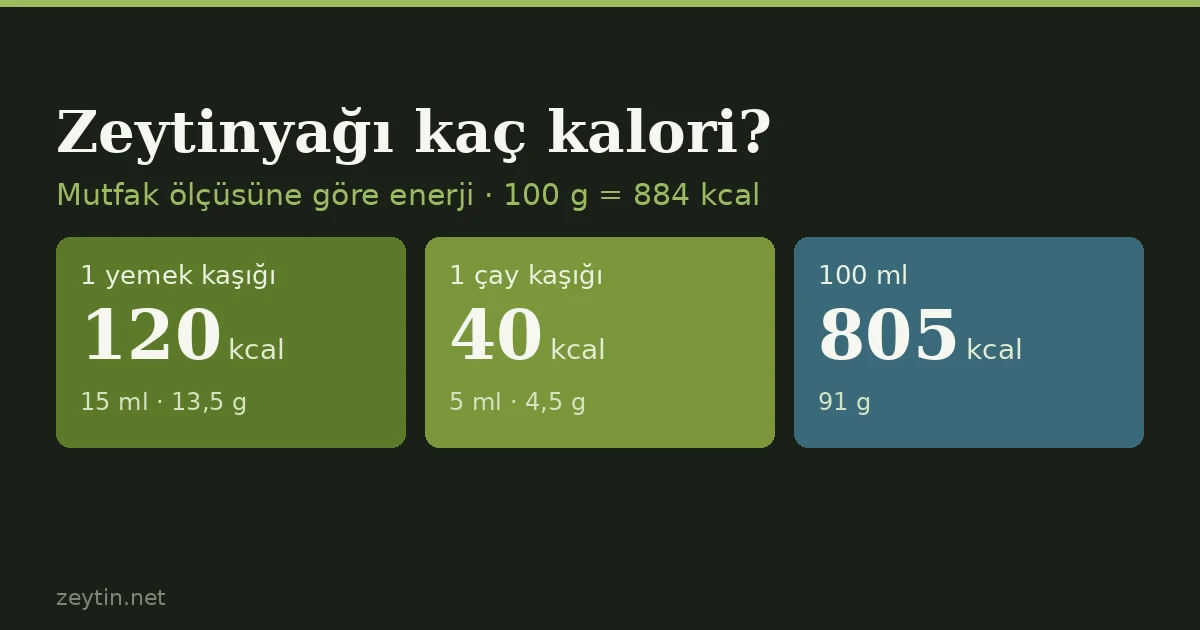
How many calories are in olive oil? Tablespoon, teaspoon and 100 ml
One tablespoon of olive oil has about 120 calories and one teaspoon about 40. Extra virgin, refined blends and sunflower oil carry almost the same energy. A measure table, plus how to count it in salads and cooked dishes.
 Article
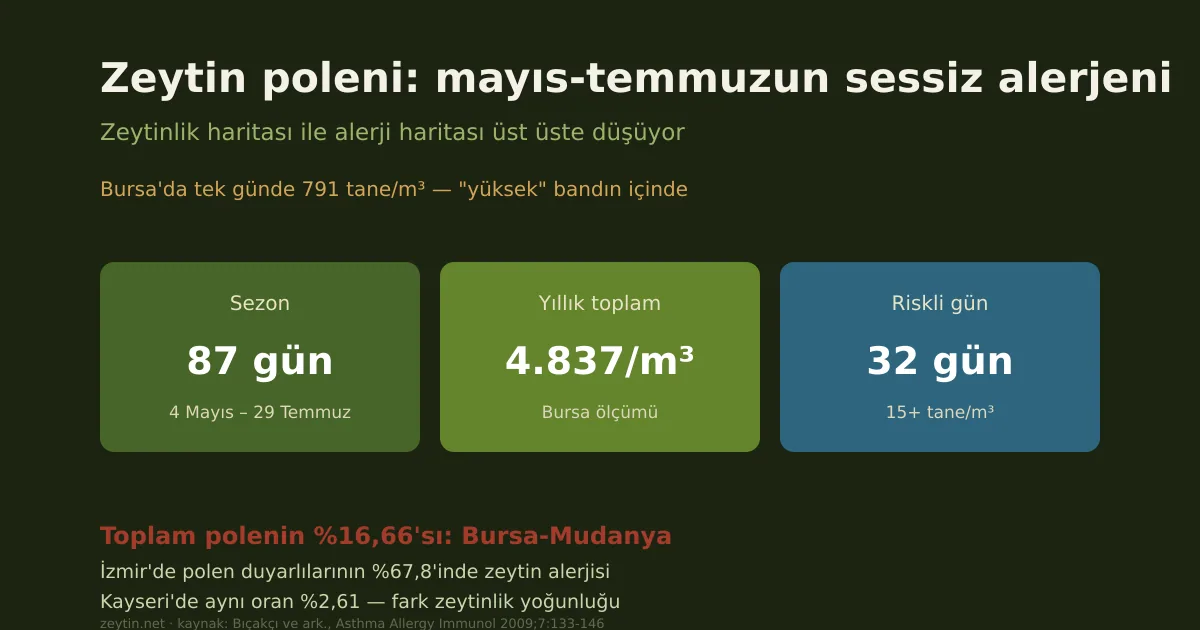
Olive pollen allergy: the quiet cause of May to July
Olive pollen fills the air across western Türkiye from May to July. Bursa recorded 791 grains/m³ in one day over an 87-day season; 67.8% of pollen-sensitised patients in İzmir react to it.
 Article
Does olive oil have downsides? Calories, the gallbladder, old oil and fraud
In normal kitchen amounts olive oil is a safe food; its downsides mostly come not from the oil itself but from quantity, misuse and poor products. High calories, discomfort after fatty meals in people with gallstones, the habit of drinking it on an empty stomach as a "cure", repeatedly reused frying oil and adulterated products are the main risks.
 Article
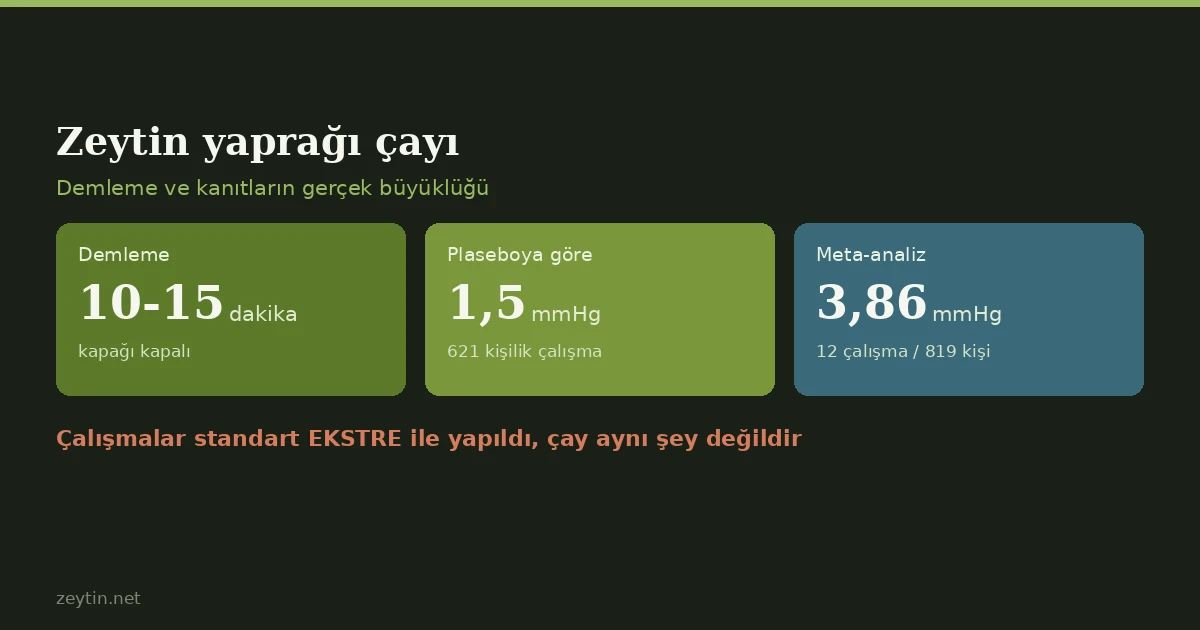
Olive leaf tea: how to make it and what the evidence says
The leaf carries oleuropein and other phenolics. Blood pressure trials show a modest effect, but all used standardised extracts — tea is not the same thing. Steeping, drying and cautions.