The Çakır olive: a cultivar that asks for a thousand hours of cold
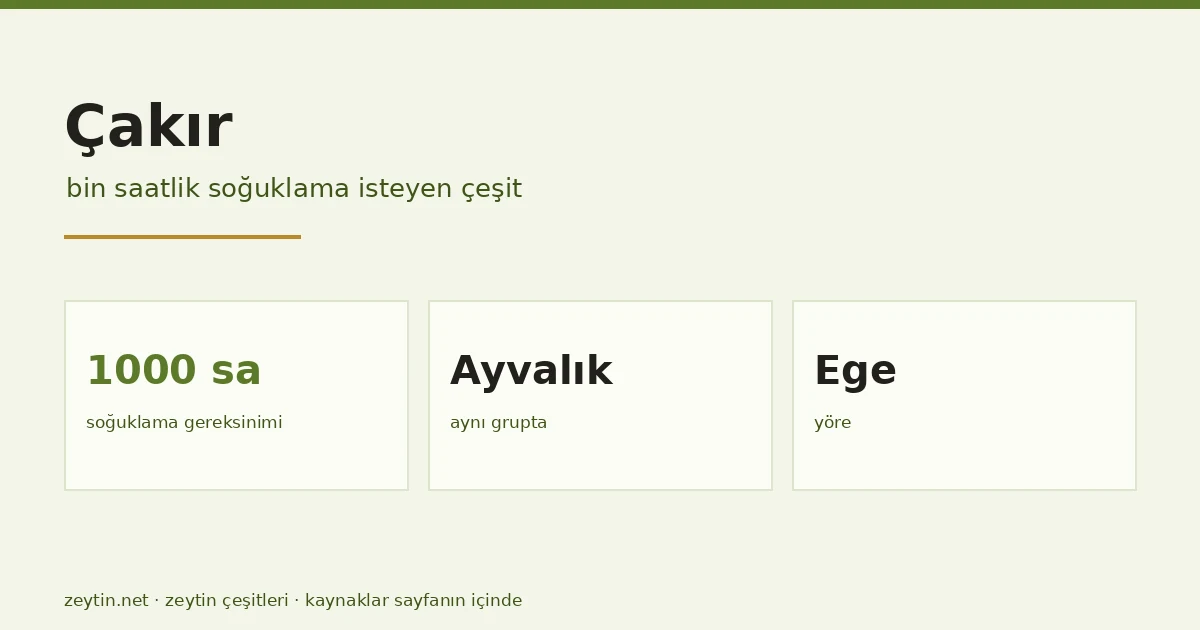
Reported alongside Ayvalık and Domat with a 1000-hour chilling requirement — the group most at risk as winters warm.
Çakır is one of the Aegean's local olive varieties, and measurements place it in the high chilling requirement group: 1,000 hours, the same figure reported for Domat and Ayvalık.
Çakır in numbers
| Property | Value | Note |
|---|---|---|
| Chilling requirement | 1000 h | same group as Domat and Ayvalık |
| Region | Aegean |
What a thousand hours means
A thousand hours is roughly 40 to 45 days of uninterrupted suitable cold. Failing to meet it doesn't kill the tree, but it disrupts flowering that year — and the crop drops.
At the other end of the scale sits Adana Topağı at 346 hours. In other words Çakır needs more than three times what the least cold-demanding variety asks for.
That narrows the geography it can grow in: only regions whose winters are long and cool enough. And in warming winters it belongs to the group that runs into trouble first.
⚠ The same measurement study records years in which Ayvalık and Domat did not have this requirement met. Since Çakır sits in the same group, it carries the same risk.
More: chilling requirement in olives · climate change and the olive.
Missing data
For Çakır we only have the chilling figure. No verified published source was found for fruit weight, oil content, flesh-to-stone ratio or self-fertility.
This is the common situation for local varieties in Turkey: their names appear in variety inventories, but pomological measurements have either not been made or not been published. This page will be updated when measurements are found.
In short
The only measured property known for Çakır is its high chilling requirement: 1,000 hours. That places it alongside Ayvalık and Domat — the varieties most at risk of flowering trouble in warming winters.
Note on sources
The pomological and chilling values on this page come from a comparative trial of Turkish and foreign olive varieties conducted under Adana conditions. Properties without a measurement have not been filled in by estimation; they are left blank.
Turkey's full variety distribution and comparative tables: olive varieties.
Where it stands among measured varieties
Zeytin Kitabı — Efe, Soykan, Cürebal, Sönmez (2016), Kitabevi Yay. s.37-80
Zeytin Kitabı — Efe, Soykan, Cürebal, Sönmez (2016), Kitabevi Yay. s.37-80
Zeytin Kitabı — Efe, Soykan, Cürebal, Sönmez (2016), Kitabevi Yay. s.37-80
Zeytin Kitabı — Efe, Soykan, Cürebal, Sönmez (2016), Kitabevi Yay. s.37-80
Zeytin Kitabı — Efe, Soykan, Cürebal, Sönmez (2016), Kitabevi Yay. s.37-80
Values are those published on each variety's own page; the comparison covers only varieties with a measured figure, so it is a comparison of what is known — not of every Turkish variety. See the full ranking and how it is built →
One rating per visitor; you can change yours at any time. Ratings are real reader votes — no seeded or default scores.
Related
 Article
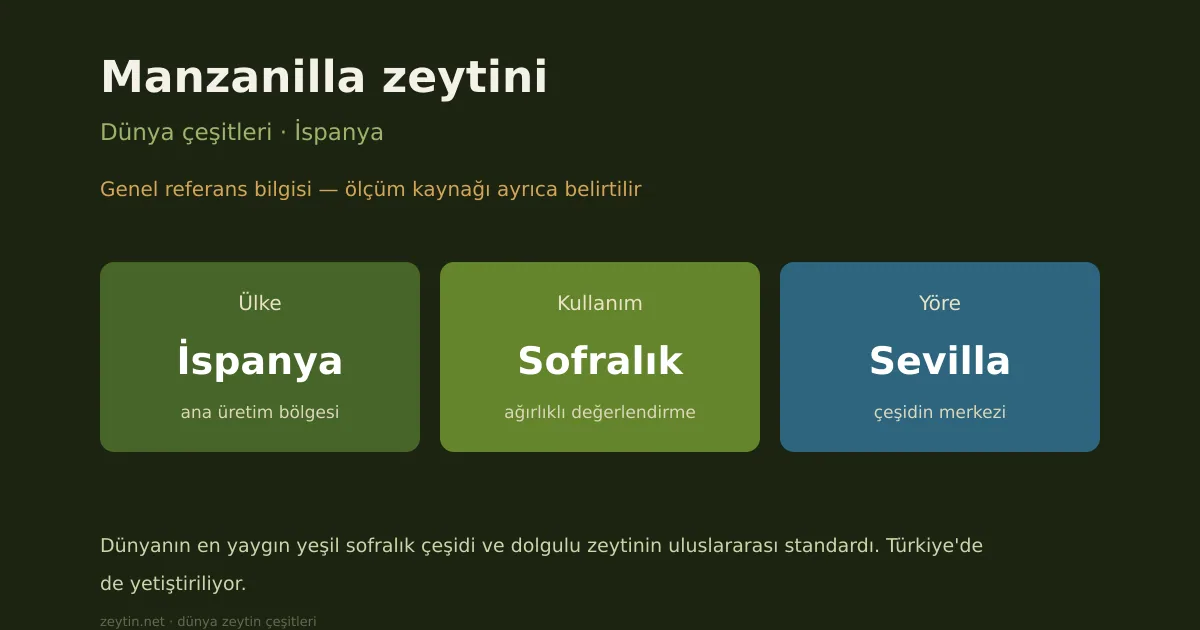
Manzanilla olive: Spain's table variety
The world's most widely planted green table variety and the international standard for stuffed olives. It is grown in Türkiye too.
Article
Manzanilla olive: Spain's table variety
The world's most widely planted green table variety and the international standard for stuffed olives. It is grown in Türkiye too.
 Article
Olive Oil Soap: How It Is Made, Its Types and How to Choose
How saponification works, why curing takes months, and how to recognise genuine olive oil soap.
Article
Olive Oil Soap: How It Is Made, Its Types and How to Choose
How saponification works, why curing takes months, and how to recognise genuine olive oil soap.
 Article
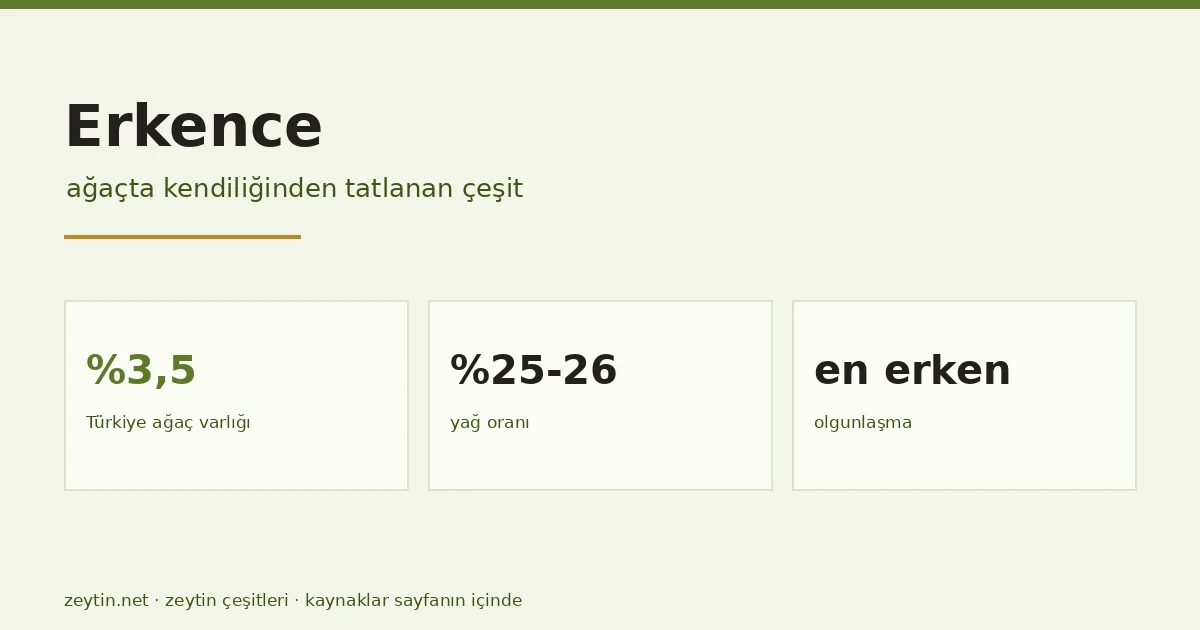
The Erkence olive: the cultivar that sweetens on the tree
Erkence accounts for 3.5% of Turkey's olive trees. It is the Aegean's earliest-ripening cultivar and has a property with few equivalents anywhere: the fruit loses its bitterness on the tree, without brine.
Article
The Erkence olive: the cultivar that sweetens on the tree
Erkence accounts for 3.5% of Turkey's olive trees. It is the Aegean's earliest-ripening cultivar and has a property with few equivalents anywhere: the fruit loses its bitterness on the tree, without brine.
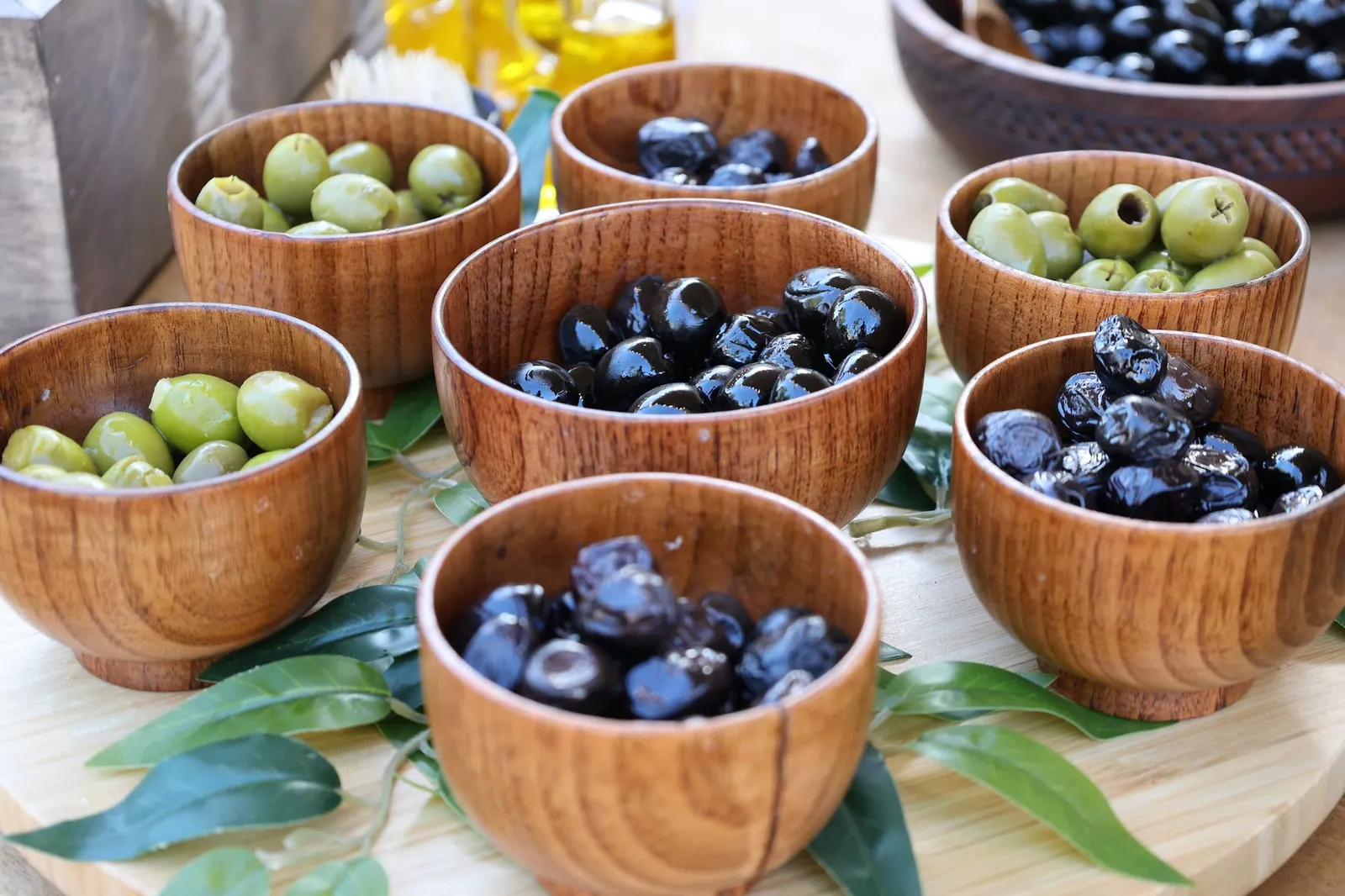 Article
Table Olives: Types, Curing and How to Choose
From green to black, cracked to dry-cured: how table olives are made, chosen and kept.
Article
Table Olives: Types, Curing and How to Choose
From green to black, cracked to dry-cured: how table olives are made, chosen and kept.