Harvest halted amid a record forecast: 50 lira for table olives in Akhisar, 10 for oil
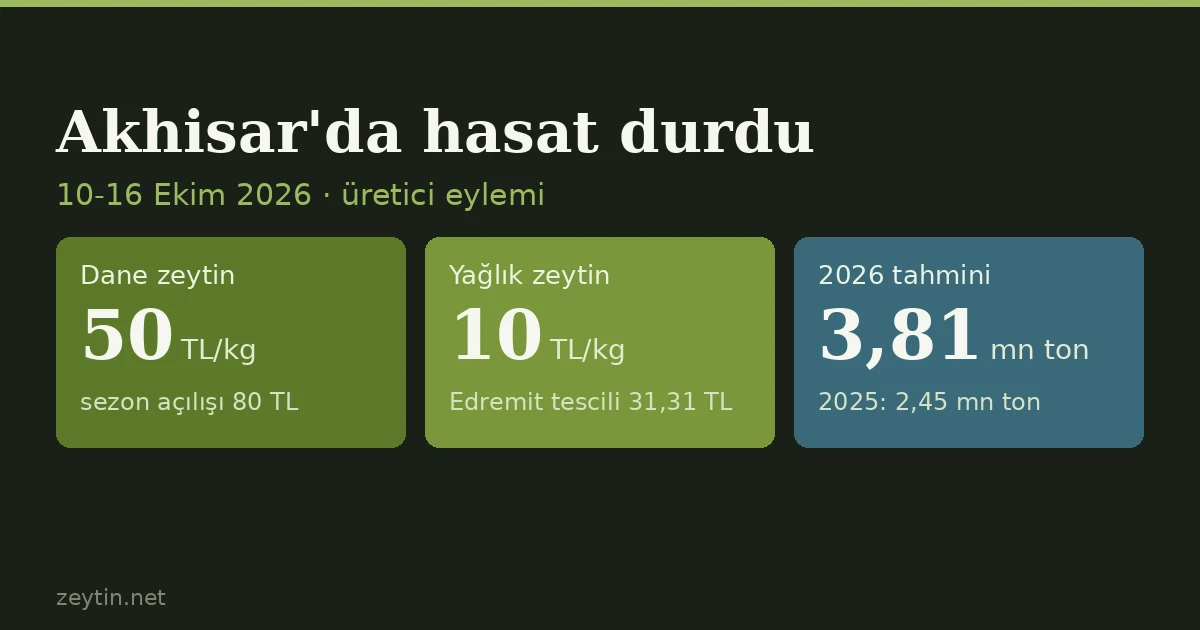
Growers in Akhisar halted the harvest for a week on 10 October. Table olive prices that opened the season at 80 lira fell to 50, and oil olives to 10 — below last season's table olive floor. In the same days the official first estimate puts production at 3.8 million tonnes.
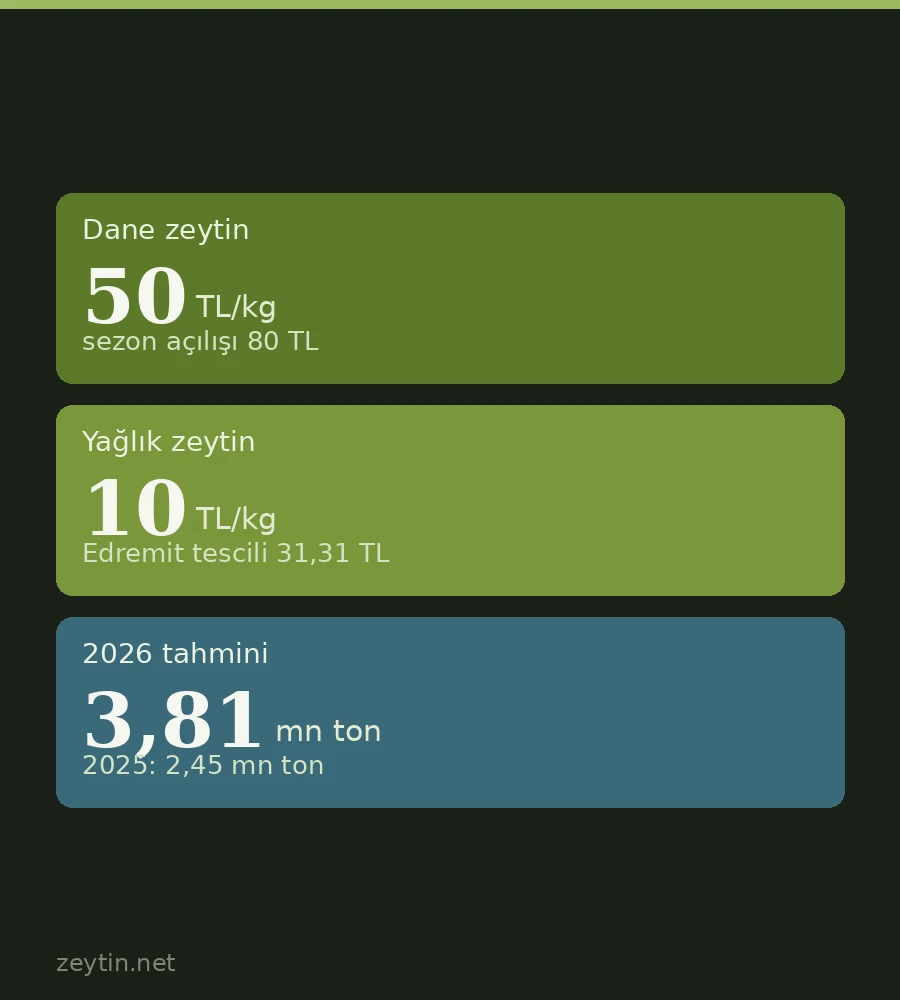
Olive growers in the Akhisar district of Manisa halted their harvest on 10 October 2026. Meeting in Zeytinliova, they announced the stoppage would last one week — no olives picked until Friday 16 October — and growers from the Ballıca and Bünyanosmaniye neighbourhoods joined the decision. The reason is a single one: the purchase prices on offer.
Ahmet Akbuğa, head of the Akhisar Chamber of Agriculture, said purchase prices had fallen below last year's level and did not cover production costs. The Tarım-Sen union called for a minimum price to be set and for producer support.
The numbers in the field
| Item | Season opening | 10 October |
|---|---|---|
| Table olives | 80 ₺/kg | 50 ₺/kg |
| Oil olives | 53 ₺/kg | 10 ₺/kg |
Those two lines amount to a fall of roughly a third in table olives and close to four fifths in oil olives between the opening days of the season and the day the stoppage began.
One point should be left open. Reports from the district put the upper bound for table olives somewhere between 50 and 60 lira. The difference may come from grading by size — a lot of large-calibre fruit does not fetch the same price as a lot of small fruit. The figure of 10 lira for oil olives, however, is the same across every account.
Another detail stands out. The 53 lira cited as the starting point for oil olives is identical to the last purchase price announced by Marmarabirlik: according to our own data, the cooperative bought oil olives at 53 lira per kilogram for the 2025/26 season. In other words, the "fall" being discussed in the field is largely the gap between last season's known reference and this season's offers.
Measured against last season's floor
| Item | Price |
|---|---|
| Table olives, ceiling (18 count) | 160 ₺/kg |
| Table olives, floor (41 count) | 55 ₺/kg |
| Oil olives | 53 ₺/kg |
The comparison needs care. Marmarabirlik is a cooperative of the Marmara basin and its dominant variety is Gemlik; Akhisar sits in the Aegean and is a Domat-weighted basin. The product, the variety and the sales channel all differ. Even so it offers a reference point, and the point is telling: the 50 lira reported in Akhisar falls below last season's table olive FLOOR of 55 lira. The complaint behind the stoppage is therefore not "prices did not rise as much as we hoped" but "prices went below the bottom rung of last year".
Marmarabirlik's purchase prices for the 2026/27 season had not been announced when this article was prepared. The cooperative's crop declaration process opened on 21 September.
What the exchange side says
A field price and an exchange registration are not the same thing, but putting them side by side helps. According to our own measurement, the registered price for oil olives on the Edremit exchange stood at 31.31 lira per kilogram on 12 October, while extra virgin olive oil was registered at 280.61 lira on 13 October.
The 10 lira reported in Akhisar is less than a third of the average registered on the exchange. It would be wrong to attribute the whole gap to one cause: an exchange registration is an average for specific lots at a specific quality, while the offer made in the field also covers lots of low yield and weak quality. Still, the size of the gap shows what kind of price band the fruit being diverted to oil is meeting this season. We have set out what to watch for when reading exchange figures in a separate article.
The arithmetic of an on-year
Behind the price pressure sits supply. According to the Plant Production First Estimate, 2026 table published by the Ministry of Agriculture and Forestry, Türkiye's olive production rises from 2,450,000 tonnes in 2025 to 3,814,500 tonnes — an increase of 55.7%.
| Year | Production |
|---|---|
| 2025 | 2,450,000 t |
| 2026 (first estimate) | 3,814,500 t |
| Change | 55.7% |
Two caveats sit on top of that figure. First, as its name says, it is a first estimate and gets revised during the year. Second, the sector runs its own measurement in parallel: the field work of the National Official Assessment Committee was under way in 41 provinces and its result had not been published when this article was prepared. The committee's report put fruit production at 3,600,000 tonnes in the 2024-25 season; if the official estimate holds, this season will go above that too.
A price decline in a year of abundant supply is no surprise. What is striking is the scale of it: production in table olives rising by more than half while the price falls by a third points to a place where the grower cannot make up the per-kilo loss with volume. We examined the same argument at the start of the season through the minimum price debate as the crop forecast rose; what was then an expectation is now in the field.
Why Akhisar is at the centre of this
Akhisar is the centre of table olive production, and there the fruit price is income directly. According to our data Manisa produced 320,045 tonnes of olives in the 2025-26 season, of which 154,683 tonnes went to the table trade and 165,362 tonnes to oil. The province's table share is therefore 48.3%, against 31.2% nationally. It holds 28.9 million bearing trees at a yield of 11.1 kilograms per tree, plus 7.1 million trees not yet in production.
A falling fruit price does something different in a table-weighted basin than a falling oil price does: the option of turning the crop into oil and waiting narrows. A grower with oil olives who dislikes the price can press and store the oil; table fruit either goes into brine or loses its value. The geographically protected Akhisar Domat olive is a product of this basin too. How much the share diverted to oil can swing between seasons was visible in the Orhangazi case.
What is being said about costs
The cost figures growers report do not settle into one calculation. Picking alone is given as 15 lira per kilogram for table olives; with fertiliser, diesel, spraying, pruning and transport added, the total is put at 25-30 lira. A commission agent employing 28 workers during the harvest gives a total cost in the 30-40 lira range, and reports that against daily sales of 27,000-30,000 lira, wages alone come to 15,000-20,000 lira.
These are not an official cost calculation — they are statements by individual businesses, and the spread between them shows as much. But they point the same way: labour accounts for close to half of the total, and the cost of harvesting is fixed regardless of what the fruit sells for. Because that is precisely the item that cannot be trimmed when the price drops, a grower may prefer to delay the harvest or skip it — which is the shape the protest has taken.
Fruit left on the tree has a second consequence. Raw material that has lost its value and carries weak traceability flows cheaply into the bulk market. That the ministry's 12 October adulteration list carries two new olive oil records from Manisa is a reminder falling in the same days.
The stoppage ends on 16 October. What follows depends on the direction of purchase prices; the position growers report is that this harvest will not be made at 50 lira.
One rating per visitor; you can change yours at any time. Ratings are real reader votes — no seeded or default scores.
Related
 Article
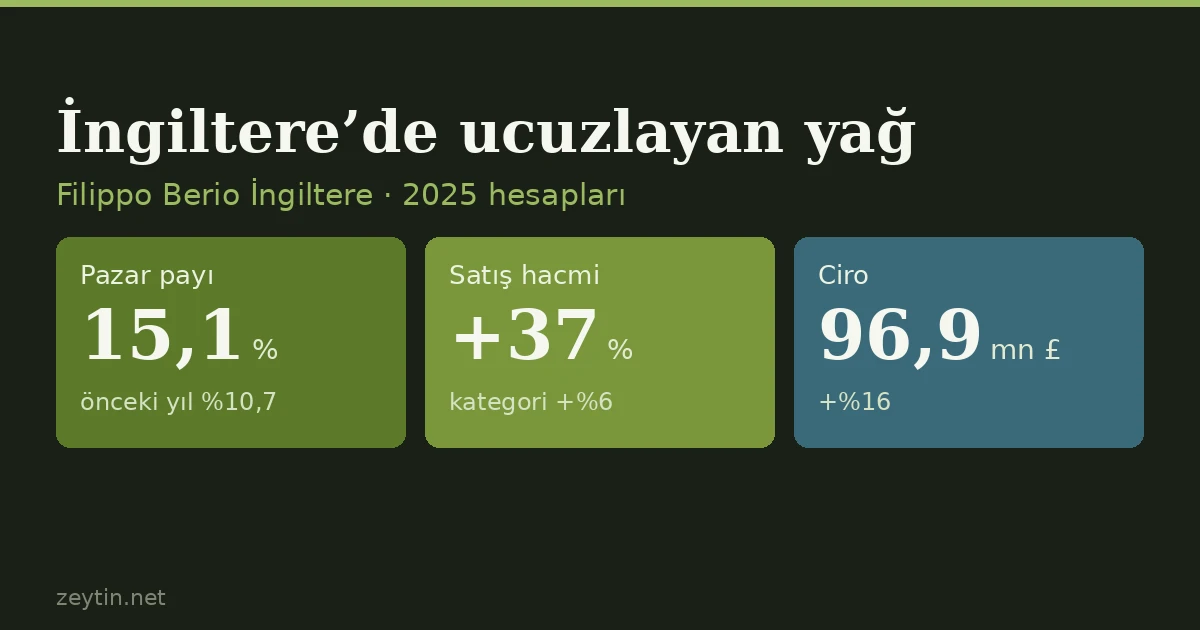
Olive oil got cheaper in the UK and Filippo Berio lifted its share to 15%
The 2025 accounts of Filippo Berio's UK company show how falling prices reached the shelf: volumes up 37%, revenue up 16%, market share from 10.7% to 15.1%. The category grew 6% and lower wholesale costs were passed on to shoppers.
Article
Olive oil got cheaper in the UK and Filippo Berio lifted its share to 15%
The 2025 accounts of Filippo Berio's UK company show how falling prices reached the shelf: volumes up 37%, revenue up 16%, market share from 10.7% to 15.1%. The category grew 6% and lower wholesale costs were passed on to shoppers.
 Article
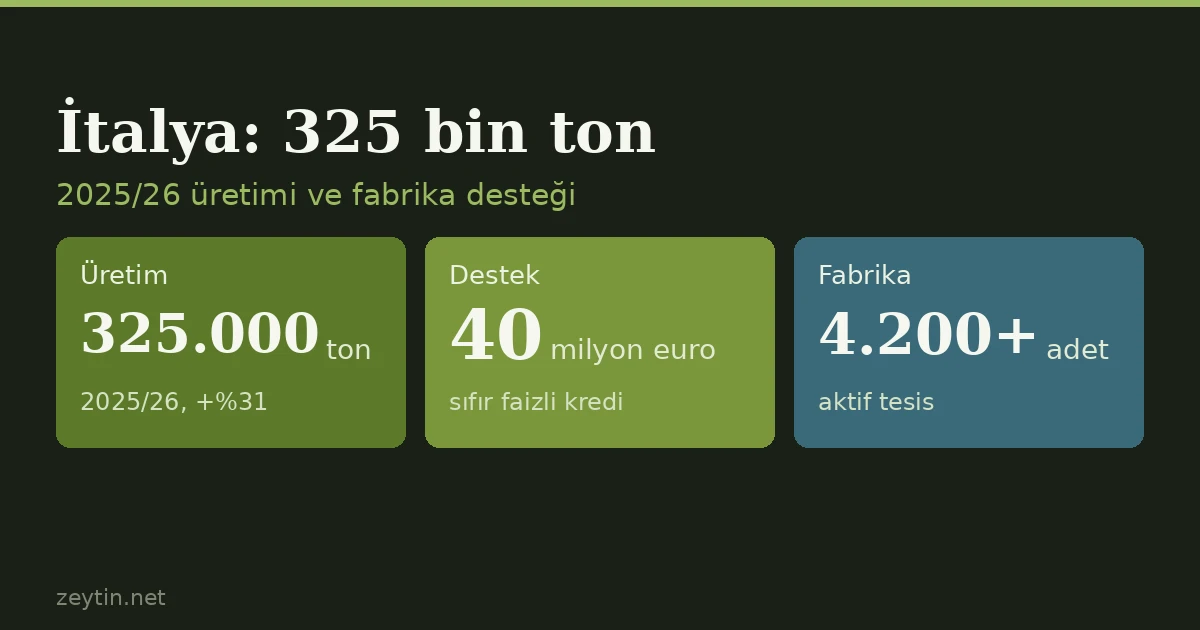
Italy is back at 325,000 tonnes yet is handing cash to its mills: a 40-million-euro zero-interest loan
Italy produced 325,000 tonnes of olive oil in the 2025/26 campaign, up 31%, according to Ismea's sector report. Yet even as output recovers, the state is pumping liquidity into mills: the 40-million-euro "Cambiale Frantoi Oleari" offers zero-interest loans of 3,500 to 50,000 euros. The five-year national olive plan aims to lift production by 25%.
Article
Italy is back at 325,000 tonnes yet is handing cash to its mills: a 40-million-euro zero-interest loan
Italy produced 325,000 tonnes of olive oil in the 2025/26 campaign, up 31%, according to Ismea's sector report. Yet even as output recovers, the state is pumping liquidity into mills: the 40-million-euro "Cambiale Frantoi Oleari" offers zero-interest loans of 3,500 to 50,000 euros. The five-year national olive plan aims to lift production by 25%.
 Article
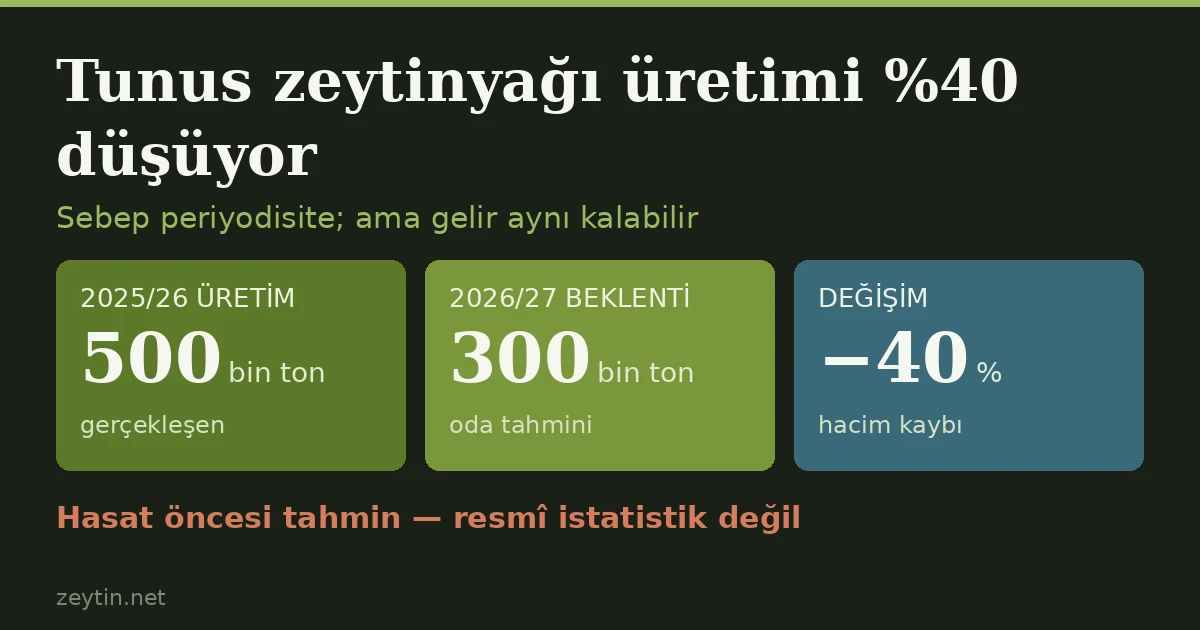
Tunisia's output falls from 500,000 to 300,000 tonnes — revenue may hold
Tunisia's National Chamber of Olive Producers expects olive oil output to fall from 500,000 to 300,000 tonnes in 2026/27, citing alternate bearing. Revenue is still expected to match last season because prices are higher. Türkiye's most direct bulk competitor is shrinking.
Article
Tunisia's output falls from 500,000 to 300,000 tonnes — revenue may hold
Tunisia's National Chamber of Olive Producers expects olive oil output to fall from 500,000 to 300,000 tonnes in 2026/27, citing alternate bearing. Revenue is still expected to match last season because prices are higher. Türkiye's most direct bulk competitor is shrinking.
 Article
Edremit Chamber: olive oil needs at least 50 lira per litre in support
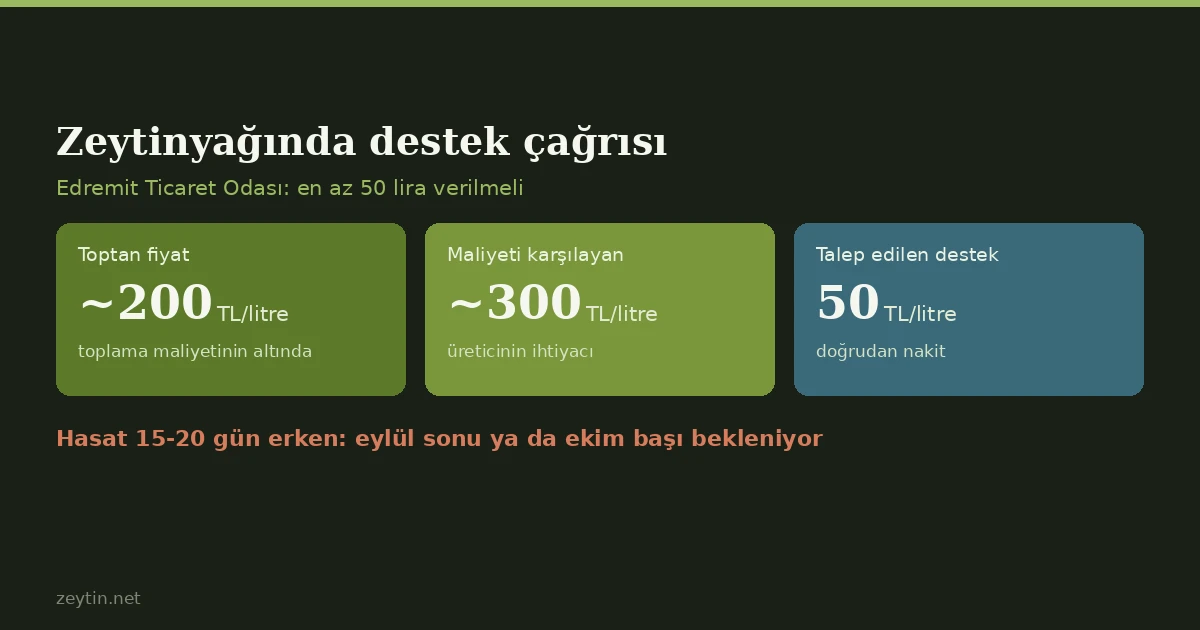
Chamber President Ahmet Çetin says the wholesale price has fallen to 200 lira, below the cost of picking. The level needed to cover costs is 300 lira. Harvest is expected 15-20 days early.
Article
Edremit Chamber: olive oil needs at least 50 lira per litre in support
Chamber President Ahmet Çetin says the wholesale price has fallen to 200 lira, below the cost of picking. The level needed to cover costs is 300 lira. Harvest is expected 15-20 days early.