Akhisar Domat Olive: the specification behind stuffed olives
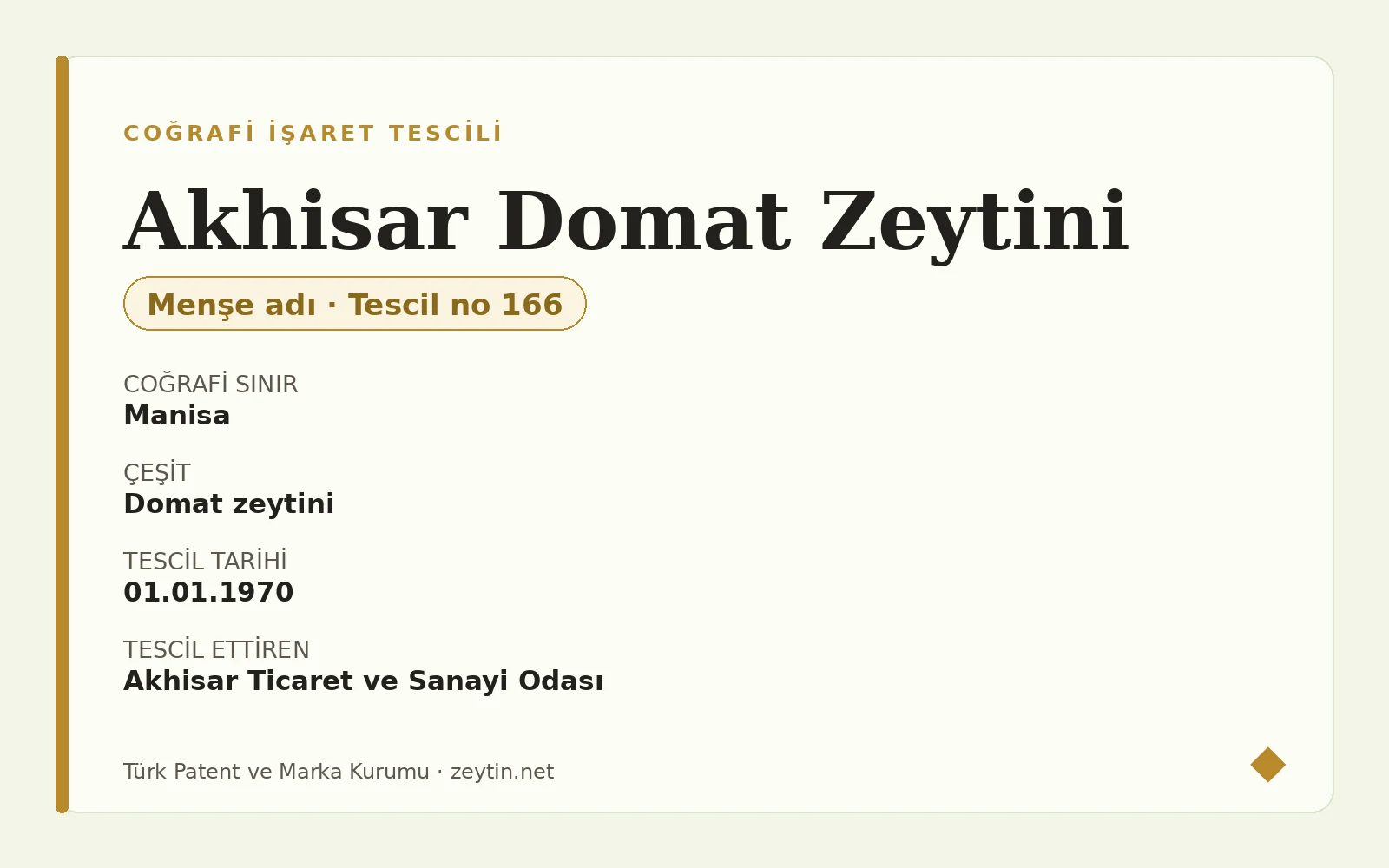
Registered in 2010. The certificate sets calibre separately for each product form — 170-290 for stuffed, 110-260 for cocktail. One cultivar, different sizes.
Domat is the backbone of Turkish green table olive production. What makes its certificate interesting is that it does not give a single calibre — it defines separate size bands according to which product the fruit will become.
The record
| Registration no | 166 |
| Protection date | 04.11.2010 |
| Application | C2010/058 |
| Type | Designation of origin |
| Registered by | Akhisar Chamber of Commerce and Industry |
| Area | The Akhisar district of Manisa and its neighbours: Gölmarmara, Salihli, Turgutlu, Saruhanlı, Kırkağaç |
| Official notice | 12.04.2012 · Official Gazette 28262 |
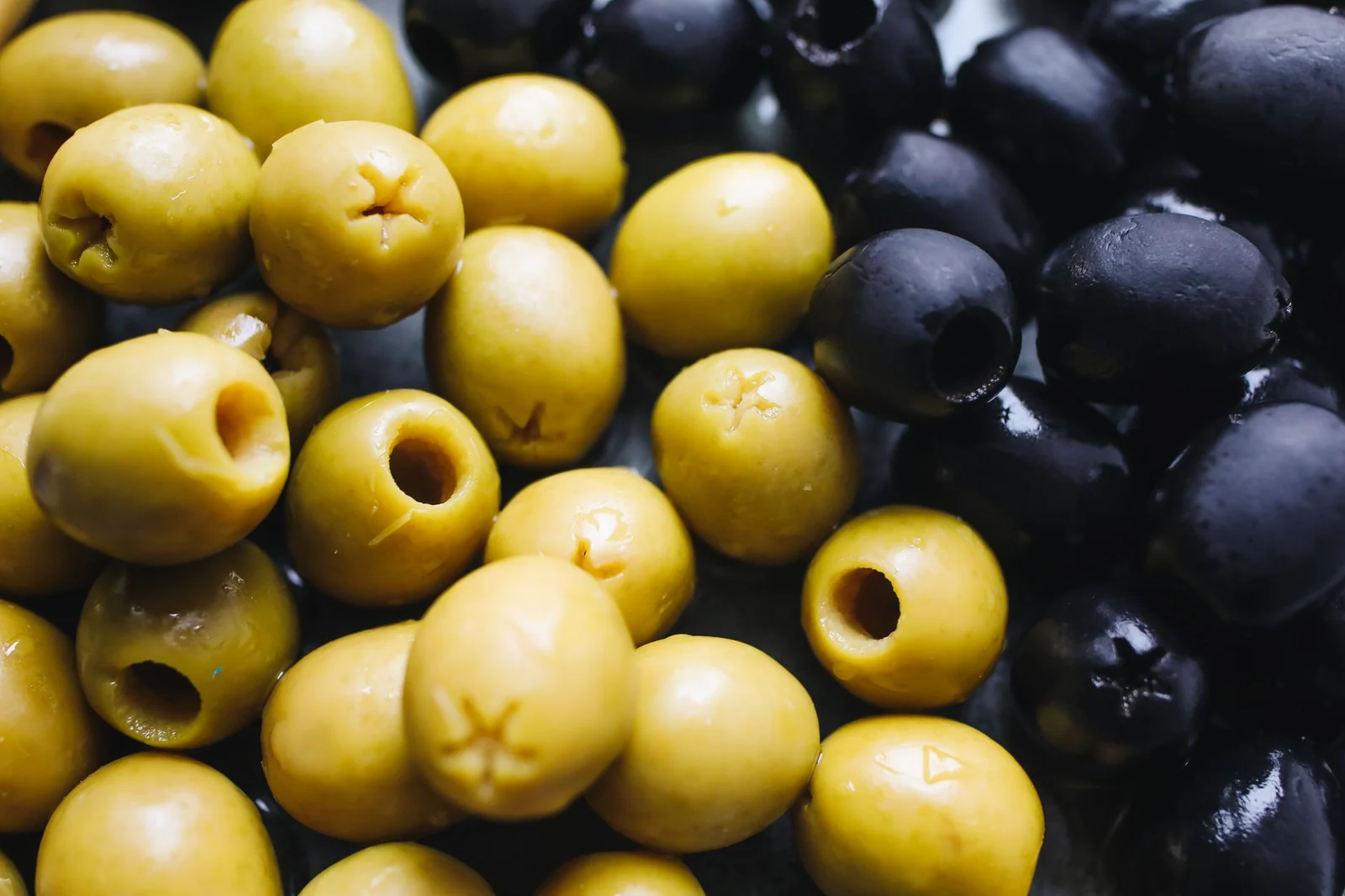
Its twin, registered the same day within the same boundary: Akhisar Uslu Olive. One is the green table cultivar, the other the black.
The measured fruit
| Criterion | Value |
|---|---|
| Weight of 100 fruits | 530.30 g |
| Single fruit | ≈ 5.30 g |
| Length | 26.70 mm |
| Width | 19.48 mm |
| Length/width ratio | 1.37 |
| Flesh ratio | 83.76% |
| Oil content | 20.57% |
| Moisture | 55.89% |
The figures on our Domat olive page come from here.
Calibre by product
This table is the certificate's distinctive part — each product form demands its own size band:
| Product | Fruits/kg bands |
|---|---|
| Stuffed olives | 170-200 · 201-230 · 231-260 · 261-290 |
| Sliced green · cracked scored | 160-190 · 191-220 · 221-250 · 251-280 |
| Cocktail · pitted · natural pink · pepper/almond stuffed | 110-130 · 131-150 · 151-170 · 171-190 · 191-220 · 221-240 · 241-260 |
The logic is simple: a fruit that will be cored for stuffing must fall within a particular size, whereas cocktail olives can use a far wider range. The cultivar's large fruit provides that latitude.
Fruit form
The fruit is large and cylindrical, symmetric both lengthwise and across, with its widest point at the middle. It carries a distinguishing mark: a pronounced ridge running on opposite sides from stalk to tip. The tip is flat or rounded, and the stalk cavity usually round — sometimes shuttle-shaped — and of medium depth.
Ripe flesh is of medium firmness, with a medium-strength bond to the stone — exactly what green table processing wants: firm enough to survive stuffing and slicing, soft enough not to eat tough.
The tree grows vigorously, generally forming a large, broad, spreading crown with dense branching.
In short
The name Akhisar Domat Olive belongs to Domat-cultivar olives grown in Akhisar and five neighbouring districts. What the certificate adds is eight measured values and a calibre table that splits by product form — the size of the fruit decides whether it becomes a stuffed olive or a cocktail one.
The production steps in the document
The registration describes production step by step. The document's own sequence:
1. Dikim Sonrası Bakım — Dikim sırasında ve bunu takip eden yıllarda yetiştirme tekniklerine özen gösterilir.
2. ÜRÜNE HAS TANIMLAR Fermantasyon Salamurası — Ürünün yenebilir nitelik kazanması acısının alınması ve işlenmesi için içme suyu ile hazırlanan %0,5 ile %7 arasında değişen oranlarda tuz, %0,065 ile %1,2 arasında değişen asit oranları ile Sofralık Zeytin Kodeksine uygun hazırlanmış…
3. Dane İriliği — Ürünün irilik kriteri olup, ürünün halka arzında bir kg’da bulunan ortalama adet sayısının gereklerini tarif eder.
4. Taç Yoğunluğu — Dallanma sık ve yaprak yoğunluğu fazladır.
5. Dalların Rengi — İki ve daha yaşlı dallar sütlü kahverenginde, genç dallar ise gri-yeşil renktedir.
6. Dalların Açı Durumu — İki ve daha yaşlı dallar dik, genç dallar ise geniş açılıdır.
7. Gövdenin Kuvveti — Kuvvetli Gövde Rengi : Koyu gri-kahverengi Gövde Yüzeyinin Durumu : Genç gövde düzgündür.
8. YAPRAK Şekli — Çok uzun-dar, eliptik şeklindedir Üst Yüzey Rengi : Hafif puslu, tüysüz, koyu yeşil 000858(leek gren) ile 0969(Spinach gren) rengindedir.
That this sequence is binding is what separates a geographical indication from a trade mark: a mark says who produced something, a geographical indication also sets down how it must be produced.
The cultivar behind it, measured
The registration is granted to a place, but the cultivar the definition rests on has measurable values:
| Property | Value |
|---|---|
| Meyve ağırlığı | 5,30 g |
| 1 kg’daki tane sayısı | 165 |
| Et oranı | %83,76 |
| Et/çekirdek oranı | 5,25 |
| Yağ oranı | %20,57 |
| Hasat | Eylül-Kasım |
| Olgunlaşma | Ekim ortası |
| Kendine verimlilik | Kısmi — tozlayıcıları Ayvalık, Memeli, Memecik, Gemlik |
| Kullanım | Sofralık — iri danesi nedeniyle dolgulu yeşil zeytin |
| Dikim aralığı | 6×8 m · 7×7 m |
| Kuraklık ve soğuk | Her ikisine orta düzeyde dayanıklı |
| Kökeni | Akhisar (Manisa) · Ege Bölgesi |
At 20.57% the oil content sits mid-range; yield alone is not the argument here, aroma is. The cultivar is partially self-fertile; pollinators are used to secure yield. A flesh-to-stone ratio of 5.25 is the basic measure of how much of a table olive is actually eaten.
Its place in Manisa's olive production
| Item | Value |
|---|---|
| Fruit production | 623,493 t |
| — for oil | 411,412 t |
| — for the table | 212,081 t |
| Olive oil production | 64,292 t |
| Trees | 24,982 thousand |
| Yield per tree | 25.0 kg |
Oil and table production are close in this province (66% for oil); the production base is not locked to one direction.
One rating per visitor; you can change yours at any time. Ratings are real reader votes — no seeded or default scores.
Related
 Article
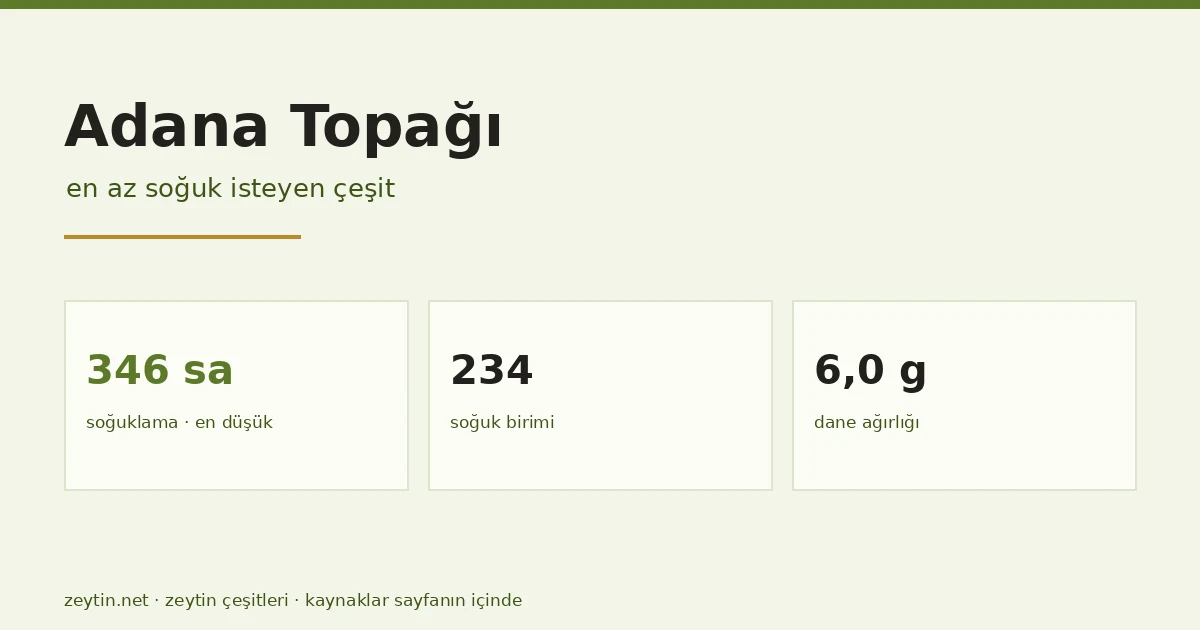
Adana Topağı: the olive cultivar that needs the least cold
The lowest chilling requirement among cultivars tested: 346 hours, 234 chill units. Why that matters as winters warm, and its 6-gram fruit.
Article
Adana Topağı: the olive cultivar that needs the least cold
The lowest chilling requirement among cultivars tested: 346 hours, 234 chill units. Why that matters as winters warm, and its 6-gram fruit.
 Article
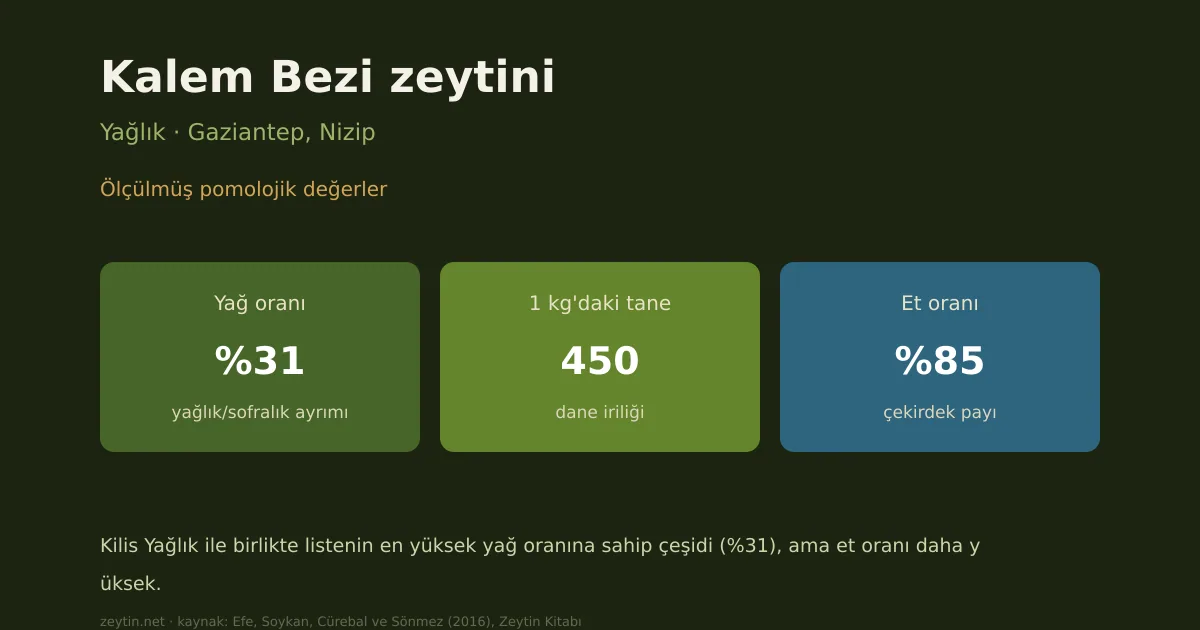
Kalem Bezi olive: characteristics, oil content and growing areas
Tied with Kilis Yağlık for the highest oil content on the list (31%), but with a better flesh ratio.
Article
Kalem Bezi olive: characteristics, oil content and growing areas
Tied with Kilis Yağlık for the highest oil content on the list (31%), but with a better flesh ratio.
 Article
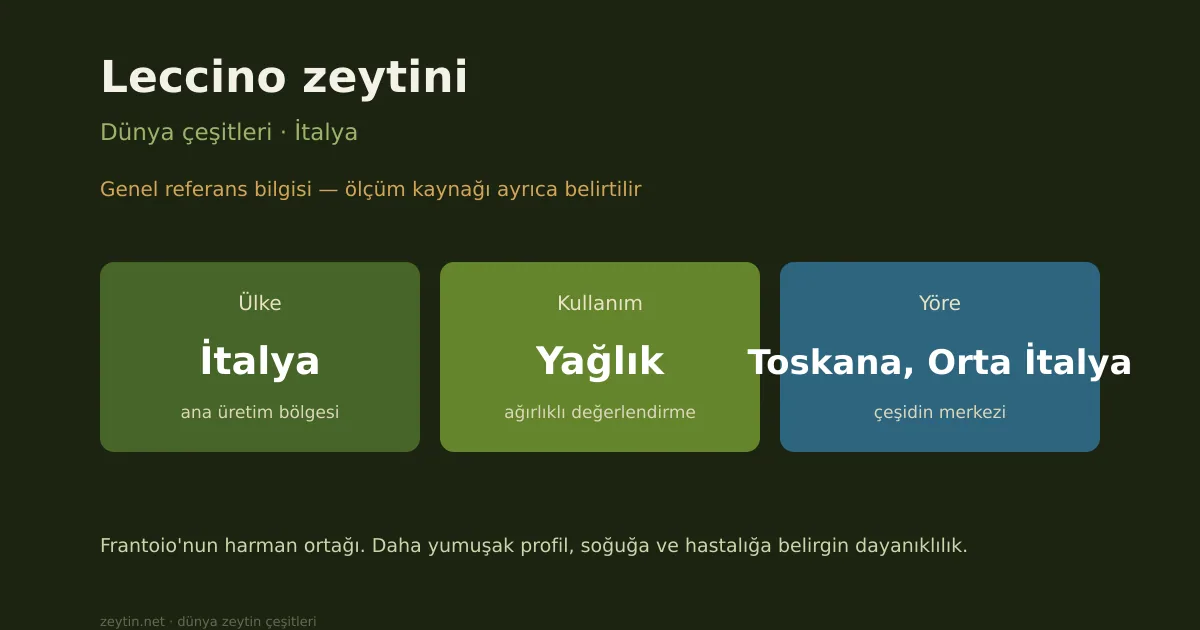
Leccino olive: Italy's oil variety
Frantoio's blending partner. A softer profile with notable cold and disease tolerance.
Article
Leccino olive: Italy's oil variety
Frantoio's blending partner. A softer profile with notable cold and disease tolerance.
 Article
Which type of olive is better?
Table or oil, green or black — choosing a variety by purpose, with a short regional map.
Article
Which type of olive is better?
Table or oil, green or black — choosing a variety by purpose, with a short regional map.