What is Türkiye's Olive Oil and Olive-Pomace Oil Communiqué, and what does it say?
Communiqué 2017/26 sets the grades, lab limits and label rules for olive and pomace oil sold in Türkiye; it was amended twice in 2023.
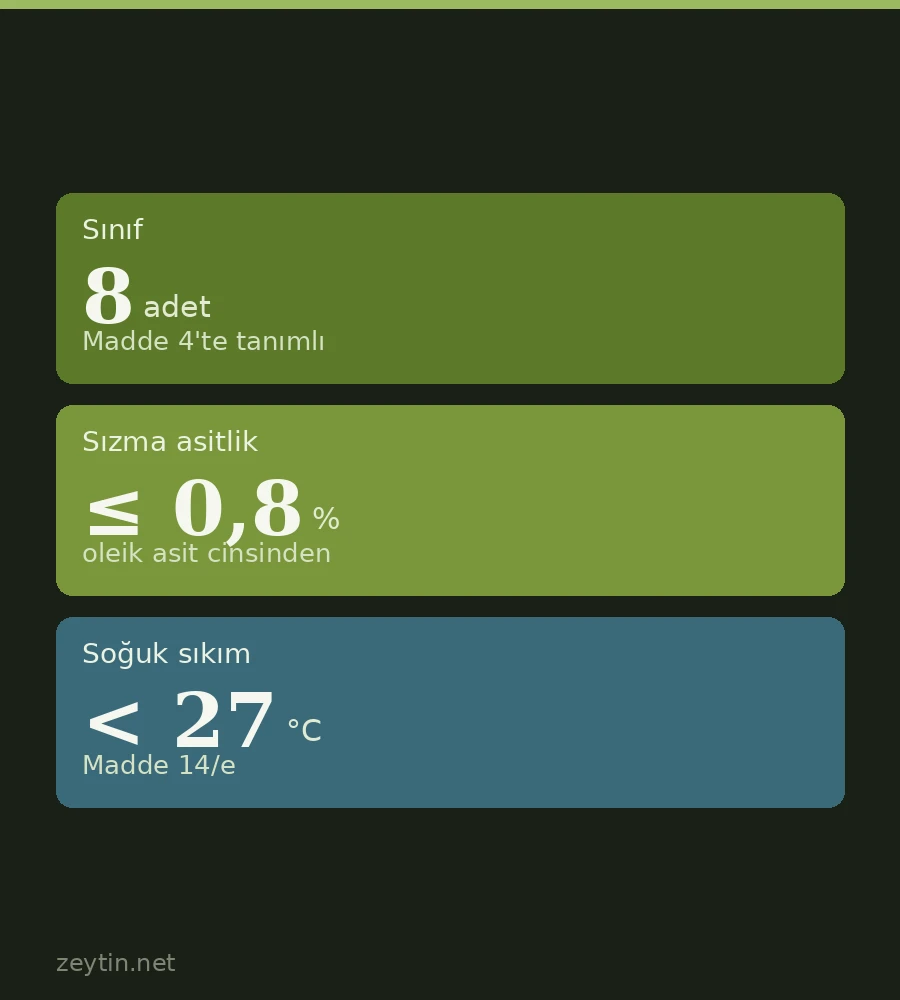
The Turkish Food Codex Communiqué on Olive Oil and Olive-Pomace Oil is the core regulation that decides what an oil sold in Türkiye may be called, which laboratory values it must meet and what its label may say. It was published as Communiqué No 2017/26 in the Official Gazette of 17 September 2017 (issue 30183), took effect the same day and replaced the earlier Communiqué No 2010/35. It has been amended twice since: on 8 April 2023 (issue 32157, Communiqué No 2023/23) and on 3 May 2023 (issue 32179, Communiqué No 2023/26). Everything below reflects the consolidated text with both amendments applied.
Reference details and amendment history
| Text | Official Gazette | What it did |
|---|---|---|
| 2010/35 (previous communiqué) | 7 Aug 2010 / 27665 | Repealed by 2017/26 (Article 20) |
| 2017/26 (base text) | 17 Sep 2017 / 30183 | 22 articles, 1 transitional article, 3 annexes |
| 2023/23 | 8 Apr 2023 / 32157 | Replaced Annexes 1 and 2, repealed Article 6 and the "Olive Oil Commission" definition, rewrote the sensory labelling rule, added transitional Article 2 |
| 2023/26 | 3 May 2023 / 32179 | Corrected the lignoceric acid and wax rows in Annex 1, Table 2, with effect from 8 Apr 2023 |
The communiqué rests on the Turkish Food Codex Regulation (Article 3). Its transitional clause gave existing producers one year to comply and stated that non-conforming products could no longer be on the market after 31 December 2019 (Transitional Article 1).
How the text is organised
The articles are short; most of the technical weight sits in the annexes.
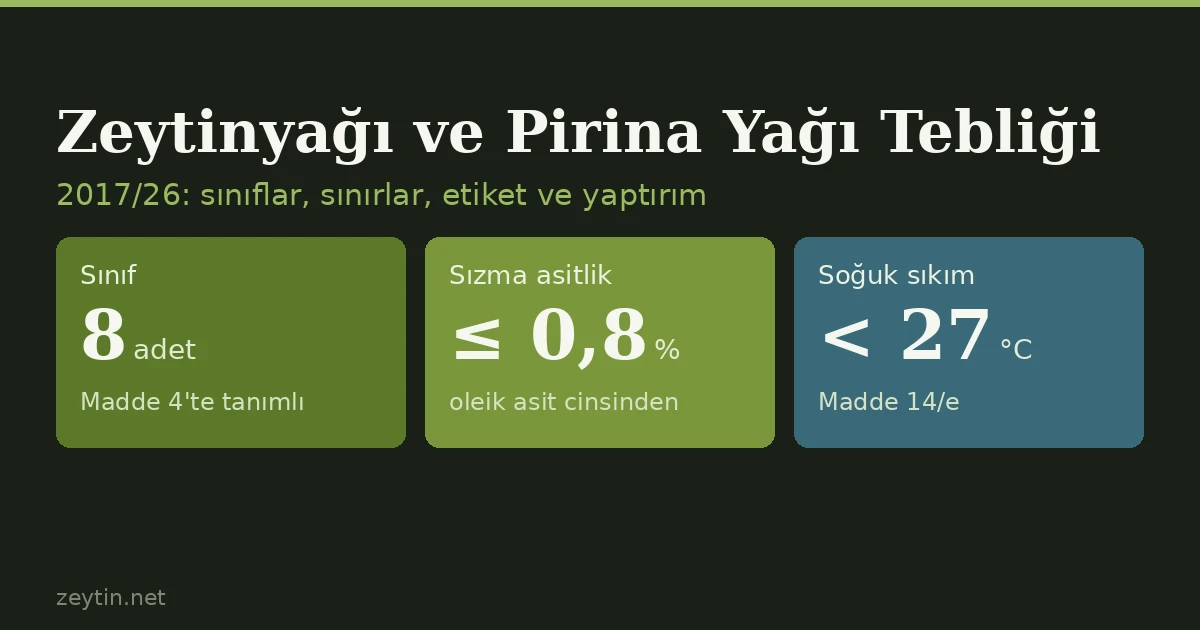
- Article 4 – Definitions: sets out the categories of olive oil and olive-pomace oil and the free acidity ceiling for each.
- Article 5 – Product characteristics: points to Annex 1 for quality and purity criteria, Annex 2 for sensory criteria and Annex 3 for the campesterol and delta-7-stigmastenol decision trees. It also contains the flat rule that olive oil may not be mixed with other liquid oils, nor other oils with olive oil (5/1-d).
- Article 7 – Additives: nothing may be added to virgin olive oils. Refined olive oil, riviera, refined pomace oil and pomace oil may only have alpha-tocopherol restored to replace what refining removes, up to 200 mg/kg in the final product.
- Articles 8-13: tie flavourings, extraction solvents, contaminants, pesticide residues, hygiene and packaging to the general food regulations.
- Article 14 – Labelling: the rules specific to olive oil.
- Article 17 – Sampling and analysis: samples are taken under the official controls regulation; analysis follows a separate communiqué on methods.
- Article 18 – EU alignment; Article 19 – Administrative sanctions.
The Article 6 that was repealed in 2023 had allowed a national commission to set adjusted sterol and UV absorbance values for domestic oil to reflect local climate and growing conditions. With it gone, domestic and imported oil are judged against the same Annex 1.
Which categories does it define?
There are eight. Definitions come from Article 4; the other values are from Annex 1, Table 1, as replaced in 2023.
| Category | Free acidity (% oleic) | Peroxide (meq O₂/kg) | K270 | ΔK |
|---|---|---|---|---|
| Natural extra virgin (natürel sızma) | ≤ 0.8 | ≤ 20 | ≤ 0.22 | ≤ 0.01 |
| Natural virgin (natürel birinci) | ≤ 2.0 | ≤ 20 | ≤ 0.25 | ≤ 0.01 |
| Crude / lampante olive oil (ham) | > 2.0 | — | — | — |
| Refined olive oil | ≤ 0.3 | ≤ 5 | ≤ 1.25 | ≤ 0.16 |
| Riviera olive oil | ≤ 1.0 | ≤ 15 | ≤ 1.15 | ≤ 0.15 |
| Crude olive-pomace oil | — | — | — | — |
| Refined olive-pomace oil | ≤ 0.3 | ≤ 5 | ≤ 2.00 | ≤ 0.20 |
| Olive-pomace oil | ≤ 1.0 | ≤ 15 | ≤ 1.70 | ≤ 0.18 |
Extra virgin must additionally meet K232 ≤ 2.50, fatty acid ethyl esters ≤ 35 mg/kg and waxes ≤ 150 mg/kg; virgin must meet K232 ≤ 2.60. On the sensory side, Annex 2 requires a median defect of zero for extra virgin and between 0 and 3.5 for virgin, with a fruity median above zero in both. Crude olive oil and crude pomace oil are not fit for direct consumption and go to refining. One definitional line matters a great deal: oil extracted with solvents or whose structure has been changed by re-esterification is not "olive oil" at all (Article 4/2). What the categories mean in practice is covered in extra virgin, virgin and riviera grades explained, and what the acidity figure actually measures in what does acidity mean in olive oil.
What does it say about labels?
Article 14 adds these rules on top of the general Food Labelling and Consumer Information Regulation:
- For flavoured oil, the name of the flavouring goes before the product name in the same font size (14/a).
- Only extra virgin and virgin oils may carry a geographical indication (14/b).
- Pomace oil may never be called "olive oil" under any circumstances (14/c).
- Each category has an optional descriptive sentence; riviera, for example, may state that it "contains olive oils that have undergone refining and virgin oils obtained directly from olives" (14/ç).
- "Cold pressed" (soğuk sıkım) may be used only for extra virgin or virgin oil obtained by percolation or centrifugation of the paste below 27 °C (14/e); this is the Turkish counterpart of the EU term "cold extraction". "First cold pressing" is reserved for the first pressing of the paste in a hydraulic press below 27 °C (14/d). There is no separate term for "cold obtained" in the text. The background is in what does first pressing mean.
- Taste and smell descriptors may appear only on extra virgin and virgin oil, only from the list in Part 2 of Annex 2 and only if backed by a panel test (14/f, amended in 2023).
- Oil may not be sold loose to the final consumer; it must be pre-packed (14/g).
- If acidity is stated, peroxide, wax and UV absorbance values must appear in the same typeface and size (14/ğ).
Origin is not regulated by the communiqué. Country of origin is mandatory on all foods under the general labelling regulation (Article 9/1-h), and where the main ingredient comes from elsewhere this must be stated so as not to mislead (Article 31). For the whole label, see how to read an olive oil label.
How does it relate to EU Regulation 2022/2104?
Article 18 still cites the EU's old Regulations 2568/91 and 29/2012. The European Commission repealed both with Delegated Regulation (EU) 2022/2104 of 29 July 2022. Türkiye did not update the article's wording, but the quality table in Annex 1, replaced by 2023/23, matches Annex I of 2022/2104 value for value. On the methods side, Communiqué No 2023/20 on analysis methods, published on 28 October 2023, was drafted with EU Implementing Regulation 2022/2105 in mind.
The differences are in labelling and blending. The EU regulation makes place of origin mandatory for extra virgin and virgin oil (Article 8), allows a harvest year only when 100% of the contents come from that harvest (Article 11), and permits blends of olive oil with other vegetable oils provided the percentage is declared (Article 12). The Turkish communiqué has no harvest-year rule and bans such blends outright. In the EU, the category's descriptive sentence is compulsory (Article 6); in Türkiye the text says it "may appear", so it is optional.
Who enforces it, and what are the penalties?
Enforcement lies with food control officers at the provincial and district directorates of the Ministry of Agriculture and Forestry. Samples are taken under the Regulation on Official Controls of Food and Feed (Article 17). A business may object to a result within seven days of being notified (Law No 5996, Article 31/4), and the Ministry may make control results public (Article 31/6).
For sanctions, the communiqué refers to Law No 5996 on Veterinary Services, Plant Health, Food and Feed (Article 19). Article 24/4 of the law prohibits imitation and adulteration. Article 40 provides for seizure and recall of adulterated product and a fine on the producer of at least 50,000 TL and at most 500,000 TL, calculated as one percent of the previous year's gross revenue. Repeat offences bring judicial fines and a ban from the sector. A mismatch between the label declaration and the analytical values is a separate offence. The amounts in the law are uprated every year by the revaluation rate. How adulteration is done and detected is covered in olive oil fraud and adulteration, and what the numbers on a certificate mean in how to read an olive oil lab report.
Points to watch
- Clause 14/f still refers to the 2014/53 analysis communiqué for sensory assessment. That communiqué was repealed by 2023/20, but the reference in the clause was not updated.
- Transitional Article 2, added in 2023, allowed refined and riviera oils with delta-7-stigmastenol between 0.5% and 0.8% to stay on shelves for their shelf life, but only stock already on the market with a best-before date up to 31 December 2024. Today the baseline limit is the 0.5% in Annex 1, subject to the Annex 3 decision tree.
One rating per visitor; you can change yours at any time. Ratings are real reader votes — no seeded or default scores.
Related
 Article
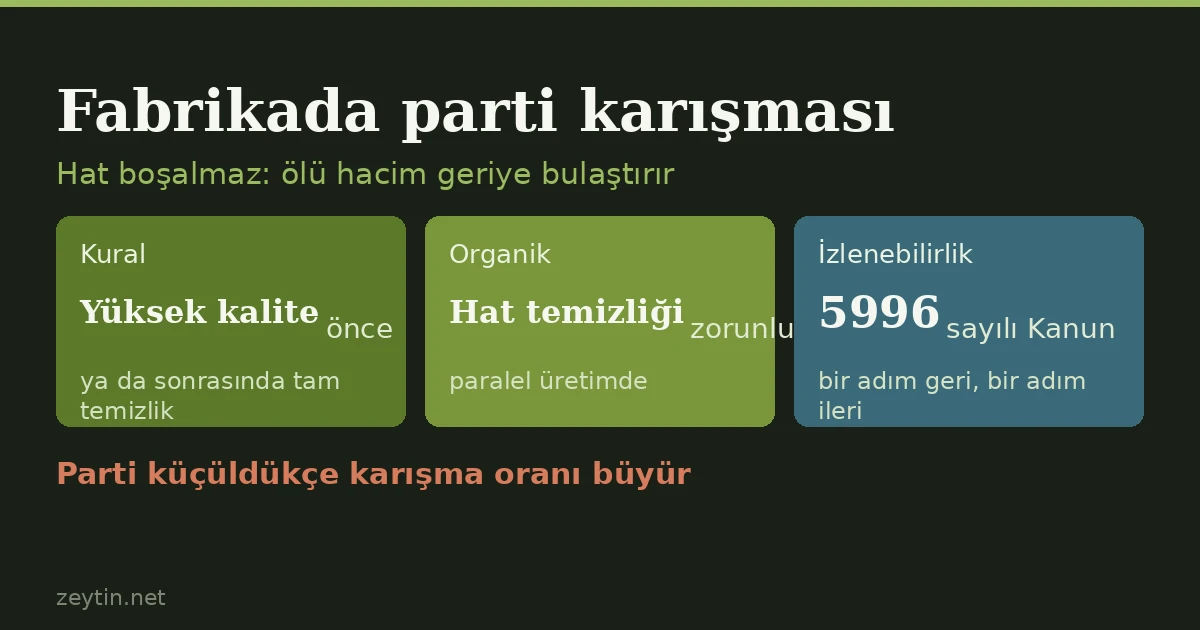
Do batches get mixed at the olive mill? Dead volume in the line and milling order
A mill line does not empty completely between batches: oil remains in the crusher, malaxer, decanter, separator and pipework. Part of the first oil out therefore comes from the previous batch. Why milling order is a rule, why organic certification requires line cleaning, and what a grower should ask at the mill.
 Article
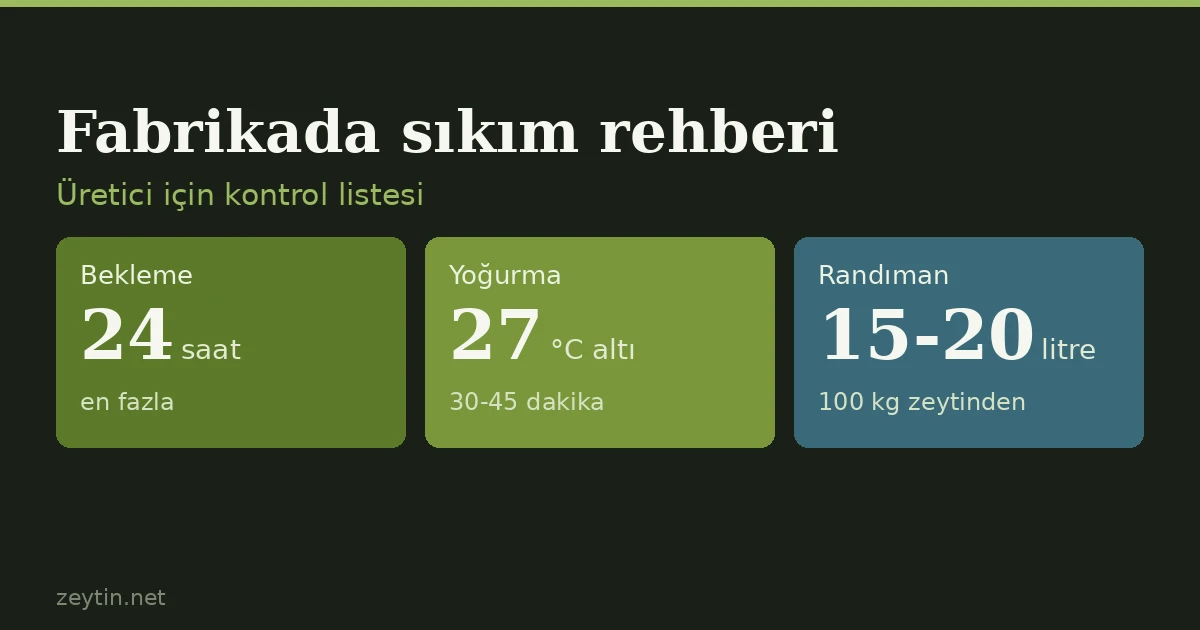
What to check when having your olives pressed at a mill: a grower's checklist
The same olives can give a very different oil when pressed at a different mill under different conditions. From what to do before bringing olives in to two-phase versus three-phase systems, kneading temperature, yield, milling fees and the questions to ask when collecting the oil, here is what a grower having olives pressed needs to know.
 Article
Olive Oil
The difference between extra virgin, virgin, refined and riviera; what acidity means, how cold pressing works and how to store oil.
 Article
Aydın Memecik Olive Oil: bitterness and pungency written into the definition
Registered in 2020. Total phenols > 100 mg/kg, peroxide ≤ 18, defect median 0. Intense fruit aroma with pronounced bitterness and pungency.