Tasting olive oil: defects and positive attributes
Laboratory tests alone do not make an oil extra virgin — it must pass a tasting panel. The three positive attributes, the six defects in the standard, and what each one says about how the oil was made.
Olive oil is one of the few foods in the world whose legal classification includes a sensory test. To be sold as extra virgin, an oil must not only pass laboratory measurements — it must also pass a tasting by a trained panel. This article explains what that panel looks for, and how to apply the same logic at home.
The two conditions for extra virgin
Under the International Olive Council's sensory standard, an oil qualifies as extra virgin only if both conditions hold:

1. The median of defects must be zero. The panel must detect no defect at all.
2. The median of fruitiness must be above zero. The oil must smell of fruit.
If the defect median is above zero but no higher than 2.5, and fruitiness is present, the oil is classified as virgin. Once the defect median rises above 2.5 — or if there is no defect but fruitiness is zero — the oil becomes lampante, and cannot be sold for consumption without refining.
| Grade | Defect median | Fruitiness median |
|---|---|---|
| Extra virgin | 0 | above 0 |
| Virgin | above 0, up to 2.5 | above 0 |
| Lampante | above 2.5 | — (or fruitiness 0) |
This has an important consequence: an oil can have low acidity and still fail to be extra virgin. Chemical measurement and sensory assessment are separate gates and both must be passed. On what acidity actually measures, see what acidity means in olive oil; on the differences between grades, see extra virgin, virgin and riviera explained.
The three positive attributes
The panel scores only three positive attributes:
Fruity. The smell of sound, fresh olives. It may be "green" (grass, leaf, green apple, artichoke) or "ripe" (ripe fruit, almond). Both are positive; which dominates depends on harvest timing and variety.
Bitter. A bitter taste felt at the back of the tongue, pronounced in early-harvest oils.
Pungent. A burning felt in the throat on swallowing, often causing a cough. It is the direct signature of the phenolic compound oleocanthal — see oleocanthal and polyphenols.
The most common consumer error is to mistake bitterness and pungency for defects. Both are defined in the standard as positive attributes and both indicate phenolic content. A "smooth, never harsh" oil is usually either low in phenols or old.
The six basic defects
The standard names each defect and defines its origin. Recognising a defect is valuable because it tells you where in production something went wrong.
| Defect | How it presents | Origin |
|---|---|---|
| Fusty / muddy sediment | Heavy, spoiled, "sack" smell | Fruit stored in piles, anaerobic fermentation |
| Musty / humid / earthy | Damp cellar, mushroom | Fruit held damp for days; fungi and yeasts developed |
| Winey / vinegary | Wine or vinegar | Acetic fermentation in the fruit |
| Acid / sour | Sharp sourness | Fermentation products |
| Frostbitten olives | Wet wood, damp timber | Oil milled from frost-damaged fruit |
| Rancid | Stale walnut, paint, putty | Oxidation — light, heat, air, time |
Read practically: five of the six are harvest and processing faults, and one — rancidity — is a storage fault. The story of a bad oil is usually written not at the mill but in the time the fruit spent getting there. This is why fruit should be milled on the day it is picked.
Tasting at home
The panel method cannot be reproduced exactly at home, but its logic can.
The glass. Use a dark, narrow-mouthed glass. Panels use blue glasses so the taster cannot see the colour. Colour says nothing about quality — it varies with variety and harvest date. The belief that greener oil is better is common and wrong.
Warming. Cover the glass with one palm and cradle it with the other. The target is close to body temperature; warmth releases the volatile compounds.
Smelling. Lift your hand and inhale deeply. Is there fruit? Something recognisable — grass, leaf, green almond, ripe fruit? Or sack, damp, vinegar, stale walnut?
Tasting. Take a small sip and spread it across your tongue. Draw air through your teeth — this carries the aroma to the nasal cavity. Look for bitterness at the back of the tongue and pungency in the throat as you swallow.
Resetting. Clear your palate with a slice of apple or water between oils.
The three most common defects
Rancid. The defect most often found in supermarket oil. It smells of stale walnut or paint, and is caused by light, heat and time. Oil sitting in a clear bottle under shop lighting develops it. This is why olive oil is sold in dark glass or tin, and why it should be kept cool and dark at home rather than beside the stove.
Fusty. Common in home production and small operations, and produced by leaving fruit in sacks or piles for a few days. Once formed it cannot be undone.
Winey. Comes from crushed fruit left waiting, usually fly-damaged or ground-collected.
Frequently asked
Does colour indicate quality? No. It depends on variety, harvest date and chlorophyll content. Panel glasses are blue precisely so the taster cannot see it.
Is bitter oil spoiled? No — the opposite. Bitterness and pungency are positive attributes in the standard and signal phenolic content.
It burns my throat, is that normal? It is normal and a good sign — the effect of oleocanthal.
There is sediment at the bottom. Is it bad? Unfiltered oils naturally carry sediment. But sediment can ferment over time, so unfiltered oil should be used sooner.
Does solidifying in the fridge prove purity? No. The point at which an oil clouds depends on its fatty acid composition and is not a purity test. This is a persistent myth.
One rating per visitor; you can change yours at any time. Ratings are real reader votes — no seeded or default scores.
Related
 Article
What happens if fly-damaged olives go into the oil?
If fly-struck olives reach the mill, the oil drops a grade: free acidity and peroxide rise, phenolics fall, and sensory analysis turns up fermentative defects plus the "grubby" attribute. Turkey's official integrated pest management instruction sets the action threshold at 3-4 percent of 800-1,000 fruits for oil olives and 1 percent for brining olives. Infested fruit cannot be sorted out at the mill; the decision is made in the grove and in the timing. This article explains exactly what fly damage changes in the oil, what share is manageable, and why an infested batch should be milled separately.
Article
What happens if fly-damaged olives go into the oil?
If fly-struck olives reach the mill, the oil drops a grade: free acidity and peroxide rise, phenolics fall, and sensory analysis turns up fermentative defects plus the "grubby" attribute. Turkey's official integrated pest management instruction sets the action threshold at 3-4 percent of 800-1,000 fruits for oil olives and 1 percent for brining olives. Infested fruit cannot be sorted out at the mill; the decision is made in the grove and in the timing. This article explains exactly what fly damage changes in the oil, what share is manageable, and why an infested batch should be milled separately.
 Article
How to make olive oil at home: crushing, kneading, separating and realistic expectations
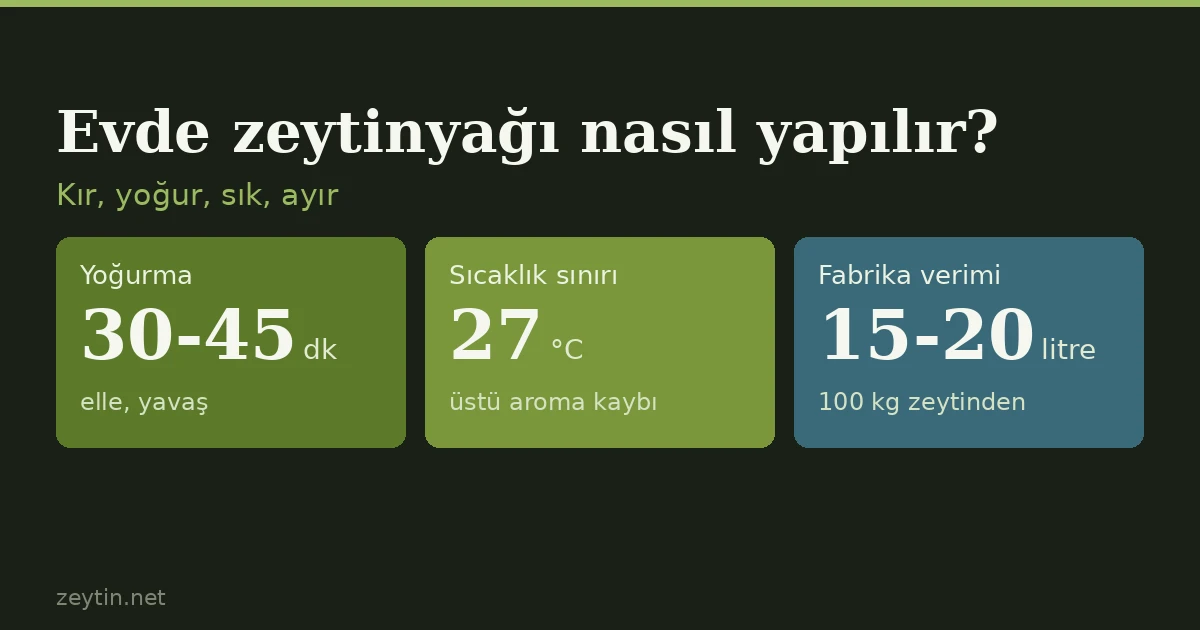
Pressing oil from a few kilos of olives at home is possible: the olives are crushed with their stones, the paste is kneaded, pressed and left until the oil separates from the water. But yield stays well below a mill's and quality is hard to protect. The steps, the equipment and the limits.
Article
How to make olive oil at home: crushing, kneading, separating and realistic expectations
Pressing oil from a few kilos of olives at home is possible: the olives are crushed with their stones, the paste is kneaded, pressed and left until the oil separates from the water. But yield stays well below a mill's and quality is hard to protect. The steps, the equipment and the limits.
 Article
Bayramiç Olive Oil: aroma compounds defined as percentages
Registered in 2022. The certificate defines aroma by compound rather than adjective: hexanal 36.15%, E-2-hexenal 26.14%. Iodine value 80-93.
Article
Bayramiç Olive Oil: aroma compounds defined as percentages
Registered in 2022. The certificate defines aroma by compound rather than adjective: hexanal 36.15%, E-2-hexenal 26.14%. Iodine value 80-93.
 Article
What does the colour of olive oil mean?
Dark green olive oil is widely assumed to be better, yet colour is not a criterion in any quality grade. The International Olive Council's official tasting glass must be dark enough that the colour of its contents cannot be seen — precisely so that the taster is not influenced by it. The chlorophylls and carotenoids that make the colour vary with cultivar, ripeness, leaf ratio and settling. Pigments do carry information in the laboratory as markers of freshness and heat treatment, but they cannot be read by looking at the bottle.
Article
What does the colour of olive oil mean?
Dark green olive oil is widely assumed to be better, yet colour is not a criterion in any quality grade. The International Olive Council's official tasting glass must be dark enough that the colour of its contents cannot be seen — precisely so that the taster is not influenced by it. The chlorophylls and carotenoids that make the colour vary with cultivar, ripeness, leaf ratio and settling. Pigments do carry information in the laboratory as markers of freshness and heat treatment, but they cannot be read by looking at the bottle.