The olive grove beside the factory: Bursa soils measured
43 PCB congeners measured in 7 Bursa olive groves: 5.82-18.71 ng/g against a 200 ng/g limit. No serious pollution — but the point near the steel works reads three times the rural one.
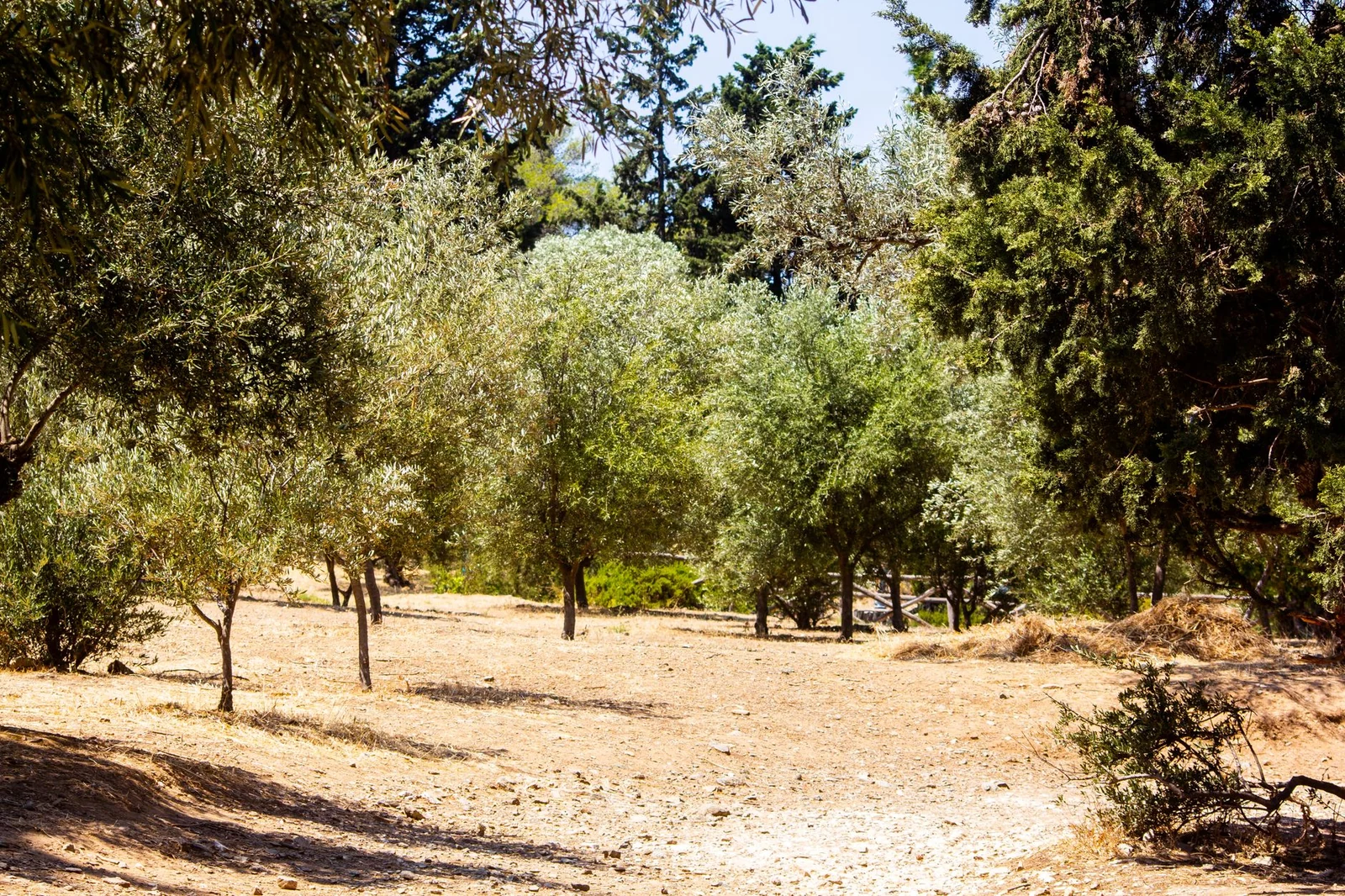
Olive groves are often right next to industry. Bursa is the classic case: dense industrial zones interleaved with some of Turkey's most important table-olive land.
Which raises a reasonable question: is the soil around an olive tree's roots affected by the factory next door?
A study from the Department of Environmental Engineering at Bursa Uludağ University measured exactly that. The answer has two layers — and the good news carries more weight.
What was measured: PCBs
Polychlorinated biphenyls (PCBs) are industrial chemicals once widely used in transformer oil, hydraulic fluids and insulation. Their production is banned, but they persist in the environment for a long time.
They matter particularly for olives because PCBs are lipophilic — they dissolve in fat. For a crop with high oil content, that raises the possibility of accumulation. Hence the question.
Where it was measured
In April, May and June 2016, soil samples were taken from seven olive groves of differing character around Bursa:
| Point | Category |
|---|---|
| Uludağ Campus - Apiary | rural |
| Uludağ Campus - Pond | semi-rural |
| Mudanya Kurşunlu | residential |
| Mudanya Yörükali | rural |
| Gemlik Campus | residential |
| Gemlik Atatepe | rural |
| Orhangazi Asilzade | industrial (close to iron and steel works) |
Samples were cleaned on a gel permeation chromatography column, and 43 separate PCB congeners were measured by gas chromatography with an electron capture detector.
The result: far below the limit
Across the seven areas, total PCB (∑43) concentrations ranged from 5.82 to 18.71 ng/g dry matter.
For comparison: under Turkey's Soil Pollution Control Regulation, the limit for exposure by soil ingestion and dermal contact — for all mixtures other than Aroclor 1016 — is 200 ng/g DM.
| Value | ng/g DM | Share of limit |
|---|---|---|
| Lowest (Mudanya Yörükali, rural) | 5.82 | 2.9% |
| Highest (Orhangazi Asilzade, industrial) | 18.71 | 9.4% |
| Regulatory limit | 200 | 100% |
So even at the most polluted point, the measured value is under a tenth of the limit.
The study's conclusion is unambiguous: there is no serious PCB-derived soil pollution in Bursa's olive groves in the spring season.
Note: The source's English abstract gives the limit as 500 ng/g DM, while its Turkish text gives 200 ng/g DM for the relevant exposure route. The lower, more detailed — and therefore more cautious — figure is used here; under either, the measured values fall far below the limit.
The second layer: industry does make a difference
"No serious pollution" is not the same as "no difference at all". The second thing the data shows is this:
t; PCB pollution is higher in industrial areas than in rural ones.
And that was no one-off. The Orhangazi Asilzade point — in the iron and steel district — returned the highest concentration in all three months.
The highest-reading points by month:
| Month | Highest points |
|---|---|
| April | Orhangazi Asilzade · Uludağ Pond |
| May | Orhangazi Asilzade · Gemlik Campus |
| June | Orhangazi Asilzade · Mudanya Kurşunlu |
The study points to the likely source: iron and steel plants and industrial activity.
At the other end, the value at rural Mudanya Yörükali (5.82 ng/g) came out close to levels measured in a rural area in England. A Bursa olive grove away from pollution sources sits at the same level as European countryside.
Where Bursa sits
The results were also set against other measurements:
- Lower than concentrations measured in İzmir Aliağa and in Nepal
- Comparable to earlier PAH measurements at the same points (5-13.9 ng/g DM)
- Within the range reported in the literature
So despite sitting in an industrially dense province, Bursa's olive groves are not an outlier internationally.
The temperature link: not what was expected
One hypothesis tested was a relationship between soil temperature and pollution. Temperatures rose from April to June, but:
t; No relationship was found between soil temperature and PCB concentration (R = 0.054, p > 0.05).
One detail did stand out: in June, as temperatures rose, the concentration of the lighter PCB congeners fell. The likely cause was judged to be evaporation of light PCBs from soil into the air.
That is not pollution disappearing — it is pollution moving. What leaves the soil enters the atmosphere.
The dominant homologue group across all three months was penta-chlorobiphenyl (5CB).
What this data is good for
Three practical conclusions:
1. A concrete answer to a real worry. "Can you eat oil from olives grown in an industrial zone?" is not an emotional question but a measurable one. In Bursa it was measured, and soil values came in far below the regulatory limit.
2. Location matters. Being below the limit does not make all sites equal. The point near the iron and steel works returned more than three times the rural figure. When establishing a new grove, distance from pollution sources is the second thing to check after soil analysis.
3. The season shapes the measurement. This study covers spring only. An earlier study of Bursa soils found PCB pollution higher in summer and autumn, lower in winter and spring. Spring may therefore be the most favourable window — this result should not be read as covering the whole year.
Summary
- 43 PCB congeners measured in 7 Bursa olive groves (April-June 2016)
- Values of 5.82 - 18.71 ng/g DM against a regulatory limit of 200 ng/g DM
- No serious PCB pollution found
- But the industrial area is clearly higher than rural ones; iron and steel plants a likely source
- The rural point matches levels in the English countryside
- No correlation with soil temperature; lighter congeners fell in June through evaporation
- The study covers spring only — summer and autumn may run higher
Related: soil quality in Kilis olive groves · olive mill waste water and pomace · olive growing in Marmara
Sources
- Erkul, Ş.N. & Eker Şanlı, G. (2020) — Determination of polychlorinated biphenyl (PCB) concentrations of olive groves in spring season, Journal of the Faculty of Engineering and Architecture of Gazi University 35(2): 1003-1014
- Soil Pollution Control Regulation — Official Gazette no. 27605, 08.06.2010
- Eker (2015) — PAH measurements in Bursa soils
- Comparative measurements: İzmir Aliağa, Nepal, rural England studies
One rating per visitor; you can change yours at any time. Ratings are real reader votes — no seeded or default scores.
Related
 Article
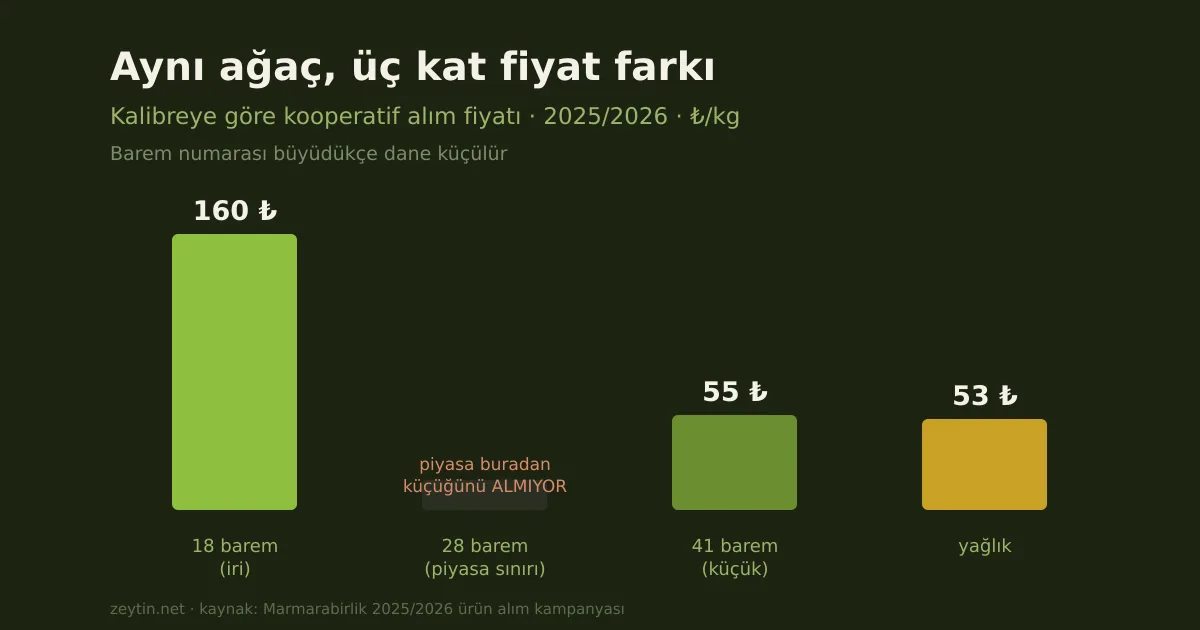
The economics of caliber: how fruit size triples the price
160 TL at caliber 18, 55 TL at caliber 41. Fruit size is price — and the cooperative pays 16% above the exchange average.
Article
The economics of caliber: how fruit size triples the price
160 TL at caliber 18, 55 TL at caliber 41. Fruit size is price — and the cooperative pays 16% above the exchange average.
 Article
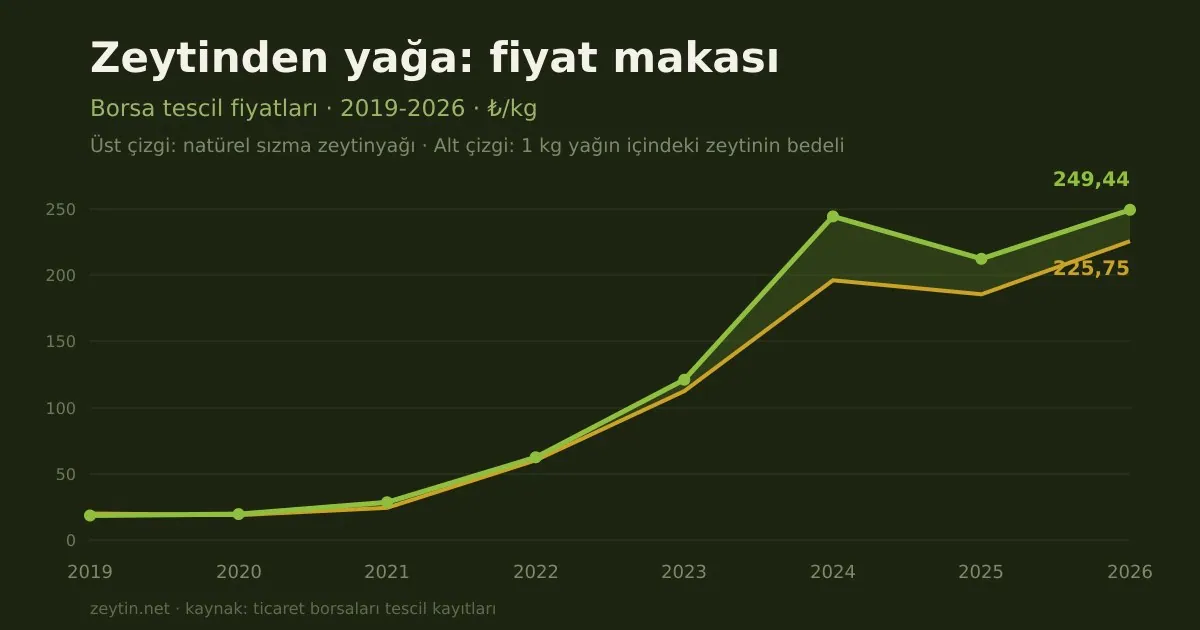
From olive to oil: the price gap, 2019-2026
The gap between a kilo of olives and a kilo of oil, measured from exchange registrations. Why it widens, and who gains.
Article
From olive to oil: the price gap, 2019-2026
The gap between a kilo of olives and a kilo of oil, measured from exchange registrations. Why it widens, and who gains.
 Article
Structural problems of Turkish olive growing
157 million trees but 5% of world output: low yield, old trees, harvest mechanisation, missing data, the support gap and informality.
Article
Structural problems of Turkish olive growing
157 million trees but 5% of world output: low yield, old trees, harvest mechanisation, missing data, the support gap and informality.
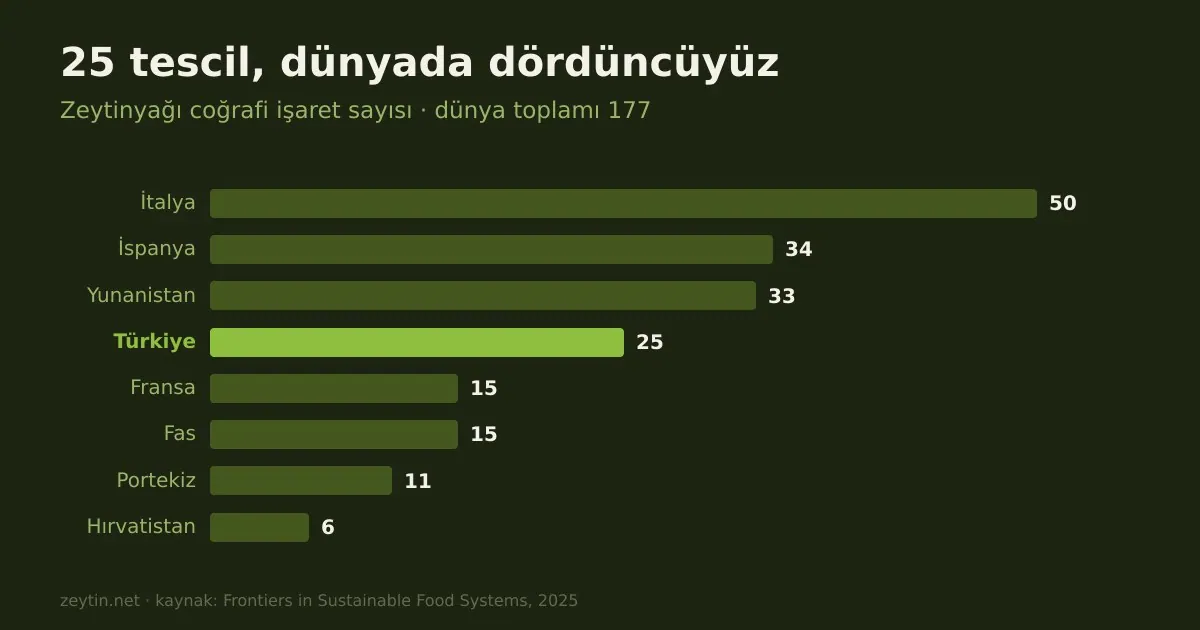 Article
Fourth in the world with 25 registrations — but what are they doing?
Türkiye is fourth in the world with 25 olive oil GIs. Yet exports fetch $3.17/kg — the product is still priced as a commodity.
Article
Fourth in the world with 25 registrations — but what are they doing?
Türkiye is fourth in the world with 25 olive oil GIs. Yet exports fetch $3.17/kg — the product is still priced as a commodity.