Olive oil exports still down 62% at the end of August: bulk loses 73%
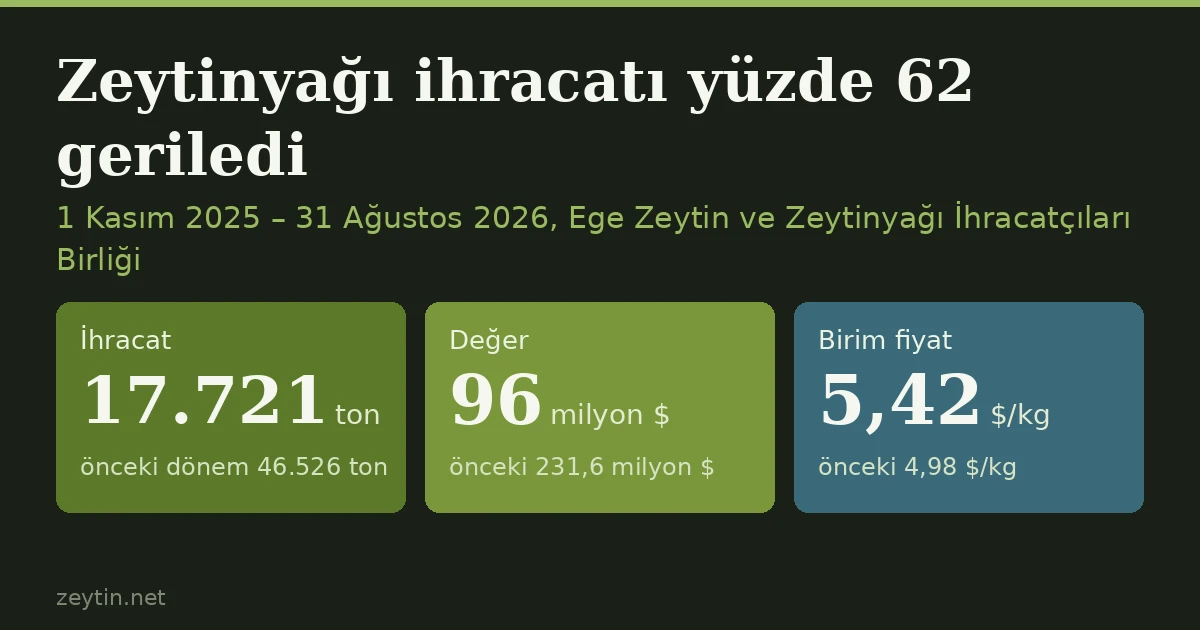
According to the Aegean Olive and Olive Oil Exporters' Association, olive oil exports between 1 November 2025 and 31 August 2026 fell 62% in volume and 59% in value. Bulk sales lost 73%, the US market 70%. Table olives, by contrast, held their ground.
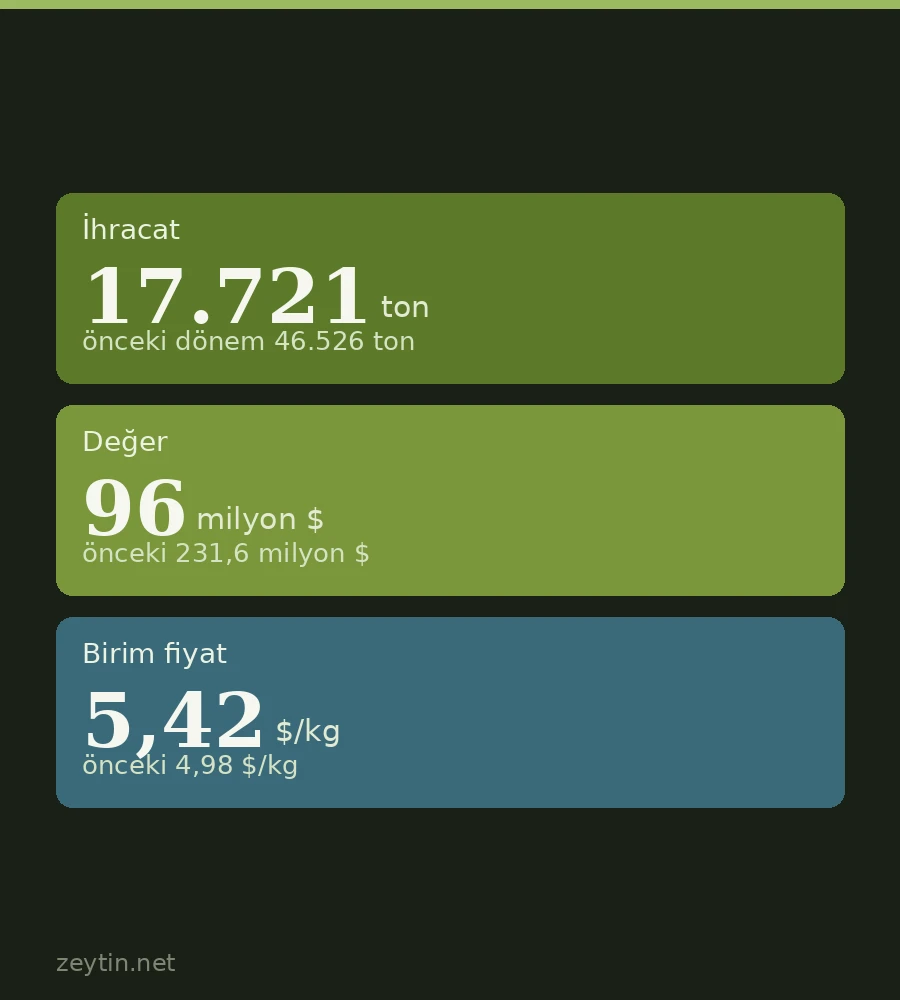
When we looked at the 1 November – 31 May data in early September, Turkish olive oil exports were down 62% by value. Three more months have passed and the picture has not recovered. Data from the Aegean Olive and Olive Oil Exporters' Association for 1 November 2025 – 31 August 2026 covers almost the entire season and shows the decline is not a blip. The figures were made public by Muğla MP Metin Ergun; their source is the association's own records.
The figures
| Olive oil exports | 2024/25 | 2025/26 | Change |
|---|---|---|---|
| Volume | 46,526 t | 17,721 t | −62% |
| Value | $231.6 million | $96 million | −59% |
| Average unit price | $4.98/kg | $5.42/kg | +8.8% |
Both columns cover 1 November to 31 August. From the start of the season to the end of August, Türkiye sold only a little over a third of the olive oil it had sold in the same months a year earlier.
Why did the unit price rise?
The third row looks contradictory at first: volume fell by more than half, yet the average price per kilogram rose from $4.98 to $5.42. There are two explanations, and both point the same way.
The first is product mix. The heaviest losses came in the cheapest line, bulk oil. Bulk exports lost 73% of their volume; packaged exports lost around 50%. When packaged oil, which sells for more per tonne, becomes a larger share of the total, the average price rises by itself. The second is that domestic prices stayed above world prices: exporters who cannot sell cheaply lose volume.
So the higher unit price is not a sign of strength. It describes a product that can only be sold in smaller quantities at higher prices. We looked at profitability in olive oil exports in detail earlier.
The biggest loss is in the US
Broken down by market, the sharpest fall is in the United States, Türkiye's largest olive oil buyer:
| Market | Previous season | This season |
|---|---|---|
| US — volume | 20,000 t | 6,000 t |
| US — value | $89.5 million | $26.8 million |
| EU — value | $30 million | $7 million |
Sales to the US fell by roughly 70% in both volume and value. The 12.5% additional tariff the US applies to Turkish olive oil is decisive here; some competing producers are exempt, which leaves Turkish exporters at a price disadvantage. We compared the competitors in our piece on the US tariff.
Table olives hold their ground
Table olive exports followed a much steadier path over the same period:
| Table olive exports | Previous season | This season |
|---|---|---|
| Volume | 92,500 t | 82,400 t |
| Value | $234 million | $222 million |
That is a fall of about 11% in volume and 5% in value. The gap shows how differently the two halves of the sector behave. Table olive exports now earn more than twice as much as olive oil. When we wrote that two-thirds of exports come from table olives, the gap was narrower; it has widened since.
Where are domestic prices?
What exporters mean when they say they "cannot sell cheaply" is visible in exchange records. Registered average prices for natural extra virgin olive oil on the Edremit Commodity Exchange at the end of August and start of September were:
| Registration day | Average TL/kg |
|---|---|
| 20 August 2026 | 290.00 |
| 24 August 2026 | 300.00 |
| 25 August 2026 | 254.33 |
| 3 September 2026 | 268.47 |
Even before the harvest, when stocks are at their lowest, prices stayed in the 250-300 lira band. That level is above what a bulk buyer can pay for other origins on the world market. We explain how to read exchange prices in a separate guide; the point here is that bulk exports are unlikely to return until domestic prices come down.
What could the new season change?
The harvest has begun and industry representatives expect an "on" year, with olive oil output estimates in the range of 400,000-450,000 tonnes. A large crop means downward pressure on domestic prices. If prices fall, exporters become more competitive against world prices and part of the lost bulk volume could return.
That is not automatic, though. The US tariff remains in place, and winning back shelf space takes longer than losing it. That is why the demands in Ergun's statement are long-term ones: stable agricultural policy, support for producers, access to finance and a shift towards branded, packaged exports. We are also following the debate over a minimum price as the crop grows.
Read with care
⚠ The season is not over. The export season ends on 31 October; September and October figures may shift the percentages somewhat, but a 30,000-tonne gap is not expected to close in two months.
⚠ The previous season's volume appears as both 46,526 and 46,452 tonnes in different texts. The 74-tonne difference does not change the percentage; the table uses the first value released.
⚠ These are registered exports. Transit and sales through third countries can distort the destination breakdown, so the US and EU figures should be read as indicative.
One rating per visitor; you can change yours at any time. Ratings are real reader votes — no seeded or default scores.
Related
 Article
Adulterated olive oil costs more than the real thing: price is no longer a sign of authenticity
Diker, president of the Edremit Chamber of Agriculture, says adulterated oils sold online now exceed the wholesale price of genuine oil: wholesale starts at 240 lira, the fake sells above 300. Our exchange data complicates the picture — genuine extra virgin in Aydın is already 307.60 lira.
Article
Adulterated olive oil costs more than the real thing: price is no longer a sign of authenticity
Diker, president of the Edremit Chamber of Agriculture, says adulterated oils sold online now exceed the wholesale price of genuine oil: wholesale starts at 240 lira, the fake sells above 300. Our exchange data complicates the picture — genuine extra virgin in Aydın is already 307.60 lira.
 Article
"Not definitive until November": Andalusian growers push back on the crop estimate
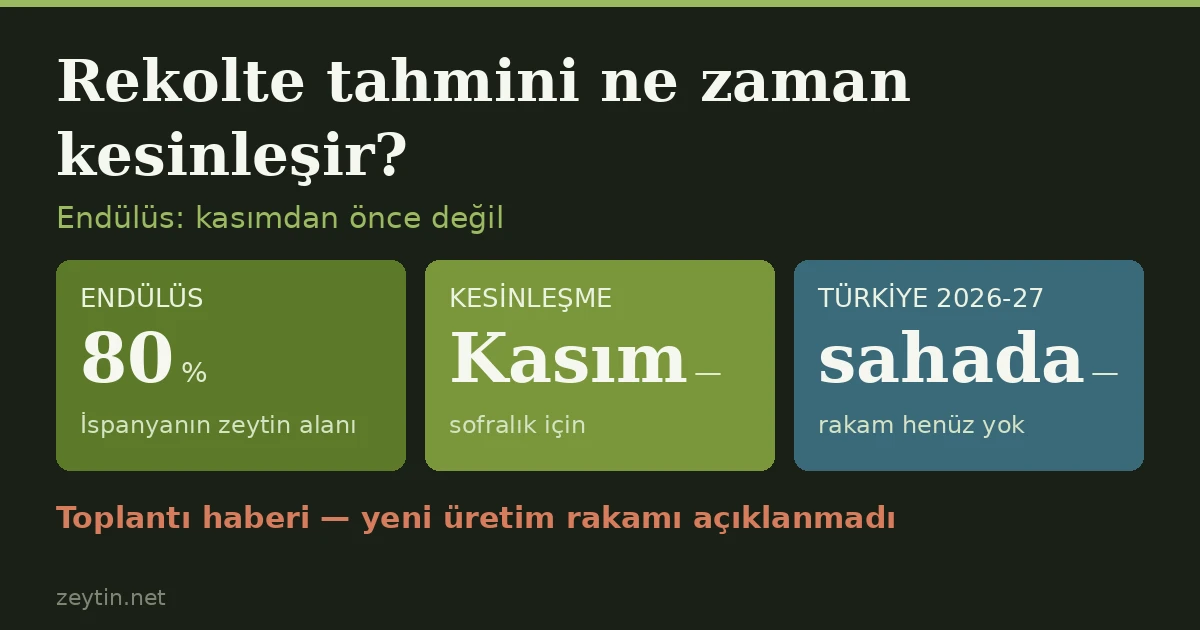
Andalusia's agriculture ministry called its first crop estimate "high production"; cooperatives and COAG in Seville objected: recent heat will affect the crop and the estimate is not definitive until November. Türkiye is making its 2026-27 estimate in the field the same week — the same caution applies here.
Article
"Not definitive until November": Andalusian growers push back on the crop estimate
Andalusia's agriculture ministry called its first crop estimate "high production"; cooperatives and COAG in Seville objected: recent heat will affect the crop and the estimate is not definitive until November. Türkiye is making its 2026-27 estimate in the field the same week — the same caution applies here.
 Article
The world's largest bottler is for sale: a €500 million race for Deoleo
Deoleo, owner of Bertolli and Carbonell, holds 22% of global bottled olive oil sales. Italy's Coricelli leads at €500 million, Spain's Dcoop cooperative at €470 million. The Spanish government regards the company as nationally strategic. Because Deoleo is a major bulk buyer, the outcome matters to Turkish exporters too.
Article
The world's largest bottler is for sale: a €500 million race for Deoleo
Deoleo, owner of Bertolli and Carbonell, holds 22% of global bottled olive oil sales. Italy's Coricelli leads at €500 million, Spain's Dcoop cooperative at €470 million. The Spanish government regards the company as nationally strategic. Because Deoleo is a major bulk buyer, the outcome matters to Turkish exporters too.
 Article
Algeria expects a record 150,000 tonnes: the Mediterranean supply map is shifting
Algeria's 2025/26 olive oil output is expected to exceed 150,000 tonnes — up 76% on the previous season and a third consecutive rise. With domestic consumption near 81,000 tonnes, an exportable surplus appears. In a season when Turkish exports fell 62% by value, that means new competition in the bulk market.
Article
Algeria expects a record 150,000 tonnes: the Mediterranean supply map is shifting
Algeria's 2025/26 olive oil output is expected to exceed 150,000 tonnes — up 76% on the previous season and a third consecutive rise. With domestic consumption near 81,000 tonnes, an exportable surplus appears. In a season when Turkish exports fell 62% by value, that means new competition in the bulk market.