Italy enters the new season with full tanks: 195,000 tonnes in stock, a 260,000-290,000 tonne crop expected
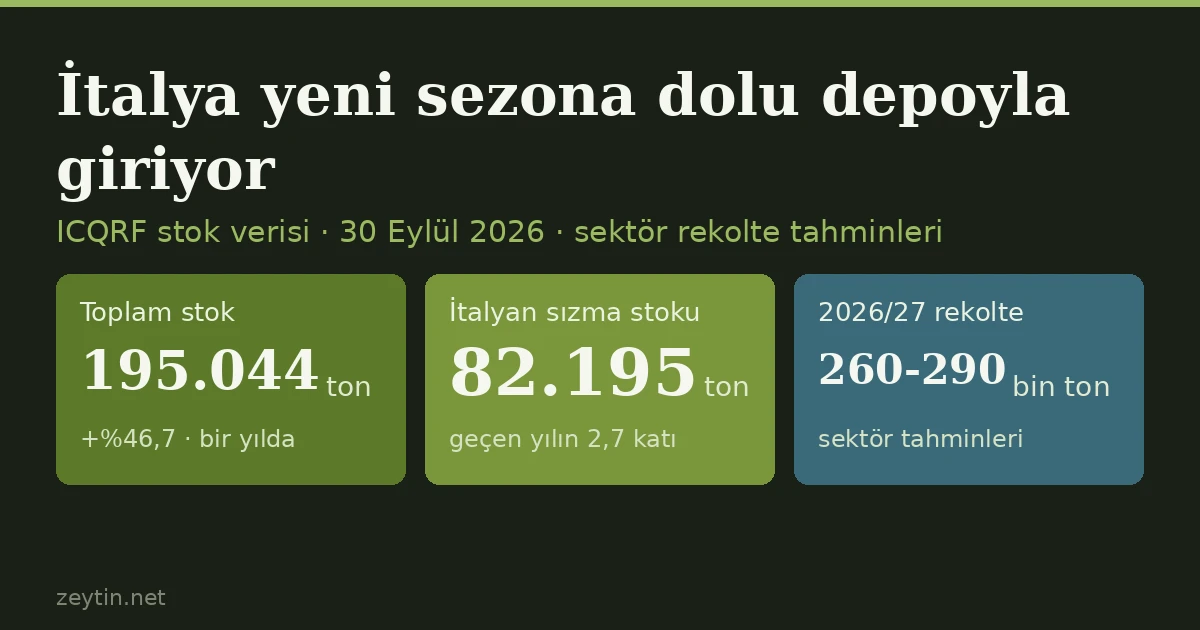
ICQRF's Frantoio Italia register shows 195,044 tonnes of olive oil in Italian storage on 30 September 2026, up 46.7% in a year; Italian extra virgin stocks of 82,195 tonnes are 2.7 times last year's. Sector estimates put the 2026/27 crop at 260,000-290,000 tonnes, 11-20% below Ismea's 325,000. With stocks added, though, the supply of Italian oil is not shrinking: in the European Commission series Italian extra virgin fell from €9.26 to €4.37 a kilo in a year, and the gap with Spain narrowed from €5 to €1.
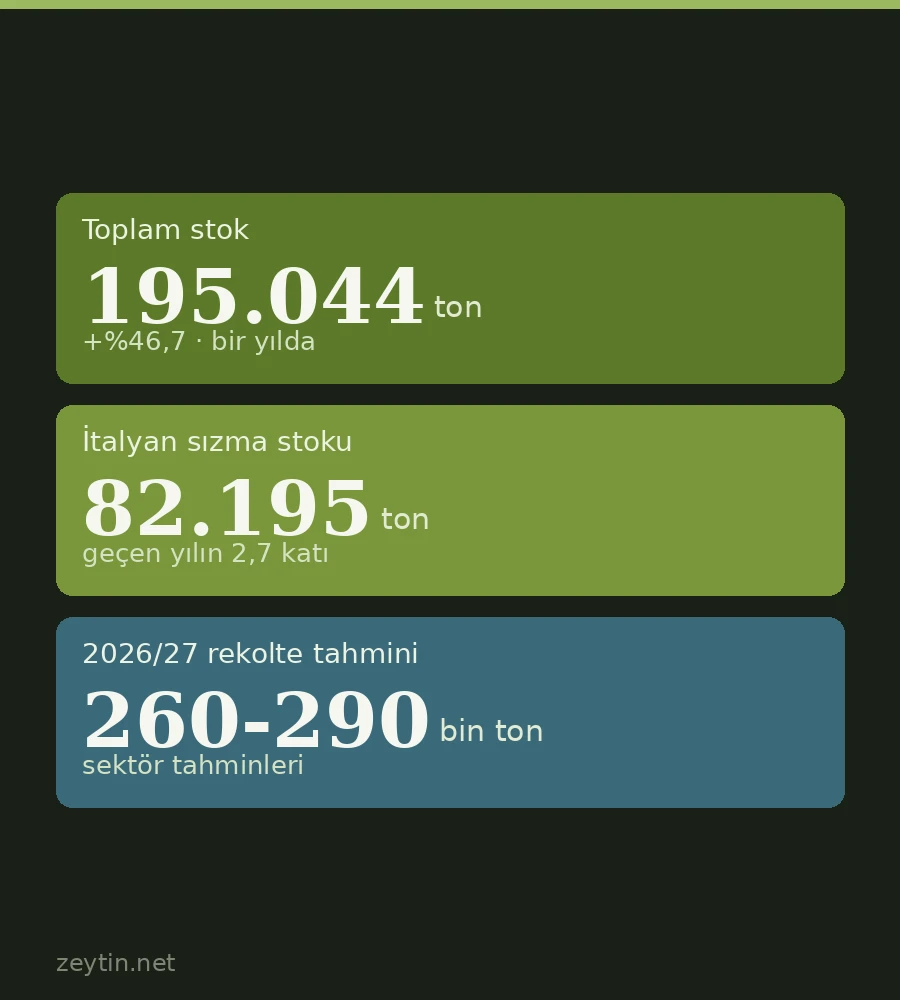
Italy is heading into the 2026/27 harvest with full tanks. According to "Frantoio Italia", the olive oil register run by ICQRF, the food fraud and quality inspectorate of the Italian agriculture ministry, Italian storage held 195,044 tonnes of olive oil on 30 September 2026. That is 46.7% more than on the same day a year earlier. The real jump is in Italian-origin extra virgin oil: 82,195 tonnes, 2.7 times last year's 30,381 tonnes.
At the same time, the first crop estimates coming out of the sector point the other way. Italy is expected to produce somewhere around 260,000 to 290,000 tonnes of oil in the new season. Production is falling, then, but the amount of oil on the market is not, and prices are behaving accordingly.
What is in storage
| Item | Tonnes | Year on year |
|---|---|---|
| Total olive oil stocks | 195,044 | +46.7% |
| of which extra virgin | 150,203 | +66.9% |
| Italian-origin extra virgin | 82,195 | +170.5% |
| EU-origin extra virgin | 52,600 | — |
| Non-EU-origin extra virgin | 5,418 | — |
Extra virgin oil makes up 77% of the total; Italian extra virgin alone is 42.1% of everything in storage. Last September the picture was the reverse. EU-origin extra virgin in Italian tanks (50,258 tonnes) had overtaken the domestic oil, the first time foreign oil had outweighed Italian oil in the national stock. This year the imported line has barely moved, while the domestic one has nearly tripled.
The stock did come down over the summer, but slowly. On 31 July total stocks stood at 233,377 tonnes and Italian extra virgin at 108,299 tonnes. Over the two months to the end of September the total fell by 16.4% and Italian extra virgin by 26,104 tonnes (24.1%). Even so, the domestic extra virgin left at the end of September is more than double the 40,213 tonnes recorded on the same date in 2024.
Six Septembers side by side
| Year | Total stocks | Italian extra virgin |
|---|---|---|
| 2021 | 210,595 | 64,855 |
| 2022 | 215,327 | 87,183 |
| 2023 | 153,970 | ~38,000 |
| 2024 | 109,081 | 40,213 |
| 2025 | 132,951 | 30,381 |
| 2026 | 195,044 | 82,195 |
The total is not a record; it was higher in both 2021 and 2022. What has changed is that domestic extra virgin, which almost disappeared during the drought years of 2023 and 2024, is back at roughly its 2022 level. More than half of the oil is held in the south, and Puglia alone accounts for close to a third of the national total. Tuscany and Umbria, which are not large producers of bulk oil, also hold significant volumes because that is where much of Italy's bottling and branding takes place.
The crop forecast: lower, but not one voice
There is no official national harvest estimate yet. Two sector estimates are in circulation:
- A joint estimate by the business daily ItaliaOggi and the trade publication Teatro Naturale, published on 23 September: 260,000 tonnes. The losses are in the south, with Puglia and Sicily down 30% and Calabria down 40%. Central Italy recovers without a real rebound, and Liguria nearly triples its output to 3,500 tonnes. The gains in the centre and north do not make up for the south.
- An estimate by Massimo Ragno, panel leader and purchasing manager at the bottler Monini, based on field surveys and contacts with growers and millers across the regions: 270,000 to 290,000 tonnes, with Puglia at 130,000 to 140,000 tonnes.
Even the baseline is disputed. Ismea, the public agricultural market agency, puts 2025/26 production at 325,000 tonnes; data from SIAN, the national agricultural information system, updated to 31 July, show 299,864 tonnes. Measured against the Ismea figure, the new-season estimates imply a fall of 11% to 20%.
Why the drop? 2026/27 is an "off" year. Olive trees tend to follow a heavy crop with a light one, the cycle we describe in our piece on alternate bearing. On top of that, drought in unirrigated groves and slow oil accumulation in the fruit, reported by mills and cooperatives, point to lower oil yields than last year. The one bright spot is the olive fruit fly, which has been largely absent in the summer heat.
Supply is not falling, prices are
A rough sum makes the point. Around 82,000 tonnes of domestic extra virgin in storage at the end of September plus a 260,000 to 290,000 tonne harvest gives somewhere around 340,000 to 370,000 tonnes of Italian oil for the season. The same sum last year, 30,000 tonnes of stock plus a harvest of 300,000 to 325,000 tonnes, came to about 330,000 to 355,000 tonnes. In other words, the harvest is smaller, but the supply of Italian oil is not.
Prices reflect it. The European Commission's weekly producer price series, which we follow in our Turkey–Europe price comparison, shows:
| Week | Italy | Spain | Gap |
|---|---|---|---|
| 12 October 2025 | 9.26 | 4.25 | 5.01 |
| 11 October 2026 | 4.37 | 3.32 | 1.05 |
| Change | −52.8% | −22.0% |
Italian extra virgin has lost more than half its value in a year, and a further 8% in the last three weeks of the series, from €4.75 to €4.37. The gap with Spain has narrowed from €5 a kilo to about €1. The premium that the "Italian" label used to command has almost closed. On the ground, that shows up as the growers' protests in Puglia and Sicily and the government's zero-interest loan line for mills. It is also the backdrop to the ministry's draft electronic accompanying document for olives and oil, which growers had demanded to stop "paper oil" from depressing the market.
The sector's worry is now as much financial as commercial. If mills and bottlers are still carrying last season's oil when new olives arrive, they need cash and tank space to take in the new crop; without them, growers can find themselves with fruit and nowhere to sell it. Italian trade commentators have compared the situation with 2021, when stocks were similar and the market eventually absorbed them.
The view from Turkey
The signals from Europe's two largest producers point the same way. Spain, with an official estimate of 1.6 million tonnes, is debating whether to withdraw part of its oil from the market, a plan its competition authority has warned against. In Italy, a smaller crop is not enough to empty full tanks. When domestic oil is plentiful, Italian bottlers may need less imported oil, which would mean a narrower market for countries that sell bulk oil to Italy.
One note on prices. The extra virgin registration at the Edremit commodity exchange on 20 October was 301.74 lira a kilo, about €5.43 at the ECB reference rate. That is a single registered trade, not an average, and not the same measure as the Commission's weekly producer series. Still, with Italian producer prices at €4.37 in the same weeks, it suggests how hard it may be for Turkish oil to compete on price abroad this season.
The next data point to watch is ICQRF's next Frantoio Italia report, the first to show new-season oil entering the register.
One rating per visitor; you can change yours at any time. Ratings are real reader votes — no seeded or default scores.
Related
 Article
Italy from production giant to trade hub: it exports more olive oil than it produces
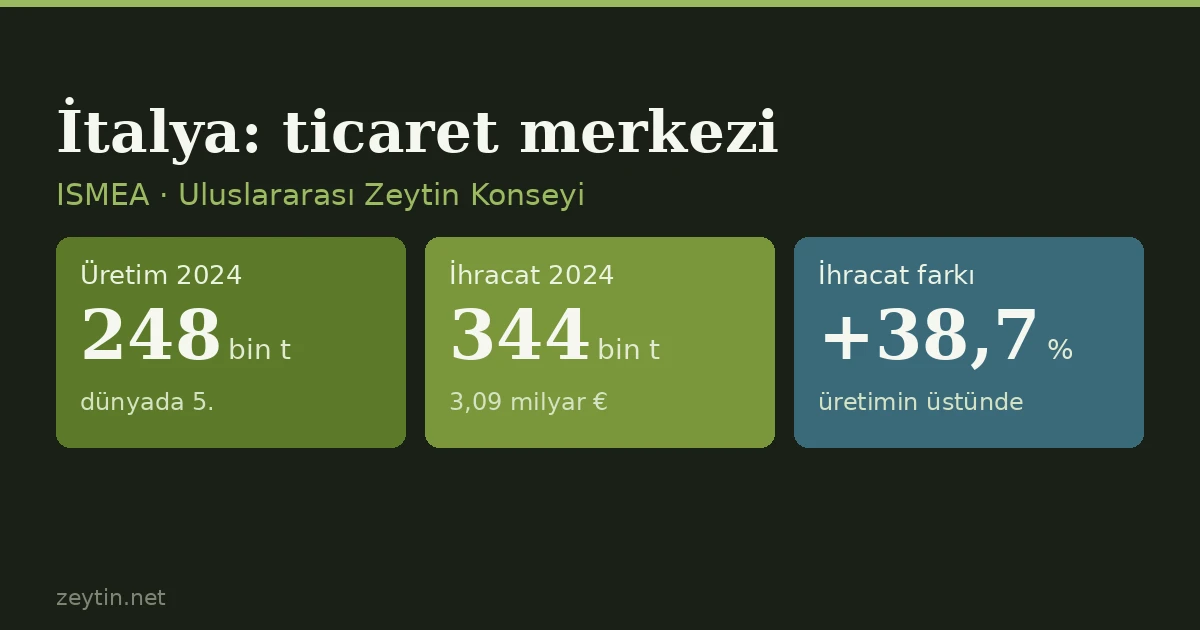
Italy produced 248,000 tonnes of olive oil in 2024 and slipped to fifth place worldwide, yet in the same year it exported 344,000 tonnes worth 3.09 billion euros. The country is now less a production giant than a trade hub that buys oil around the Mediterranean, blends it and sells it to the world.
 Article
A 282-member doctors' cooperative puts sensors in the olive grove
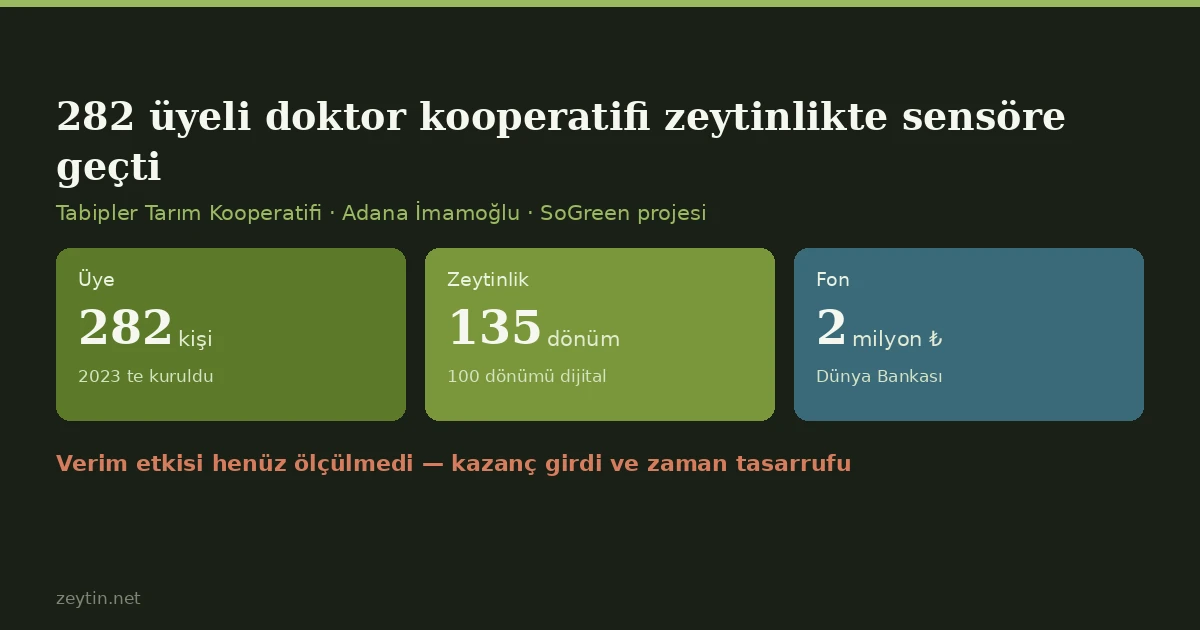
A cooperative founded by doctors in Adana is monitoring water and fertiliser with buried sensors across 100 of its 135 dönüm of bearing olive grove, funded with 2 million lira.
 Article
Palestinian olive oil: output down from 33,000 to 7,000 tonnes — the cause is access, not the crop
In a productive season Palestine yields 33,000 tonnes of olive oil; last season it produced 7,000. Seventy per cent of the groves sit in the northern West Bank, reached through 62 agricultural gates, and shipping times have gone from ten days to two months.
 Article
Italy's protest widens: thousands of growers in Bari, mills idle in Sicily, still no crisis status
The deadline given in Puglia expired without crisis status being granted: on 12 October thousands of growers gathered in front of the Bari prefecture, hundreds of tractors blocked roads on the Gargano, and harvesting and milling have been suspended since 5 October across nine municipalities in Sicily. Two of the four demands concern anti-fraud controls and an electronic transport document for olives. In the European Commission series, Italian extra virgin stood at 4.64 €/kg in the week of 4 October; the figure quoted in the field is 4 euros, against 9.20 € last November. The next threshold is 15 October.