The Gemlik Olive designation of origin: what the certificate says
Turkey's first registered olive (2005, no 76). The certificate defines four districts, three cultivars, four curing methods and seven size grades — all of them binding.
Not every packet marked "Gemlik olive" looks like it promises the same thing — but it does. Gemlik Olive has been registered as a designation of origin since 2005, and the certificate sets out, line by line, the conditions for using the name.
This article reads that certificate. What follows is not interpretation but binding provision.
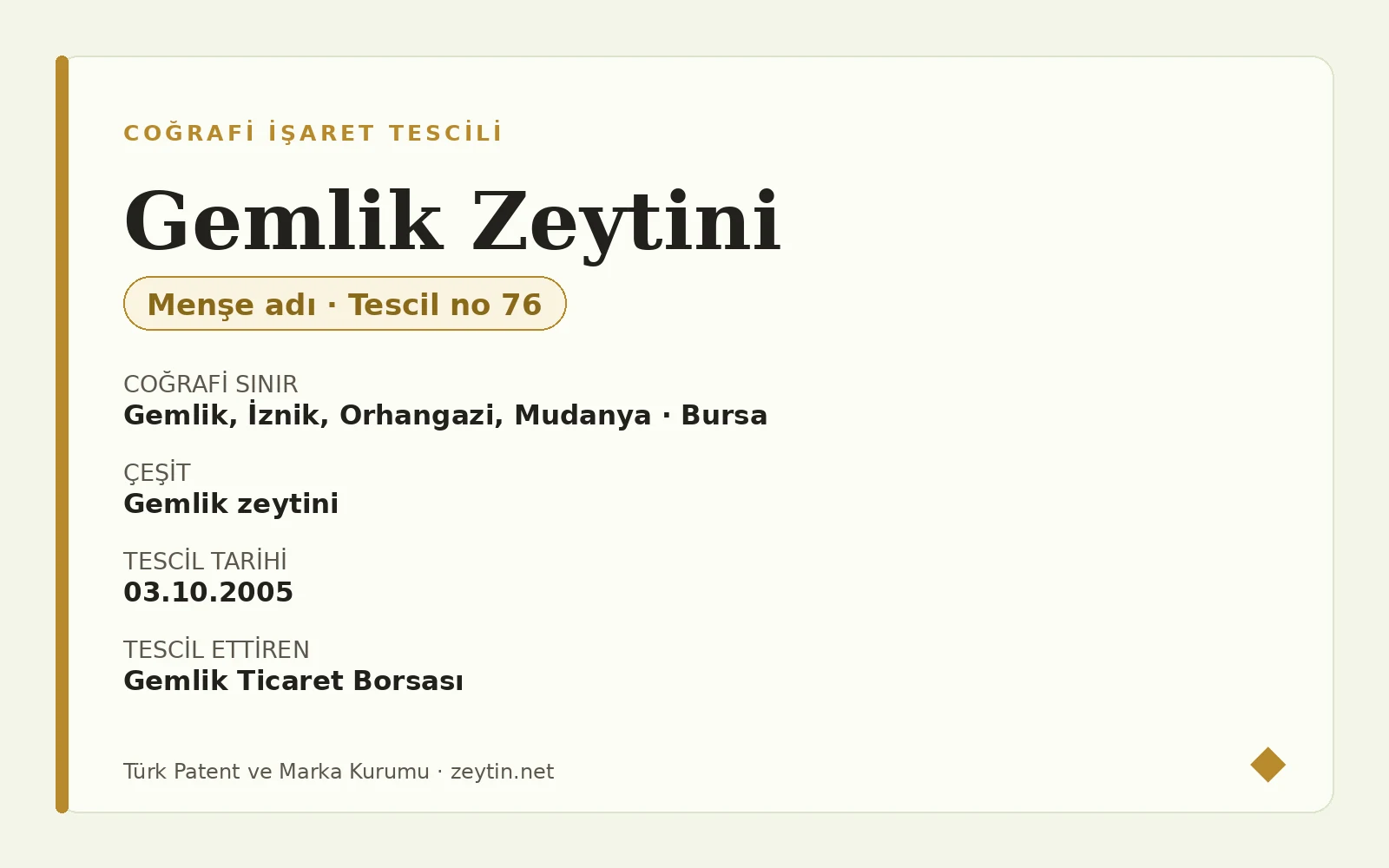
The record
| Registration no | 76 |
| Registration date | 03.10.2005 |
| Application | C2003/008 · 05.03.2003 |
| Type | Designation of origin |
| Registered by | Gemlik Chamber of Commerce |
| Geographical area | The Gemlik, İznik, Orhangazi and Mudanya districts of Bursa |
The date matters: 2005 makes this one of Turkey's earliest olive registrations. We looked at what geographical indication registrations actually do separately.
A common misconception: the area covers four districts
The name "Gemlik olive" does not belong to the Gemlik district alone. The certificate's boundary takes in four districts: Gemlik, İznik, Orhangazi and Mudanya.
The certificate explains why. The sheltered bays of Gemlik and Mudanya, and the proximity of Orhangazi and İznik to the gulf and their position around the lake, produce a comparable microclimate. The boundary is climatic rather than administrative.
Three cultivars, one name
The certificate also fixes which plant the name may come from: the Gemlik, Gemlik 21 and Gemlik 27 cultivars of Olea europaea. "Gemlik" is not a single clone but a group of three recognised in the registration. For the cultivar's own measured values: the Gemlik olive.
Four curing methods
The certificate recognises four methods and binds the naming to them:
| Method | How | Called |
|---|---|---|
| Brine | water + sea salt, pressed with granite | salamura |
| Basket | sea or rock salt | sele |
| Dry basket | salt only | kuru sele |
| Oiled basket | salt + corn or sunflower oil | yağlı sele |
⚠ A critical provision: Gemlik Olive undergoes no alkali treatment. It is naturally fermented. Debittering with caustic soda, common with green olives, is prohibited under this registration. We covered home curing methods separately.
Measurable limits
The certificate does not say "should be of good quality" — it gives numbers:
| Criterion | Limit |
|---|---|
| Flesh-to-stone ratio | 6:1 – 7:1 |
| Fruit size | at most 410 fruits/kg |
| Oil content | 28-35% |
| Salt (in the brine) | at most 12% |
| Salt (in the fruit, brined) | at most 8% |
| Salt (dry and oiled basket) | at most 4% |
| Firmness of the cured fruit | 8-12 kg/cm² |
| Organic foreign matter | at most 3 pieces per kg |
On smell and taste there is a single rule: no foreign odour and no fermented taste.
Calibre: what the letters on the packet mean
This is the certificate's most practical section. The olive is graded into seven classes by the number of fruits to the kilogram:
| Class | Fruits/kg |
|---|---|
| XL | 201-230 |
| L | 231-260 |
| M | 261-290 |
| S | 291-320 |
| XS | 321-350 |
| 2XS | 351-380 |
| 3XS | 381-410 |
So the XL you see in the shop is not a marketing adjective but a range defined by the registration. The smaller the number, the larger the fruit. We worked through the effect of fruit size on price elsewhere.
Where the distinctiveness comes from
The certificate traces the flavour to climate and soil, and gives figures:
Temperature. Average minimum 5.8 °C in January and 6.8 °C in February — suitable for the plant's chilling requirement. In May, the flowering month, the average minimum is 16.9 °C, and during fruit ripening 21.1 °C.
A transitional climate means lower temperatures during the growth phase, and according to the certificate this is why the skin is thin and adheres tightly to the flesh. If you do not feel the skin when eating a Gemlik olive, that is the reason.
Altitude and terpenes. The mean elevation of the area is 112 metres. At that height the levels of cyclogeraniol, which carries a grassy, sweet aroma, and (E,E)-α-farnesene, which carries a woody one, are higher than in warmer regions. The certificate quantifies it: a difference of roughly 4-5 ppm in terpene content between regions.
Rainfall. The roughly 61.8 mm falling in April affects yield, while September's 43.7 mm affects fruit size and oil content.
Soil. About 63% clay loam, 20% loam and 17% clay. That structure holds water and lets the roots go deeper.
The rule on use
The name, logo and designation-of-origin emblem, together with a hologram carrying a QR code, must appear on the product itself or its packaging. Where the product is sold unpackaged, those marks must be displayed visibly on the premises.
So the registration mark can be looked for even at a loose-weight counter.
In short
The name Gemlik Olive is given to three cultivars grown across four districts, cured without alkali by one of four defined methods, and meeting eight separate criteria. None of it is advice; all of it is the condition for using the name.
The production steps in the document
The registration describes production step by step. The document's own sequence:
1. Dikim — Fidanların dikimi arazinin eğimine göre değişir.
2. Gübreleme — Çiftlik gübresi 2 yılda bir, ağaç başına 5-6 kg şeklinde uygulanmalıdır.
3. Kimyasal gübreleme için 15 — 15:15 azot (N), fosfor (P) ve potasyum (K) şubat-mart aylarında 1,5-2 kg/ağaç şeklinde uygulanmalıdır.
4. Sulama — Sulama işlemi, genellikle 15 Temmuz’dan sonra başlar ve ağacın ihtiyacına göre su verilir.
5. Budama — Sahil kesiminde ocak-şubat aylarında budama yapılır, daha yüksek bölgelerde mart-nisan aylarında yapılabilir.
6. Hastalık ve zararlılarla mücadele — Yalnızca kullanımına izin verilen ruhsatlı ilaçlar kullanılır.
7. Hasat — Zeytin hasadı, ağaçtaki zeytin meyveleri koyu kahverengi ya da siyah renge döndüğünde ekim ayının sonlarında veya kasım ayının başında başlar ve aralık ayının sonlarında sona erer.
8. İşleme — Zeytinler, salamura ve sele olmak üzere iki farklı işleme şekline tabi tutulur.
That this sequence is binding is what separates a geographical indication from a trade mark: a mark says who produced something, a geographical indication also sets down how it must be produced.
The cultivar behind it, measured
The registration is granted to a place, but the cultivar the definition rests on has measurable values:
| Property | Value |
|---|---|
| Meyve ağırlığı | ≈ 3,7 g |
| 1 kg’daki tane sayısı | 270 |
| Et oranı | %85 |
| Et / çekirdek oranı | 6,4 |
| Et/çekirdek oranı | 6,14 |
| Yağ oranı | %29-30 |
| Toplam fenol | 244-491 mg CAE/kg |
| α-tokoferol | 207-261 mg/kg |
| Hasat | Kasım-Ocak |
| Olgunlaşma | Ekim ortası - sonu |
| Kendine verimlilik | Kısmi — tozlayıcıları Ayvalık, Edincik Su, Şam, Samanlı |
| Periyodisite eğilimi | Düşük |
| Soğuğa uyum | Yüksek |
| Kuraklık | Duyarlı |
| Kullanım | Siyah sofralık ve yağlık |
Oil content reaches 30% at the top of its range — on its own enough to justify pressing. The cultivar is partially self-fertile; pollinators are used to secure yield. Alternate bearing is low: the year-to-year swing in yield is smaller than is usual in olives. A flesh-to-stone ratio of 6.4 is the basic measure of how much of a table olive is actually eaten.
Its place in Bursa's olive production
| Item | Value |
|---|---|
| Fruit production | 280,720 t |
| — for oil | 110,229 t |
| — for the table | 170,491 t |
| Olive oil production | 25,127 t |
| Trees | 11,833 thousand |
| Yield per tree | 23.7 kg |
61% of the province's fruit is table fruit — the registration runs with the grain of the province.
One rating per visitor; you can change yours at any time. Ratings are real reader votes — no seeded or default scores.
Related
 Article
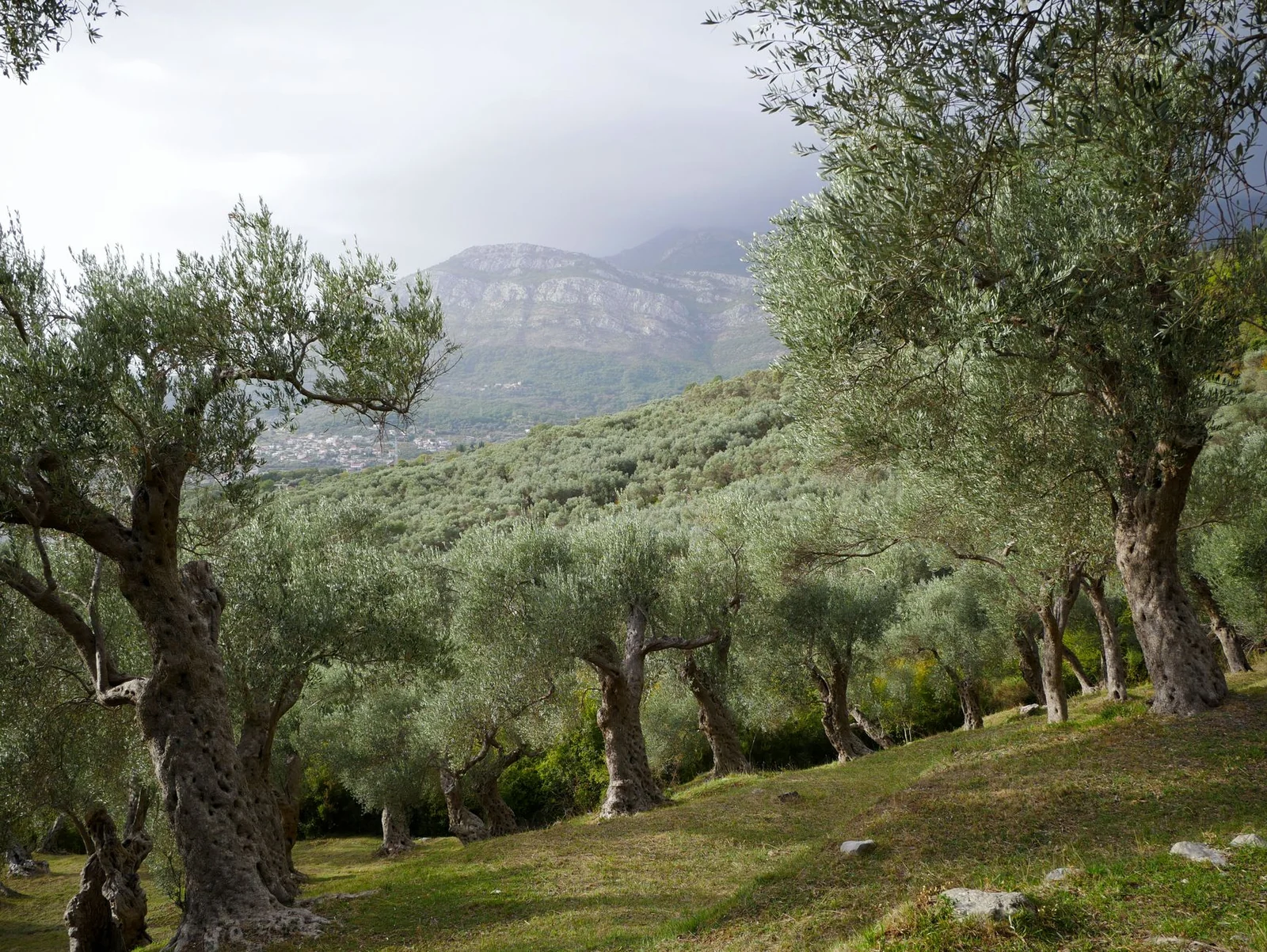
Table Olive Varieties
From Gemlik to Kalamata, Manzanilla to Castelvetrano: the world's best-known table olives and what each is good for.
Article
Table Olive Varieties
From Gemlik to Kalamata, Manzanilla to Castelvetrano: the world's best-known table olives and what each is good for.
 Article
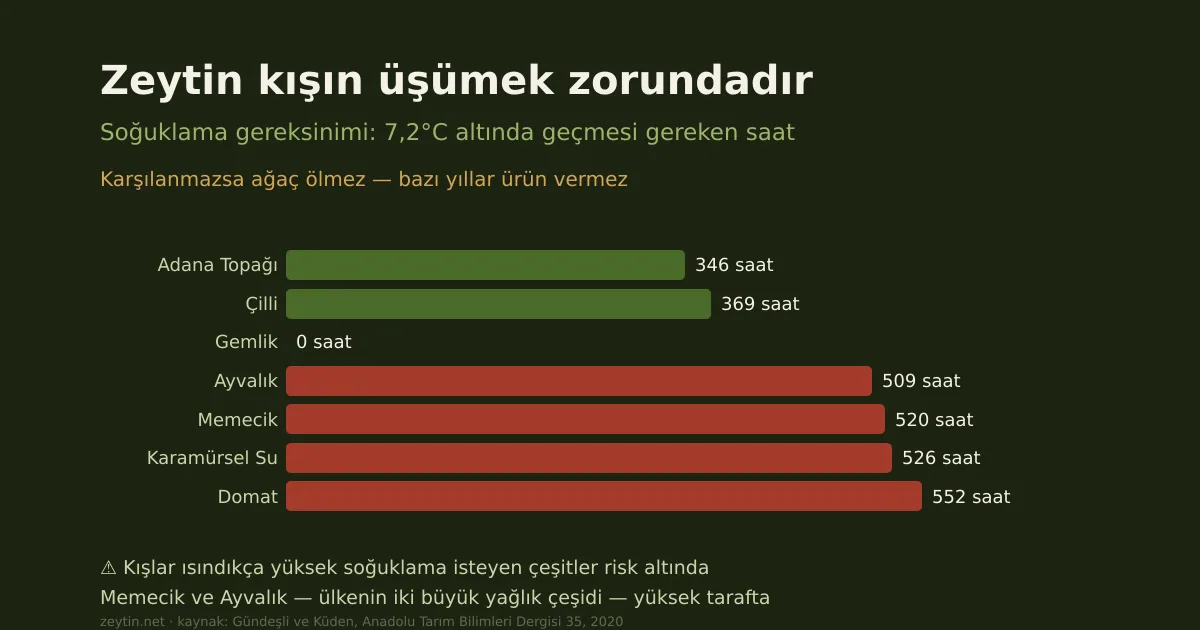
Chilling requirement in olives: which variety grows where?
The olive must spend time below 7.2°C in winter. Adana Topağı needs 346 hours, Domat 552. Unmet, some years bring no crop.
Article
Chilling requirement in olives: which variety grows where?
The olive must spend time below 7.2°C in winter. Adana Topağı needs 346 hours, Domat 552. Unmet, some years bring no crop.
 Article
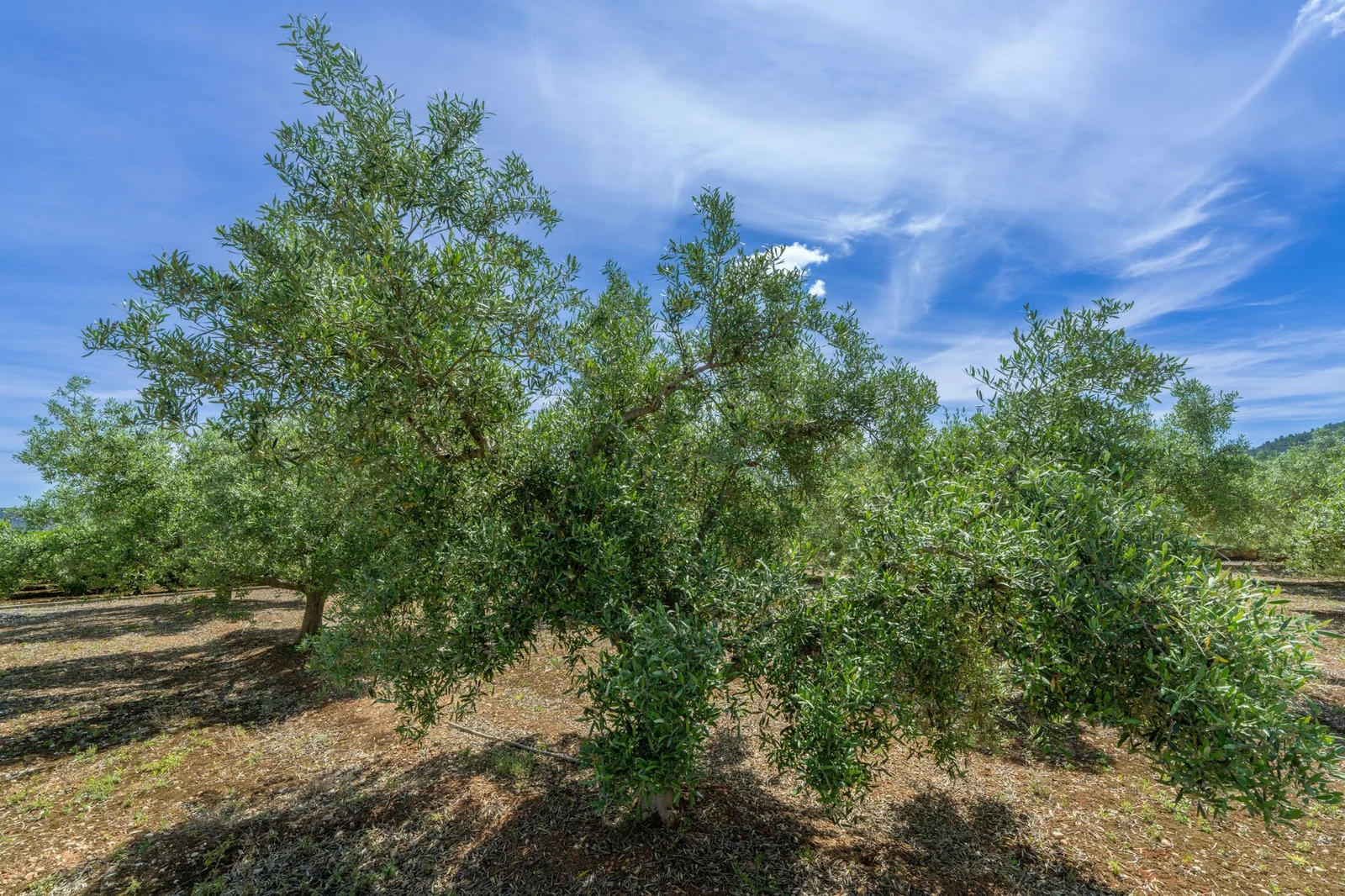
Olive and Olive Oil Glossary
Oleuropein, lampante, pomace, malaxation, designation of origin… Short, verifiable definitions of olive and olive oil terms.
Article
Olive and Olive Oil Glossary
Oleuropein, lampante, pomace, malaxation, designation of origin… Short, verifiable definitions of olive and olive oil terms.
 Article
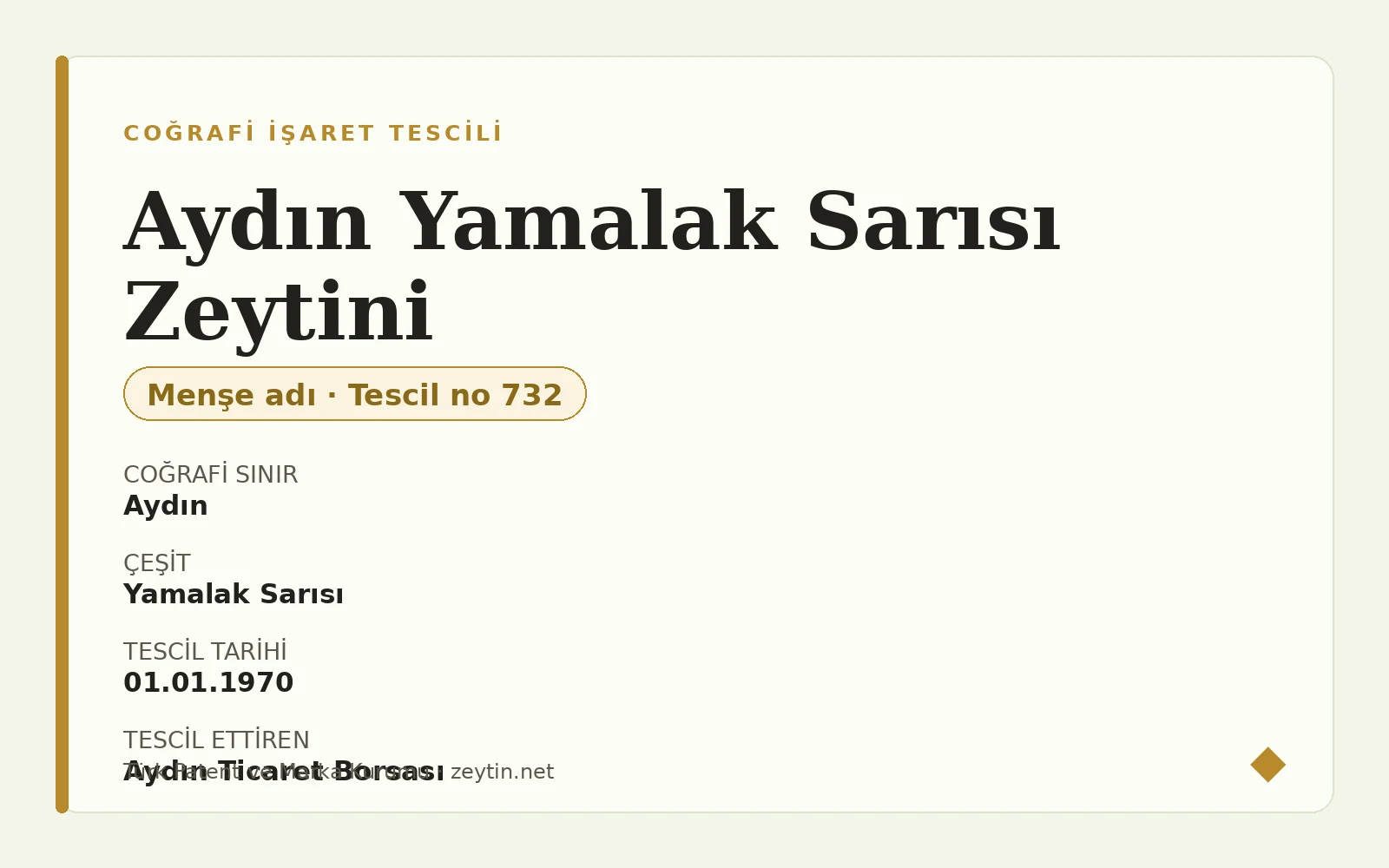
Aydın Yamalak Sarısı Olive: a table fruit reaching 11 grams
Registered in 2021. At 6-11 g the fruit is among Turkey's largest table olives. It is propagated by grafting onto wild rootstock and harvested in late September.
Article
Aydın Yamalak Sarısı Olive: a table fruit reaching 11 grams
Registered in 2021. At 6-11 g the fruit is among Turkey's largest table olives. It is propagated by grafting onto wild rootstock and harvested in late September.