Derik Halhalı Olive Oil: a burn reminiscent of red pepper
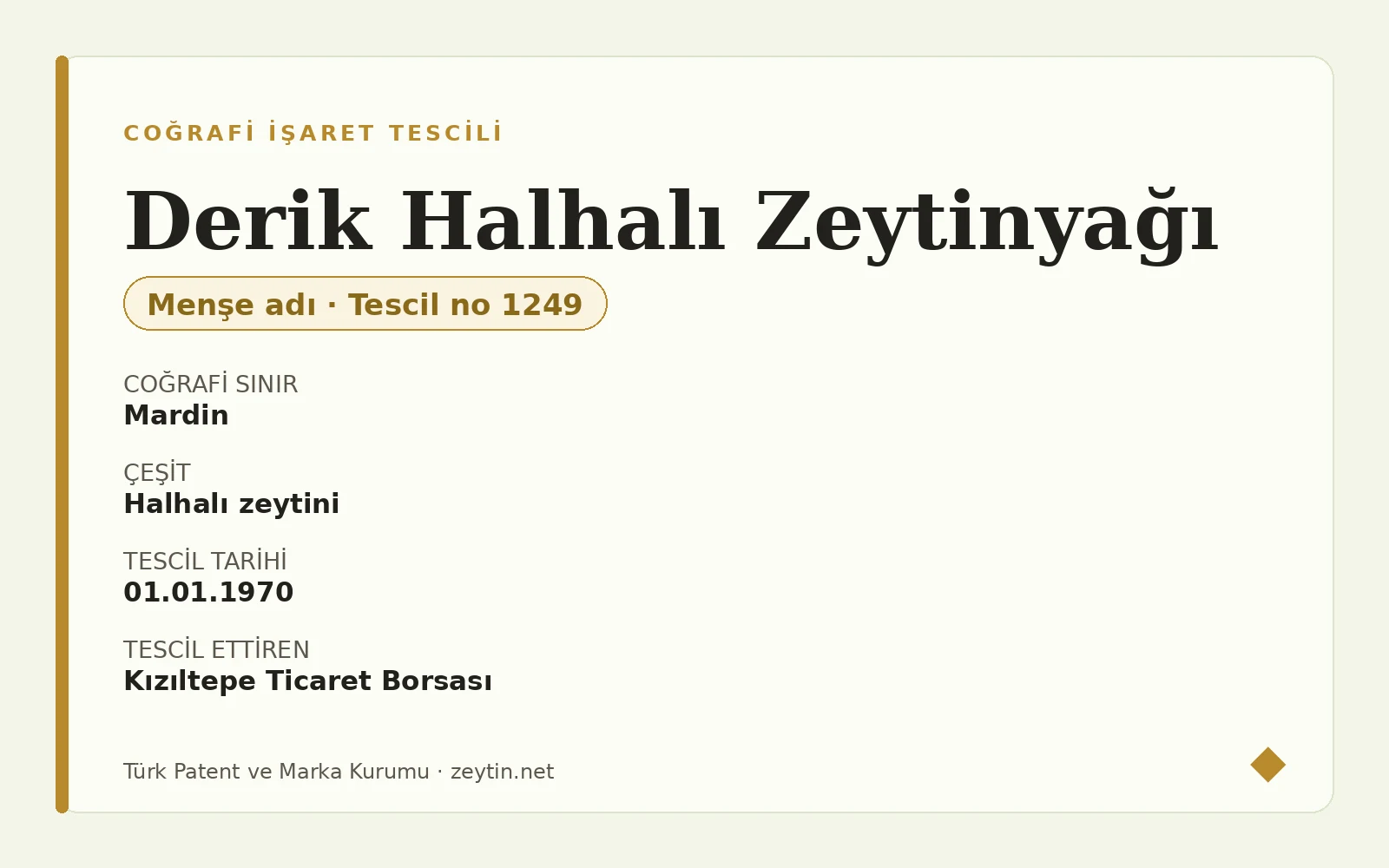
Registered in 2022. Low acidity (0.29-0.60%) and high phenols; the certificate describes the pungency directly — a lasting burn spreading over tongue and lips.
Pungency in olive oil is not a fault but an indicator of phenolic compounds. The certificate for Derik Halhalı Olive Oil describes that sensation with unusual directness.
The record
| Registration no | 1249 |
| Protection from | 19.11.2019 |
| Type | Designation of origin |
| Registered by | Kızıltepe Commodity Exchange |
| Area | The Derik district of Mardin |
| Cultivar | Halhalı |
What the certificate says
t; It has a low free acidity and a high phenolic content. For this reason, once taken into the mouth it spreads over the tongue and lips to produce a lasting, pronounced burn reminiscent of red pepper.
That is a rare sensory statement in a registration document — and its cause is given: phenolic content.
Measured values
| Criterion | Min | Max |
|---|---|---|
| Free acidity (% oleic) | 0.29 | 0.60 |
| Peroxide value (meq O₂/kg) | 7.51 | 18.54 |
| K232 | 1.45 | 2.48 |
| K270 | 0.15 | 0.21 |
| Oleic acid (C18:1) | 60% | 79% |
| Linoleic acid (C18:2) | 8.51% | 9.98% |
| Stearic acid (C18:0) | 2.50% | 3.40% |
The upper limit on free acidity is 0.60, where the legal ceiling for extra virgin is 0.8 — so the certificate defines a narrower band than the codex.
We explained what acidity means in olive oil separately, and covered the compounds behind pungency in oleocanthal and polyphenols.
One cultivar, two provinces
The Halhalı cultivar underpins two separate registrations: Derik Halhalı Olive Oil here in Mardin, and Hatay Halhalı Olive as a table olive in Hatay. Oil at one end, table at the other.
South-eastern Anatolia forms its own belt on Türkiye's olive map: see the olive map.
In short
Derik Halhalı Olive Oil is a designation of origin distinguished by low acidity and high phenol content. The most striking thing about the certificate is that it defines the distinguishing feature through a table of chemistry and what that chemistry does in the mouth.
The criteria the document binds
The registration does not only protect a name; it defines the product numerically:
| Criterion | Value in the document |
|---|---|
| Peroxide value | 2 meq O₂/kg (max) |
| Total phenolic content | 250 mg/kg |
| Processing temperature | max 22 °C |
Capping processing at 22 °C is what cold extraction means in practice: above that threshold yield rises but aroma compounds and phenolics are lost. That the document sets a floor for total phenolic content is notable — most registrations never define phenol levels, although bitterness, pungency and shelf-life behaviour largely depend on them.
Inspection. Members: Kızıltepe Ticaret Borsası, Mardin İl Tarım ve Orman Müdürlüğü, Mardin Artuklu Üniversitesi. Results are reported under Industrial Property Law no. 6769 and submitted to the Turkish Patent and Trademark Office.
The production steps in the document
The registration describes production step by step. The document's own sequence:
1. Zeytinlerin yetiştirilmesi ve hasadı — Zeytinlerin yetiştirilmesi: Derik Halhalı Zeytinyağının üretiminde, coğrafi sınırda yetiştirilen Halhalı çeşidi ağaçlardan elde edilen zeytinler kullanılır.
2. Hasat — Derik Halhalı Zeytinyağının üretiminde kullanılacak zeytinlerin hasadına, meyve renginin yeşil olduğu dönem olan ekim ayında başlanıp kasım ayı ortalarında tamamlanır.
3. Zeytinlerin yağa işlenmesi — Derik Halhalı Zeytinyağı, “natürel sızma zeytinyağı” olup yağdaki fenolik bileşik kayıplarının en aza indirilmesi için 2 fazlı dekantör içeren sürekli sistemler kullanılır.
4. Zeytinlerin temizlenmesi — Zeytinler, basınçla sağlanan bir hava akımı ile sap, dal ve yaprak gibi yabancı unsurlardan temizlenip içme suyu kalitesinde ve 20 - 30 °C sıcaklıktaki suyla yıkanır.
5. Zeytinlerin kırıcıdan geçirilmesi — Zeytinler, kırıcıdan geçirilerek hamur haline getirilir.
6. Zeytinlerin yoğrulması — Malaksiyon olarak da adlandırılan bu işlemde, kırılan zeytinler yoğrulurken zeytin hamuru sıcaklığının 27 °C’yi ve malaksiyon süresinin de 50 dakikayı aşmaması gerekir.
7. Dekantörde yağın ekstraksiyonu — Yatay santrifüj ilkesiyle çalışan dekantörde, zeytin hamurundaki yağ fazı katı kısımdan (sulu pirina) ayrılır.
8. Filtrasyon — Seperasyondan sonra zeytinyağı doğrudan kâğıt veya pamuklu bir filtreden geçirilerek filtrelenir.
That this sequence is binding is what separates a geographical indication from a trade mark: a mark says who produced something, a geographical indication also sets down how it must be produced.
The cultivar behind it, measured
The registration is granted to a place, but the cultivar the definition rests on has measurable values:
| Property | Value |
|---|---|
| Meyve ağırlığı | 2,5-3 g |
| 1 kg’daki tane sayısı | 260 |
| Et oranı | %83 |
| Yağ oranı | %21 |
| Kendine verimlilik | yok |
| Ana kullanım | yağlık |
| Meyve boyu | 20 mm |
| Meyve eni | 16 mm |
| Türkiye ağaç varlığındaki payı | %2,2 |
At 21% the oil content sits mid-range; yield alone is not the argument here, aroma is. The cultivar is not self-fertile — a pollinator is required in the grove. The planting the registration describes is therefore never single-cultivar in practice.
Its place in Mardin's olive production
| Item | Value |
|---|---|
| Fruit production | 4,076 t |
| — for oil | 334 t |
| — for the table | 3,742 t |
| Olive oil production | 59 t |
| Trees | 423 thousand |
| Yield per tree | 9.6 kg |
92% of the province's fruit is table fruit. An oil registration here points away from the province's centre of gravity.
One rating per visitor; you can change yours at any time. Ratings are real reader votes — no seeded or default scores.
Related
 Article
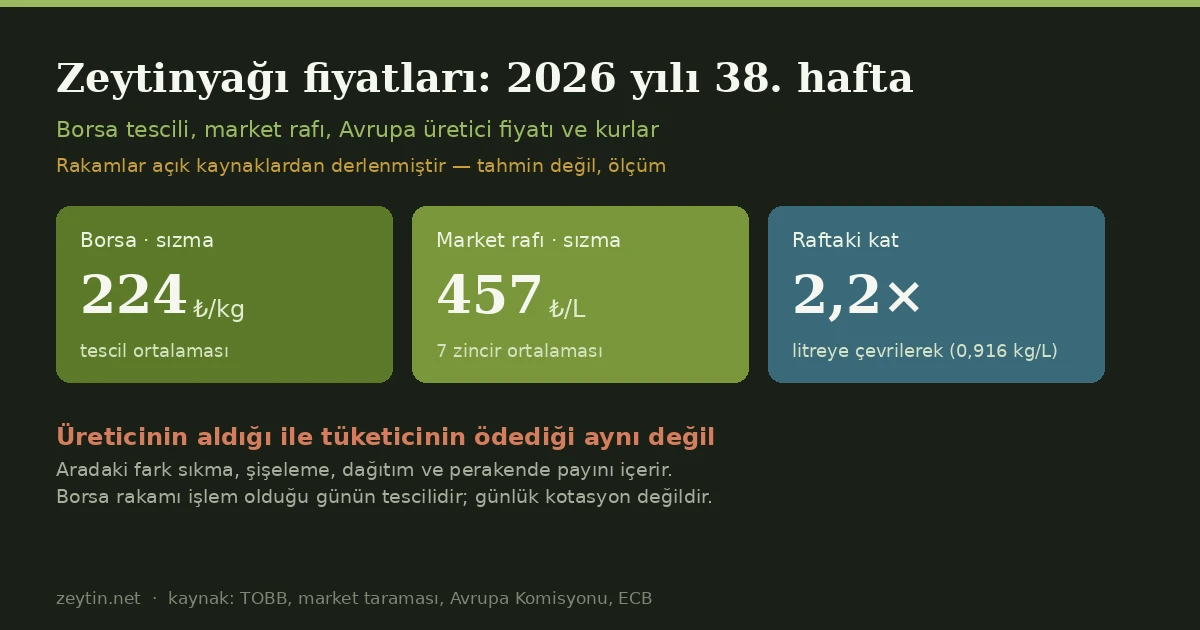
Olive Oil Prices: Week 38 of 2026
Week 38 of 2026: Turkish exchange prices, European producer prices and exchange rates side by side.
 Article
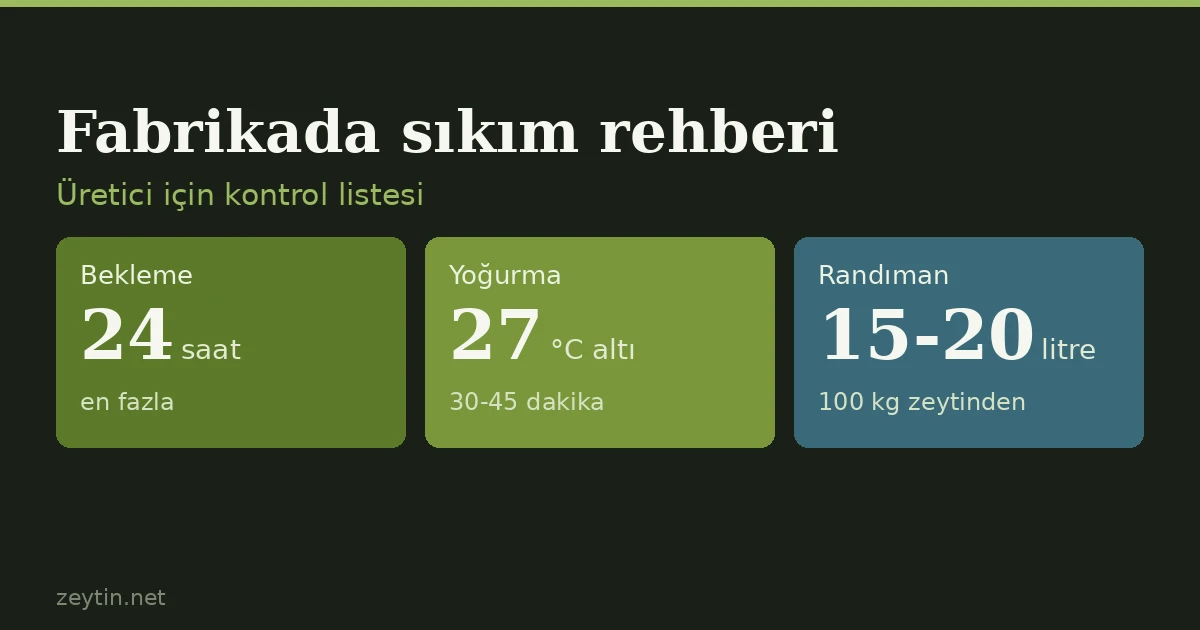
What to check when having your olives pressed at a mill: a grower's checklist
The same olives can give a very different oil when pressed at a different mill under different conditions. From what to do before bringing olives in to two-phase versus three-phase systems, kneading temperature, yield, milling fees and the questions to ask when collecting the oil, here is what a grower having olives pressed needs to know.
 Article
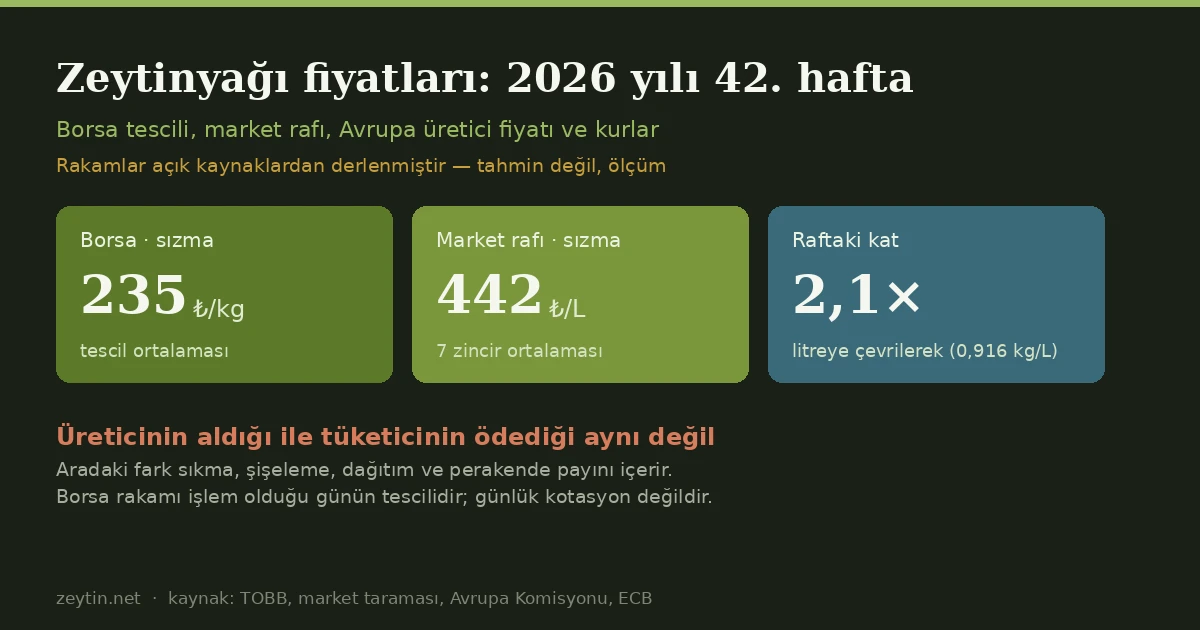
Olive Oil Prices: Week 42 of 2026
Week 42 of 2026: Turkish exchange prices, European producer prices and exchange rates side by side.
 Article
Nizip Olive Oil: a registration that sets a floor for its raw material
Registered in 2011. The certificate sets conditions on the fruit, not just the oil: 15-17 mm wide, 19-20 mm long, at least 25% oil. Fruit outside that cannot be used.