Can you eat olives and olive oil during pregnancy? What to watch for
Yes, green and black olives are fine in pregnancy and on no avoid list. Watch the salt, hygiene of homemade olives, and leaf extracts.
Yes, olives and olive oil are fine to eat during pregnancy. None of the official lists of foods to avoid in pregnancy, including those of the UK's National Health Service (NHS) and the US Centers for Disease Control and Prevention (CDC), puts olives or olive oil on them. Three things deserve attention: the salt in table olives, hygiene with homemade or loose olives, and olive leaf extracts sold as capsules or drops. Green and black olives are equally safe; the difference between them is mostly how much sodium they carry.
How much salt is reasonable in pregnancy?
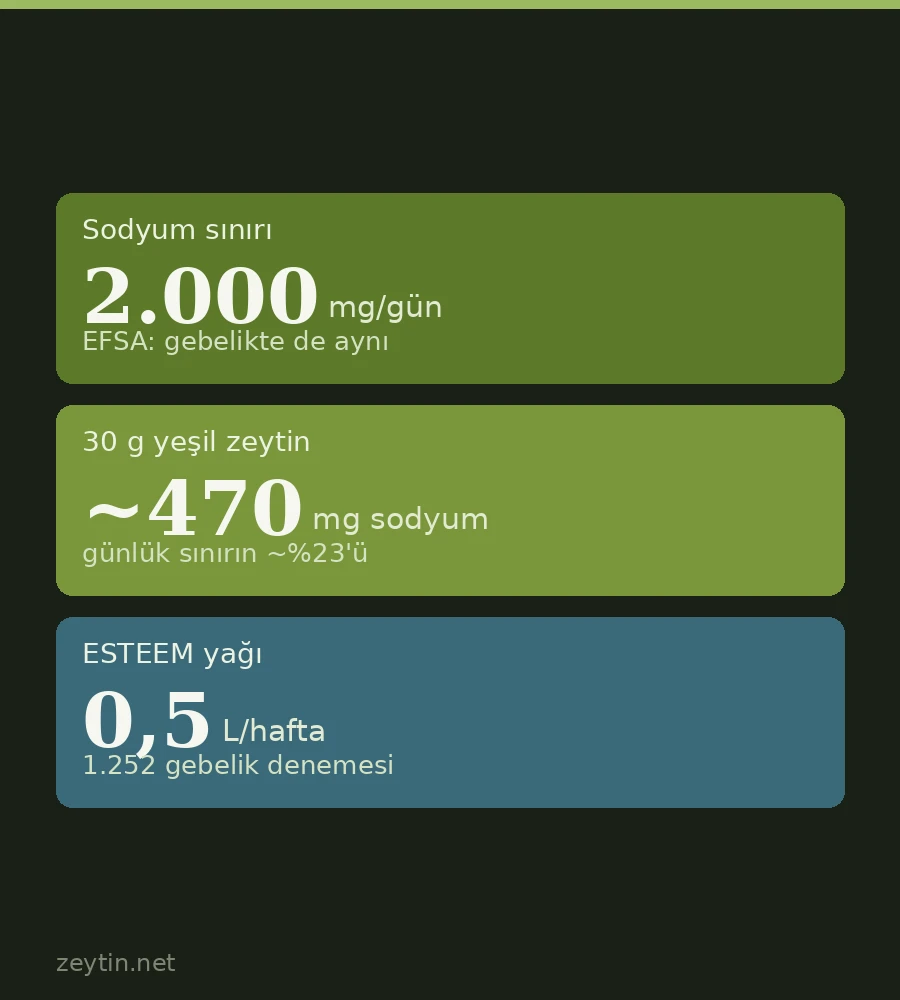
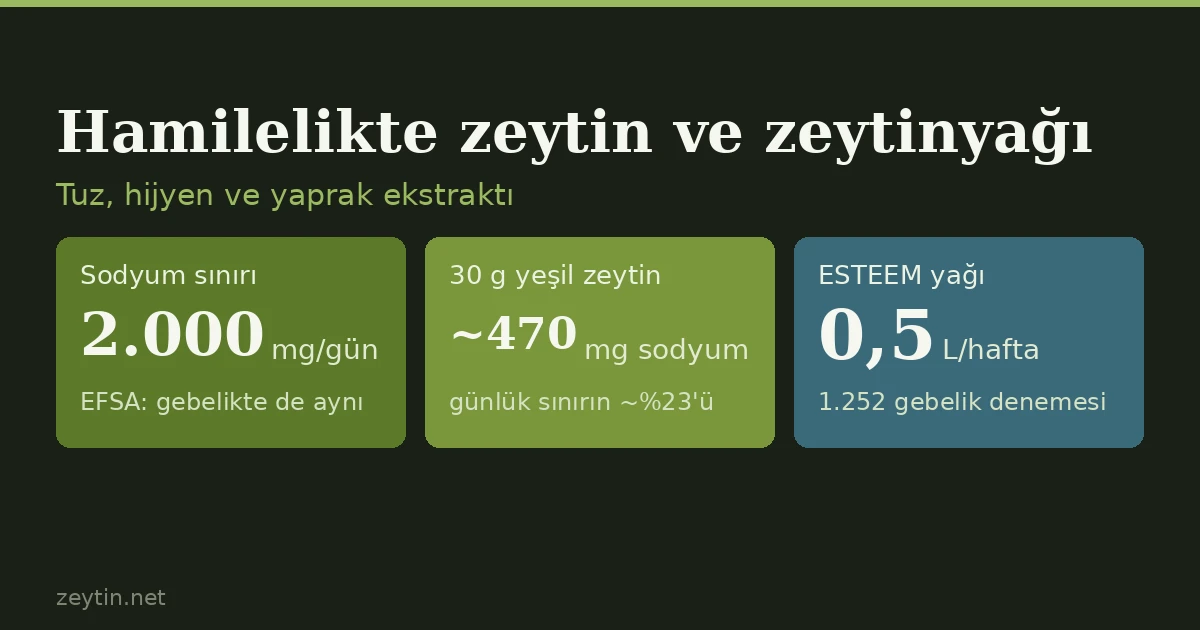
In its 2019 opinion, the European Food Safety Authority (EFSA) set a safe and adequate sodium intake for adults at 2 grams a day and stated that the same value applies to pregnant and breastfeeding women. The World Health Organization's limit of 5 grams of salt a day for adults corresponds to roughly the same amount of sodium. Pregnancy, in other words, does not enlarge the salt budget.
How much of that budget olives take up depends on their colour and how they were cured. Using average values from food composition databases:
| Portion | Green olives | Black olives |
|---|---|---|
| 30 g (about 7-10 olives) | ~470 mg (23%) | ~220 mg (11%) |
| 50 g | ~780 mg (39%) | ~370 mg (18%) |
These figures are based on averages of about 1,560 mg (green) and 735 mg (black) of sodium per 100 g. Brands vary widely, so the nutrition panel on the pack is the number that counts. Add a slice of white cheese at breakfast and the morning plate can easily reach half the daily limit.
People often ask whether salt raises blood pressure in pregnancy. A Cochrane review of salt restriction in pregnancy found, across two trials with 603 women, no evidence that cutting salt prevents pre-eclampsia, and concluded that salt intake in pregnancy can remain a matter of personal preference. That is not a licence for unlimited salt: if your doctor has advised you to limit it because of blood pressure or swelling, olives belong in that calculation. The reasoning behind sensible portions is in how many olives should you eat a day, and tested ways to bring the sodium down are in how to reduce the salt in olives.
One more detail: iodine needs rise in pregnancy. The World Health Organization puts the requirement at 250 micrograms a day during pregnancy and breastfeeding, and public health advice in Türkiye follows the line of "less salt, but iodised". Whether the salt in an olive brine is iodised is usually not known. Spending the salt budget on olives while cutting back on iodised salt in cooking is therefore a poor trade.
Green or black?
Both are fine in pregnancy. Green olives carry roughly twice as much sodium on average; black olives are milder. The high iron figure often listed for black olives mostly belongs to oxidised, darkened olives whose colour is fixed with ferrous gluconate, so it is not a sensible way to plan iron intake in pregnancy. That is a job for your doctor or dietitian. A fuller comparison is in the nutritional profile of olives.
Are homemade and loose olives safe?
The main food-safety concern in pregnancy is the bacterium Listeria monocytogenes; the NHS notes that listeriosis can cause miscarriage, stillbirth or serious illness in a newborn. The higher-risk foods named by the NHS and CDC are unpasteurised dairy, soft cheeses, cold deli meats, refrigerated pâtés and spreads, and ready-made deli salads. Olives are not on those lists.
That does not make olives risk-free. Their safety rests on high salt and low acidity, yet laboratory work published in Frontiers in Microbiology in 2018 showed that Listeria can survive for weeks under brine conditions. A low-salt homemade brine whose acidity has never been measured, or olives that have sat in an open tub handled by many people, offer less of that protection. In practice:
- Choose labelled, packaged olives; once opened, keep them in the fridge and take them out with a clean, dry spoon.
- Discard a jar with mould on the brine, an off smell or softened flesh. Storage times are covered in how to store olives.
- Ready-made mixes containing cheese, meat or fresh herbs are closer to the deli salads the CDC advises pregnant women to avoid; buy them fresh and kept cold, or skip them.
Why is garlic or herb-infused olive oil a separate issue?
Olive oil itself does not grow bacteria. The risk comes from fresh garlic, chilli or herbs placed in it. Oil shuts out air and creates an oxygen-free setting for Clostridium botulinum spores, which arrive with soil on plants. After botulism cases linked to garlic-in-oil in the United States in the 1980s, the US Food and Drug Administration (FDA) called in 1989 for acidifying agents or microbial inhibitors to be added to such products. Health Canada likewise stresses that toxin can form in fresh plant material under oil without any visible sign of spoilage, and that refrigeration alone is not a sufficient safeguard.
The rule in pregnancy is the same as for everyone: do not leave homemade oil with fresh garlic at room temperature, and use it the day you make it or within a few days in the fridge. For flavoured oil meant to keep, a labelled commercial product is the safer choice.
Olive leaf extract and capsules
Olive leaf extract is a supplement that delivers far more polyphenols than any amount of food would. No clinical study has examined its safety in pregnancy, and medical reference databases describe the information for this period as insufficient. Absence of evidence is not evidence of safety, so these capsules and drops should not be taken in pregnancy without asking a doctor. Olives and olive oil eaten as food fall outside this warning.
What has the Mediterranean diet shown in pregnancy?
The strongest pregnancy data involving olive oil come not from a single food but from a Mediterranean-style eating pattern. The ESTEEM randomised controlled trial, run in the UK and published in PLoS Medicine in 2019, enrolled 1,252 pregnant women with metabolic risk factors such as obesity, high blood pressure or raised blood fats. The intervention group received 0.5 litres of extra virgin olive oil a week and 30 grams of walnuts, hazelnuts and almonds a day.
The results need careful reading. The main composite outcome, gestational diabetes or pre-eclampsia, did not fall significantly. Among secondary outcomes, the risk of gestational diabetes was lower (adjusted odds ratio 0.65) and weight gain in pregnancy was on average 1.2 kg smaller. A pooled analysis the authors ran with a similar Spanish trial also showed a reduction in gestational diabetes. None of this means olive oil prevents diabetes on its own; what was tested was a whole dietary pattern. For the bigger picture, see what is the Mediterranean diet.
Does olive oil ease labour or prevent stretch marks?
Easier labour: We found no study showing that drinking or eating olive oil in pregnancy shortens or eases labour. In a trial of 700 women, perineal massage with olive oil during birth reduced episiotomies and tears but did not shorten the second stage of labour. There the oil is simply a lubricant for massage; it has nothing to do with consuming it.
Stretch marks: The evidence is mixed. A 2012 Cochrane review found that creams and oils applied to the skin, olive oil among them, did not prevent stretch marks across six trials with 800 women. Small Iranian trials disagree with one another: two, from 2010 and 2011, found no significant difference, while one from 2012 did. A 2022 trial of 156 first-time mothers in Türkiye reported stretch marks in 50% of the olive oil group versus 69% of women who applied nothing, but it had no placebo. Bottom line: rubbing in olive oil is harmless and may soften the skin, but it has not been shown to prevent stretch marks.
In short
Olives and olive oil can stay part of a normal pregnancy diet. Count olives in your daily salt budget, choose packaged products kept cold after opening, do not store homemade oil with fresh garlic, and leave leaf-extract capsules alone. When the baby later starts solids, when can babies have olive oil is a useful next read. For your own situation, talk to your doctor or a dietitian.
One rating per visitor; you can change yours at any time. Ratings are real reader votes — no seeded or default scores.
Related
 Article
Oleocanthal and Polyphenols
Why does a good extra virgin oil sting the throat? That sensation is not a flaw but the mark of a measurable compound.
 Article
Does an olive oil and lemon cleanse work? What the evidence says
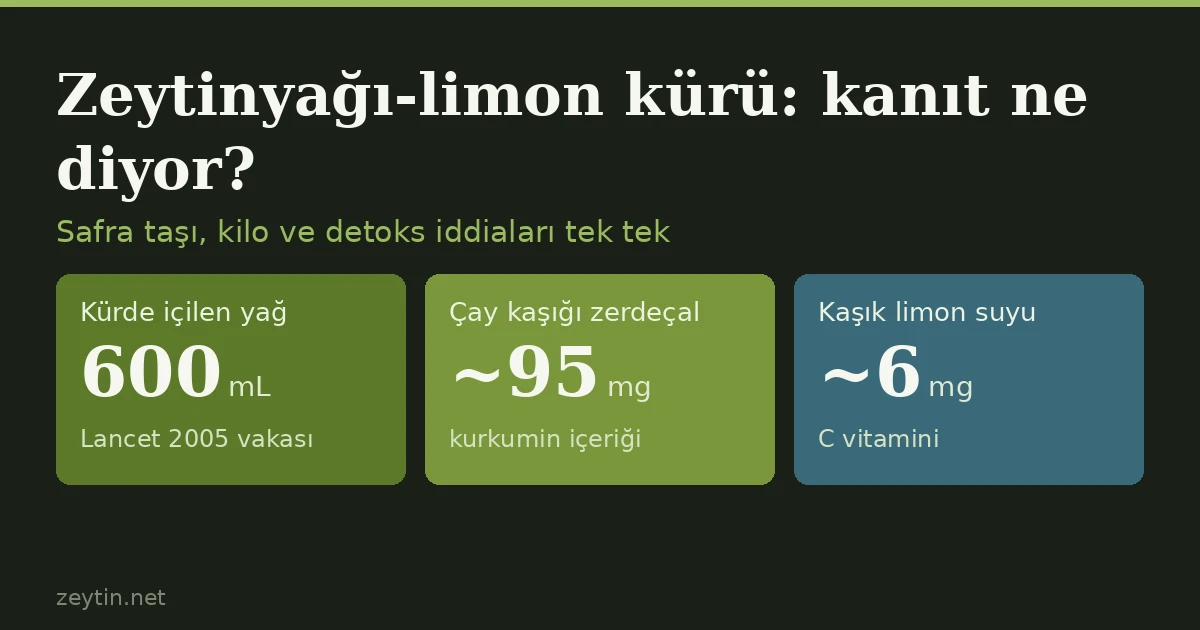
No measured benefit as a mixture: no evidence it flushes gallstones, slims or detoxes; the 'stones' after a flush are soap-like lumps of oil.
 Article
Olive Oil and Heart Health
Why is Mediterranean cooking so often linked with cardiovascular health? Unsaturated fats, polyphenols, and replacing saturated fat.
 Article
Olive pollen allergy: the quiet cause of May to July
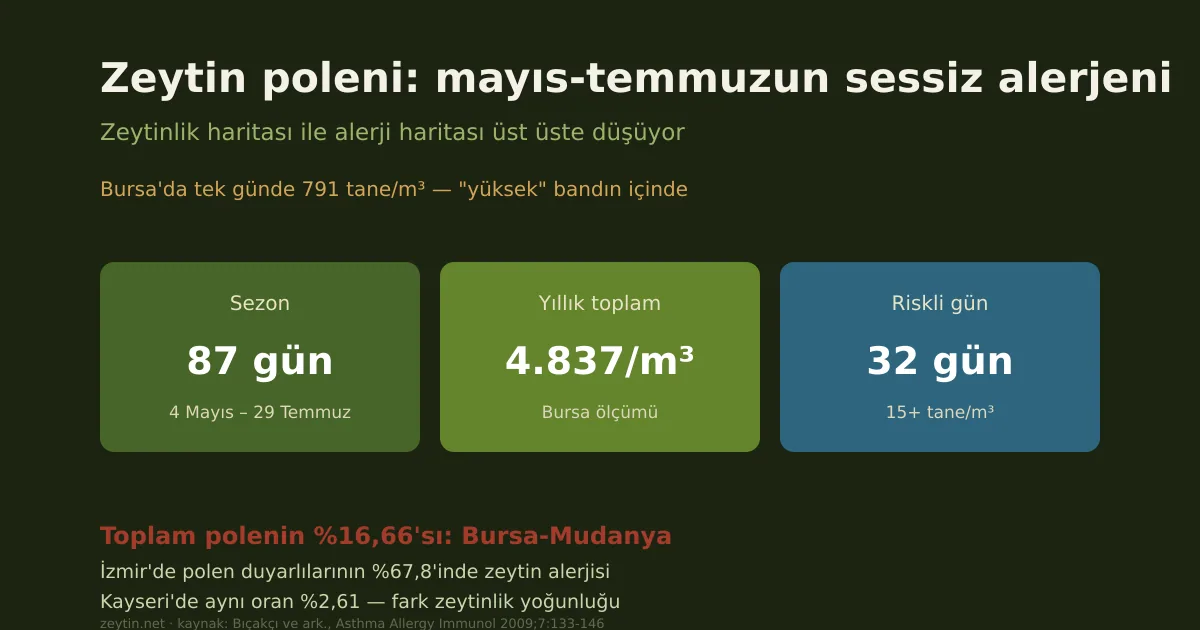
Olive pollen fills the air across western Türkiye from May to July. Bursa recorded 791 grains/m³ in one day over an 87-day season; 67.8% of pollen-sensitised patients in İzmir react to it.