Can olive trees tolerate salty soil and saline water?
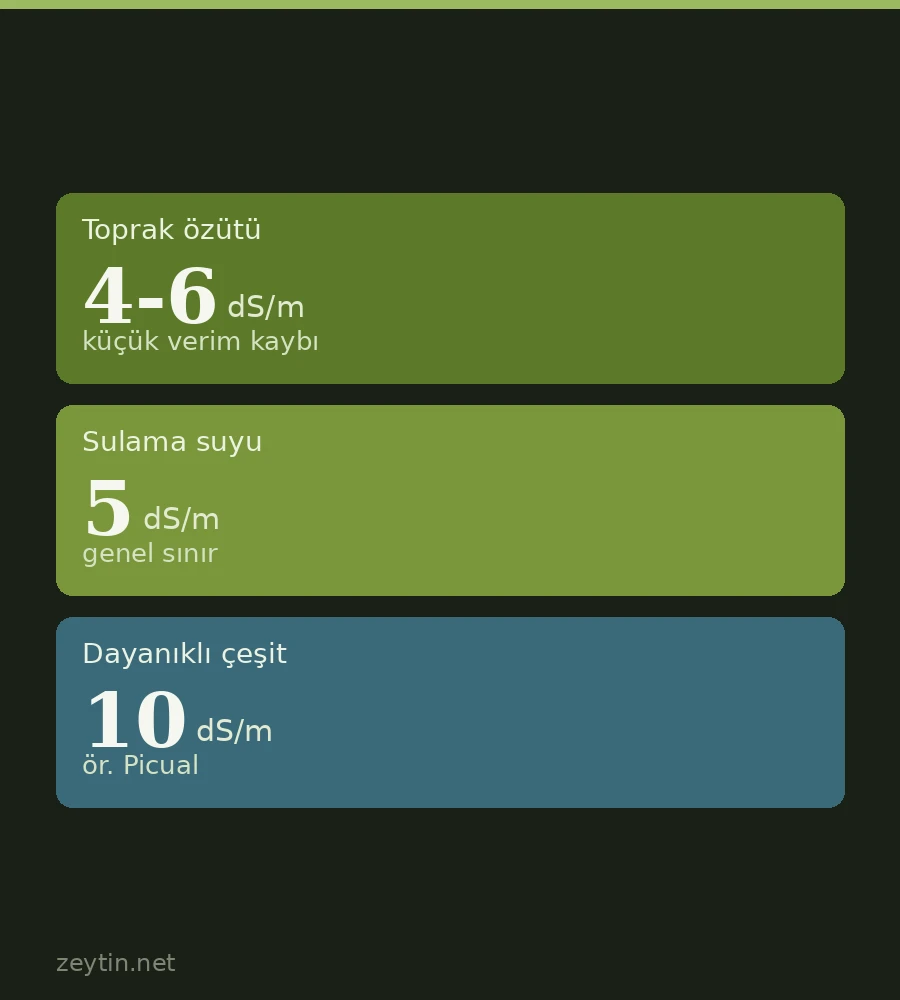
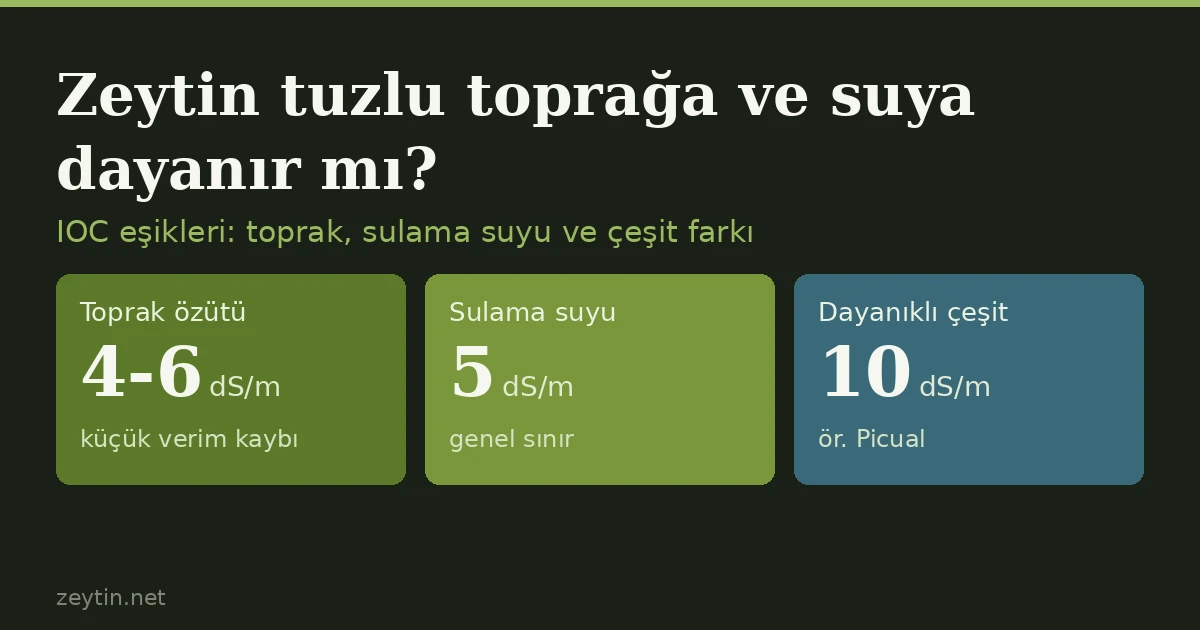
The olive is moderately salt tolerant: according to the IOC, yield loss is small up to 4-6 dS/m in soil, the limit for irrigation water is 5 dS/m and up to 10 dS/m in tolerant varieties such as Picual. The main risks are sodium and boron; Leccino and Arbosana are considered sensitive.
The short answer: yes, up to a point. Among fruit trees, the olive is one of the most salt-tolerant species. In the table compiled by the Food and Agriculture Organization of the United Nations (FAO) on the salt tolerance of crops, the olive is classed as "moderately tolerant". The same source notes that most woody fruit trees are salt sensitive, that only the date palm is considered relatively tolerant, and that the olive is one of the few others believed to be moderately tolerant.
That tolerance is not unlimited. Once the threshold is crossed, shoot growth and yield decline; when salt levels get very high, leaf scorch and leaf drop weaken the tree. What matters is knowing how much salt there is in the orchard and choosing the variety accordingly.
How is salt measured?
Salt in soil and water is measured by electrical conductivity (EC), expressed in decisiemens per metre (dS/m). The saltier the water, the better it conducts electricity.
- In soil: The laboratory saturates the soil with water and measures the conductivity of the extract it draws off. On a soil analysis report this value appears on the EC or "salt" line.
- In water: The conductivity of well or irrigation water is measured directly. Pocket EC meters also give a rough idea.
Using the approximate conversion in FAO's water quality guidance, 1 dS/m corresponds to about 640 milligrams of dissolved salts per litre. Water with a conductivity of 5 dS/m therefore carries around 3 grams of salt per litre. The conductivity of seawater is roughly ten times that.
How much salt can an olive tolerate?
According to the assessment in the International Olive Council's (IOC) World Catalogue of Olive Varieties, the thresholds are as follows:
| Measure | Value | What it means |
|---|---|---|
| Soil extract EC | 4-6 dS/m | Tree grows well, small yield loss |
| Soil extract EC, calcareous soil | 6-8 dS/m | Tolerance rises in calcium-rich soil |
| Irrigation water EC | up to 5 dS/m | Generally usable |
| Irrigation water EC, tolerant variety | up to 10 dS/m | e.g. Picual |
| Table salt (NaCl) in water | 2 g/L | General tolerance |
| Table salt in water, tolerant variety | 4 g/L, sometimes 8 g/L | In tolerant varieties |
| Boron in soil | 2 ppm | Boron toxicity threshold |
Source: International Olive Council, World Catalogue of Olive Varieties, salinity section.
The literature review in a Spanish irrigation study published in 2019 paints a similar picture: when the conductivity of irrigation water stays between 3 and 6 dS/m, no effect on growth or yield is seen, while significant yield loss begins above 7.5 dS/m.
For most orchards in Türkiye these figures are reassuring. In a soil survey of olive groves in Kilis, for example, every sample fell into the non-saline class, below 2 dS/m; the details are in our Kilis soil article. Problems arise more often in dry inland areas, on poorly drained plains and in over-pumped coastal wells, where seawater can seep into the aquifer.
Sodium and chloride: two faces of salt
Salt damage does not come from total salt alone; the individual ions in the salt matter too.
Chloride: According to the IOC, the olive's tolerance of chloride is high.
Sodium: The real problem is sodium. Trouble begins when the exchangeable sodium percentage of the soil exceeds 20-40 percent. Sodium breaks down soil structure: the soil compacts, and its permeability to water and air falls. In irrigation water this risk is measured by the sodium adsorption ratio (SAR). According to the IOC, a SAR below 3 indicates good-quality water, though the risk has to be judged together with the water's total salinity.
Calcium: The IOC catalogue states that calcium prevents sodium from being transported from the roots to the shoot, and that adding calcium chloride to irrigation water prevents this transport. This is also why tolerance is higher in calcareous soils.
This is the basis of the olive's resilience: the tree is good at holding harmful ions back in the roots and keeping them away from leaves and shoots. That exclusion capacity varies from variety to variety.
Which varieties are more tolerant?
The IOC catalogue groups varieties into three classes:
- Tolerant: Picual, Arbequina (Spain); Frantoio (Italy); Kalamata (Greece); Chemlali (Tunisia).
- Moderately tolerant: Hojiblanca, Manzanilla, Gordal Sevillana (Spain); Koroneiki, Amfissis, Mastoidis (Greece); Maurino, Coratina, Carolea (Italy); Barnea (Israel); and Sour, grown across an Eastern Mediterranean area that includes Türkiye.
- Sensitive: Chetoui, Meski (Tunisia); Cobrançosa (Portugal); Chalkidikis (Greece); Leccino (Italy); Lastovka (Croatia); Arbosana (Spain).
Türkiye's most widespread varieties, Gemlik, Ayvalık and Memecik, are not included in this classification. If a new orchard is to be planted on land with saline water or soil, a local variety recommendation should be sought from the regional olive research institute.
How do you recognise salt damage?
The symptoms of salt damage can be confused with other problems:
- Browning and a scorched look at leaf tips and margins
- Slower shoot growth and smaller leaves
- At a later stage, leaf drop
Leaf drop can have many causes besides salt; we listed disease, water and nutrient problems in our leaf drop article. If salt is suspected, a soil and water analysis is needed rather than guesswork. Because boron toxicity also causes scorching at leaf tips, boron should be requested separately in the analysis.
Can you irrigate with saline water?
Moderately saline water can be used on olives, but it needs care. The methods recommended by specialists are:
- Leaching: Winter rain washes salt out of the root zone. Where rainfall is not enough, deliberate leaching is done by applying somewhat more water than the trees need. For this to work, the soil must be able to drain.
- Drip irrigation: By keeping the soil constantly moist, drip reduces the concentration of salt around the roots. But salt accumulates at the edge of the wetted area, and rain can carry that build-up into the root zone. Details are in our irrigation article.
- Blending or alternating: Average salinity is lowered by blending saline water with fresh water or by using the two in turn.
- Soil amendments: On sodic soils, applying a calcium source should be decided on the basis of a soil analysis and on the advice of an agronomist. We explained how a fertiliser plan is built from an analysis in our fertilisation article.
Does salt affect oil quality?
In a trial in Spain with the Arbosana variety, irrigation with water of high salinity lowered the share of oleic acid in the oil and increased linoleic acid. In the same trial, salinity and deficit irrigation raised the oil's polyphenol content. So the effect does not run in one direction only, but the shift in fatty acid balance is an outcome to weigh alongside any yield loss.
Summary
- Among fruit trees, the olive is one of the most salt-tolerant; FAO classes it as "moderately tolerant".
- In soil, yield loss is small up to 4-6 dS/m; in irrigation water the general limit is 5 dS/m, rising to 10 dS/m in tolerant varieties.
- The main dangers are sodium and boron; tolerance of chloride is high.
- Picual, Arbequina, Frantoio and Kalamata are considered tolerant; Leccino, Arbosana and Chetoui sensitive.
- If in doubt, have the soil and water analysed; leaching, drip irrigation and calcium management are the most effective tools.
Reading notes
⚠ Threshold values are averages. Soil structure, climate, tree age and rootstock all change the effect of the same level of salinity.
⚠ Soil extract EC and irrigation water EC are not the same thing; check which one was measured on the analysis report.
⚠ The variety classification is the assessment in the IOC catalogue; the same variety can give different results in different trials.
One rating per visitor; you can change yours at any time. Ratings are real reader votes — no seeded or default scores.
Related
 Article
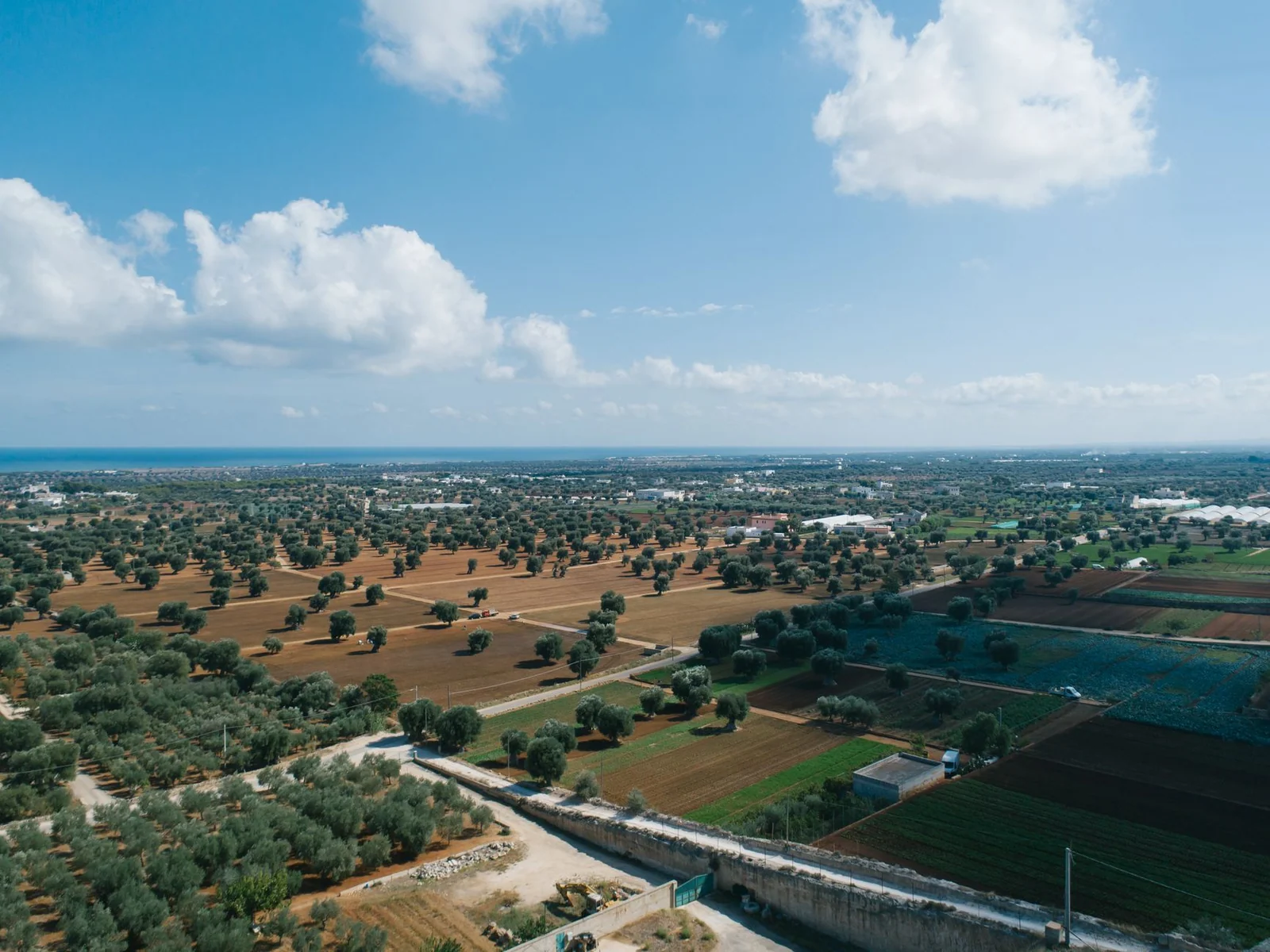
Fertilising Olives: From Soil Analysis to an Annual Programme
How to read a soil test, which nutrients olives need and when, fertigation and organic matter management.
 Article
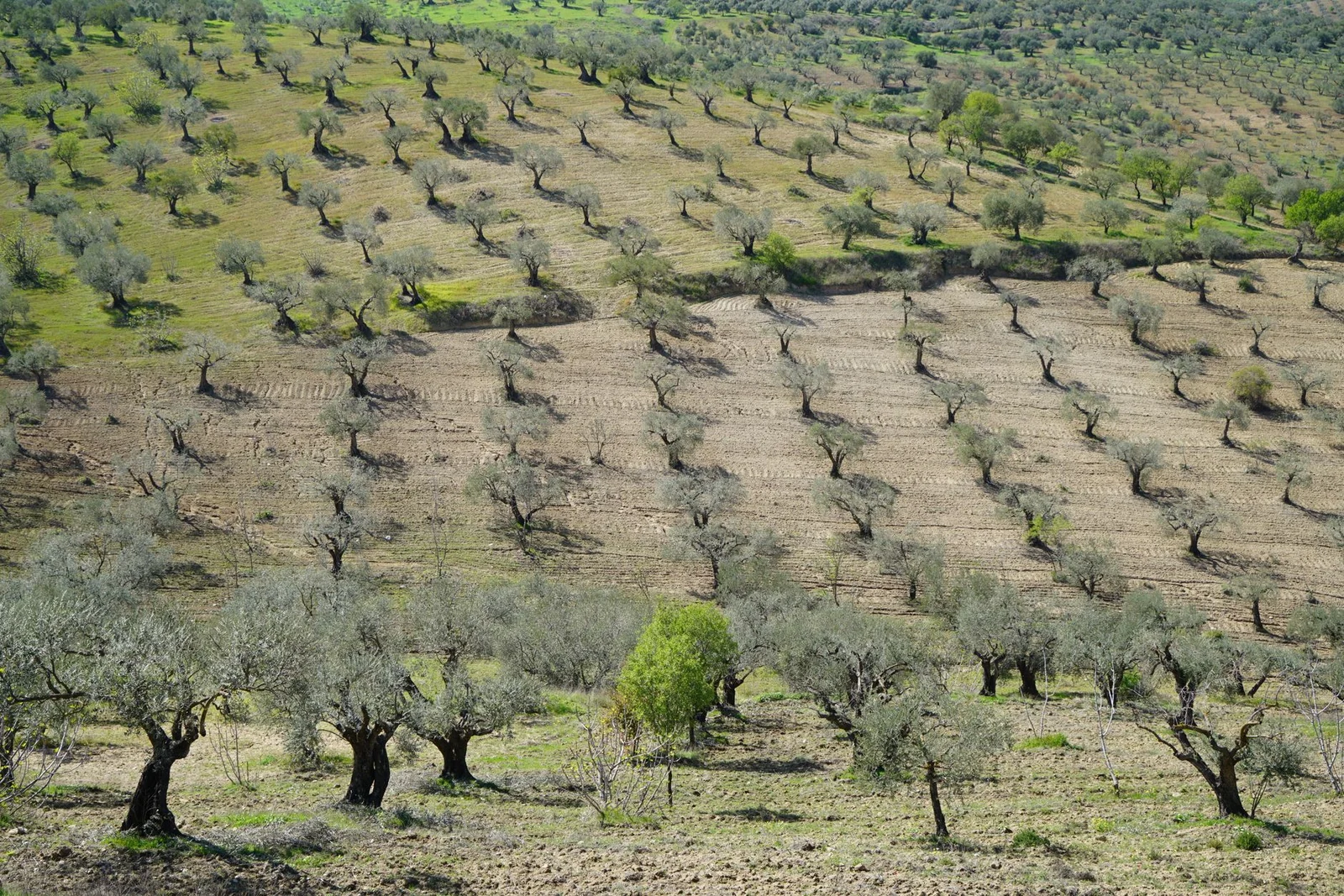
Irrigating Olives: When, How Much, How
Olive water requirements, critical periods, drip system layout, deficit irrigation and water quality.
 Article
Does a harvesting machine damage the olive tree?
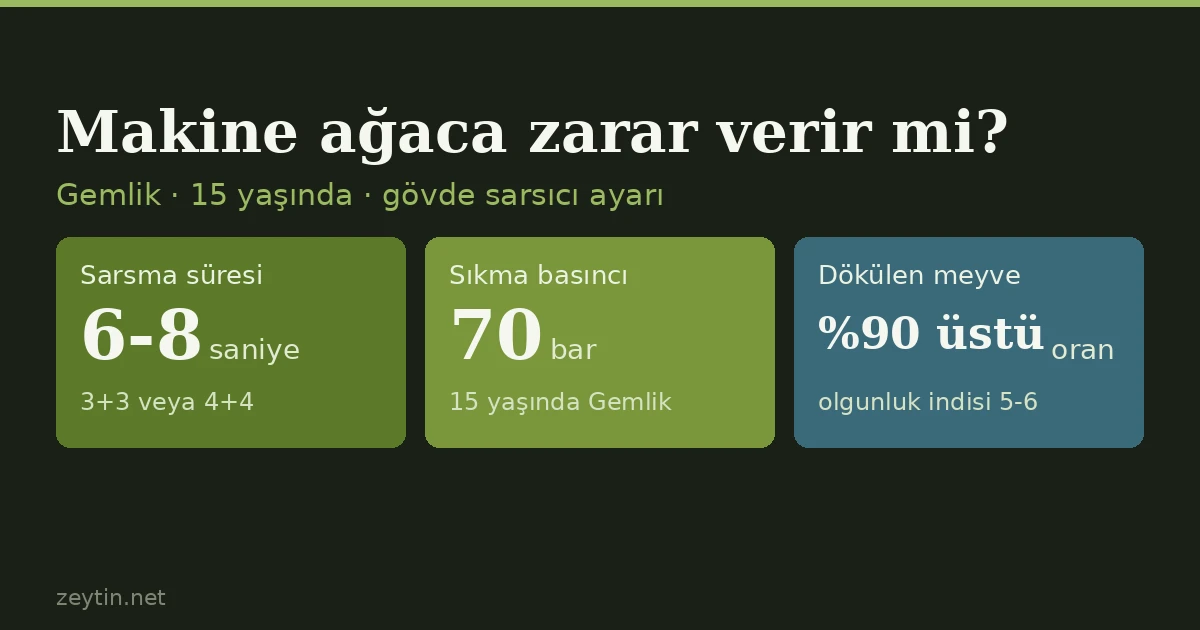
Trunk shakers, branch shakers and hand picking: the damage comes not from the machine itself but from its settings and duration. The figures the Turkish agriculture ministry's research institute gives for the Gemlik variety — 70 bar clamping pressure, 20 Hz, a 6-8 second shake — and what falls off the tree once that window is exceeded. Why grove spacing, slope limits and operator training are technical requirements.
 Article
What to do for olive trees after harvest: a November-to-March care guide
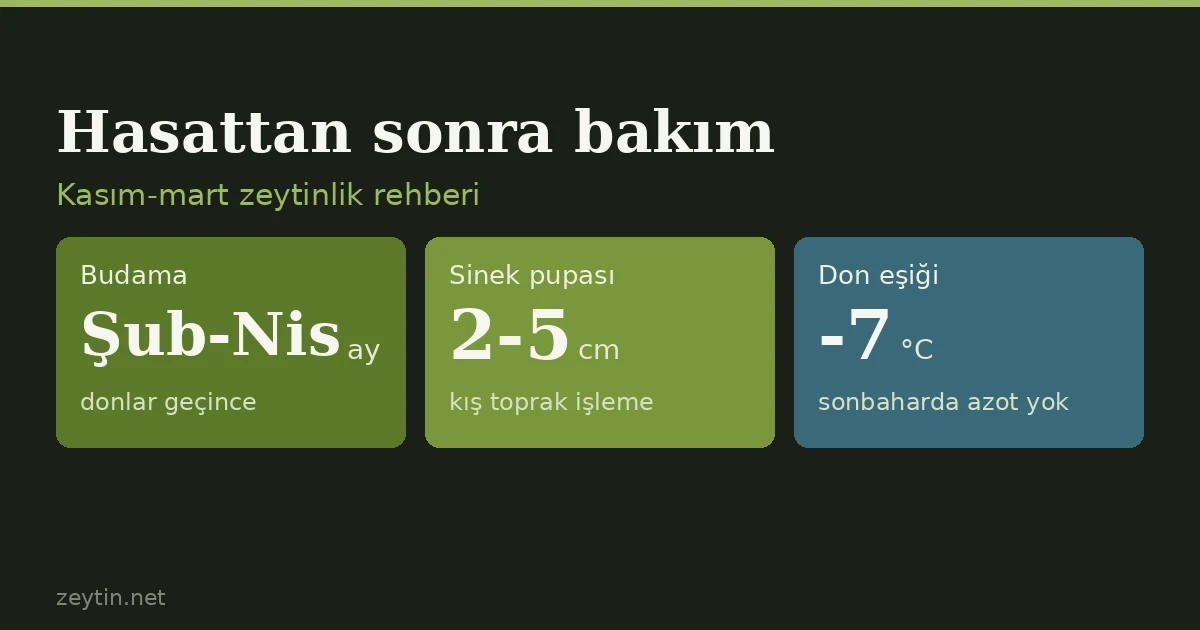
The work in the grove does not end with the olive harvest; next year's crop is prepared in exactly these months. From collecting fallen fruit and protecting harvest wounds to region-specific peacock spot sprays, the right pruning time, autumn feeding and winter soil work, here is what needs doing after harvest.