Can olive prunings be burned? What the law says and what to do with diseased wood
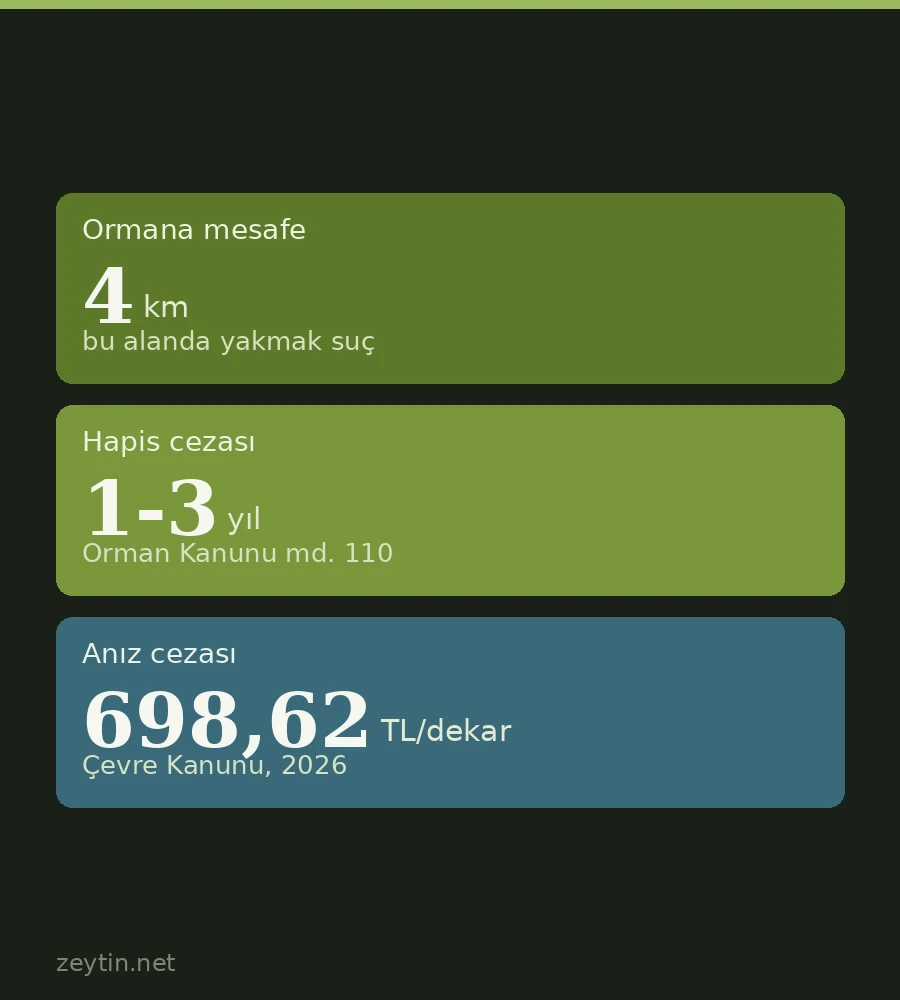
Burning prunings within four kilometres of a forest, or in a village with state forest inside its boundary, is an offence under Türkiye's Forest Law carrying one to three years in prison, and many governors' orders also ban burning to clear olive groves. The ministry's own technical guidance, however, recommends burning diseased residues. The way between: use healthy wood, remove diseased wood from the grove.
Olive pruning starts after the harvest and runs through the winter. Every year it leaves the same pile behind: branches, shoots and leaves. According to one study an olive tree yields an average of 33.6 kilograms of prunings a year; across Türkiye that adds up to millions of tonnes. The most common fate of that pile is a bonfire at the edge of the grove.
So can you burn olive prunings? The short answer: it depends on where the grove is and whether the wood is diseased. Burning near a forest is a criminal offence carrying a prison sentence, and in many provinces governors' orders explicitly ban burning branches to clear olive groves. On the other hand, the Ministry of Agriculture and Forestry's own technical guidance recommends burning diseased prunings to destroy them. Below we set out both sides and the path between them. The legal provisions are Turkish, but the agronomic reasoning applies anywhere olives are grown.
Within four kilometres of a forest: an offence
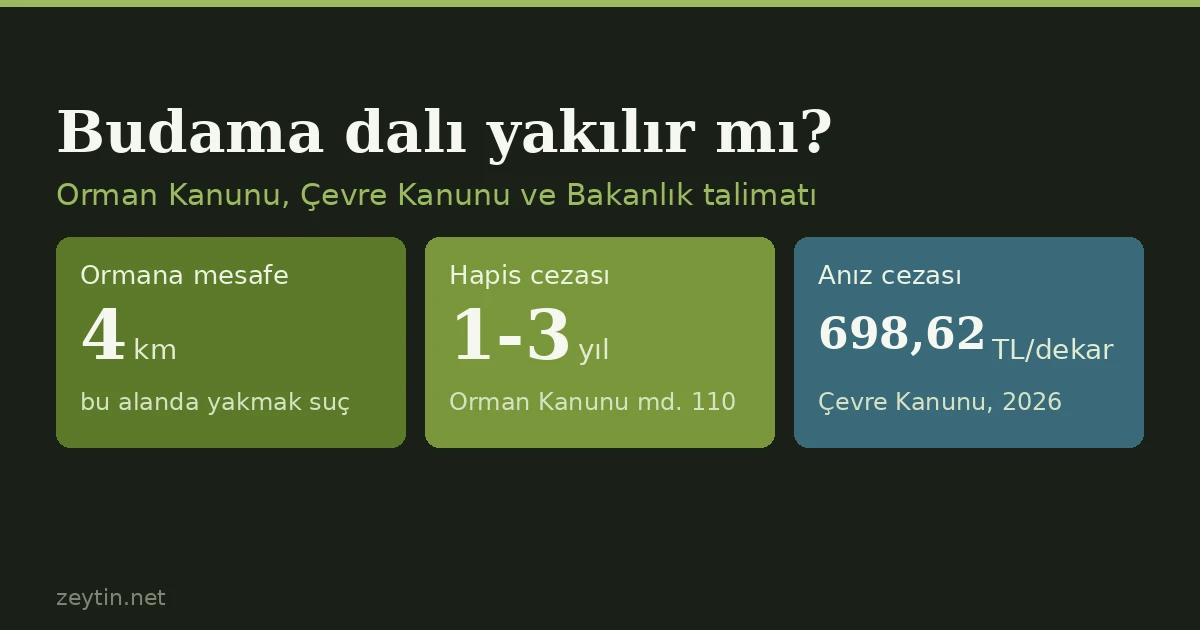
The decisive provision is Article 76 of Türkiye's Forest Law, No. 6831. It prohibits burning "stubble or similar vegetation" within four kilometres of a forest, or within the boundaries of villages covered by Articles 31 and 32 of the same law — that is, villages whose administrative boundaries contain state forest.
Pruning wood falls within that definition: the law covers not only stubble but "similar vegetation". The penalty is set out in Article 110: one to three years' imprisonment and a judicial fine. If the fire spreads to the forest, the stakes rise sharply; anyone who causes a forest fire through a breach of the duty of care faces three to ten years in prison.
In other words, if your grove borders a forest, or there is state forest within your village's boundaries, burning prunings is forbidden regardless of the season.
Governors' orders: often banned far from forests too
Every year each province convenes a forest-fire commission and the governor's office publishes its decisions. Those decisions can reach well beyond the forest edge.
In Bursa, for example, the commission's decision of 5 May 2026 banned the burning of trees, branches and all vegetation in forest villages, villages adjoining forests and all villages and neighbourhoods with no connection to a forest, when done to clear stubble, vineyards, orchards, olive groves or fields. The decision states that anyone who breaches it will face administrative and criminal proceedings under the Provincial Administration Law, the Forest Law, the Turkish Penal Code and the Misdemeanours Law.
The scope and dates of these orders vary from province to province. The way to find the rule in your own province is the forest-fire decision on the governor's website; the village headman and the local forestry office will also know how it is applied.
The Environment Law: a fine per decare for stubble
Additional Article 1 of the Environment Law, No. 2872, prohibits burning stubble; in areas where a second crop is sown, the governor's office may allow controlled burning under an action plan. The fine in Article 20 of the law, according to the text currently in force, is 698.62 lira per decare (a tenth of a hectare); it is multiplied by five if the burning takes place next to forests or wetlands, or in a residential area.
This article uses the word "stubble", and whether pruning wood falls under it is not explicit in the text. In practice, though, it makes little difference to the grower: near forests the Forest Law applies, and across much of the province a governor's order usually does.
The ministry's own guidance says "burn it"
Here is the contradiction. The Integrated Pest Management Technical Instructions for Olives, published in 2022 by the ministry's General Directorate of Agricultural Research and Policies, recommends burning prunings for some diseases:
- For olive knot: "Pruning residues should be destroyed by burning."
- In the management section, as a general principle: diseased fallen leaves and pruning residues should be gathered and burned.
- For peacock spot: spotted fallen leaves should be gathered and burned or buried.
- For verticillium wilt: diseased shoots and branches should be cut back to healthy wood and removed from the orchard, and pruning finished before the leaves drop.
The aim of the guidance is not to leave the pathogen in the orchard. Burning is only one route to that aim; burying and removal are options the guidance itself lists.
What burning costs the orchard
Legality aside, burning is a loss for the grove. Branches and leaves hold part of the nutrients the tree drew from the soil over a year; burned, the organic matter goes up in smoke and only a handful of ash remains. A pile burned close to trees scorches the bark of trunks and lower limbs, and slow-healing bark wounds in olives open the door to diseases such as olive knot. In a grove with dry grass, a fire can get out of control in minutes.
There is also the neighbourly side: smoke and flying sparks are not only your problem but the next grove's as well.
What to do in practice
Healthy wood. Use it instead of burning it. Thick wood makes firewood; thin branches and leaves can be chipped and spread under the trees or added to a compost heap. That removes both the fire risk and the risk of a fine, and the soil gains organic matter. On a larger scale, prunings can also be turned into pellet and briquette fuel.
Diseased wood. Do not chip and spread branches with olive knot galls, wood killed by verticillium or heavily infested limbs in the same orchard; the whole logic of the guidance is to take the pathogen out. Collect them separately and remove them from the grove; for leaves with peacock spot, burying is an option the guidance names. It is worth asking the municipality or the district agriculture office whether there is a collection arrangement for plant waste.
Harvest leaves. The same rule applies to leaves separated from the olives at the mill or by a cleaning machine: they are not burned near forests or during a period covered by a governor's ban. Leaves are easier than prunings to shred and work into the soil.
If you must burn. First make sure it is not prohibited: the site must be more than four kilometres from a forest, there must be no state forest within the village boundary, and your province's governor's order must not cover the period. If any one of the three is unclear, do not burn.
Tools. To reduce the spread of disease, the guidance asks for pruning tools to be disinfected with 10 per cent household bleach. Whether or not you burn, this is the cheapest precaution any grove can take.
Summary
| Situation | What to do |
|---|---|
| Within 4 km of a forest, or in a village with state forest inside its boundary | Do not burn; criminal offence, 1-3 years |
| Governor's order bans burning to clear olive groves | Do not burn; administrative and criminal action |
| Healthy wood | Firewood, chipping for mulch, compost |
| Diseased wood (olive knot, verticillium) | Collect separately, remove from the grove |
| Fallen leaves with peacock spot | Gather; burying is a listed option |
For pruning itself see our pruning guide, and for post-harvest work the article on tree care after harvest.
Read with care
⚠ This article is not legal advice. Penalty amounts follow the texts of the laws in force as of 2026; administrative fines are updated every year.
⚠ Governors' orders change from province to province and year to year; the Bursa decision is given only as an example.
⚠ The 33.6 kilograms per tree is the research value used in our article on pruning biomass; it varies with variety, tree age and pruning intensity.
One rating per visitor; you can change yours at any time. Ratings are real reader votes — no seeded or default scores.
Related
 Article
Does a harvesting machine damage the olive tree?
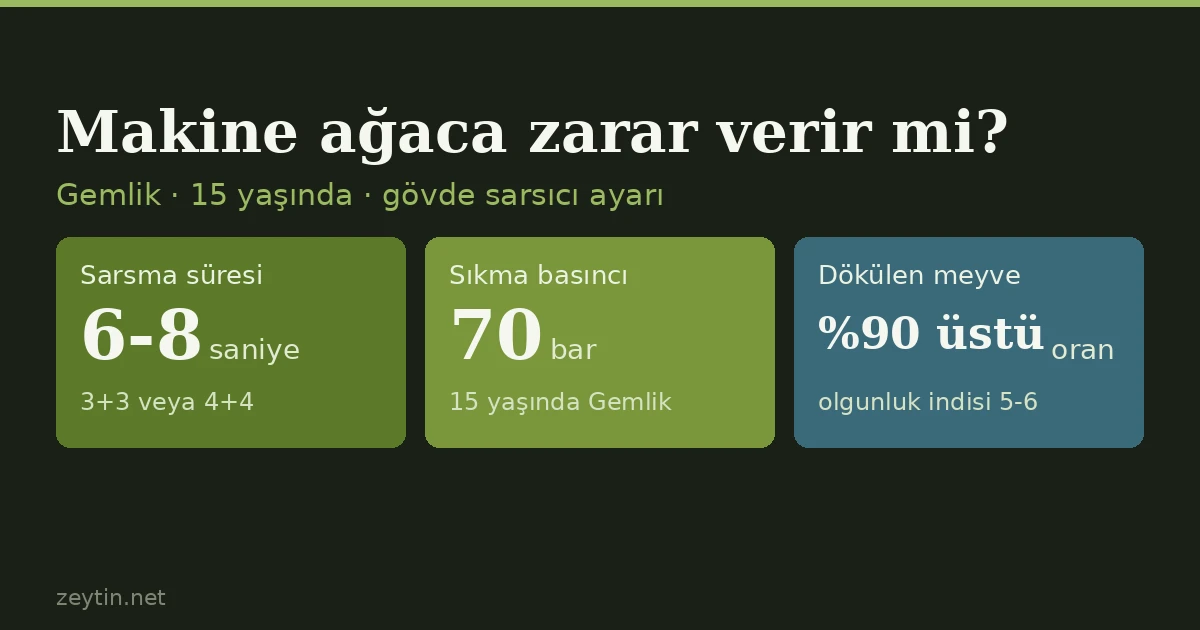
Trunk shakers, branch shakers and hand picking: the damage comes not from the machine itself but from its settings and duration. The figures the Turkish agriculture ministry's research institute gives for the Gemlik variety — 70 bar clamping pressure, 20 Hz, a 6-8 second shake — and what falls off the tree once that window is exceeded. Why grove spacing, slope limits and operator training are technical requirements.
 Article
Arbequina IRTA-i18: the clone behind super-high-density olive groves
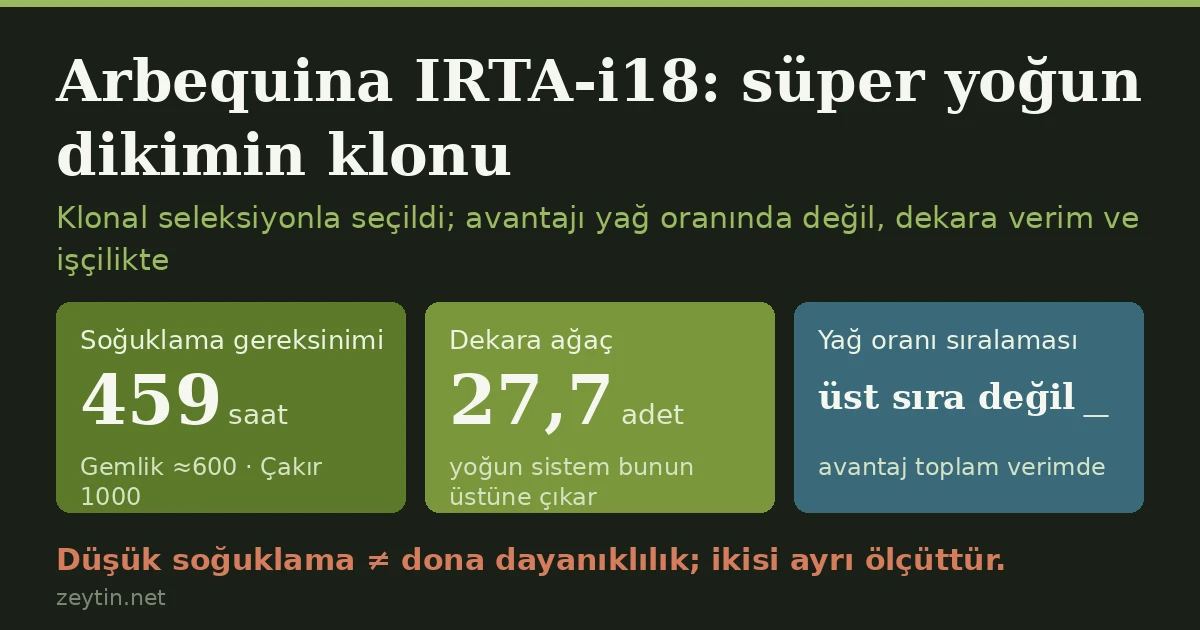
IRTA-i18, developed from Arbequina by clonal selection, was chosen for super-high-density groves. What early bearing, mechanical harvest and a low 459-hour chilling requirement actually mean.
 Article
What to check when buying an olive grove: title deed, shares and the trees
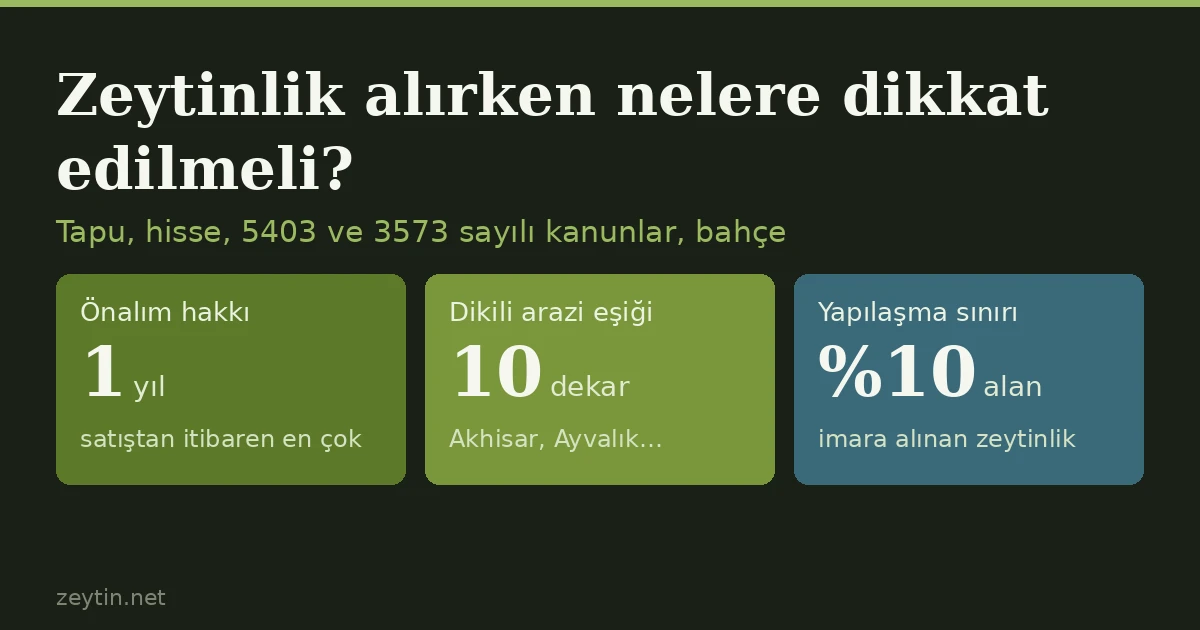
In Türkiye, an olive grove sale is valid only at the land registry, and a share-cropper's lease continues with the new owner. In co-owned groves, the pre-emption right can last up to a year and, since a 2025 amendment, is decided on market value; transfers of shares need ministry permission. Law 3573 bars reducing olive-growing areas. Trees, grafting, disease, water, frost and real yield from several seasons' receipts: a point-by-point checklist.
 Article
Irrigating Olives: When, How Much, How
Olive water requirements, critical periods, drip system layout, deficit irrigation and water quality.